


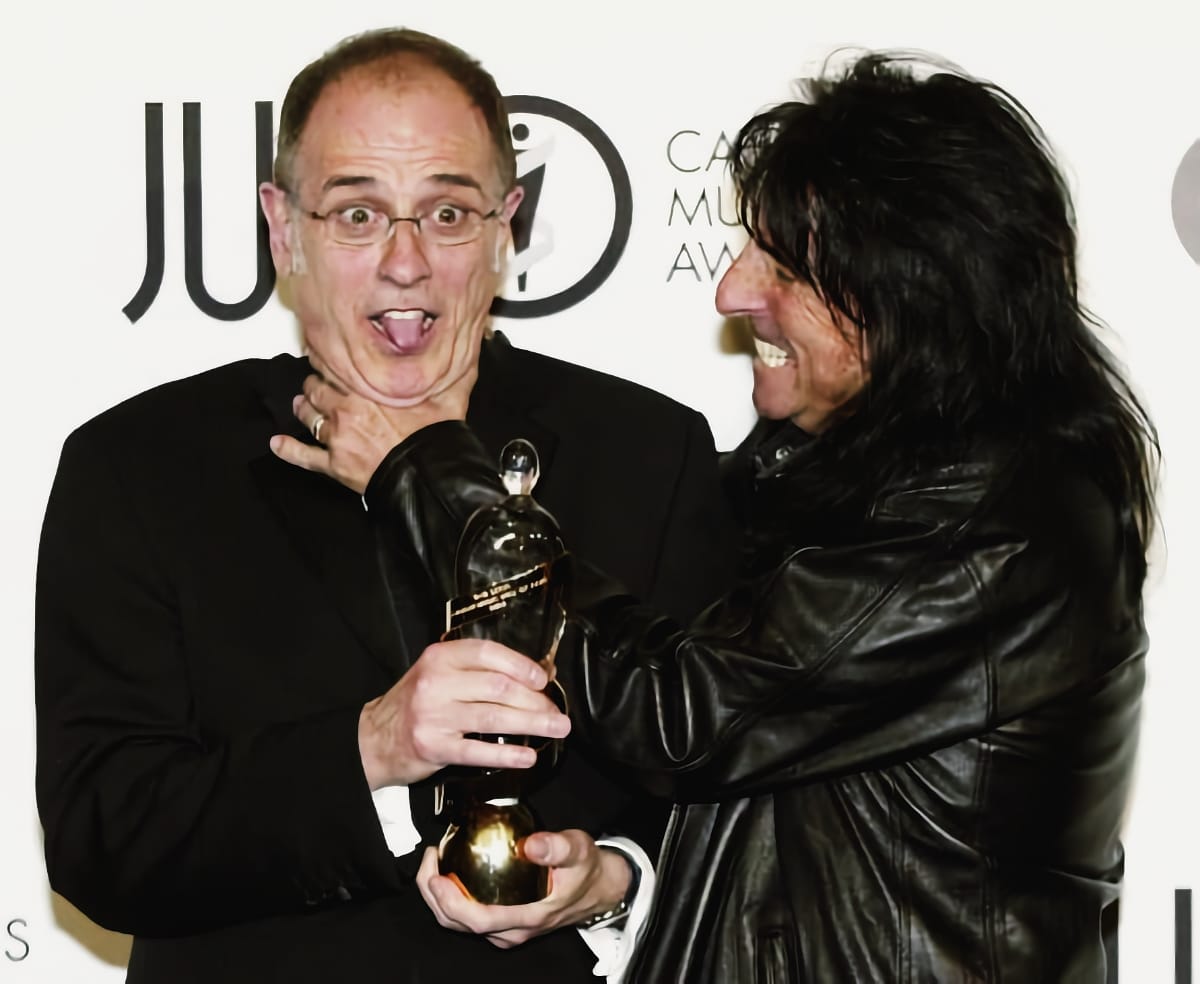
Bob Ezrin was nineteen and apprenticed to the producer Jack Richardson at Nimbus 9 in Toronto when he was sent to New York to see Alice Cooper. Richardson had no interest in the band, and at first neither did Ezrin, who has described that first show as stepping into a Hieronymus Bosch painting. He watched them again at Max's Kansas City and came back wanting to produce them. He co-produced Love It to Death in 1971, which carried "I'm Eighteen" and rescued the band's contract with Warner Bros. Cooper's version of the story is shorter, and he still calls Ezrin a nineteen-year-old Jewish hippie.
In the fifty-five years since, Ezrin produced Killer, School's Out, and Billion Dollar Babies for Cooper; Lou Reed's Berlin; Peter Gabriel's first solo album; and Kiss's Destroyer, where he also co-wrote "Beth." He co-produced Pink Floyd's The Wall, worked on the story with Roger Waters, and co-wrote "The Trial." Later came A Momentary Lapse of Reason, The Division Bell, six albums with Deep Purple, two with Phish, and Andrea Bocelli's first number one. Canada made him an Officer of the Order of Canada in 2022 and gave him a Governor General's Performing Arts Award for lifetime achievement in 2025, the same year he left Nashville and moved home to Toronto.
His newest record is Sanctuary Park, out in August on Thirty Tigers, made with the Jayhawks in a Toronto studio twenty-six years after he produced their Smile. Jayhawks frontman Gary Louris has also settled in Canada, and the two cut the album live in the room with the band playing together, a decision Ezrin traces to what he was looking for at the time. "There's just so much hardness around right now, and I needed a fix," he says.
Lawrence Peryer recently hosted Bob Ezrin on The Tonearm Podcast. They discussed what a producer is actually hired to do, how a record gets built from a handful of live takes, why his working relationships tend to last decades, and the permission he asks for at the start of every project.
You can listen to the full conversation in the audio player embedded below. The transcript has been edited for length, clarity, and flow.
Lawrence Peryer: I want to start with walking back into the room with the Jayhawks after so long. What did you find was different from the first time you worked with them, and what did you find was the same?
Bob Ezrin: It wasn't very much different, I must say. The people in the band have very distinct personalities, and they have had those personalities for most of their adult lives.
I didn't come in when they were teenagers. I came in when they were already established and had been doing this for quite a while. So from a personality level, everybody entered the room in the same place we were when we left the room twenty-six years ago. In terms of the experience and the work, what was different this time is that there's been a little more water under the bridge, and there's been more time spent in studios and more time spent apart. In a way, it was really lovely to get back to that spot.
When we started before, what brought me to Minneapolis was that I got a call from Josh Sarubin, who was an A&R guy at Columbia Records, who said, "We've got this new Jayhawks album, and they're a little bit stuck, and they could really use somebody who's material-oriented." Would I be interested in going down to Minneapolis to meet them?
They saw me—Gary will say this even to this day—as being a very direct person. You've known me for many years. I'm not direct in a confrontational or provocative way. I'm not trying to provoke anybody. But at the same time, I feel like we're all pros and we've been doing this for a while. So if you play me something and I don't think it's great, instead of spending two days beating around the bush, I'll just say, "That one's not working for me."
Nobody had really sat with them that way before. And I challenged Gary as a writer, too, because I felt that in several cases he was capable of doing even more than he did on a particular song. I felt like sometimes he got a great idea and rushed through to the end because of the excitement.
I come from a school where you rush through to the first iteration, and then you go back and try to perfect it. I kept pushing him to go back. He got frustrated with me from time to time, but inevitably, when the songs were ready and we were ready to record them, he was really thankful that I pushed him, because he was very happy with the end result. Happy with his own work, and that's great.
Lawrence Peryer: If I have it right, you guys recorded in only ten days. That feels really high-stakes to me for a rock or pop record.
Bob Ezrin: It's a new world, and with the tools that we have, you're able to do a significant amount of editing and comping and pulling things together from various different takes, in a way that was much more difficult to do when you were dealing with tape.
My preference is to go for performance. Rehearse the stuff to make sure we know it really well before we take it in, and rehearse it well enough so that they can just get on the floor and make it sound really good to everyone as they play. Don't let them overdo it. And then when it's all sounding right and everything is functioning properly, just hit record and tell them to go for it. And we record, in pretty much every case, three to four takes of live performance. That's it. I just want them to go for it. And somewhere in there, I keep a mental note as we're going along.
Somewhere in there are all the parts that we need to put the record together. And then of course there's a little bit of overdubbing. Obviously, we didn't do the vocals live. We did guide vocals live with Gary, but we had to go back and redo all the big vocal harmonies. The playing was live to a guide vocal.
And that's it. With four takes, you have four takes of high energy, four takes with full concentration, full energy. They haven't overplayed it to the point where it becomes intellectual and not emotional, or too mechanical. So a lot of what you're hearing in the record is that sort of spontaneity that you can get.
And then they go home, and I go through everything and present it back. Gary added some guitars afterward to a couple of things we were missing, and that was it. And then it was mixing, which I spent a good deal of time on because I really wanted it to sound special. I didn't want it to be too effected. I didn't want it to be too modern, but I didn't want it to sound like a throwback either. So we had to balance our intentions and try to get the end result we had always imagined when we first started. That's the thing, right?
That is the trick here for somebody that's been doing it for as long as I have. For me, it's like a task. I set myself a task, and then I work really hard to accomplish it. I wanted it to sound like this, and I wanted it to have this kind of spirit. And so then the job was to make sure that I actually accomplished that.
Lawrence Peryer: Throughout the course of a project, how do you balance that notion of having a task, or being on a mission, or knowing what you want to hear at the end, with leaving room for serendipity or pleasant surprises? Or do you not want surprises?
Bob Ezrin: No, I love surprises, but that's part of what I want. The task I set for myself is to create an environment where people feel free and just go for it. And then I pick the best surprises, right? The best stuff that happened.
We worked on making sure that everybody understood what the song was to be and how we were going to do it. Then we took it in the studio, and then there was that freedom of just saying, "Just play it. Don't stop. Just play it. Let's play it again." That's not to say that we didn't ever go back, like, "Let's do that chorus again as an insert," or something like that. We did occasionally, but most of the time these were live takes, top to bottom.
Lawrence Peryer: You alluded to it earlier, that Smile very specifically had much more adornment—for lack of a better way to say it, modern production technique. What drove the lack of adornment and the restraint this time around?
Bob Ezrin: That's an interesting thing. I think we were trying to recapture the band’s elemental sound. Not that they'd lost it, but they just hadn't done it for a long time.
When we did Smile, they were well into their career, and they had tried a variety of different approaches. I liked the idea of a little additional production and some experimentation, and they seemed to enjoy it. We all had a really good time. But this time, especially now, where everything is so produced and so effected and tuned and perfect and, in every way, mechanical to me, I wanted none of that for this one. Yes, we worked to click tracks so that everybody was in the same time, but I wasn't religious about it.
We didn't have Auto-Tune going 24/7. There were the occasional parts or notes where I may have thought, "Oh, if I could just bump that up a little bit, it'd sound a little bit better," but there wasn't a whole lot of that. The biggest thing was finding those special moments where the live performance was as alive as it could be, and combining them into one complete work.
Lawrence Peryer: If I see there's a Bob Ezrin working with so-and-so, there's a new album out—Bob Ezrin, the producer—I have certain ideas of what I think the hallmarks of that are. I would love to know what you think an artist is looking for, or what they think they're going to get. What are they buying, and what are you selling?
Bob Ezrin: Fortunately, I haven't had to really do much selling. I don't actually go out after the work, which is kind of interesting. A lot of it is just word of mouth—you know, somebody that I know knows that somebody's doing something, and they call me and say, "Would you be interested?" And then I go and meet, and we start from that point, from a point of curiosity about each other. Then we get to know each other, and it either goes forward, or it doesn't.
I think that in every case, when an artist is about to make a record, there are several schools of interest—several special interest groups, let's say—involved with the project. The label’s plan may differ from the manager’s plan for the band, which may itself differ from what the artists want to accomplish. So what are they looking for? Everybody's looking for something different, and it depends on who's making the call. In the case of Josh Sarubin, who called me to work with the Jayhawks the first time, they were looking for something commercial, something that wouldn't get lost, and that would reestablish the band as the important artistic force that it was.
They wanted something artful and accessible. That was their wish. In the case of the band, I think that they were looking for something that might succeed more than what they had just done, because success meant better venues, better gigs, better everything. So they were kind of hoping that we would come up with something like that, but they weren't looking for a quote-unquote "commercial" record. I think for the most part, that's a dirty word amongst most artists, at least from that era. They wanted something better and better received.
What I wanted was to do the best thing I could for that group at that time, and to serve the people I was working for. In that case, I was working for a combination of the label and the band. This time around, it's just the band and me, and nobody was telling us what they expected or wanted.
Lawrence Peryer: Do you have a working theory of why you have so many ongoing, long-term, and revisiting relationships with artists? Sometimes you see artists work with a producer for a couple of records and then go away, or be afraid to be too associated with one producer. Jimmy Page is notoriously famous for not letting the same engineers work with him. What's your working theory of what it is about you, or how you show up, that makes artists comfortable with you as a long-term collaborator?
Bob Ezrin: I think they sense very early on how much I love them. I don't go into a situation expecting to be in conflict with somebody, or expecting it to be difficult, or them to be difficult people. In fact, I never go into any situation like that. I walk into a room with an open heart, feel what’s going on, and appreciate it to the best of my ability. The worst thing to do is go in with preconceived notions, and even worse is to go in with a game plan before you've talked to the people.
Luckily for me, I have loved most of the people that I work with. I have some relationships that have gone on for—with Alice, it's almost sixty years. That's insane. And I love him. I love Alice, I love Sheryl. I love their family. I love their grandkids. They're like family to me. And Gary's like family to me, as are the other members of this band.
Lawrence Peryer: I told you before that I feel like there are three hallmarks, for me, of a Bob Ezrin project. One is the commitment to the song: the songs have to be finished and strong and, I guess, follow their own internal logic. The other is what you bring to the table as an arranger. You can take the song and make it more than the sum of its parts. And the third has to do with the performance. It's not about pulling out the best performance—that feels a little hack. There is a high level. The performances are always strong and crisp. They're not lazy.
Bob Ezrin: No, I don't like lazy.
Lawrence Peryer: And I think maybe that's the meta theme across all three of those points: if you're going to do it, there's a standard bar. There's the Bob Ezrin standard bar, and it's, "I'm not doing this if we're not going to agree on that bar."
Bob Ezrin: Well, my wife sometimes accuses me of seeing more in people than there really is. She says that, and she's English, so from their point of view, that's a cardinal sin. But from my point of view, that's a badge of honor. Yes, I do. I'm optimistic, and at the same time, I do see the potential in people. And invariably, when we're working together, I always ask permission to hold them to that potential.
There's always an early-on conversation where I go, "Remember that song that you did back here? Brilliant. Amazing. And that is a standard that is very high. And if you don't mind, I'd like to hold you to that standard for all of this project." And nobody ever says, "No, don't do that." (laughter)
Lawrence Peryer: "I'd like to do worse, please."
Bob Ezrin: Yeah, "I'd like to do worse." They invariably say yes. And then when I do push, they understand why I'm pushing. And I'm sensitive enough to know when somebody is starting to rail against what I'm pushing for, and I will stop and talk to them about it and say, "What's bothering you about this?" And if they say, "I just don't feel it," or "I'm not happy with the way in which this is going," then I let them tell me what they would be happy with and what would work for them. And as long as it serves the project, serves the end result, I'm okay with it. I don't have a pride of authorship or anything like that.
If somebody comes in with a better idea than mine, I'll love it. In fact, I say this over and over: I really love to be the dumbest guy in the room. I do. I love to be with people who are way smarter and way better. It's more interesting. It's thrilling and challenging, and it's tons of fun. Much better than being with people you've got to drag along.
Stay on top of The Tonearm.
Subscribe for exclusive interviews, cultural tip-offs, and community fun.
And your support keeps our site free of advertising and paywalls.
Lawrence Peryer: In this commercial environment, why is the album still so important? I'm curious, from your perspective—"why bother" is one way to say it—but why an album?
Bob Ezrin: It's a good question. In some cases, I tell people, "Don't even think about it. There's no point. Why would you want to make an album?" There is no point, because people go after an individual song. Rarely do people listen to a new record from top to bottom. When it's somebody you know and love, somebody you’ve been a fan of for a long time, you appreciate taking a journey with them, whether that journey is seven songs or seventy. There's nothing precious about it.
An album only existed because that was the size of the carrying case. Back in the old days, you could only carry one song at a time, because that's all the disc could handle. And then they learned how to flip it over—"Oh, now we get two"—in that same carrying basket. And as the baskets got bigger, more songs got added. Now we're in a world of infinite songs, and the basket is infinite because it's virtual. So you could make thirty-five songs. For my money, that's fine, too. But it's funny that I get mostly approached by people who are album artists, who like to make a full album's worth of stuff. So that's what I've been doing for the longest while.
You were talking about the three things. I think the fourth thing about what I do—and it's what I do in a general sense, too, not just with the music—is I'm a storyteller. I love to tell stories. And I think that's what song form is: a story set to melody, a series of words that tell a story, set to a melody. And for me, the perfect form of storytelling in this medium is when the words sit perfectly on the notes that carry them, and they accompany each other perfectly.
That takes a lot of work. Mostly that's at the songwriting stage, where you really want to make sure that you're not squeezing too many syllables into a single note, or that the sound of the syllable doesn't feel right on that particular note. That note calls for a sweet sound, and you're saying something harsh, or vice versa—that note calls for power, and you’re saying something soft, and it doesn't stick through.
These are all parts of the craft of telling stories through songwriting. And then the production is: how do you augment that? How do you present it? The song is the script for a film, and the record is the film itself, which is a combination of performances, sets, lights, props, and atmosphere. And that's what we try to build.
Lawrence Peryer: How often do you know, when you turn in a record, that it's not working? I'm curious about the experience of turning in a record and thinking, "I wish I could take my name off this," or "I just didn't achieve the original task I set out to do." What is that experience like? It must happen.
Bob Ezrin: Not often, though, thank God. A lot of it has to do with working with the same people over and over again: we’ve developed a methodology and a standard we set for ourselves. Every once in a while, we do have something where we kind of look back and go, "Oh, I wish we had done better."
There are very few things I’ve made where I’ve walked away saying, “I wish I hadn’t done that,” because I tend not to take a gig that won’t work out. I have a pretty good sense for when the chemistry's going to be okay. And I like to think that I'm good enough. I've done this for so long, God knows, that I should know what I'm doing by now. And if I don't, man, somebody put me away, please. (laughter)
Lawrence Peryer: You'd have no reason to remember this, but when we first met, I said to you, "My mother would like to have a word with you, because you corrupted me at a very young age with your music, young man." (laughter) So many of those records.
The thing that's interesting about that body of work is that sometimes pop music's ephemeral, but so many of those records—you can look on Spotify. Those records get played, and that's one measure, right? People revisit that music.
Bob Ezrin: Yeah. I hear from people all the time who still want to talk about Killer, or still want to talk about Destroyer: "What did you guys do?" These things are half a century old, and in some cases more. I'm surprised they have survived in people’s imaginations for this long.
And I'm gratified. I'm so glad the stuff we did was meaningful to somebody, because what's the point if it isn't? At the end of the day, our goal really is to touch people and to give them an experience that lifts them up. We're making stuff that we hope moves people. We hope it elevates them, lifts their mood, gives them something to think about. That's also good. And maybe, maybe, maybe, if we're super, super lucky, it infects them with an idea that improves their life.
Check out more like this:
 Andrew Hamlin
 Lawrence Peryer


Comments