


1971. Gram Parsons and an unidentified counterman inside Burrito King in L.A.’s Echo Park. Does the counterman know Gram has a band called the Flying Burrito Brothers? Does he know Gram has a trust fund good for 30,000 bucks a year (about $280,000 in today’s money)? Does he know why somebody came in the door posing with a photographer? Does he care?
Mysteries. Most likely never solved. But we can lose ourselves in the pondering. Haiku poet Buson wrote: “Straw sandal/Stuck to the bottom of a pond…/sleet falling.” Whose sandal? How did it land in the pond? Where’s the other sandal?
Winn invites us to join in, supply the other half of her puzzles. Winn didn’t prove every picture tells a story. Her work—all of it previously unpublished—in her collection Grievous Angels, Trout Masks, and American Beauties, shows photos speak a language different from words—more immediate, more visceral, and often dipped in that mystery. “I’m always looking for something when I’m shooting,” she wrote, covering her time as staff photographer for Warner/Reprise, and beyond. “I get close. I always want to see the pupils in their eyes.”
Her work slices through artist arcs, too. Watch Alice Cooper’s leopard legs sheathing hip stack heels: Alice with his original quintet spent two albums cheerfully throwing everything at the speaker to hear what would stick, emerging into the venom-laced hard rock making them (and eventually just him) notorious worldwide. Watch Captain Beefheart with a pensive look in his million-mile eyes—he peddled Reprise albums of trademark Captain kaleidoscopic visions, then (quite possibly because kaleidoscopic visions didn’t sell well) one album of relatively straightforward white blues. Dory Previn—singled out by Ginny Winn as one of her personal faves—had talent, family connections, personal connections, and critical praise; but that sadly added up to pretty much nada commercially.
Gram Parsons, who had talent, money, good looks, and a close friendship with Keith Richards, died in Room 8 of the Joshua Tree Inn two years after that Burrito King shoot, his veins pulsing booze, barbiturates, and liquid morphine until his brain couldn’t tell his lungs to breathe. Ginny Winn stepped back from photography in 1983 to work as a residential counselor and caretaker of emotionally disturbed teens. By 1988, she was a licensed therapist, working in that field until retirement. She died July 18, 2026. This piece is dedicated to her memory.
The transcript has been edited for length, flow, and clarity.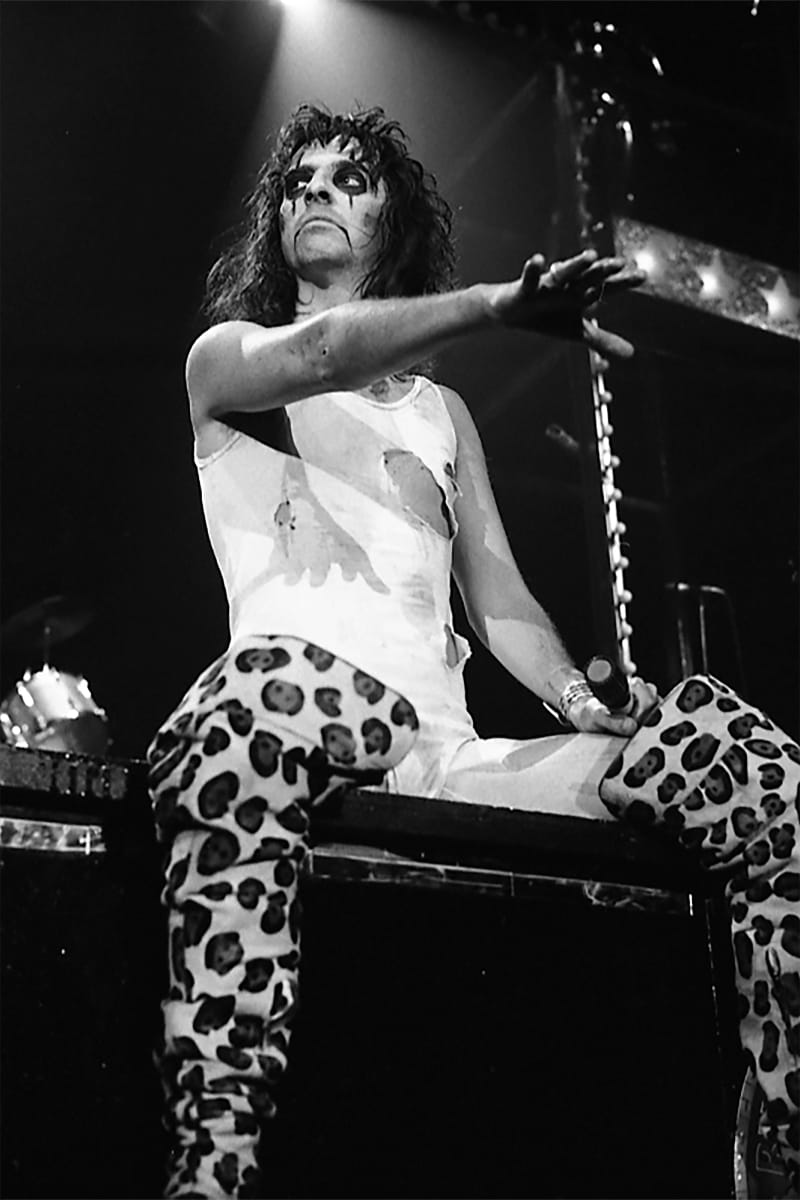
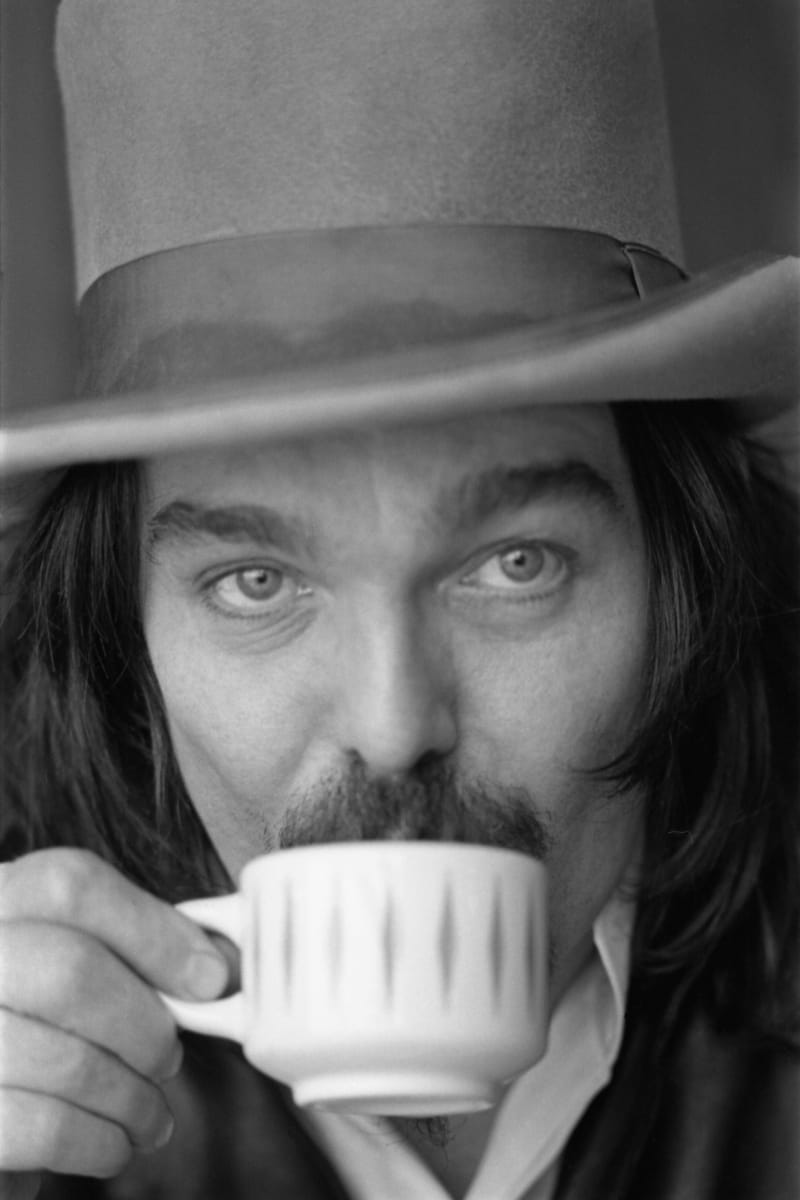
Alice Cooper's leopard legs. Captain Beefheart at the coffeehouse. Photos by Ginny Winn, courtesy of Fantagraphics.
Andrew Hamlin: How did you get started in photography?
Ginny Winn: I had a little Brownie camera as a child, and I just was very fascinated. I suppose everybody remembers their first Brownie camera. But it was so cool. You look in there, and then you have to adjust. And I remember it was a great relief when you didn’t have to adjust anymore.
Then I was shooting slides. I used to go to a lab in New York, and when I picked up my slides, I built a tent around the part of the light table where I looked at them. I would open them right there, and I would blockade myself so no one could see; I was so worried about how they would be.
That’s with my $50 Pentax camera. And one time the guy in the lab said to me, “Come here, I want to show you something.” So, he shows me some pictures, slides of other photographers. Then he says, “What do you think?” I said, “Hmm, they’re okay.” And he goes, “You’re better than that.” He goes, “You don’t need to hide when you’re looking at your slides. You’re good. They’re good.”
We had a group of friends, and we left New York and moved to Woodstock. But in the summer that we left New York, which I think was the summer of ’68, could have been ’67, we were on Fire Island, and somebody lent me a camera. And I just walked around. We were living in a little remote community called Atlantique, about a half hour from JFK Airport.
We were in Fire Island for the summer, and then we moved to Woodstock. In Woodstock there was Big Pink [home of the Band] and Van Morrison. I was in Fire Island the summer of ’68, the summer of the Chicago riots.
And that’s when I started getting serious about shooting; I would shoot things like ice cream with syrup, and just anything you could get a fun visual trip out of.
And then I was out here [Los Angeles], and somebody called me and said there was this perfect job for me at Warner Brothers. And it was doing what I was doing, but it was with the artists and the new releases. There were new releases about every six weeks. To promote people like Neil Young, but really just everybody from each new release.
This job turned into a full-time job, and I was often called on to shoot. Warner/Reprise never had a staff photographer before. I also often shot the band, but I would go take pictures that fit the hit song on the album, or one of the songs on it.
I was doing a visual trip to the music. Captain Beefheart drinking tea, Gram Parsons playing basketball, and Rita Marley’s Beverly Hills party—these are very choice moments.
Stay on top of The Tonearm.
Subscribe for exclusive interviews, cultural tip-offs, and community fun.
And your support keeps our site free of advertising and paywalls.
On Captain Beefheart:
I spent a day with him. He lived outside of Eureka, and he was very paranoid. I don’t know exactly what he thought, but I think he was afraid he was going to get busted somehow. He was also really, really nice. We were sitting in this coffee shop, and it was a ’50s coffee shop, with those kinds of cups and stuff. And this little round table, just quiet at the end of the day. And I just took my camera, and I was just sitting at one of those little round tables with my camera just pointed right at him. He just stared into the camera and let me take the shot.
On Playing Basketball with Gram Parsons:
I can’t remember how I first met him. We were at his house. As I recall, it was Laurel Canyon on the Valley side. And we were shooting baskets. My first true love was the captain of the basketball team at Andover. And I beat him [the captain] in set shots. What was cool is he told his coach I beat him.
But anyway, Gram was trying to give me an extra point because I’m left-handed. He thought that I should have a handicap point. And we argued. I’m like, “No, I don’t need a point.” He was always very sweet when we were together.
I felt like Gram liked to hang out with me because of my calming energy. I remember going to a picnic with him, and there are pictures of him holding a beer bottle with a horse. And we also went downtown to a burrito stand. There was a calm that would happen. He trusted me.
On Bob Marley:
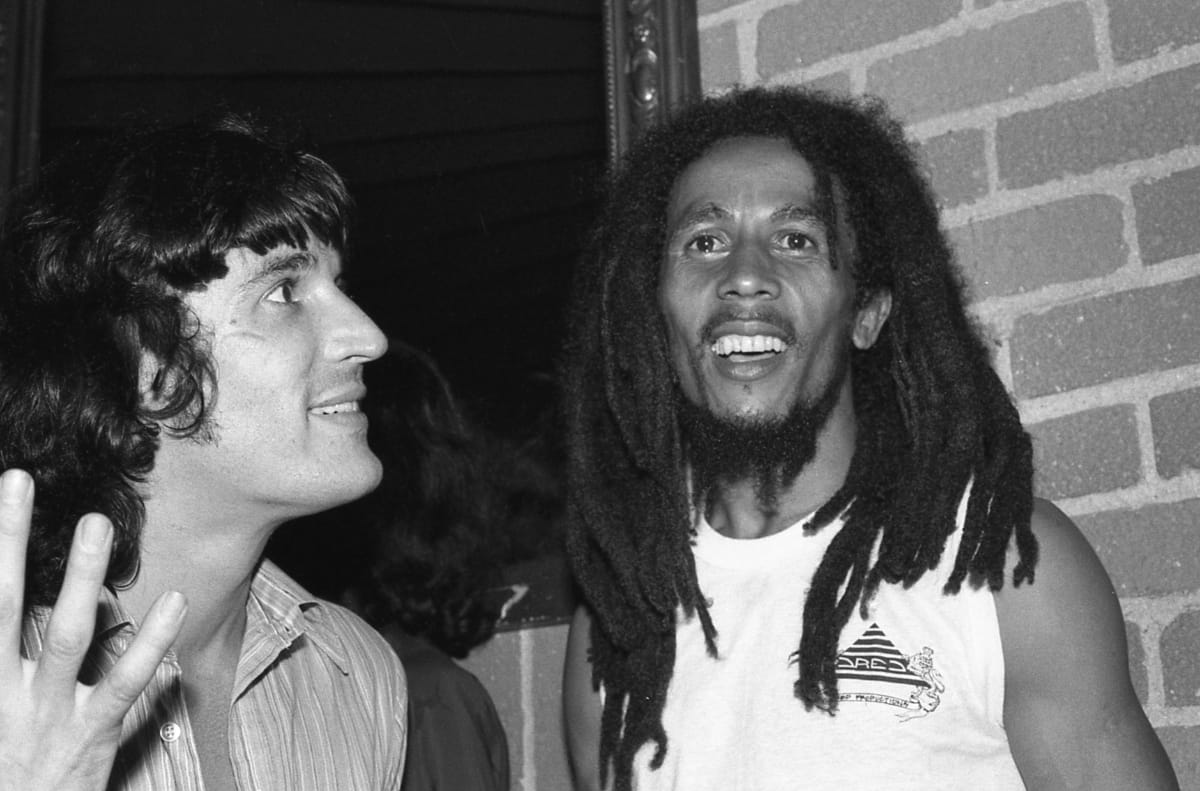
Diana Ross’s sister asked me to come to the Daisy in Beverly Hills on Bob Marley’s wife’s birthday and photograph Bob Marley. Two other photographers were there, and they gave me a really hard time because I was prepared to shoot without flash. And they’re like, you’re not going to get any shots. Really bullying me.
Bob Marley was late. I figured they were going to get drunk and stoned. I’m just going to sit here, drink coffee, and wait. And sure enough, they did. And Bob Marley came; he wouldn’t let them shoot. He said, only Ginny. The rest of you can’t.
Andrew: What were Bob Marley and Rick Danko from the Band discussing?
Ginny: It was the ’70s in Los Angeles; Danko and Marley could have been talking about anything!
I didn’t want to be intrusive or be like a groupie or anything like that. So there were many photos I didn’t take when I was backstage with bands like Fleetwood Mac, talking to Stevie Nicks and Christine McVie when that lineup first started, and I was really close to Mick Fleetwood, and I always kicked myself that I didn’t shoot pictures when I was sitting with them.
I probably could have gotten a lot more shots. I would hang out with the Rolling Stones backstage and not take pictures because other people were just trying to grab shots. I was sitting right in front of Mick Jagger and didn’t take a picture, which was insane.
But that attitude, that practice, also might have really worked in my favor sometimes. Bob Marley preferred me to other photographers.
On the Grateful Dead:
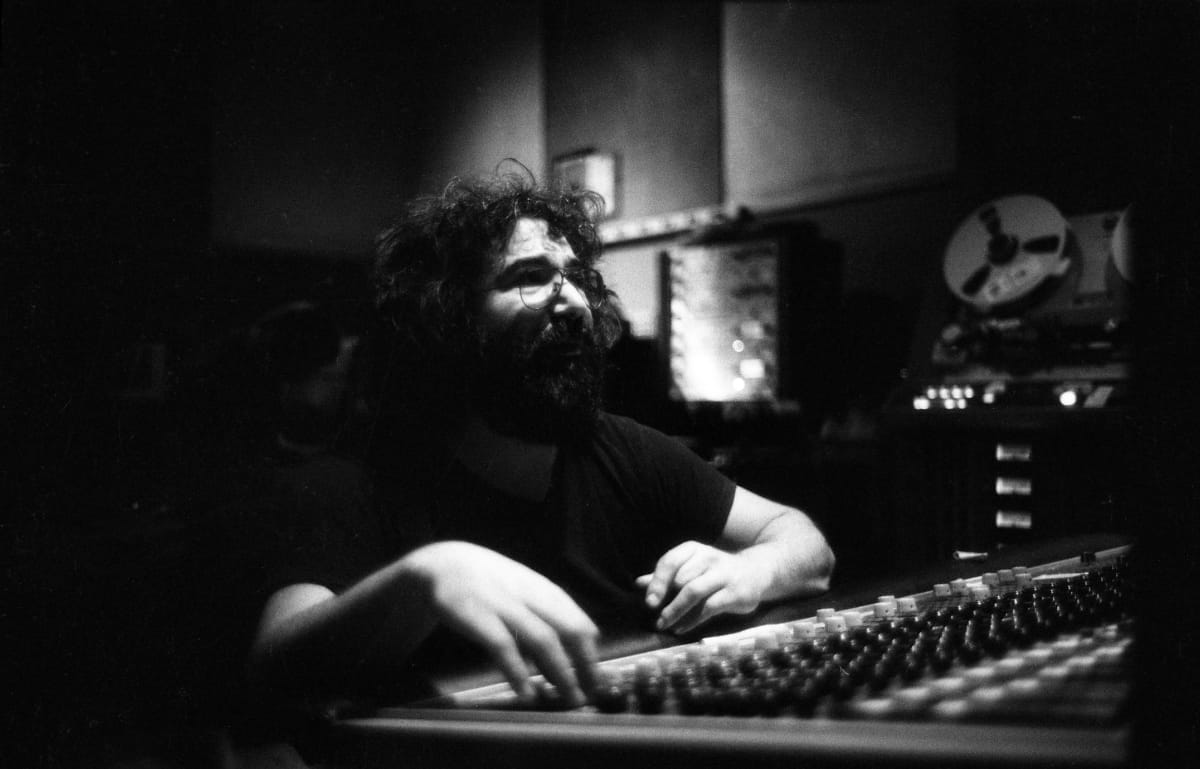
The most fun thing about the Grateful Dead was getting to hear [the live album] Europe ’72 mixing in the studio. And they had plans to do some kind of estate, like a place where they would all live and work.
I went to the Grateful Dead ranch; I spent a day there. In the morning, we went down by the horses. I was shooting [drummer] Mickey Hart. There was a bottle; it had liquid Owsley acid. So, each of us had a drop. I just had a kind of heightened awareness all day. And then in the evening was when we went to the studio. And then we did this Chinese restaurant that Mickey Hart loves on Nob Hill.
On the Archive
Andrew: Were you told that your archive had been destroyed? How were they recovered? How does it feel to see them gathered together at last?
Ginny: Most of my Warner/Reprise photos were in their vault, and I just didn’t know what happened to them—until a couple of kind employees in recent years reached out and helped me get digital copies of my own work.
A photo is worth 1,000 words is so true. It feels like . . . when people look at my photos, what they say is that there’s a kind of immediacy. And I’m looking; I always want to see the whites of their eyes. I focus on the eyes, but you’re looking soul to soul. The Native Americans know that. They don’t want their picture taken because you’re stealing their soul.
I’m just so glad I’m reconnecting through photos. You reconnect with the people, and that’s like you’re keeping them alive, the same as any artwork.
There’s Bob Marley alive. I will always remember that night. I’ll always remember Bob Marley saying, “Ginny, do you mind taking this picture? No, only Ginny.”
Check out more like this:
 Chaim O’Brien-Blumenthal
 Andrew Hamlin


Comments