


I first encountered Brandon Locher during a doldrum stretch of the pandemic. We were casual online pen-pals steeped in making weird sounds and observing weird art. At the time, Brandon had returned from New York City to a rural swath of Western Pennsylvania. There, cohabitating with his sister (Olivia Locher, another gifted visual artist) in a farmhouse in a town that sounds like any town, he was etching some of the most intricate illustrations I’ve ever witnessed in an era of short attention spans.
Some of those illustrations, which often took months to actualize, eventually ended up as Ghostly slipmats and record sleeves. When you look at Brandon’s visual art, you instantly feel that this guy is “weird” in the absolute best way. You also notice the fine details that demonstrate just how much time he spends contemplating light, shadows, and relationships to pleasing colors. It is a reticent determination inherent in his work, and it transfers perfectly over to Brandon’s other craft: sound.
Rahu Ketu is a work of endurance built within a tight constraint. Every letter of the alphabet is crafted into a track—minus the letters R-A-H-U-K-E-T-U. When I witnessed the sheer volume of tracks here, I decided to greet the lunacy head-on.
As it turns out, it’s not lunacy; it’s mad genius. I held onto the entire record without a single skip on train rides barreling through the East Coast. I loved it. I slipped into a strange sonic world where everyday elements are blown apart and pieced back together into something deeply sincere. These tracks are little novellas of carefully sculpted snares and digital, throaty drones. It is meticulous work; the low register of synthesized horns steps away from a campy ’90s production feel and into an intentional score that mangles East and West.
Weird guys were once weird teenagers. For Brandon, realizing the potential to make something generic into his own began in the late 1990s, much like it did for many of us Gen X cuspers. It started when he hacked the traditional AOL “You’ve got mail” greeting. I’ll let him tell the story below, but I find it interesting that Brandon’s sonic art world begins with email and then somehow brings us full circle by escaping the nuisances of email—with art.
In 2026, we find Brandon immersed in a deep spiritual practice, living in something approaching solitude, rising willingly while the rest of us dream heavy. This is not bullshit or performative asceticism. It’s the discipline of trying to make sense of a world we so often move through without really looking or listening.
The transcript has been edited for length, flow, and clarity.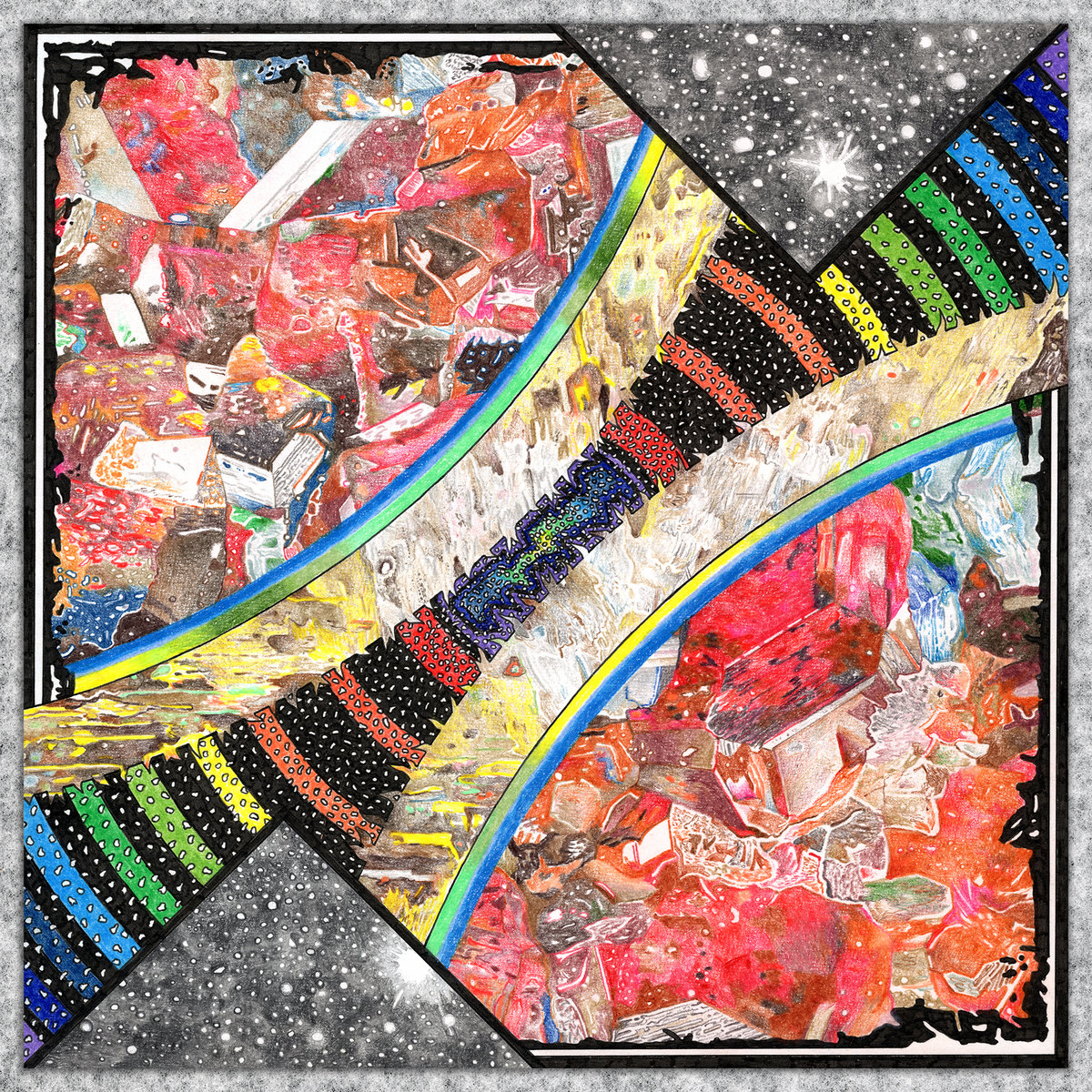
Carolyn Zaldivar Snow: I like your room behind you. I see a book ladder, I see some abstract works, and I’m wondering if that’s your own painting behind you.
Brandon Locher: That’s an old painting of mine, and this little nest is actually where I made the album [Rahu Ketu]. So, yeah, this is my bedroom. I’ve always made music in my home using very minimal materials.
Carolyn: I can tell by your space, even just the small parts I see, everything is carefully placed and chosen. Rahu Ketu is over 70 minutes of music, and it did not lose me. I was surprised to read that the album had such a tight production constraint, because this feels like something someone would have worked on over many years. For anyone reading along who doesn’t know what Rahu Ketu is: What is the primer?
Brandon: Early last year, a friend generated my Vedic astrology birth chart for fun, and I noticed I was about to enter this astrological period called Rahu Ketu. I didn’t actually get into the astrology too deeply; I wasn’t really interested in predictions or anything like that. I was focused on these specific cycles and periods of time. Something I discovered about my own creative pursuits is that establishing constraints creates freedom. It seems paradoxical. The more specific the boundaries I create, the more deeply I can express and explore what exists inside them. I don’t necessarily need infinite materials, sounds, and possibilities, and I can draw a parallel to my drawing practice. For over ten years, I limited my materials to ink on paper, and by doing this, I’ve discovered that a limited palette doesn’t necessarily make the work less expansive. These limitations force me to look more closely and creatively attempt to push these materials to their limits and right to the edge. So this particular astrological period, which lasted 264 days, didn’t allow me time to overthink the material, right? This created an endpoint predetermined by the astrological chart I was given.
Carolyn: When you hit that endpoint in May, is it like when you’re taking a test at school, and they say, “pencils up”? Did you just come to a full stop?
Brandon: I knew that that was the endpoint, and the album was the accumulation of daily work. This is the first time I really recorded music or worked on music in roughly 10 years, and my creative practice was so informed by my drawing practice that I work on generally every morning, which is very disciplined, and I set aside two or three hours a day, and I just wake up and go at it. I’ve always believed that slow and steady wins the race, and just being consistent with something, just always nurturing something, always giving it the attention it needs. I knew I had an endpoint. In the past, while working on music, I would continually want to rework and rework and rework the same material.
Carolyn: Can you remember your state of mind, or did you keep daily journals or notes about your interior self? What is Brandon Locher like in September 2025? And then what is Brandon Locher like in May 2026? How do you shift as a person in that time frame?
Brandon: What I’m learning through meditation and through studying such Vedic texts like the Upanishads and the Bhagavad Gita is that “self” with a capital “S” is unchanging. This awareness illuminates our five senses, and this is how we navigate and explore the world. Of course, my mind and our minds are constantly changing. One day, we can wake up feeling content and happy, and an hour later we’re bored—just all of the different emotions the mind goes through in a 24-hour period. I’m identifying less and less with the surface gross values of life, and identifying more with just a pure awareness that is witnessing the world, that is witnessing my changing thoughts and emotions—that is, witnessing even over a short period of time of how our hair and our fingernails grow—but that’s all surface value of life. Brandon Locher, at birth, childhood, teenage, young adult, recently turning 40, is the same, unchanging. So to answer your question, even though I just said a lot of stuff, the real me is always the same.

Carolyn: You strike me as a creative monk, and definitely from a different spiritual tradition, but definite Thomas Merton vibes here. Merton also meditated and held the constraints of being a Trappist monk. Did you wake up early and meditate this morning?
Brandon: I did. I find it such a strange coincidence that you mentioned Thomas Merton. It’s like the universe is sending me signals. I’ve never read Thomas Merton, but yesterday I made a bookmark to buy The Seven Storey Mountain.
Carolyn: I think the way you describe your being out in the world, I see a lot of parallels. So hopefully, it’s enjoyable for you. Or maybe you read it, and you’re like, “Ah, I hate this guy.”
Brandon: I’ll love it. Even if I read something I dislike, I still enjoy it. To answer your question, I wake up every morning at roughly five a.m. So I wake up and begin my day with a set of yoga asanas, which really seems to loosen a little bit of that stress that we accumulate in our bodies. Then I do breathing exercises for about 10 minutes, and then I meditate for 20 minutes. So this entire round takes an hour, and it’s now six a.m. That’s when I generally go right into a creative activity. I find that by not waking up in the morning and looking at the news, or checking emails, or looking at social media—all of these things that are constantly trying to grab and pull at our attention—I start the day with my mind being very calm and one-pointed, and my art has always been the most important thing to me. So of course, as the day goes on, all of these other responsibilities come in. We have to do all of these things, but I wake up so early because it gives me time in the morning to enjoy the silence and the quiet, and then to channel that into some type of creative work. I have been doing this for maybe three or four years now, and I’m really strict on bedtime. I’ve really gotten into bedtime. My bedtime’s 8:30 p.m., and I try to nail it every night so I can wake up in the morning feeling fresh, alive, and grateful for all the blessings this world can give us.
Stay on top of The Tonearm.
Subscribe for exclusive interviews, cultural tip-offs, and community fun.
And your support keeps our site free of advertising and paywalls.
Carolyn: It’s interesting to hear about the early rise and early bedtime, but then you previously inhabited these spaces that are very electronic music, New York City adjacent. Where, in my mind, I feel like that is, you know, someone’s day starting at 8:30 p.m.
Brandon: Yeah, nightlife.
Carolyn: Everyone has previous lives, right? So you tell me this practice has really been for about four years, and I know you used to live in New York City, but what is it like to work in these almost dance spaces? You’re such a juxtaposition.
Brandon: Yeah, I mean, I honestly don’t know where my music even fits in. I also, I think while making music, I get bored really easily, meaning I’ve noticed by listening to my own work that it seems every minute or two the genre morphs into something else, something it wasn’t previously, and the arrangement completely changes. So even though there are parts of the album that I think could work in a nightlife dance club setting, I think it would take a really skilled DJ to not let the track continue too much because then it would just become some type of modern classical-sounding bit, and it would really throw everyone on the dance floor for a curve.
Carolyn: Like, what are you gonna do if Charli XCX calls you? And was like, “I like the bones on ‘W-X-Y.’” Would you accept the collaboration?
Brandon: Yeah, potentially. I think to relate this to my own material, I was working ahead of my deadline, and I realized, you know what? I think if I have to finish this by May, I’m going to just be twiddling my thumbs a bit, and eventually having too much time, and I may start overworking this material. So around January, I thought I could also make an EP as well. So I made an EP called The Shadow Planets, and I had my friends Sam [Prekop] and Salvatore [Mercatante] do remixes.
I think of those remixes almost as a companion release to Rahu Ketu, where they can be thought of as one whole listening experience. They are all from the same era, and they all had the same intention. But I went to friends because I knew they could take the material I created and put their spin on it, and both of those tracks are so consistent with those specific artists.
Being in New York City for so many years and really enjoying nightlife—you’re out until the sun’s up, and that experience of dancing and movement on the dance floor. I feel like if my music’s going to be in that arena, the remix would suit it best. Even with ownership of my music, I don’t feel like I have any ownership over it. People can take it and do whatever they want. Like, I don’t really care if they make it into their own thing, and I’m completely fine with that.
Carolyn: I feel like you’re saying you feel like nothing is really yours, like it’s collectivist? Your label is called Shared Materials—does this principle come out of your spiritual practice too?
Brandon: Yeah, a bit, but not necessarily. I just think I’m anti-copyright. I don’t care if people steal or bootleg my stuff. I sell visual art, and that’s how I make most of my income. But even with friends or friends of friends, I’ll just send them high-definition files and tell them to send them to a printer. I don’t care if people bootleg or steal my work.
Carolyn: What makes you comfortable with that?
Brandon: I don’t feel like I have any ownership over it. I had several experiences while making this record where I was simply witnessing my mind and body at work. I was silently, innocently observing this. When I have flashes or insights of this experience, it feels to me to be the truth, that thing that I’ve always been searching for, but it’s not necessarily anywhere outside in the world. It’s always been within me. So there’s a bit that I don’t even feel like I made this record. Sure, I’m in this body and mind, and my mind created thought generated thoughts and ideas, and I’m using my arms and limbs to turn knobs and play the keyboard, but on a very, very subtle level of experience, I’ve had flashes and moments in the creation where I’m just witnessing this unfold.
The music’s also not for sale. Towards the end, I decided, sure, I’ll put it up on the streaming services. It’s free on Bandcamp. I support people sharing it on file peer-to-peer services like Soulseek. Making art is the endpoint, and I’ve always viewed success, even with any other artist, any other creative individual; if you sit down and do it and make something, you’re successful. We live in this world with so much suffering. There are so many problems. We’re constantly bombarded with so much stress, and if someone’s able to sit down and just transcend that and be creative and flesh something out and make something, I view that as the endpoint. That’s the greatest success in life.
Carolyn: We live in a time of such short attention spans. How does it feel to send something out into the world that requires time from the listener?
Brandon: I don’t think about how things are received too much. I just think all of my work time is almost immaterial. Even if I’m working on a drawing, sometimes a single drawing will take me three months. So everything is about a sequential unfoldment of time and how things accumulate within those specific boundaries, but I would want to fight against short attention spans. It would make me feel good to know that maybe I’m putting something out that is challenging because of the length. I experience so much more happiness when my attention doesn’t feel like it’s being pulled in multiple directions at once. If the album I made could even give one single person the ability to sit and listen to something fully, that’s great. I don’t want to make art that promotes this TikTok constant scrolling.
Carolyn: You’re very positive about your approach to music. In thinking about viral music, and just being a person—a few months ago, I read a New Yorker article about whatever happened to mean critics, and it’s been a long time since I’ve seen a true piece of music criticism that felt scathing, and then the Rebecca Black album released, and Paste magazine just went to town, and this kind of angered me in a way. It’s not that I’m protective of Rebecca Black’s record, but rather that she’s not allowed to evolve as a person. She’s still always going to be the person with the viral hit “Friday” that her mom paid for production on when she was a teenager, a kid, you know. Who is allowed to change in the eyes of critique?
Brandon: Change is the nature of life. Look how much our bodies change from birth to old age. Look, nature is constantly evolving and growing. I think we shouldn’t fight change.
Carolyn: I think change is great, and I know something that really bothers listeners—just general listeners—as critique is when somebody comes out of a genre. I know you’re Ghostly adjacent, so I will use Shigeto as an example. You know everyone really likes the older Shigeto works, and then when Cherry Blossom Baby came out, they’re just like, “Wait, what are you doing?” And I think it’s great.
Brandon: I’m happy you mentioned Shigeto. I love his development, and Zach’s been an old friend for many years. As a creator, I work so that almost the second I finish a project, I disconnect from it. Like, oh, that’s not me, and I instantly try to reinvent myself on the spot.
Carolyn: So what is that reinvention for you?
Brandon: The next album in this cycle is Rahu Venus, and it’s a three-year period that ends on May 9, 2029.
Carolyn: When does it start?
Brandon: Oh, it started the day Rahu Ketu ended.
Carolyn: Did you immediately go to work on that day?
Brandon: I didn’t actually start recording until the end of October [2025], because I didn’t have any gear together, and I just sat around for two months thinking, “How am I even going to make music? How am I even going to make an album?”
Carolyn: Where did your equipment go?
Brandon: It was all cracked and stolen. My gear was an old laptop that became corrupted with viruses and spyware and Trojan horses and all the things computers get over time. Ableton stopped working, but I have hard drives I’ve been collecting for the past 20 years of field recordings—just endless amounts of data I collect along the way. So for even Rahu Ketu, that’s an essential part of the process for me. All of that preliminary stuff of organizing my space, getting the gear up and running. If that doesn’t happen, then I can’t sit down and work on the music. So that was contained within that. So for this next period, I’m approaching it completely differently. I have three years to make an album.
I feel like with Rahu Ketu, it’s a lifetime of experimentation that has blossomed into this album. The gear that has informed my creative practice is just these very basic programs, and understanding how you can have very minimal materials, but use your creativity to push them to the edge, push it to the limit, and I still work that way now.
Carolyn: When did you first get the idea that you wanted to even listen that intensely or organize sounds in a novel way?
Brandon: Probably 1996. I had AOL (America Online), got on the internet for the first time, connected with alternative subcultures, and listened to alternative rock music. I was really into the band, the Smashing Pumpkins. I used Winamp. I could open up the Smashing Pumpkins “Bullet with Butterfly Wings,” and just isolate the lyrics, “the world is a vampire,” and take that recording and go into the America Online folders, and every time I would get an email instead of saying, “you’ve got mail,” it would play back my now-saved WAV file that said, “the world is a vampire.”
Carolyn: That’s amazing.
Brandon: That was like my first audio work, and then within that, my whole being exploded. The potential, the possibilities, how I could hack into this software and change the standard “you’ve got mail” to Billy Corgan singing, “the world is a vampire.” Things just kind of snowballed from there. It’s like that aha moment. Ah, a wave editor. Ah, raw sound. You can make sonic paintings.
Carolyn: I feel like you parallel a lot of these mid-century intellectual spaces. Black Mountain College, for example, principles of “at hand.” Josef Albers, John Cage. I’m realizing throughout this interview that I often frame things through audience reception or cultural benchmarks about how we’re feeling about technology or listening. But you’re in this room behind you, in your head, in your heart.
Brandon: Previously in our conversation, you kind of alluded to or mentioned that I’m working in these different avenues with visual art or sound art or music. It’s all equal. It’s all coming from the same place. So, I think if somebody connects with and likes my new album, that ultimately I would hope that they could look at something I made 15 years ago and see the same quality within it. It’s expression. It’s the love of art. It’s the love of creativity, and it all comes from the same source.
Check out more like this:
 Steven Garnett

 Carolyn Zaldivar Snow



Comments