


A vocal break, by its mere technical definition, is the place where the human voice changes registers. Lauren Elkin takes this further and explores this transition as an esoteric place, one where we (particularly women) have permission to explore identity, and the forever minefield of changing, becoming, intensifying in full view. This lens can be politics—whether it is the absolute withholding of a woman’s right to a voice as witnessed under Taliban rule, or the expectations around who may be decorated and awarded on Broadway. These extremes are not meant to diminish the hardship of one over the other, but to highlight a thesis.
Women are often depicted as dangerous, performative, insincere. Many of these tropes are often held in the voice and reception of the voice. Elkin has an ability to discuss Riot Grrrl and Me Too with both academic and personal candor. Vocal Break weaves passages about Elkin’s young adult life as an “awkward theater kid” training with Shakespearean rigor to push her voice to the front, to recognizing what it truly means when Kathleen Hanna also invites her to the front.
Over the phone from London, Elkin, who previously penned Art Monsters and Scaffolding, takes my call across the Atlantic and tells me—I am only hearing a perception of her voice. She can’t possibly know how she sounds, and I will interpret it how I wish over the noise floor of a digital telephone line.
I am reminded of a quick meditation in Lavender Suarez’s Transcendent Waves: “When a sound is produced, it goes out into the world and immediately changes. When we put a creative work into the world, it also undergoes an immediate change: it gets placed in new environmental contexts—such as galleries, books, and albums—and is reflected upon in ways one can never fully predict or control.”
The transcript has been edited for length, flow, and clarity.
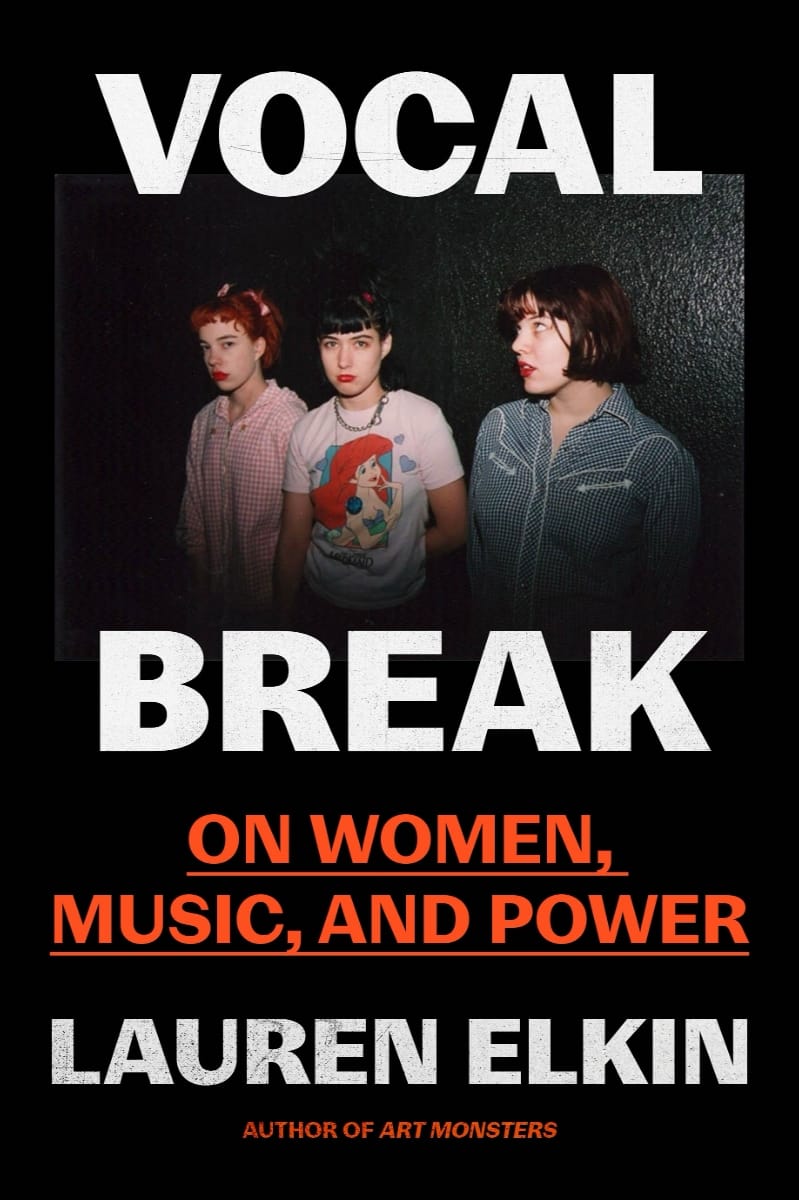
(L) Lauren Elkin, photo by Marianne Katser. (R) Cover of the US edition of Vocal Break, courtesy of Farrar, Straus and Giroux.
Carolyn: Vocal Break is a dense book. You pen dense books. You have an ability to do things like pivot from Britney Spears to the Taliban. You can be scholarly and footnoted while also being like, “and I wore Doc Martens and lipstick.” As a young girl, how did you negotiate your interactions between training for musical theater and taking these vocal lessons while also listening to pop music in the ’80s?
Lauren: Musical theater was my everything. It was the only music that I listened to for a long time. I think early on, when I was a kid, all the other kids on the playground were debating whether Cyndi Lauper was better than Madonna, or vice versa. Pop music was everywhere, so I took part in it. As I transitioned to middle school, I lost interest in pop music. In the late ’80s and early ’90s, it became much more about techno, hip hop, rap, and R&B. I think I got bored with what was on the radio and became much more interested in learning the entire Rodgers and Hammerstein back catalog and every Sondheim musical. It wasn’t even a performative thing. It wasn’t a point of pride. I was a really weird theater kid who didn’t know much about pop culture, but I could tell you who the original Anthony was in the Broadway cast recording of Sweeney Todd. (It was Victor Garber.)
As I got older, I made friends with people who were a little less theater-focused. I had a really good friend, a dancer, who turned me on to PJ Harvey. I think I coincided with this flourishing of female singer-songwriters that I write about in the book. Tori Amos, PJ Harvey, Fiona Apple. Alanis Morissette came out when I was in high school. All of these one-woman shows, women who did everything. They wrote the music. They played the instruments. They sang. They produced. They were very involved in conveying a musical idea that I hadn’t really come across before. At that point, I was pretty unschooled in terms of pop music history. I didn’t know anything about Joni Mitchell, Poly Styrene, the Slits, or any of the people I write about in the book. There was this moment when I was learning about these other singers, and it brought me out of my musical theater bubble and connected me to what was happening more largely in terms of female music and female voices at that point.
Carolyn: I think it’s interesting the way film and television can also introduce us to these things. I like talking about The O.C. and all these bands like Low coming to mass audiences—similarly, you talk about My So-Called Life in Vocal Break. Tell me about encountering My So-Called Life as a theater kid, or is this something you’re watching later in life?
Lauren: Oh no, this was in the ’90s when I was still a theater kid. I remember being envious because Claire Danes was a couple of years younger than me, and she’d gotten cast in this TV show, and I wasn’t auditioning for TV shows or anything. That was not my track, but I remember being jealous that she got to be on this TV show, and we sort of looked alike. I certainly identified with that character and that feeling of being extremely shy in a high school where I didn’t feel like I fit in. There’s something about that soundtrack. There’s the Christmas episode with a really good song, but I’m totally blanking on her name. She plays the Christmas angel. But I discovered her through that show. She has a very ethereal voice. [The singer is Juliana Hatfield, and the song is “Make It Home.”] Around that time, the Reality Bites soundtrack was also really big. I found out about a lot of music that way.
Carolyn: To your point about the Reality Bites soundtrack—that has Lisa Loeb. I’m curious what you think about this independent music standout, alone in an apartment, asking someone to stay.
Lauren: I loved that song. I remember listening to it with this boy that I had a crush on, and he described how she does this double “well.” I remember being so enthralled by this boy who was such a close listener to music and lyrics. I’m still struck by the double “well.” It’s a real naturalist approach to lyric writing.
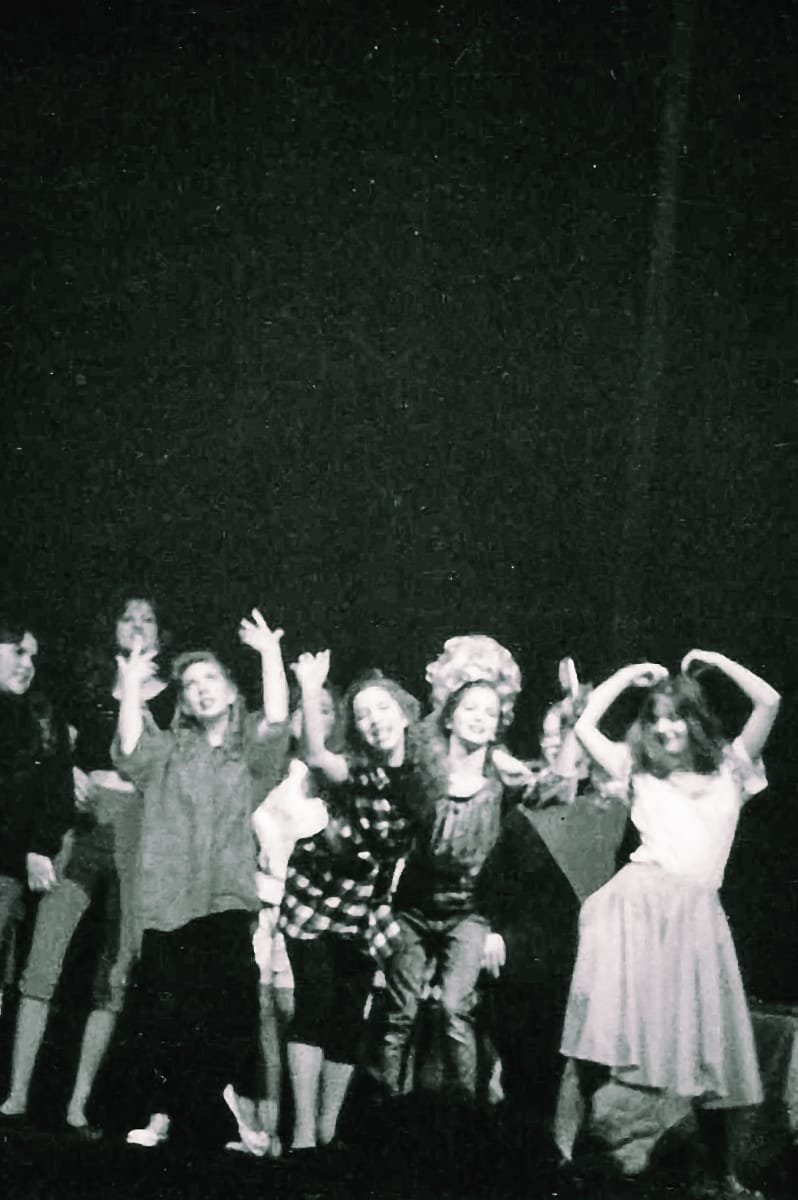
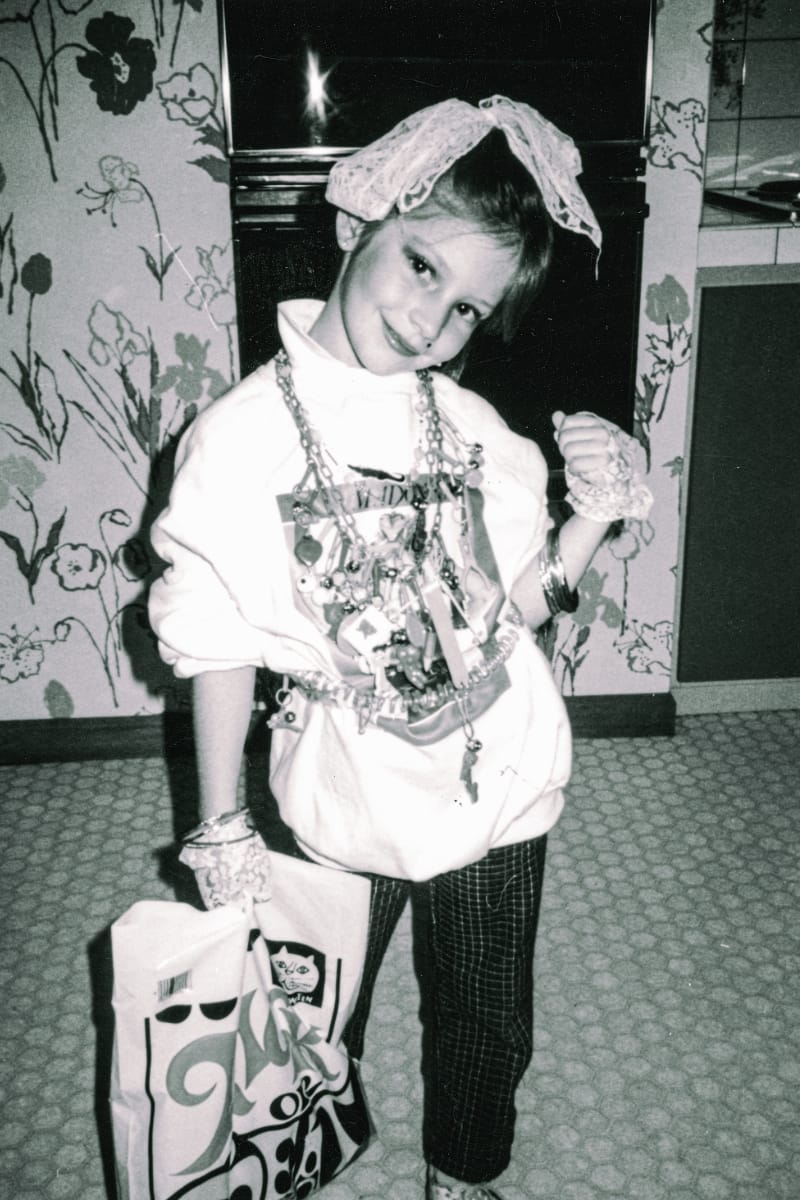
“Musical theater was my everything.” Childhood photos of the author, courtesy of Lauren Elkin.
Carolyn: You classify a lot of your chapters by intonation or timbre, and at one point you refer to yourself as a “belter.”
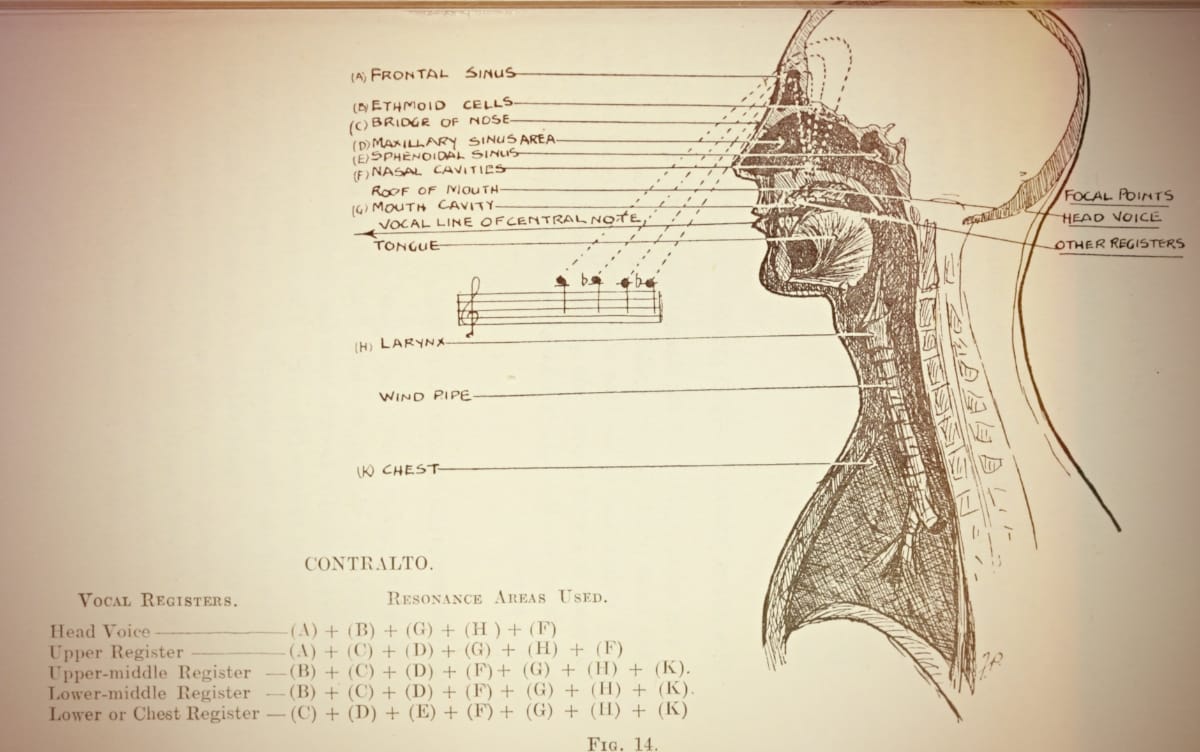
Lauren: I would think of Courtney Love as a belter. What that woman can do with her lungs is powerful. I don’t mean to speak of Courtney Love and Kathleen Hanna in the same sentence, but I’m going to. Kathleen Hanna has this amazing belt. As I write in the book, I was still listening to a lot of pop music, but I had gone down the Broadway rabbit hole of mixed voice and had a very hard time getting out of it. I think I’m maybe getting out of it now at almost 48. I figured out what to do with that middle section of my voice with the vocal break that is the title of the book. Which was to blend my chest voice with my head voice. I think Lisa Loeb does a little blending, but she has a much lighter, alternative-pop singer-sort-of approach to her vocal break.
Carolyn: Speaking of blending the head voice with the chest voice, you say that this is where our discomfort with art and fiction lives. Do you want to expand on that idea?
Lauren: Happily. I am writing this book about the place in the female voice where it transitions from chest voice to head voice, and I’m thinking a lot about breaks, passages, and craft-based techniques for managing what is excessive, what is bodily, and what is by nature difficult to tame. The book began with thinking about female voices and why they can be challenging to listen to or receive in the culture. I wanted to focus on this place in the voice as a way of thinking about the relationship between art and professionalism, or art and the technique for making art, like the passion that you have that you want to convey in your chosen discipline. Then the craft that gives it a framework or a structure or a reliable mode for conveying it.
I was thinking about this in relation to Céline Dion, who is often compared less favorably to Édith Piaf for being inauthentic and being processed. I was also thinking about Maria Callas and the increasingly creative ways music critics and journalists tried to describe the flaw in her voice, or how weird and flabby it could sound. A vocal performance is not a spontaneous eruption of feeling expressed through the voice, but something that is worked on, rehearsed, and produced. That is the fruit of choices, like artistic choices made on the part of the singer.
And so I was thinking about vocal production with regard to autobiography and the ways that women’s voices are often minimized or sidelined or made fun of because they’re seen as being too close to the body, too excessive, too diaristic, too messy, and that really underestimates the amount of work and craft and technique that goes into those choices. I was thinking about the female voice and all of the challenges of the female voice, as in some way triggering all of our discomfort with art. I include myself in this category. When something makes us feel good—like if you get the chills from listening to a Céline Dion song, without even meaning to because she did such a nice thing there—then we’re suspicious of it. Then it’s like, am I being manipulated? That’s not an honest response to art. That’s like the singer doing something to make me feel this way. When really, all of art is calculated to make you feel something.
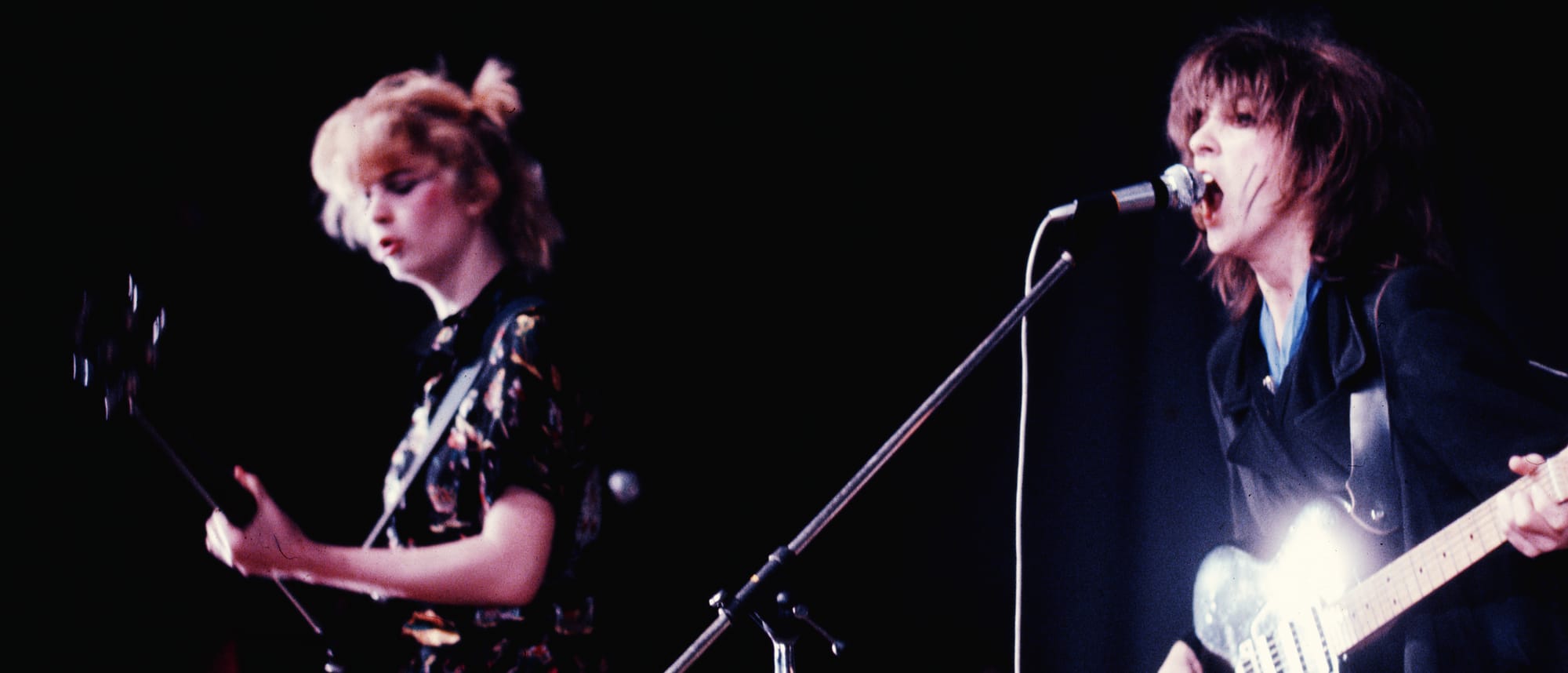
Carolyn: You write a lot about sirens and mermaids in Vocal Break. Appreciating this because I recently interviewed an artist named Jolanda Moletta, and she definitely harnesses the sea siren in her work. Something I found interesting about Jolanda is that she presented a siren as a softer fantasy figure, whereas in your book you really go into how terrifying they are. And then there’s the Ariel mermaid shirt on Kathleen Hanna, on the US edition cover of Vocal Break. I thought that was so interesting because in the Disney depiction of The Little Mermaid, she is willing to lose her voice for a man. And then here we have someone who is telling men to get to the back.
Lauren: That was such an amazing moment when I found that photograph. I was just working on mermaids. I knew I was going to have a chapter about mermaids because of this moment when I was about to do karaoke with some friends of friends in London a long time ago, and one of my friend’s friends was a singer. I’m not going to name names, but she has a career. I sang a few bars of Lana Del Rey’s “Video Games,” because that was on the radio a lot then, and I was really drunk. And she went, “Oh, you sound just like the Little Mermaid.” I was so embarrassed. It was like one of the worst moments of my life. I don’t think she meant it badly, but she’s this cool indie singer who’s doing that for a living, and I was a failed singer, and she was right.
I knew I wanted to write about mermaids and this idea of the singer who goes silent and what she does it for, what she’s willing to trade her voice away for. In The Little Mermaid, it’s a guy, and in the Hans Christian Andersen story, she wants to become human because humans have eternal souls and mer-people don’t.
I was researching one day. I knew I was also going to write about Kathleen Hanna, Bikini Kill, and Riot Grrrl. And so as I was patterning the book and trying to see where I could loop in the figure of the mermaid, I Googled “Kathleen Hanna,” “Little Mermaid,” and lo and behold, found this picture of her wearing this T-shirt. Bikini Kill were becoming extremely well known at the same time this movie came out and became a cultural force. I was very young when The Little Mermaid came out and was young enough that I would hoist myself up onto the side of a friend’s swimming pool and sing “Part of Your World” like Ariel on the rock.
I wrote chapters about Riot Grrrl for my previous nonfiction book, Art Monsters, which is about women using art to claim space for themselves and make feminist statements in the world. I was really interested in the fact that at their shows, Kathleen Hanna would say, “Men get back, girls to the front.” Make room for girls to have a very visceral physical experience of the music. I had ended up excising those chapters from Art Monsters because it felt like they didn’t fit, and I decided I was going to write a whole book around women in music, and that became this book.
Kathleen Hanna was using her voice to invite women. This is way before Me Too. She was using her voice as a singer, the leader of this band, and the founder of this movement to invite women to share their stories with each other. They didn’t have to live the way that they were living, being abused by boyfriends or family members. They had a space to talk about what had happened to them. It was a way for young women to realize it’s not okay for some guy in your high school to grab your ass. It’s not okay for young women to be pitted against one another and competing over some guy. There’s no point in being bitchy to people, or being bitchy to other girls, or competitive with other girls. It’s patriarchy and capitalism that are separating us from one another and making us compete for these finite resources, which are dumb teenage boys.
Carolyn: You mention one thing we’re all fascinated with—Elizabeth Holmes’s lower-register voice to mask among the tech bros of Silicon Valley. But what about performative women? Sometimes you classify people like Grimes as being kind of baby-voiced or almost disingenuous and physicalized. Lana Del Rey is always a puzzle because I remember when she was new, people liked to beat up on the whole vamp thing. But I’m like, why not? And I know earlier in our interview, you’re like, that’s okay. This is the instrument we bring to the table.
Lauren: Okay, we’ll talk about Elizabeth Holmes, and then we can talk about the baby voices, little girl voices. I have always been struck by how people adapt their voices to different situations with no judgment whatsoever. I know my voice is probably not the same as it was in high school. I’ve lived in all these different countries. That shapes how you sound as you move around and talk to different people. Anne Carson writes that every sound we make is a bit of autobiography, and I think that’s really true. Our voices are not unified. They’re not singular. They shapeshift. It’s impossible to even know what they are. I can’t hear what my voice sounds like because it’s mediated through all of the bones and cartilage in my face and my ears. You’re not hearing what my voice really sounds like because I’m down the line talking to you from London. I’m fascinated by the ultimate unknowability of the voice as a singer, which really tortures me.
Margaret Thatcher famously took voice lessons to lower her voice because she believed that if she sounded more like a man, she would be taken more seriously in 1970s Britain, and she is probably completely right. Elizabeth Holmes, however, took that to grotesque ends. Listening to this woman speak in her heyday as the CEO of Theranos hurts my vocal cords because it’s so clearly produced and uncomfortable for her. She’s having to do so much with her body to produce that sound—it’s like someone singing badly. I feel sympathy for this woman who feels like she cannot be herself. She can’t speak in her own voice.
Carolyn: Well, let me now shift from a lower register to breathy baby voices. Tell me about the performative aspects of being what you term a “forever baby.”
Lauren: Well, that’s exactly it. To get what you want, you have to use the voice you think will get you what you want. No shade to girls who do sexy people vocal fry or breathy singer voice—they are just trying to do what they think they need to do to be heard and not to be judged. My response to that comes from my training in theater, where I took voice lessons for singing. I had voice classes as an actor and studied with British voice teachers who’d worked at the Royal Shakespeare Company. I was assigned textbooks written by people like Cicely Berry and Kristin Linklater, which are really the Bibles of serious actors who know they have to do voice work to free up their voice to do Shakespeare on a stage and be heard in the back row. There’s a lot of breath work involved. One day, our teacher said something like, “Come on, ladies, don’t give me your breathy little girl voices.” That really stayed with me.
Around 2010, 2011, I want to say you started hearing all of these very breathy female singers. Grimes first among them. I remember my partner at the time listening to a lot of Grimes, and I was like, “Why is she whispering?” Stop using your little girl voice and sing your goddamn song. And then in time, I came to have a real appreciation for Grimes. I don’t even know what she’s doing, raising Elon Musk’s babies. Something happened to her. I don’t know what, and maybe it had something to do with her breathy voice. Maybe the breathy voice was asking us to help her in some way.
In terms of writing this book, I felt like I had to get to grips with what my bias was against these voices. That obviously came from my training as an actor, but these women are not actors. This is pop music. It’s about feelings rather than technique, but it felt like it was translating some kind of feeling in the culture that women couldn’t take up too much space; otherwise they would be judged or dismissed.
Think of Anne Hathaway in Les Misérables; the film had just come out when I was first writing about all of this. I think Manohla Dargis in The New York Times said she should have won the best Oscar for best performance by a uvula. Hathaway had this enormous voice, this enormous mouth that was swallowing up the screen as Fantine in Les Misérables. Then, in response, there was this massive Hathaway backlash. It was really hard not to see it in the context of the fact that she had made such a big noise, and been so good and so lauded, with a Golden Globe and an Oscar; the backlash was sort of inevitable. The backlash came at these awards shows when she got up on stage and used her teeny tiny baby voice and was like, “Oh my God! Thank you, guys!” She desperately undermined her own authority and begged people to like her, not to see her as a threat. In that chapter, I felt there was some kind of punishment for women who sang with all the resources of their voices in the pop culture domain.
As a result, you saw a lot of young women singing in this teeny tiny voice that got codified as “the voice.” If you were going to be an indie girl singer, you had to sing in that voice. You had to do this cursive singing thing, which I was so excited to learn the name of because for years I was like, why do they sound like someone’s grandma in New Jersey?
So it was on the basis of that that I just rejected out of hand a lot of female singers for much of the 2010s, and initially wrote off Billie Eilish. I was like, “That annoying Billie Eilish who’s always whispering.” And then I circled back in the revision after the first draft. I was like, “That’s mean.” Let’s have another listen to this Billie Eilish person because clearly she’s enormously successful. Zadie Smith called her a genius, and I take it seriously when Zadie Smith calls someone a genius.
She was 13 when “Ocean Eyes” came out. Of course, she didn’t know what to do with her voice. She was just trying to sing a song in a nice way, and then her career took off before she even knew what was happening, and she kept making the sounds people seemed to like. She’s just surviving sudden superstardom, and she’s an incredibly skilled musician with very good instincts, pitch, and flexibility. She’s clearly a solid musician.
Once she had some time to think about what she wanted to do, she started studying. Her craft opened up new capabilities. She learned to trust her voice and let it do more, and became a much more interesting singer as a result, and that overlapped with her coming of age as a woman. She went from being 13 to whatever she is now. So yeah, Billie Eilish, actually, yes, a genius. Thank you, Zadie Smith.
Check out more like this:
 Andrew Hamlin
 Carolyn Zaldivar Snow


Comments