


Best described as a Japanese Andy Warhol, Takashi Murakami is known for creating life-sized statues of anime figurines, massive paintings of religious figures, album covers, or animated music videos for Billie Eilish. However, he's only made one feature-length film, the 2013 Japanese live-action film Jellyfish Eyes. When the film debuted, several viewers and critics were either confused by it, despised it, or both. Later, the Criterion Collection gave Murakami's film a physical release, and many fans dubbed it one of the worst in the entire collection. Still, Jellyfish Eyes endures as an example for artists to take chances and step outside their comfort zone.
Although Murakami made paintings and statues, he always dreamt of branching out and trying new mediums, especially film. In early 2011, the late Yoshihiro Nishimura, a low-budget horror director—best known for splattery gore films that critique Japanese culture, such as Tokyo Gore Police—approached Murakami. Nishimura heard Murakami was interested in creating a feature-length film and wanted to work with him. Though Murakami didn't have a top-of-mind idea then, this would soon change when he heard explosions near his studio a few months later.
These sounds came from the Fukushima power plant disaster, where an earthquake and tsunami caused electric grid failure and damaged the plant's backup energy sources. Regarded as the worst disaster since Chornobyl by the United Nations Scientific Committee on the Effects of Atomic Radiation, it showcased the Japanese government's failure to communicate. Bureaucrats gave both evacuation and shelter-in-place orders, often ignoring nuclear expert advice. Some local governments even learned about the evacuation solely through the media. Due to these miscommunications, some municipalities issued evacuations independently, which created further issues when residents traveled to areas that were soon deemed unsafe. About 20 percent of residents nearest to the disaster had to evacuate more than six times.
Here, Murakami experienced—for the second time in his life—his government's weakness. A postwar child born in 1962, Murakami grew up after the country's devastation from WWII. While Japan tried to rebuild itself from the ashes of sanctions and American censorship, the country had to determine its identity after an embarrassing defeat on the global stage. As expected of any such trauma, Japan's citizens often worked through these issues in their art.
As a child, Murakami found solace in the TV show Ultraman, a series he cites today as the most formative in the development of his art, as he says in an interview on Criterion's release of the film. Created by the special effects director and co-creator of the Godzilla series, Eiji Tsuburaya, the show starred a team of scientists fighting off aliens and other kaiju (Japanese monsters like Godzilla). Ultraman's monsters often portrayed Japanese society's ills, and heroes who fought them often symbolized how the culture combated them. Featuring a mashup of cultures that took from America's The Twilight Zone, the British show Thunderbirds, and, of course, other Japanese media such as Godzilla, it would later inspire a movement spearheaded by Murakami when he viewed it through Japan's unique art form of anime.

In his 2001 manifesto "A Theory of Super Flat Japanese Art"—his title separates the term into two words, though the movement later settled on one—Murakami argues that Yoshinori Kanada, a Japanese animator who worked with Hayao Miyazaki and was influential to modern-day anime, continued the traditions of the more eccentric artists of the Japanese Edo period (1615–1868). Murakami writes that "low wages and inferior conditions of employment led to a shortage in workers" and that "insufficient budgets and limited time made it difficult to bring a work together seamlessly."
These limitations would attract a group of zealous fans, known as otaku. A Japanese subculture often used to describe a specific consumerist group of people that consume and purchase "nerd culture" products, it was not seen as a positive term to be called, especially in the '80s and '90s.
Akio Nakamori coined the term and the associated negative imagery in his essay "A Study of Otaku," which appeared in the June 1983 Manga Burikko, an erotic manga magazine. Writing in a diminutive tone about otaku, he pens, in Kaichiro Morikawa and Dennis Washburn's translation, "You've seen this type in almost every class in your school. You remember . . . they're the ones who are hopeless at sports, who stay locked up in the classroom during breaks, fidgeting in the shadows, utterly absorbed in a game of shogi . . . Always sitting off in a corner of the class, virtually invisible with a gloomy expression, without a single friend."
Despite the Japanese not appreciating these aspects in their populace, this subculture grew. Murakami explains that, despite the culture's attempts to focus on historical Japanese art post-WWII, Western art was idealized as other art prices rose in the "bubble economy" of the 1980s. Murakami writes in his manifesto about how the Western world looks for "eroticism and nonsense . . . in the realm of art [that] have always been a part of Japanese subculture and manga; perhaps excessively so." In addition to music and "celebrity art (art whose subject matter is celebrity)," these art forms have been, according to Murakami, the "most recent product of a business that has been exploiting the genre confusion created by the explosive proliferation of media."
Thus, like many other creators of his youth who tried to merge Western motifs with Japanese imagery, Murakami attempts in "Superflat" art to merge his vision of high art (traditional Japanese aspects) with low art (anime, manga, Western TV and media) to make sense of a more realistic—and thus more confusing—modern world. Jellyfish Eyes serves as both a culmination and shift in Murakami's work. By grounding the film in an imagined near-future, post-Fukushima world, the director integrates the zeitgeist's pop culture to help children work through the tragedy, just like Ultraman did for him when he was young.
Yet instead of using touchstones like Ultraman, Murakami would use cultural media that children of the time of the Fukushima disaster would have been more familiar with, such as Pokémon or Digimon. In his debut feature, he wanted to help children who must navigate a weak, ineffectual government after a shameful national tragedy, not too dissimilar to one from his own past.
Like the other series Jellyfish Eyes takes from, the film's child characters battle each other with creatures called F.R.I.E.N.D.S. Akin to Digimon's Digivice, these creatures are summoned by cellular devices that look like phones. Unlike these children's TV shows, however, F.R.I.E.N.D.S. are somewhat creepy-looking and feel out of place, as computer-animated beings seemingly placed into the children's environment. Though Murakami wished to animate the film, he soon learned how expensive a feature-length animated film would be, so Nishimura showed him how he could merge live action with cheaper computer-animated creatures.
Unlike their animated counterparts on children's TV, F.R.I.E.N.D.S. aren't always seen as 'good' in the film either. Instead, they are part of the secret organization Cloak Four's nefarious plot to remake the world. Through hard-to-process methods, these creatures suck negative energy out of children to create a world-ending creature. Often vague, confusing, and weak, Jellyfish Eyes's plot points are the main issue critics and audiences had with the film. For these reasons, they miss that the story's overly complex complications were purposeful choices by Murakami.
Throughout, Murakami wanted viewers to experience the film from a child's perspective, as they attempt to navigate the horrifying and unnavigable, as all the Japanese did during Fukushima. Due to these intentions, Jellyfish Eyes becomes intensely personal both to Murakami as a person and his Japanese upbringing, which are easily ignorable or missed if unfamiliar with the artist's work or Japanese media.
When it comes to personal connections, Murakami has based several of the F.R.I.E.N.D.S. on his own previous artwork. For example, Miss Ko², an anime-inspired woman who was a statue Murakami first sold in 2003, appears in the film. Here, an orphan loner named Koh has her as a F.R.I.E.N.D. Due to Koh's strength in hacking, he transforms his F.R.I.E.N.D. into a young anime woman who is also surprisingly more powerful than most other creatures in the world.
Though Koh isn't the main character, he feels like a surrogate for Murakami. He's young and seemingly helpless, but when pushed, Koh becomes one of the most confident battlers, almost scoffing when others decide to challenge him with their F.R.I.E.N.D.S. Thinking of himself like a god—as an artist like Murakami might envision themselves in a universe they created—Koh makes quick work of challengers, before all citizens in the film focus on a greater threat, a world-ending creature that the Cloak Four summons.
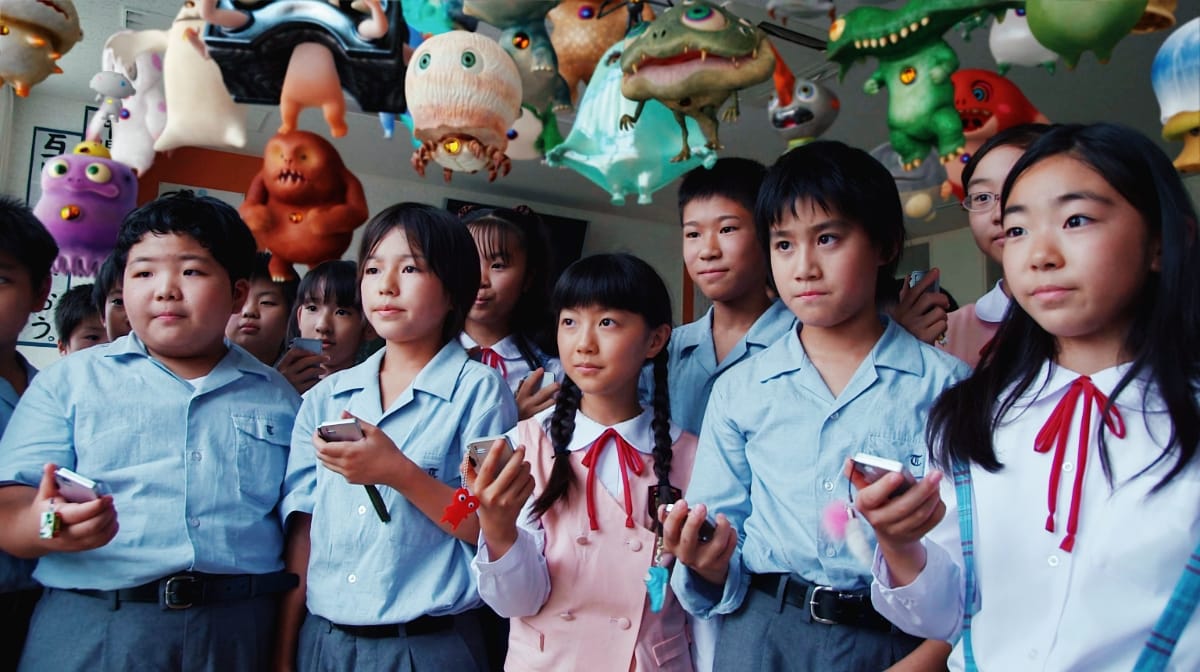
Then, there's a hyper-specific current of Japanese media references throughout the film, which further obfuscate it. Locations such as a classroom or a shrine, though seemingly exotic to foreign viewers, are stereotypical choices in anime. Murakami says he wanted most of these scenes to take place in these environments to soothe viewers. He believed children would connect more easily with touchstones like this, and perhaps even more so if they were older. He also hoped that this "Japanese-ness" would attract foreign audiences who appreciated this setting in his other artistic work.
Still, over-the-top scenes, ridiculously scripted dialogue, and low-budget affectations linger over the entire production. Easily observable as bad filmmaking, they are also anime conventions used to create the "Superflat" blending of art forms (high—film, low—anime, children's TV) and, additionally, a blending of fiction and reality.
However, while it may have the charm of low-budget filmmaking, Jellyfish Eyes's production was also rushed to completion. The reason Murakami was even able to create it in the first place is that several artists were out of work right after Fukushima occurred. Nishimura, who originally approached Murakami a few months prior, did so again after Fukushima for this exact reason, telling him to capitalize on the timing.
The crew didn't have much time to prepare, though. First, they had issues coming up with an idea. Then they had scheduling conflicts with child actors (the main stars of Jellyfish Eyes). Then, the production team had only a few months to write the script before children were out of school for summer break, and they were further limited by the need to complete production before the children went back to school.
These production issues are shown at length in Jellyfish Eyes's Criterion Collection release. Often, Murakami has his face in his hands, trying to figure out how to make things work. It's especially difficult for him, given that the director had no prior experience and was trying to do something massively ambitious. He also seems unable to take charge and is often asking others what he should do. Though he had Nishimura, Murakami often fought with the horror director over certain aspects, such as when Nishimura wished to add satirical or stronger horror elements to the film. Another common debate was over the title Jellyfish Eyes and how there was no specific character named "Jellyfish Eyes" in the film, something that Nishimura thought would be confusing to children who watched.
Despite Murakami's noble urges, hopes, and hard efforts, Jellyfish Eyes flopped in his home country, pressuring him to pursue an international release. But if this was such a specific cultural event, why did he think that those from other countries would connect? Clearly, if you look at film reviews, the New York Times's Roberta Smith describes the film as "very bad," calling it "thrown together . . . poorly shot and afflicted by tedious sound (lots of screaming and saccharine music) and inept special effects." Others expressed similar sentiments, as Jellyfish Eyes holds a 29 percent approval rating on Rotten Tomatoes. Despite a positive review from Slant's Chuck Bowen, the film would flop overseas as much as in Japan.
But maybe this is the wrong selection of people to ask. Several express on Reddit that their children appreciated it, the exact demographic that Murakami was trying to target. Then, there are some others—those who say they were into Pokémon or "offbeat Japanese cinema"—who feel like it "scratches an itch." Intentionally or not, these viewers are a similar demographic to the otaku, as they find Murakami's unconventional and somewhat off-putting creation uniquely charming. This experience of discovery isn't unlike the Japanese subculture that originally enjoyed Kanada's anime for its unconventional practices created under severe time constraints.

There's also something even more worthy of note: another project Murakami worked on around the same time Jellyfish Eyes was created. Murakami started painting Arhats—enlightened Buddhists who free themselves from the cycle of rebirth and achieve Nirvana—to heal. He kept making larger versions until he released his massive painting, The 500 Arhats, which is 3 meters tall and 100 meters wide. The work merges traditional, religious values with bright, garish colors and repetition, not unlike the pop art traditions of Andy Warhol.
Murakami did not create this jaw-dropping piece by himself. As a film production would, he employed over 100 people to create this work. Though some critics argued that this community-driven artwork ruins the religious aspects and reasoning behind the work, Murakami likely wished for viewers (and even the artists he employed) to work through the devastating emotions they felt after the Fukushima disaster, as with Jellyfish Eyes. Despite not being able to reach as many with his film, these same sentiments came through more strongly with The 500 Arhats.
Though Murakami has never put out another feature-length film (an unfinished sequel to Jellyfish Eyes lies somewhere, discontinued after his company faced bankruptcy during the pandemic), he has continued to expand into places outside his honed craft in the high art world by creating music videos with Billie Eilish, working with fashion companies to create baseball uniforms for the LA Dodgers and designing helmets for the Formula One Japanese Grand Prix, a short (though unfinished) anime series, and various album covers.
There are three lessons one can take from Jellyfish Eyes. One: as Jellyfish Eyes gave Murakami the confidence to continue trying new things, even when some didn't work out, the film shows that ideas like this can be worth capitalizing on anyway. Two: as Murakami was completely out of his depth in filmmaking, he enlisted Nishimura's expertise. Lastly, Murakami used similar themes in The 500 Arhats and Jellyfish Eyes, but separate demographics resonated with the work he created, meaning each project will connect with different people. So, if one tries out a project and it fails, but the idea still feels good? Well, maybe it's worth expressing oneself in another medium.
Check out more like this:
 Bill Cooper
 Bill Cooper


Comments