


Jeff Lieberman's Remote Control (1988) and Michael Haneke's Funny Games (1997) illustrate how our preferences and choices influence our entertainment. On the one hand, there's Remote Control, a film that presents itself as schlocky, campy B-sci-fi but is actually a subtle satire critiquing viewers' taste for trashy movies. On the other hand, there's Funny Games (1997), a film designed to make viewers question why they watch movies filmed with horrific violence and drama, while torturing them in the process. Together, they represent how entertainment can shape what we think. When we view these films through a modern-day lens, they become another way to illustrate the extent to which various media and app algorithms influence or control us.
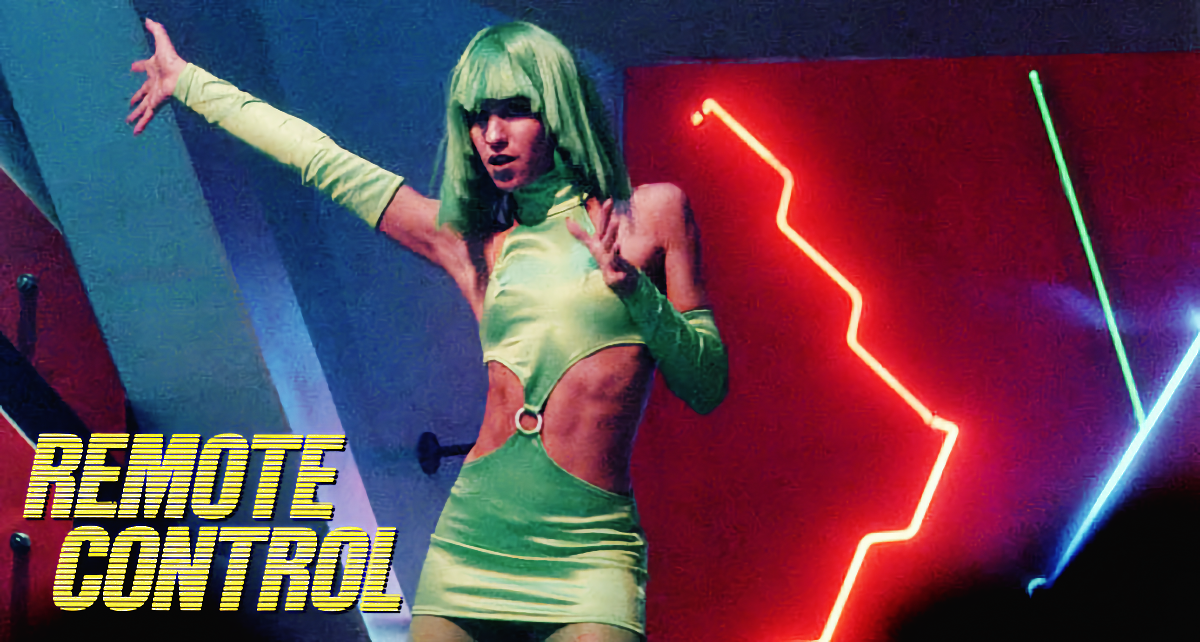
But first, let's begin with Jeff Lieberman's Remote Control. The plot begins simply enough, with a couple renting a tape, uncannily also titled Remote Control, from their local video store to watch. The tape seems like typical B sci-fi fare, and quickly, both are engrossed in the film rather than the kinky sex act they had planned. Yet, at a certain point, the film switches from the plot to a reflective screen, showing the two of them staring back at it. When it does, the tape becomes sentient, reaching out by repeatedly calling each of their names. After a few moments, the woman whips the man to death in cold blood.
From here, we shift perspectives to Cosmo (Kevin Dillon), who works at a local video store. The tape is part of a recent promotion where stores can get some sample tapes for free if they set up a display. When Cosmo and his boss Georgie (Christopher Wynne) turn on the large sci-fi tinfoil contraption display, it emits beeping noises, somewhat reminiscent of modern-day phone notification sounds. The tones draw in several video store patrons, including one named Patricia (Kaaren Lee), like moths to a flame. First, they look at the strange opaque mirror that is part of the display before picking up the tape and renting it out. As if to confirm the patrons' helplessness, signs that read "You Can't Control Yourself" are proudly displayed nearby, almost as a warning for anyone who looks in the display's general direction. These words become more literal than expected, revealed in a following scene.
Georgie and Cosmo use the rental store software to find Patricia's address, because Georgie wants to ask her out. However, they find another patron already visiting her when they arrive, who is also driven by the desire to watch the tape. Cosmo and Georgie watch what they think is the beginning of sexual relations, but are scared off by a neighbor. Instead, though, this man, Victor (Frank Beddor), strangles Patricia before later murdering her parents. Over time, the two, along with Cosmo's crush, Belinda (Deborah Goodrich), realize that the entire Remote Control video release is a nefarious plot concocted by aliens to control the world.
From here, things devolve into pure "trash" sci-fi, with Cosmo, Belinda, and Georgie traveling around to various video stores to destroy all the tapes. As the story progresses, Remote Control uncovers its theming like a Matryoshka doll, with each layer revealing another level of meta-narrative commentary about entertainment. On the surface, it seems like a typical B-sci-fi horror, like the videotape itself. However, there is more to the eye here, often displayed in subtle ways. Take Cosmo and Belinda's outfits, which increasingly resemble those of the characters on the sinister videotape. By the end, Cosmo's attire has transformed from tank tops to a suit of reflective tinfoil, and Belinda's attire follows a similar transformation. Action, violence, sexual situations, and explosions are frequent throughout. Later, moments like this become bombastic when the three try to escape from the alien company headquarters that made the tape, as Georgie is murdered and an over-the-top explosion occurs when the other two barely make it out alive. Still, it's possible to miss these aspects if completely focused on the plot.
The film does all this purposefully to comment on your taste, and these motives are best explored in its final scenes. First, we see Cosmo and Belinda burn all the videotapes in a large bonfire, exchanging a few words about how the videotape must have ended, with Cosmo supposing that it was "just like this" with them winning. However, the following scene features one of the aliens pulling a lone Remote Control videotape from a car, then holding it up to the camera and exclaiming that they are the ones who have won. Though the alien seems to be addressing Cosmo—who strangely enough isn't anywhere nearby—he looks right at the camera, breaking the fourth wall.
This last aspect may seem like a typical sci-fi horror trope with an ambiguous ending, conveying the threat of evil long after the film finishes. But if you look deeper, you may find that the film is commenting on entertainment itself. This is because, like the viewers of the Remote Control videotape in the film, you can't help yourself and lose control, lost in the film's silly storyline, no different from a perfectly crafted Netflix show or YouTube video catered to your specific taste. You end up doing the film's bidding—in this case, watching the film (or in today's common parlance, "consuming the content"). Though this is relatively minor when compared to some of the acts characters portray on screen, it still says something deeper about the people who watch it.
This is not the first film to have critiqued similar themes in the late '80s. There was a fear of these entertainment types and how they could affect communities, that they would brainwash people into more violence. For example, David Cronenberg's Videodrome utilized body horror to convey fears of home entertainment and the issues it presented for consumers. Because media was becoming easier to rent and consume (and "trashier" stuff to boot), many were worried about what the future of availability and choice would do to viewers' brains, especially children. Fears are now even more rampant in today's omnipresence of algorithmically driven media.
But before delving into modern-day connections to Remote Control, we first need to explore how, only nine years later, we'd see this film's ideas expanded upon in Haneke's Funny Games. The 1997 Austrian film (later remade in 2007 by Haneke in an American version) features the Schobers, a bourgeois family, including wife Anna (Susanne Lothar), husband George Schober (Ulrich Mühe), and son Georg "Georgie" Schober Jr. (Stefan Clapczynski). They arrive at their holiday home on the lake and see two men they don't recognize. George meets one of them, Paul (Arno Frisch), a few minutes later, introduced by the next-door neighbor, Fred (Christoph Bantzer).
Meanwhile, Anna is in the kitchen cooking. In the middle of her doing so, she's interrupted by the other young man, Peter (Frank Giering), who asks for some eggs. On his way out, Peter drops them and asks for more. This perceived clumsiness continues, with Peter knocking the phone into the sink and later breaking more batches of eggs on the ground.
Things begin to build when Paul arrives and asks to borrow one of George's golf clubs. After he leaves, the Schobers' dog abruptly stops barking when he is outside. It soon becomes clear that Peter and Paul are intentionally playing games with the family, though it's unclear for what reasons or to what ends. From here, the film shifts toward increasingly violent scenes.
Though the film presents itself as a simple home-invasion horror thriller, Haneke's film regularly breaks the fourth wall, building upon Remote Control's more ambiguous use of the technique. The inclusions begin rather subtly, in a hide-and-seek game scene when Anna looks for the dog. Paul—the only one who breaks the fourth wall—winks at the camera (or maybe someone behind him, it's unclear) after Anna opens the family car and the dog slumps out, dead.
As the "funny games" heat up, Paul and Peter ask the family to take bets as to whether they will survive the night. Here, this meta-aspect becomes abundantly clear when he turns to the audience and asks whose side you, the viewer, are on and whether you think the family will make it. By calling you out for being engrossed in the narrative, which regularly shows dark, violent, and often horrifying acts against the family, you feel as if you are somehow colluding with him by continuing to watch. Then later, you are left to question why these types of films are enjoyable and why such narratives grip people. The feeling may be reminiscent of wondering why "the algorithm" recommended a certain video on social media.
But in a deeper sense, it's also interesting when the film becomes less engaging, likely to confront the viewer. This shift occurs after "Georgie" is shot in the head. The two men decide to leave, explaining that they won't get anything from the other two. Beginning with an extremely elongated fixed-camera shot of Anna trying to untie herself next to the bloody corpse of her son, what follows is a slow, drawn-out several minutes where both the husband and wife try to make sense of the wreckage.
These drawn-out scenes seem almost out of place in the general structure of a thriller film. They become slice-of-life and hyper-realistic, as little is cut and we see just simple tasks of getting out of the bindings and Anna cleaning up her husband, while they discuss next steps. Here, it feels as if Haneke is trying to express how your lack of engagement with the film says something about you, and in a greater sense, humanity. Essentially, if you're the one bored with these two trying to figure out their lives and wish that the two men would come back, you're as bad as these assailants are.
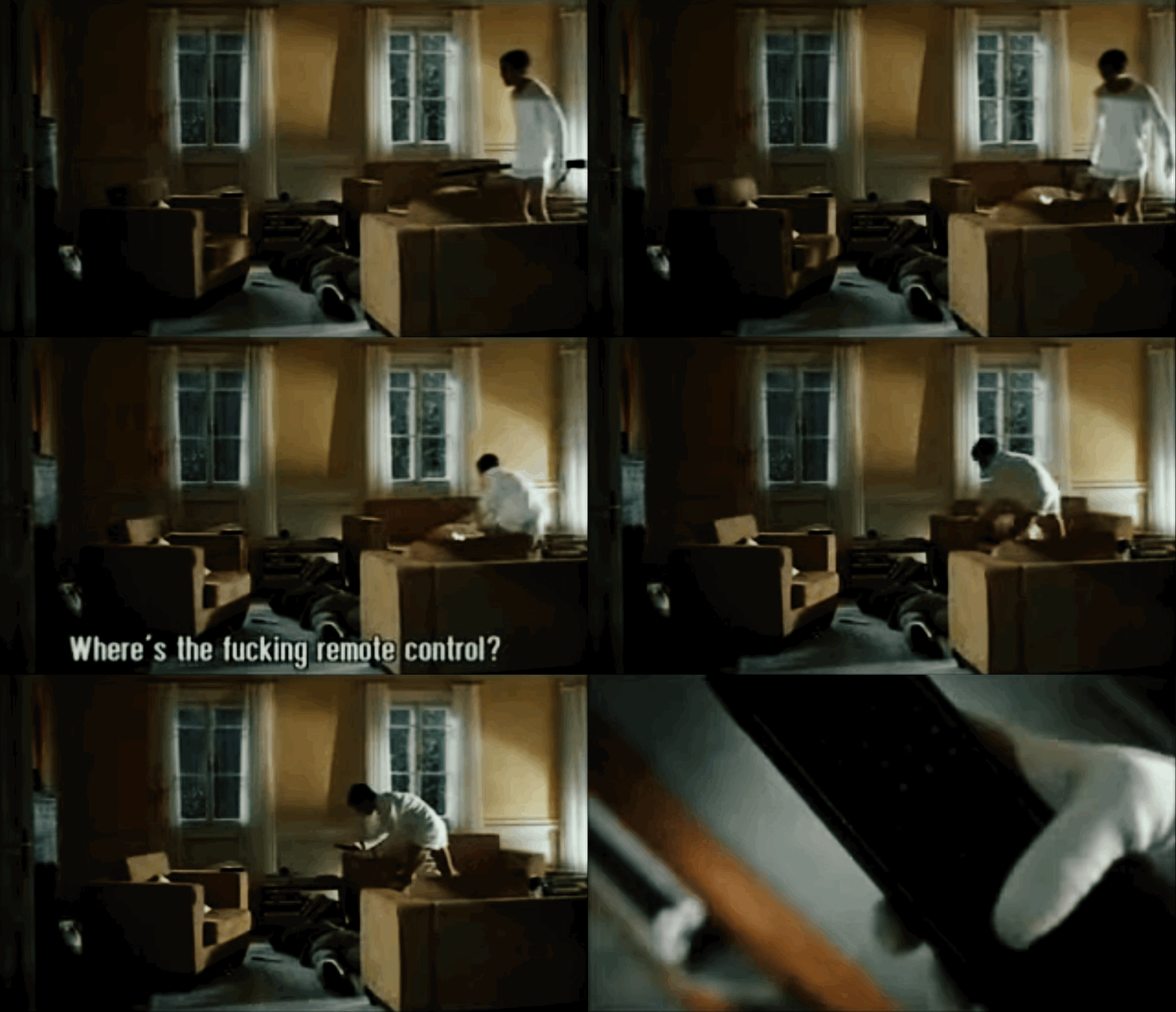
To our horror—or possibly our sickly delight—though, the two men do return. Here, in another strange break-the-fourth-wall scene, Haneke does something even more unexpected. In the middle of another game, Anna reaches for a shotgun and shoots Peter. In response, Paul grabs a nearby remote control and rewinds Funny Games (yes, the film itself) to reverse the events to correct what just occurred. Haneke explains during an interview on The Criterion Channel that this was to give the audience a bit of hope before he took it away.
All of this can be quite provocative, which is probably why Haneke had such strong reactions during his showings of the film. He further said that this film "is for those who deserve it," meaning that if you specifically sought it out and felt bad afterward, that's on you, not on him. However, what he or Lieberman may not have realized is that Funny Games and Remote Control are proto-examples of modern-day arguments about whether algorithm-driven entertainment controls us.
Platforms like YouTube or Netflix are no different from Remote Control (and to a degree, Funny Games) in how they lure viewers into their control by showing what they enjoy. Though these mechanisms of the machine may seem innocent, only there to help you find the content you want to enjoy, there is a price beyond what you'd think. Some of these are relatively tame, such as advertisers sponsoring specific shows or retention rates being analyzed to try to offer you the right video or show to keep you on the service longer, to your own detriment. But when looked at more deeply, these can become just as sinister. Sure, these companies aren't making you commit horrifying crimes, but they can influence the way you think, even if you don't realize it.
Netflix, for example, could push its top 10 to coerce you toward specific titles, or surface a similar one when it doesn't have what you searched for. This may seem innocuous, but the streaming giant also has "Netflix Originals" that it benefits from promoting, and a financial incentive to reduce its content library. If they're already trying to "retain" you, why wouldn't it make sense to "retrain" you as well?
YouTube operates by utilizing similar retention methods, but one of its worst aspects involves its studied "alt-right pipeline," where various conspiracy videos that users could watch out of fascination can slowly have them travel down a path of radicalization. A simple video essay on alien landings could lead to anti-feminism, opposition to immigration, or Islamophobia. While both a 2022 City University of New York study and a 2021 Proceedings of the National Academy of Sciences found "no evidence that engagement with far-right content is caused by YouTube recommendations systematically," the 2018 Data & Society Research Institute and an extensive study over 11 years presented in 2020 both provided evidence for a "radicalization pipeline."
It's possible that the algorithm was eventually retooled, giving way to less favorable data for this argument over the years. Regardless of whether this was a system quirk or a tool exploited by those in the know, the result isn't good. Having recommendations that lead users down a specific set of choices in the guise of entertainment and retention, but actually could lead them toward hate-filled beliefs—even if accidental—isn't a good modus operandi. Here, Remote Control's theming would argue that you can't help yourself, and are likely to submit completely to any algorithm-controlled media. There is another argument, though, that you deserve to go down this pathway if you subject yourself to it, because to a degree, you sought it out in the first place.
This argument—more in line with Funny Games—expresses that what you're being suggested is somehow representative of what you like. For example, what does it say about you—or to a greater degree humanity—that hatred spreads like wildfire on YouTube? Is it the company's fault if the user seeks out this content, or does it rely on the user? Remote Control would argue that the user can't help themselves, but Funny Games would argue that the viewer has a choice.
However, Haneke's perspective may be harder to stomach when seeing evidence relaying how the algorithm has blatantly retooled to the company owner's advantage. Take, for example, Elon Musk's X, which expressly highlights the billionaire's tweets over others on the platform, as evidenced by data given in Chris Hayes's The Siren's Call. Though Hayes argues this is partially just a fix because Musk desperately wants to be popular and liked, it's worth noting that allowing a site to do this and then run it under the guise of curation for the user's own benefit could be seen as nefarious.
A company that's more focused on algorithms for profit is the music streaming service Spotify. Reported in Liz Pelly's Mood Machine, the company has slipped tracks of low-cost stock music into created playlists, so they don't have to pay royalties. Now, with AI making this process easier, the company is likely integrating AI tracks as well. Beyond these profit goals, there's also an enormous amount of power the streaming service has, given that its algorithms allow it to highlight whoever it wishes.
A stronger example of a more sinister and detrimental algorithm can be found in sports gambling apps. Though The Daily Cardinal explains that these algorithms (influenced by AI) "are able to quickly gather specific player stats and historical data to accurately predict money lines, benefiting both sportsbooks and bettors in providing an analytical look at sports," they are also "optimized for profit." This means the algorithm is "designed with the capability to identify bettors susceptible to a gambling addiction and further push them into self-depleting behaviors." Unlike at a casino, where players must visit to gamble, users of these apps can do so from the comfort of their own homes. After the algorithm learns your behavior and when you're most susceptible, it can do the most damage, much like how Remote Control's videotape waits until you're looking for a fun escape to do its lasting damage. Then again, Funny Games' theming would argue that if you chose to download the app in the first place, you have opened yourself up to "deserve" this possible exploitation.
Stay on top of The Tonearm.
Subscribe for exclusive interviews, cultural tip-offs, and community fun.
And your support keeps our site free of advertising and paywalls.
Lastly, of course, there are AI chatbots, like ChatGPT. They're helpful to some, yet the controversial software has lately been in the news for its "AI psychosis" side effects. In "The Emerging Problem of AI Psychosis" in Psychology Today, Marlynn Wei explains how chatbots mimic user interactions until the service is seen as more human. Over time, if "delusional themes" (such as the "grandiose," "referential," "persecutory," or "romantic") are displayed, the chatbot will amplify these themes and fail to question them, thus entrenching the user into intensely delusional thinking. One can again argue that these ideas come about in a Funny Games way, that they are essentially within the user, and the AI is just making them stronger. However, when you consider that this may be a by-product of an algorithm designed to increase retention, it does make you wonder whether Remote Control's argument is stronger. The Guardian tells a recent story about Dennis Biesma, who "within months of downloading ChatGPT," "had sunk 100,000 dollars into a business startup based on delusion, been hospitalized three times and tried to kill himself." This story is not unique. A recent New York Times article reported on several people who thought ChatGPT had channeled spirits or become sentient, and other articles on Futurism make similar claims.
Both Remote Control and Funny Games offer critical commentary on what we enjoy in our entertainment and why—and the algorithms aren't far behind. As a society, we seem to want to be catered to, fed "exactly" what we want in a "frictionless" experience. But what's the cost of buying in? Beyond your data and money, there may be a more sinister answer: your own control. Lieberman would say you can't help yourself; Haneke would say you deserve it. Either way, what those who've signed up for these services may not have considered is whether any of it actually benefits them in the long run.
Check out more like this:
 Lawrence Peryer
 Bill Cooper


Comments