


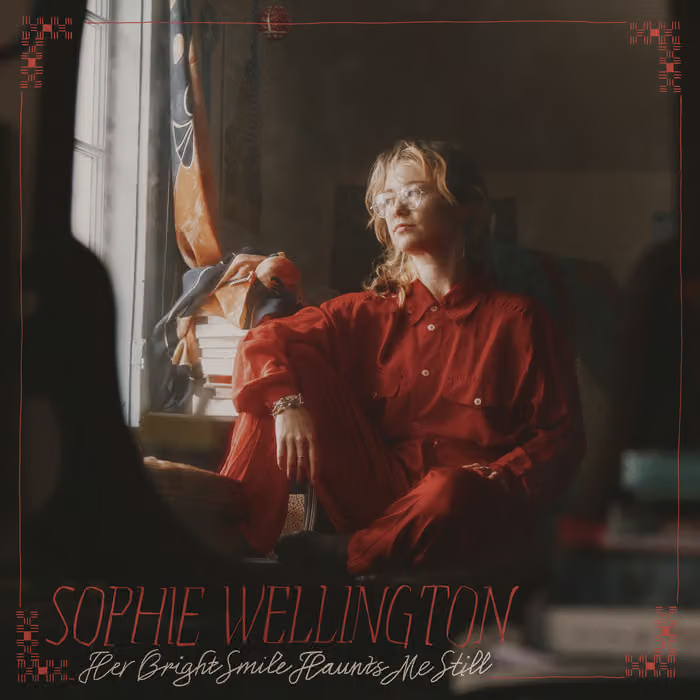
Sophie Wellington grounds themselves in their Appalachian roots on their focused and virtuosic second release, Her Bright Smile Haunts Me Still. The record creates a warm atmosphere full of Wellington's traditional folk sensibilities, "and pairs it with their stunning virtuosity as a percussive dancer to create a one-person band in a category all to themselves," per a presser.
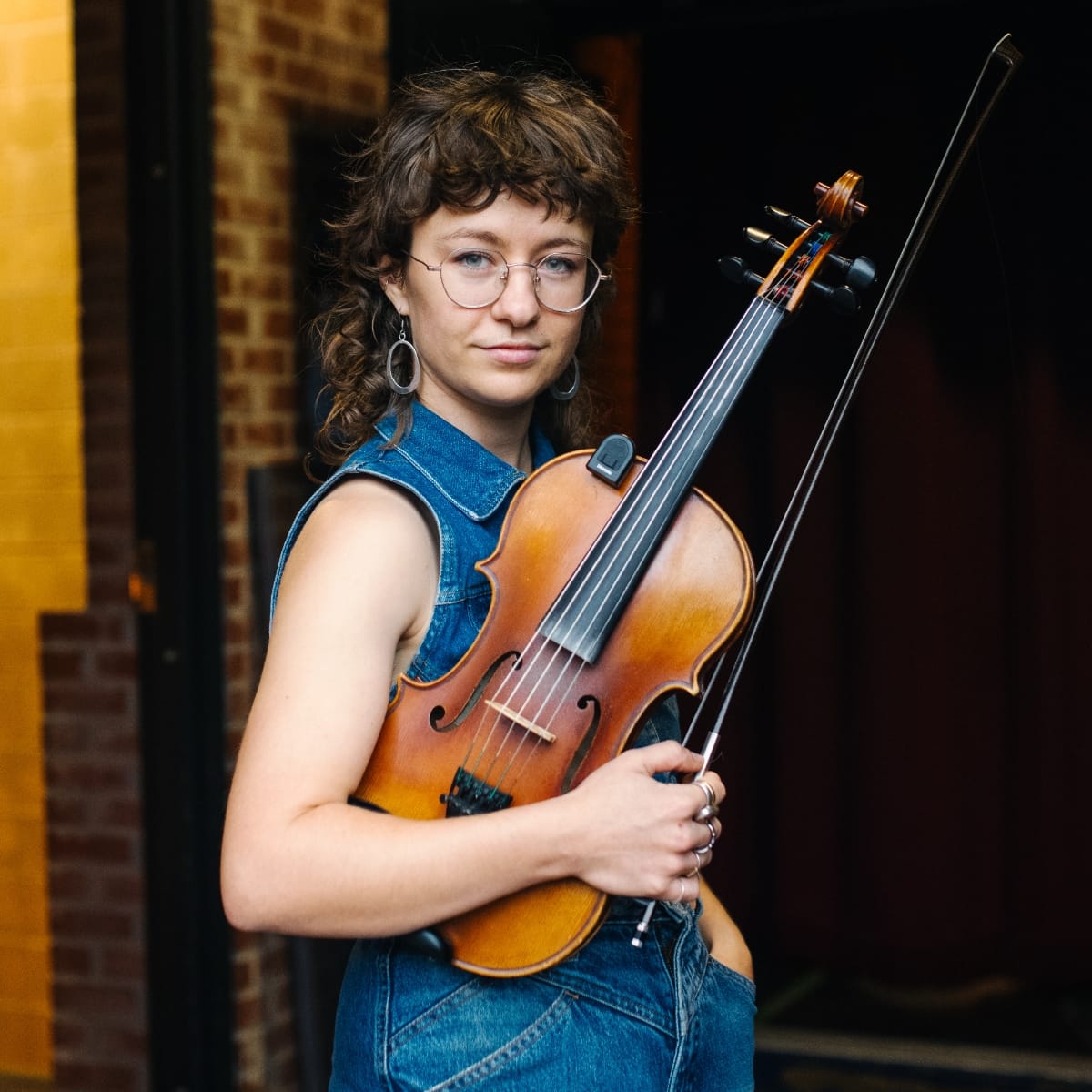
Wellington was raised in Staunton, Virginia, by concert pianist Lynne Mackey and old-time musician and dance caller Bill Wellington. They earned a degree from Berklee College of Music in 2021, studying vocal jazz alongside the school's American Roots Music Program, where their teachers included Bruce Molsky and Darol Anger. A debut solo record, Roving Jewel, followed, moving across old-time fiddle tunes, percussive dance duets, and vocal jazz standards. Her Bright Smile Haunts Me Still narrows that eclecticism to a single player and a guitar.
Tunes such as the opener, "Scolding Wife," pair the Boston-based musician's melodic, harmonic-forward guitar style with the rhythmic backdrop of dance that falls and slides like hard rain on a windowsill. Many of the record's instrumentals, such as this, are followed by a hauntingly potent vocal folk-americana tune like "Shacks and Chalets." The pairing of "Jack of Diamonds" with "Shirt of Lace" was a particular highlight. Wellington's emotive lyricism and at times whispery vocal delivery bring the day around you to a halt. Tonally, the guitar sounds on Her Bright Smile Haunts Me Still are incredible, impressively raw, and a true master class in acoustic music. "In Seaport Town" is another favorite.
I spoke with Sophie about their upbringing in the musically rich hills of western Virginia, the communal nature of social dance, and learning not to get in the way of the path that life has carved for them. This conversation has been edited for clarity and length.
Sam Bradley: Are there any particular musical a-ha moments you recall that flipped your switch in the early days?
Sophie Wellington: My parents are both professional musicians, so I grew up in a household surrounded by music, and not only playing old-time banjo and fiddle music. When my mom was pregnant with me, she was doing all of this John Cage prepared piano and chord clusters, contemporary weird stuff. It has been inspiring to watch my parents want to do it so badly that they made it work, learning music from and through their community.
I had a natural desire to play and sing from when I was really little. I credit that to being given opportunities to see it as a worthy and engaging pastime. I was also part of a vibrant dance community, so I grew up doing lots of partner dancing, social dancing, and Irish step dancing. So music and dance—it's almost like I'm having an a-ha moment now of how much that was integrated into me from a young age. Now I'm seeing the merits of knowing how to use weight change, gravity and momentum, and timing when it comes to movement, how that all translates from a corporal gestural place into hearing and making music that kind of comes together with that.
My path wasn't very linear. I had to pick a band instrument, so I picked saxophone, and I really took to it, and I played that for 10 years before I even picked up the fiddle. That's what made me want to be a jazz singer, and then I went to Berklee and got my degree in jazz singing and theory. Those things informed my musical written comprehension, kind of an understood language, which means I felt much more comfortable communicating the intricacies that exist in folk music and traditional music that kind of transcend what you would expect to happen. Having the language in my body and also in my training to create with that medium, those things are starting to come to light to me. I'm just trying not to get in the way of the path that I'm on now so that in the future, I can keep having a-ha moments, you know?
Sam: I can imagine having all of those different influences and experiences can blossom and show up in unexpected places.
Sophie: Yeah, because that's also happening outside of me. I'm in community with other people, and I want to remain open-minded to what's coming my way. I didn't think I was going to make a guitar album. I kind of was like, "I'm going to be a jazz singer forever," and then that changed (laughter).
Sam: I wanted to ask you a little bit more about that idea of community, specifically coming up in Staunton, and how it shapes this record. Do you see any world where you would have the same output had you been in a different community, or just geographically in a different place?
Sophie: Probably not. Staunton is special. It has a rich musical community now, and it had one when I was there as a child. My mom was involved in more of the academic world. She was teaching at different colleges in and around that area, so she was in contact with some choirs, specifically the Shenandoah Valley Children's Choir, which still exists today. I was in it from about second grade through 12th grade. The reason why I'm bringing it up is that I do think that choir was very important in developing my ear and ability to speak this language of music.
They have a rigorous theory program that they start you in really early, but it's all applied, so you're never really seeing it as a classroom activity. All of it is integrated. I learned a lot of solfeggio for example, which is an applicable, communicable way to speak the language of music. So now, if you give me a fiddle tune, I can sing the entire thing in solfège before I know what the note names are. I would credit a lot of my trust in my own ear and a curiosity and ability to manage multiple things at a time, understanding of practice, understanding of listening and blending with other people; I would credit a lot of that to this choir and how they built it up.
My parents aren't from Staunton; my mom is from Michigan, and my dad is from Massachusetts, actually near where I live now. I grew up in a place where I made friends and understood some of the culture, but I was also in a home with people who had lived in various different places and brought to our family a piece of where they were coming from. Old-time music is rich in that area. It's a deep tradition, and I'm learning more about that now that I've kind of moved away from it. I've dived more into Virginia tunes and Virginia musicians.
Sam: Did you ever feel any urge, maybe in that stereotypical teen angst kind of way, to rebel from that upbringing or shy away from your parents' interests?
Sophie: I will say that I've seen them grow and change from people who were strict about what I was doing and in their ideas about what the right way of going about being a musician was. I'm really impressed and proud of both of my parents for how they've come to kind of learn about how things can be done now or a different path that can be taken. I feel like it's a beautiful experience to be able to get on that different level with folks who you have that relationship with. You can watch that change happen from, "okay, you have to go to piano lessons," to being like, "oh, you play piano differently than I did." I've felt less and less like I need to push hard to create those new ways for myself. I have their support now, but it's different from how they supported me when I was young.
Sam: On that idea of changing or meeting expectations, was there ever any kind of pressure with upholding such a traditional, oftentimes rigid, art form?
Sophie: I would say that everyone who plays traditional music in some form interacts with these things, where it can feel like a fine line between forwarding the genre and keeping it alive by making it authentic to who you are in the present moment, and then preserving it so that future generations can appreciate the way that it has been before I played it. I think about this a lot.
With old-time music, just like pretty much everything in the world that people are opinionated about, people want to shit on people. They want to shit all over each other, and it's not very productive in my mind to sit in that space. I think the best way to help the music breathe is to listen really closely and move the awareness of listening through time. Listening to old recordings and appreciating the way people used to play, noticing how special that is—we can bring that into our own playing now, which feels really awesome.
One of the coolest parts about playing traditional music is that you can reach back in time and connect with people. I think that my friend Rhys Jones has put this beautifully: that it's a sign of a successful folk revival that we can carry these tunes to people by teaching them person to person, by going to events where people are playing them authentically in this present moment. Even if a tune is being, in some people's opinions, bastardized and played wrong, the tune itself isn't fragile. I just think that the tunes are stronger when people bring themselves to them and bring grace to each other when playing them. The point is to enjoy the music and enjoy each other.
Sam: I spoke with Darol Anger a while back, and he echoed a very similar sentiment, particularly how he sees young students getting into this style of music. As someone in the recording, touring, and teaching world, do you feel like the past handful of years have been kind of an upswing in that?
Sophie: Yeah, definitely. I mean, people all just got obsessed with country music and bluegrass all of a sudden. Country music has been completely the butt of the joke for far too long, you know? The great thing about country music becoming more popular is that folks are going dancing. Folks are going line dancing and two-stepping and learning to get in community with one another, which I'm inspired by, and I am proof of the power of social dancing to maintain a community in this music. That will last longer than anything else: a genuine community found in music just because of the joy of sharing it with people. That is what's going to outlast everything else, right?
I'm in a country band in Boston. I play guitar in this band, The Talking Hearts, and we have a honky-tonk residency every first Tuesday at the Burren Backroom, which is this big Irish bar in Boston. We just get tons of people out there; it's super fun to have a regular thing people can put on their calendar. And I would say that Boston has been extremely good to me in the past eight or so years. There's a vibrant music community in so many different genres, and I have been lucky to participate in a lot of them. It's nice when the amount of work you put in is something palpable, and you can see it happening; then it gets momentum and people want to help. That's just how a scene is made.
Sam: In the presser for this album, there is a quote somewhat along the lines of, "Dance is a space where people can be comfortable to make mistakes." Is there a sort of contrast with music in that regard?
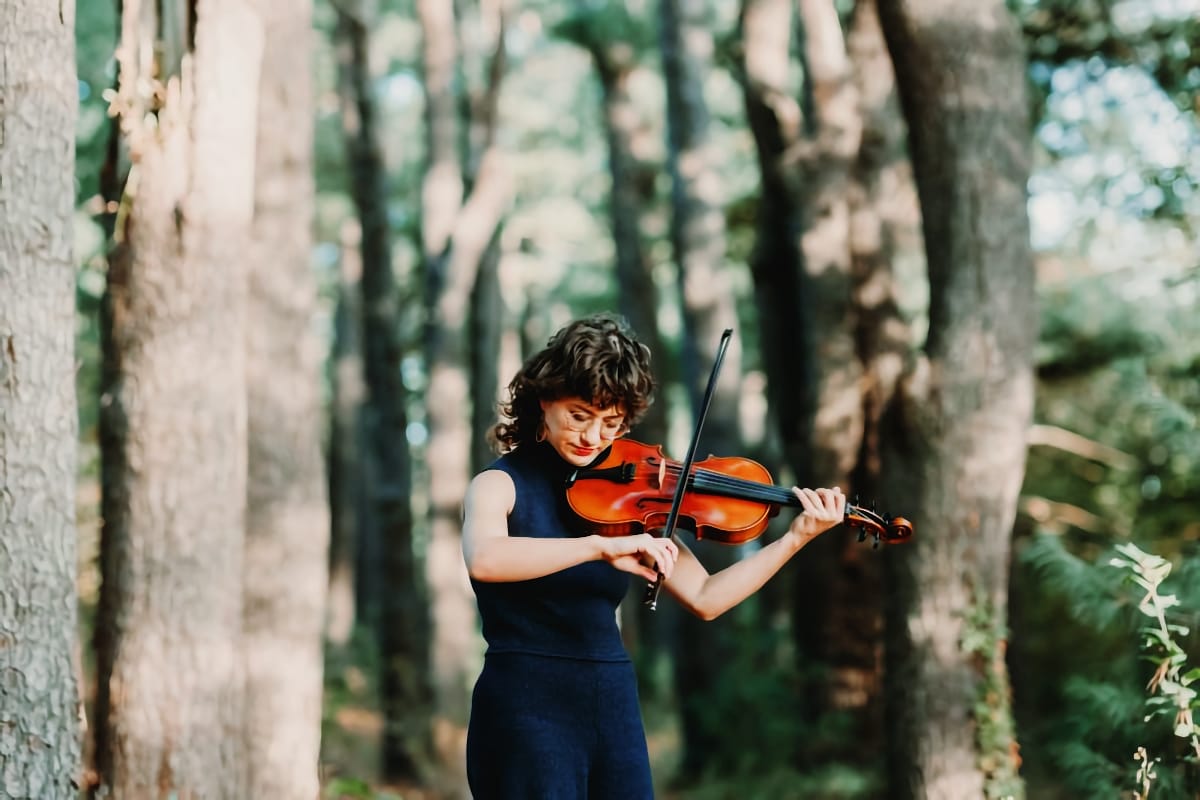
Sophie: I'm playing and dancing at the same time, which is like a big part of my solo program. I do that in tandem. It's kind of a matter of calibrating them; both of those things need to breathe. The relationship between the creator of the thing and the thing is one of listening and taking the temperature at all times. It's just this constant calibration. People see that calibration happening on stage, and they think, "Okay, so there's the relationship between Sophie trying to do the one thing (dance) and also Sophie trying to do the other thing (playing) and how those things have to be in relationship with each other." But the thing that I like to think about is how those things, in order to maintain balance, need to fall out of balance to show where the balance point is. We're never perfectly balanced moving through space. When you're walking, the thing that propels us forward is being slightly tipped forward in space, and then we can continually and smoothly catch ourselves because this is something we've rehearsed.
It would be stupid for me to be like, "And now I will perform something that is void of error and completely perfect." It's just not realistic, and I don't want to be creating anything between myself and the audience that makes it feel like I'm lying. I like to feel honest. The moments when this is calibrated, when these parts are coming in and out of balance with one another, those are the moments that I want to call attention to. I say the word 'mistakes' on stage, so I get a little laugh, but you can look and see where those things are happening because that's the beauty of being here and experiencing it and witnessing it in person. That's why I want to do it.
I do think that a lot of people probably possess the nerves and discomfort of needing to hold it all together on stage and convince the audience that they're superhuman. I'm not going to be able to do that, and I know that, and I think some of the best performers know that. Then it's a matter of forgiving yourself and allowing for the space to be comfortable that you create.
Sam: How does teaching play a part in this? Do you get inspiration from seeing these lessons imparted onto others, whether it's recorded music, dance, performance, or any sort of combination of the three?
Sophie: I have been feeling inspired by teaching private lessons and the task of finding and calibrating with someone the exact location in the music or location in the movement where nonjudgmental observation can soften and release.
It's almost like it's a muscle, right? You might have a whole part of your back that hurts, but then if you go deeper, it's actually not down there, and it's actually not up here. It's right under that shoulder blade. It always is under that fricking shoulder blade. It's the worst thing, you know? That's a matter of listening and observing. I just think that being a human being and living in a society in which many things we are forced to do go completely against our natural tendency to be connected with our bodies and our environments means that we carry a lot of those things into our practice. We carry a lot of the expectations, stress, and rigidity.
I think old-time tunes are interesting little etudes because they use repetition. They're all totally different from each other. Even when they sound the same, once you dig, they're quite different from one another. Within the tune, there are all these little exercises you could impart into your playing or practice. Instead of seeing it as a rigid thing that I have to show up and do for this amount of time, I've really been trying to follow this idea that it's like making little games. I'm finding a sense of play in my practice.
The melody doesn't lie, and it contains everything that you need to know about the tune. It contains the rhythmic information. It might not contain strong markers of what the chords are or the harmonic landscape at all times. There might be some hidden things, but that's like a video game. It's like a little hidden code that somebody put in that you got to learn. People are much more capable of learning, I think, than they make space for in practice. It is hard to leave all these societal weird pressures of being a human being during this time period. It's really hard to just relax into the activity and forgive yourself for just being where you're at.
Sam: Did you kind of face any challenges in the recording process with this record, being kind of the only person on there?
Sophie: Yeah. I recorded this record in February, surrounded by 8-inch-thick sheets of ice in Silver Spring, Maryland, where the entire fucking place iced over; it was really intense. I was recording with Cathy Fink, who's incredible to work with for many reasons, but also a strong enough person that the love is tough. She's really taught me a lot about how to work with people and how to make music. She was live mixing it because it was just me, so a lot of those things were being calibrated in the moment, which was great because it moved really fast. The masters were done like 10 days after we finished recording, which is crazy. That was a pretty interesting experience to just have one other person in the studio with me, who is strong and driven, but also opinionated and right pretty much all the time. I'm a deeply emotional person, and I kind of can lean on other people in those moments of emotional saturation that you get in the studio where there's this microscope on everything that's happening, inside and outside. She's somebody who allows that to happen without getting involved in a way that I kind of appreciated.
I had a different experience in the studio before where it was kind of a big social party. I noticed that the difference between these records, in how they sound, is that I feel much more focused. I feel so much more aware; I was more particular about the song choices and the vision, and I wasn't distracted. There's kind of a thread that I'm really happy to have preserved throughout the album that I think is difficult to maintain.
As I said at the beginning, my path to the music I'm making now hasn't been linear, and I needed to take stock of where I was at that moment of my life. And if these albums represent anything about where I'm at, I think they each represent what I'm feeling pulled to do. I was really pulled to do all those different things on my first album; it had string band stuff and jazz singing, all these different things. I was trying to do them all at first, and now I've kind of pared it down to like, "Well, what are you interested in?" I'm listening to myself to follow that, so it's interesting to compare them.
Sam: Did you ever feel too close to it?
Sophie: Yes. I am only now learning about what burnout really is. I played between 50 and 60 shows from the beginning of September to the end of November last year. I was traveling. I was on the road with Willi Carlisle, and then I did stuff with my band. I'm not going to talk about all the different things that burnout is, but just trust that I know that it's a lot of different things that I didn't connect to that one thing.
I live in this Victorian house in Boston; I was alone and processing not only the burnout, but trying to figure out how to be alone. For me, my response is always to go and be with other people. I mean, I'm an extremely social person. To create from that space was very hard. It was like I had my internal emotional notifications muted, then when I decided to convene with myself, it's like they all flood in at one time. I was in that space right when this album happened; it was a quiet space, but it was very loud, and I was trying to be present for that and also make this intimate album. I think I can really hear where I was at with that.
It's been interesting though, to rebuild my energy reserves and get ready to go out on the road again, because when I listen back to this music I can hear in myself this real slow-moving, winter chill. Now today I'm like, "it's summertime! Fun time! Festival season! I can't wait to bring this deeply sad solo winter album to you all!" (laughter)
Check out more like this:
 Steven Garnett
 Sam Bradley


Comments