


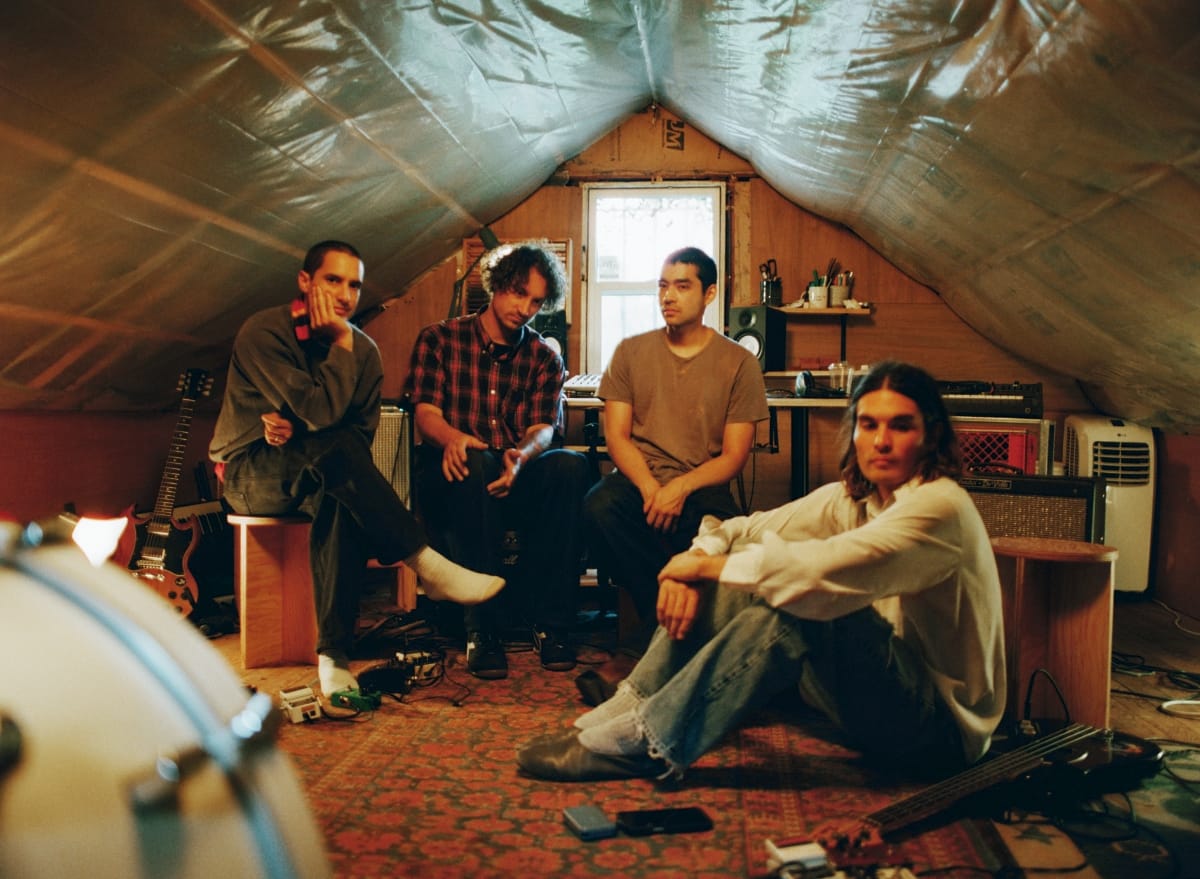
When a group of individuals forms a band, they become a new entity beyond their individual selves. But for Bondo, a foursome based in Los Angeles, they’ve pushed the idea of what a band can be. Instead of a group of four people, Bondo proposes they’re an interconnected, egoless collective that works together to create songs. Putting aside their differences to serve the greater whole, they almost become the antithesis to a rock band stereotype—filled with power struggles and arrogance.
Bondo’s music is difficult to describe, as it varies from track to track. Still, there’s a cohesiveness to it—often intertwined arpeggiated guitar chords against straight-ahead drumbeats and melodic basslines that build an atmospheric sensibility one would often equate with post-rock. Yet that’s a simplification of what you’ll hear on their third, self-titled album. Take “Brian Screams,” which begins with heavy feedback before launching into a punky, driving song where vocals strain themselves to be heard, or “Robby’s Song,” which sounds like you’re walking by the band as you listen.
But how does a group of individuals, working to create art as a collective, become truly egoless? Thankfully, I was able to find out. I spoke with three out of the four members on a video call, as Brian Bartus was on tour with another band. Throughout our conversation, all three gave me a solid picture of how they approached songwriting and composing in this unique way.
Bill Cooper: How did you meet each other, and how did your relationship develop as a group?
Cook Lee-Chobanian: [Band member Niko Escudero] hired me at a coffee shop when I was in college. I was twenty-two. I was a fan of Niko’s band he played in when he lived in San Francisco. He was doing his own project at the time and needed a drummer. Then Gerry and the other guy, Brian, were assembled to do one show of Niko’s that we played—I think it was the end of 2019. That was how we all got together as one band, but I’m trying to remember when we decided to do more.
Andrew “Gerry” Dykes: We were working off demos that Niko had, post-COVID. I had moved into a new house with a large space that my partner and I were going to split. Niko helped build a wall between the rooms to create separation. That turned into a music space, and that’s still where we practice. It became more of a collective band through that process.
Niko Escudero: Your house, Gerry, enabled us to go into “band mode.” The space itself really lent itself to being four band members, as opposed to one demo-maker and the people who play to it. It’s been about six years since we’ve been playing together, and we’re all really close now.
Bill: One of the things that really attracted me to you guys and your music is this idea of you putting aside your ego to be a collaborative whole.
Niko: The nice thing about Bondo is that it’s organic. It’s “first-thought-best-thought.” We go with what feels right and lean into each of our opinions. We’ve just been sharpening the blade over the years. Get the four of us in a room together, and that’s the Bondo sci-fi world.
Gerry: At our best, it’s just us riffing off each other. That’s how most of the songs start. One of the songs on the record, “Robby’s Song,” is a testament to that. It’s just an iPhone video, and we just took the audio from that and put it on the record. It was a spur-of-the-moment thing—we played it, and we liked it. We tried to revisit it, and then we were just like, “I think we got it.”
Bill: That one stood out to me, because you guys have an interesting way of mixing tracks. There are portions where the vocals are brought to the forefront and become central to the track, and other times, like in “Brian Screams,” where vocals try to break through the backing instrumental noise. Are these decisions intentional?
Niko: There’s a feeling to each song we try to listen to, as opposed to projecting a concept onto it. We all go into each song with an awareness of what the song wants. There’s a good Townes Van Zandt quote about him writing brilliant songs, where he says, “I didn’t write them. I just happened to be there at the right time.”
That’s the feeling we have—we’re not trying to force anything on it. For example, on “Brian Screams,” we just felt like Brian should just be in the mix in that way. And “Zuma” felt like a singer-songwriter vocal take, so the vocals go more up front—you want to hear the story. We’re not sticking to any formulas, and we’re all sensitive guys, so we try to feel what’s happening.
Bill: One of the things I’ve read about your band is that you’re trying to create a specific type of world. Do you have a vision, or is it more like, when each specific song comes, you build the world around them?
Niko: I think there’s a Bondo-verse, so to speak—and there are things that fit in and things that don’t. When I write a riff, I sometimes hear the whole song in a specific way. But then part of the fun is that I take it into the room, these guys all have different ideas, and it ends up being something totally different than I expected.
Gerry: Process-wise, if someone has an idea, we see it through all the way. By the end of that, we have our north star. When we’re done with a song, we move on quickly. For this record, we gave ourselves about two weeks to work on new material right before going into the studio. Even now, as we’ve played them live, they’ve taken on different vibes from the record, which is cool.
Niko: Because we spend so much time together and have been doing this for so long, our tastes are aligned with the band’s abstract motif. I really like sci-fi, and Bondo is a sci-fi band because it has this world-building element. Sci-fi doesn’t exist, and music doesn’t exist in the real world either. It’s not solid—you can’t touch it and say, “This is red.” I like to play on that abstractness and non-material quality.
Cook: What I appreciate about the abstractness is it affords us the ability to do whatever kind of song we want. If you go on whatever streaming service and click the top five Bondo songs, you’ll be like, “Why do they all sound so different?” We can do whatever we want, within reason, and I like that about the atmosphere we’ve created.
Bill: So earlier, Niko, you said what Bondo is and isn’t. Cook just said you can do whatever, but there are obviously still limitations of what fits and what doesn’t. Where do the limitations lie?
Niko: For the most part, if we play a major chord—like a Bob Dylan C chord—it sounds weird. But there’s one song, “Headcleaner,” on [our last record] Harmonica, that has a big old C chord in it, and for some reason it works in the song. There’s nothing that I know isn’t Bondo until it happens. If it isn’t Bondo, I’m like, “God, this doesn’t really feel good.” But it could all fit once it goes through our filter of playing live in the room together.
Bill: You’ve decided to self-title your latest release. There’s a song on the release called “Bondo,” too. In a way, you’re defining what you can create. What made you decide that this is going to be a self-titled release, and that you’re also going to name this track after the band?
Niko: For the album, we’ve gotten to a point with the four of us in a room, the recording style, capturing the songs, and the songwriting itself, where I was like, “This is the essence.” I almost wanted to call it Greatest Hits, because it felt like, “Okay, we’re hitting our stride as a band.” I think this is the best one we’ve made, so when we got to the naming part, I felt like this was poster-child Bondo.
There’s that saying: the whole is greater than the sum of its parts. Bondo aligns with that. And “Bondo,” by Bondo, is funny. We’re cheeky guys, and we like to have fun. No one fucking cares about what we do, but we’re going to do it anyway, because we love it and we have no choice. This is how we want to suffer through our lives—by working blue-collar jobs and making music at night.
Bill: I want to delve into the songwriting process a little more. You said before that one of you comes to practice with an idea, and then everyone jumps in and throws their own interpretation. What does that look like?
Gerry: It’s improvisational. You could have any idea coming into it, but it’s ultimately going to change. We’ve all gotten better at that: letting go of the control of what we think should be right in the song. We’re now at a point where we expect it to sound different than any one idea that we might have.
Niko: The band came together to play a show for songs that I wrote, so I’ve had to learn to let go and not project too much. I’ve come to trust these guys so much. Even if I don’t like what they do at first, I know they’re doing it for a reason, and eventually I will like it. That’s why this record feels so good—the trust and egolessness is there. We had to learn that.
Bill: I was going to ask, “What do you guys do when you have disagreements about the way a track should go?” But it almost sounds like you accept it—if one of you feels it’s right, the others accept it.
Gerry: We’re not fully selfless here. There’s biting of the tongue—there’s a little blood in my mouth from time to time. You’re trying to create this thing, and you want it to reach its full potential. Sometimes it already has, and you just aren’t aware of it yet.
Bill: It’s not an easy process to trust each other this much and let go. How do you do it?
Niko: If I listen back to the recording and I’m like, “Actually, I don’t like this—can we do this?” then I say it. But there have been enough times where I’ve said, “I don’t like that,” and then we do something different, and the song feels weird. We come back the next day and say, “Let’s go back to the way we were doing it before—it actually worked out better.”
It’s not the Gerry, Cook, Niko, and Brian band. It’s Bondo—this ethereal concept. It’s bigger than us.
Bill: How do you guys write the lyrics?
Niko: Brian writes his lyrics, and I write my lyrics, but then we’ll work through them. For example, “Paul Gross,” a song on the last record that people seem to really like—Brian wrote that. We were in the studio doing vocal takes, and it just didn’t feel right. Gerry and I both sat with Brian for a while and asked, “What does this need?” We said, “Maybe it just needs fewer lyrics.” So, Brian went and worked through it, brought it back, and we said, “Okay, that feels better.”
Gerry: I’d say lyrics are probably the last thing that is worked through—those are worked through in the studio.
Niko: We’re in a practice space with a shitty PA, so you can’t hear the vocals well. That helps, because then vocals have to feel like an instrument or frequency to fit the composition. There’s never really a message; just words that complement the song’s feeling.
Bill: When you were selecting the album cover, what was your process as a group for selecting that image? Where were you in the process?
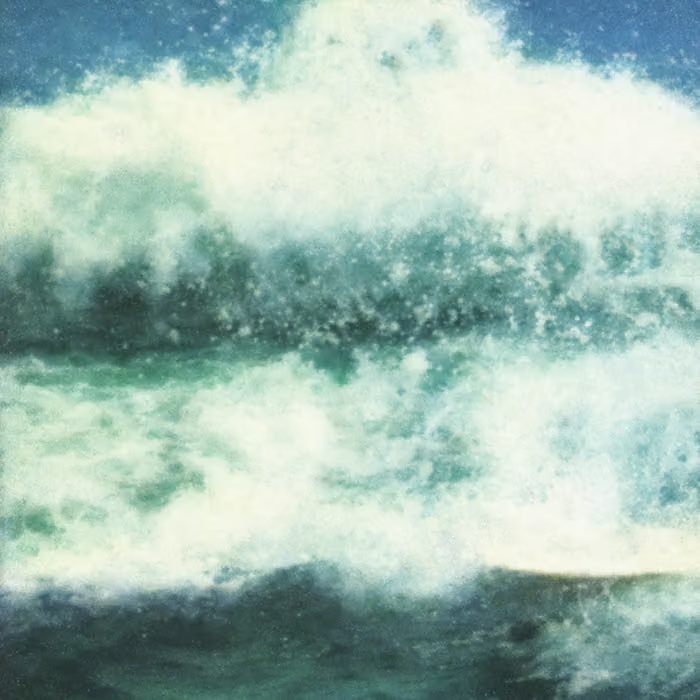
Niko: We had a few different ideas for what the cover would be. That cover is a screenshot of an old surf movie on the back pages of a weird website. It’s pixelated and small. It just felt like it fit into the world well. I said, “What do you guys think of this one?” and everyone said, “Yeah, that one works.”
Still, that is one of the more contentious things we worked through as a band—what the image looks like. It’s hard to find an image that works, because there are a lot of things that could work. There’s a picture of a scarecrow we used for a while, and that worked most of the time. Then there was another picture of the sunrise on Mars that the Mars rover took, and we liked it for a while. Eventually we just landed on this one.
Gerry: For Harmonica, we said, “Let’s get a photographer’s photo.” I think it overcomplicated the process, to be honest. When Niko sent this one, I was like, “Yeah, this fits with what we were doing.” The abstractness adds to it—you don’t have to think about it or overthink it as much.
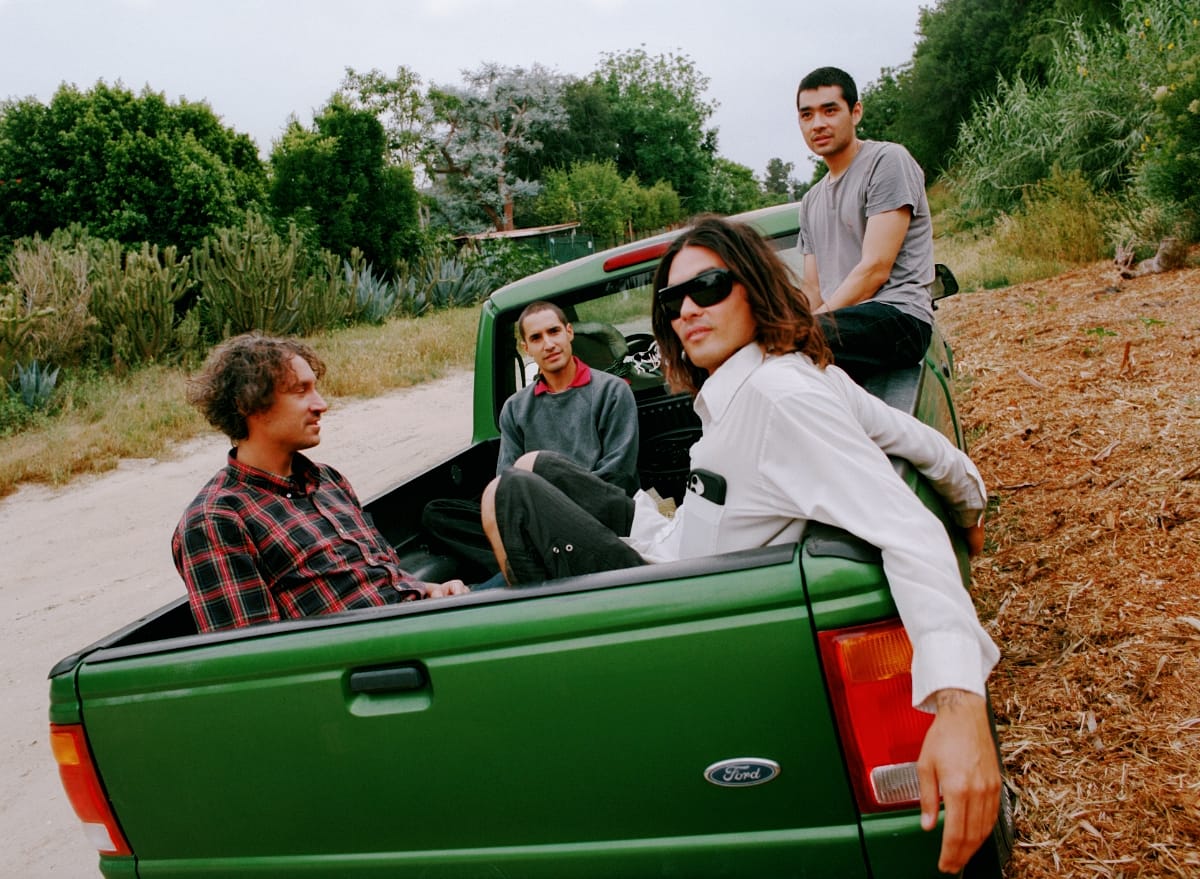
Niko: I’ve been dancing around this point for a long time, but a lot of this band is intuitive. My soccer coach used to tell me, “KISS—keep it simple, stupid. Don’t overthink it on the field. Your body knows what to do.” I try to think like that in a lot of aspects of my life, Bondo particularly, because it’s such a sensitive, subtle thing that you have to be able to catch your intuition when it feels something. With the image itself, I’d want the Bondo artwork to capture that intuitiveness as well. The last record, Harmonica, was cool, and I liked the truck picture, but it was too explicit—too tangible. Bondo is just a hole filler—it can shape into anything—but when you say the word “Bondo,” you get a feeling from it.
Cook: Honestly, I like the cover a lot now. I didn’t really like it at first, because I thought, “Enough with the water, man.” People associate Bondo with surfing. We’ve played in a lot of surf shops, we’ve had songs in surf movies, which is cool, but it’s a weird label to have. I was a little wary of the water, but I think it looks cool now.
Check out more like this:
 Damien Joyce
 Bill Cooper


Comments