


Post-rock, a phrase credited to the music critic Simon Reynolds for coining, and who is amazed that the term has persisted over the years, generally refers to bands that use typical rock instruments to create nontraditional rhythms, melodies, and dramatic chord progressions. One of the things I love about post-rock is that it’s such a wide-ranging genre; you can find elements of ambient, electronica, krautrock, jazz, even chamber or classical.
I was originally drawn to post-rock while working in IT in a busy corporate office for years. To help with focusing and working on computers, I used to put on my headphones and listen to instrumental music to keep my mind on task. I would then be able to work on different projects with the music on, which would help drown out the chatter and din of simultaneous phone conversations in an open-plan office.
The instrumental post-rock music of Unwed Sailor brings me back to that rapt state of mind. The band has been guided by the vision of founding member, producer, arranger, and multi-instrumentalist Johnathon Ford (Pedro the Lion/Roadside Monument), who has been a musician for over twenty years, starting the band in Seattle in 1998 and releasing their debut album The Faithful Anchor in 2001.
Unwed Sailor embraces a unique form of instrumental post-rock with the bass guitar in the forefront. Ford has combined these elements with shoegaze, dream-pop ambiance, and film-music elements to create a captivating sound. Chasing and creating alternate rhythms and melodies, things that don’t necessarily revolve around the guitar or drums (respectively provided by longtime collaborators David Swatzell and Matt Putman), is what motivates this unconventional bass player.
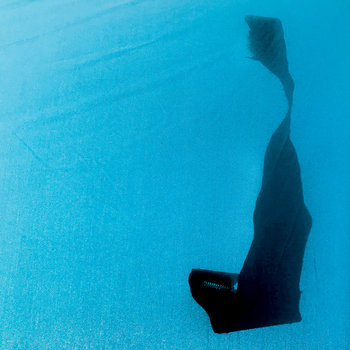
Since returning from a decade-long hiatus in 2019, the Tulsa-based instrumental institution has been on a prolific spree of creative exploration and genre-blending, churning out new music with the goal of releasing an album each year. The band has just revealed their eleventh album, High Remembrance, via Current Taste.
I had the pleasure of talking to Ford about making music in this genre, being productive, returning to his hometown of Tulsa, and eating good Thai food. The interview has been lightly edited for length and clarity.
Damien Joyce: I've been listening to the High Remembrance album, and I'm really enjoying it. Are you making up for lost time?
Jonathon Ford: I think yes, in a way. I had a realization around 2018 that I've been a musician for close to 30 years, putting out records, touring, and recording. I was on tour, and I met with a friend who also puts out records and is in a band. He said he wanted to set a goal for himself to put out a record every year. There was something about that that really intrigued me. I thought, well, ok, I've done this for this long, I feel like I should fully commit. This is what I do, it's my life, it's what I love, so why am I not doing that? Starting in 2019, I decided to put out a record every year, and I've managed to accomplish it up to 2026. Actually, I just finished the bass and drum demos for the 2027 album, so we're on track for another album in 2027!
I've developed a kind of schedule throughout the year where I'll start recording demos for the next record, then set aside time for studio recording, mixing, mastering, and manufacturing. I've got a timeline throughout the year where I put all those objectives into place. Then, we set up the release cycle for the album the following year. So, yes, it's what I've been doing for seven years now, I guess.
Damien: It's pretty impressive. But much of post-rock is guitar-centered, where your music tends to be bass-led. I'm wondering, when you're creating melodies, is that the starting point? Is it a bass melody that you come to the studio with? How does a song's creation take place and fit into that schedule?
Jonathon: It fits really well. First off, it starts with me not really trying too hard to write anything. A lot of the ideas come from a couple of bass guitars sitting around the house.
Damien: Wait, be honest now, how many guitars do you have?
Jonathon: Ok, well, way more than a couple. I lost count a few years ago. In fact, I just bought another one last week! (Laughter)
Damien: We'll just say many!
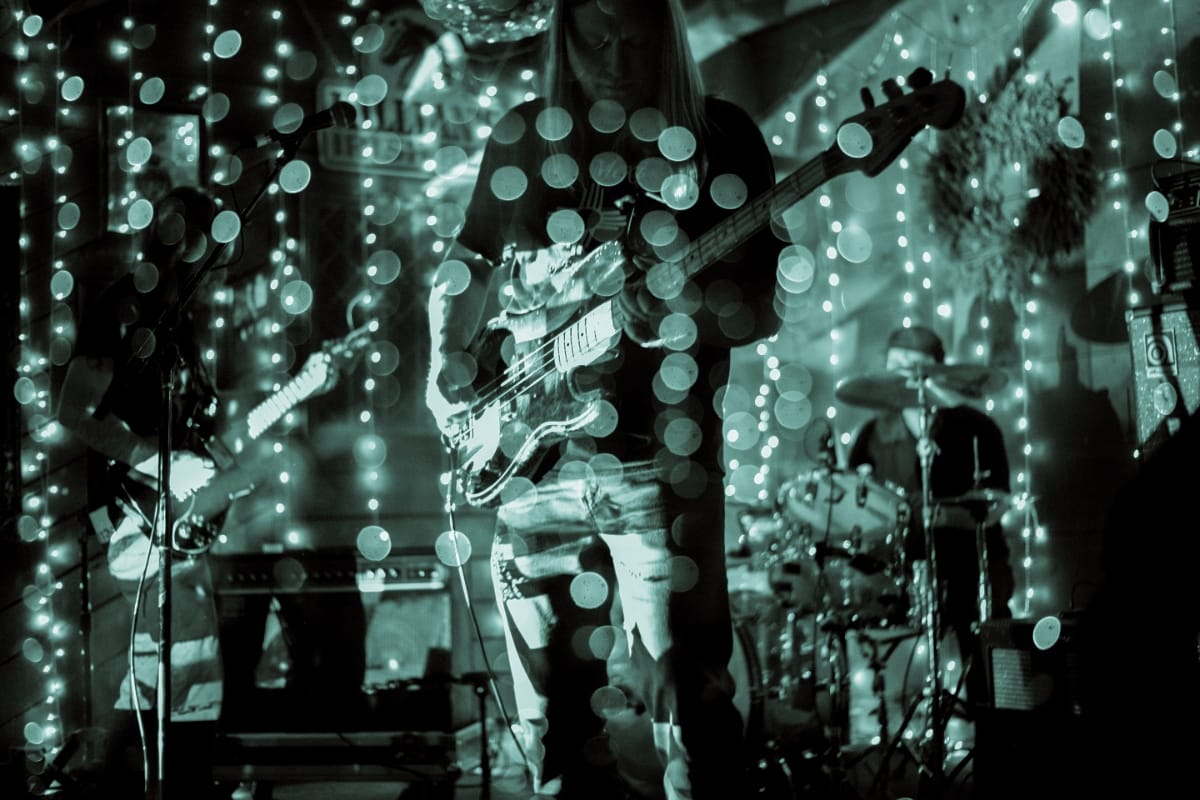
Jonathon: Many! I'll pick up one of the many bass guitars I have around the house, carry it across the room, and start playing. If a little bass line happens that I feel like has something to it, then I'll pick up my phone and film it, just a basic little recording of it, and I'll save that. Then whenever it's album time, I'll go back through those ideas and listen to them. I just start writing the songs from that. I'll take that bass part, and let's say that that's a verse. I'll write a chorus to that verse, and then I'll write a bridge to that verse and chorus, and I build the songs that way. They're all written on bass first, and then I'll write bass melodies on top of the main bass, and so that's how we start. I'll come to Matt and Dave with fully structured songs on bass. Then, usually, we'll write drums to the bass, then guitars, and then keyboards.
Damien: And does this all happen in the studio?
Jonathon: Whenever I write the bass structure of the songs, that's all done in my house. Then we have our own home studio, where we'll go in and write the drum parts and record drum demos. We have a main studio here in Oklahoma that we've been going to, and Dave will come in and play guitars there. He writes 95% of his parts just right on the spot in the studio.
Damien: So, is it a response?
Jonathon: Exactly. It's a responsive thing straight away, something that he feels, which I love because it's his feeling of what he's hearing in the bass melodies and the drums. I'll send him the songs before he comes into the studio, but he doesn't really work on them. He likes to come in and be on the spot. I think he feels like he can write better that way. It's really exciting, actually, in the studio because you don't know what's coming. You're basically hearing this album come to life in real time. It's a fun process, and it doesn't feel stale.
Damien: That's pretty awesome. In the past, I know you have filled in on bass for bands like Pedro the Lion. Did you enjoy those types of sojourns? Do you bring something back from those experiences to your own project?
Jonathon: I did. I was with Pedro the Lion back in the late nineties, early two thousands. I played bass with Damien Jurado for a little while, and I went on tour with Rosie Thomas, a Sub Pop artist, back then. I played in other friends' bands too.
During that time, Unwed Sailor was new. So, I think especially Pedro the Lion had a big influence on Unwed Sailor. Dave Bazan from Pedro the Lion actually played drums and guitar on the first Unwed Sailor release. I learned a lot from him in that era.
Now, almost 30 years later, I find that if I start venturing out playing with other people's projects, I get really overwhelmed. Because Unwed Sailor has become so much of my life, and especially putting out a record a year, I'm just constantly thinking about Unwed Sailor, working on it, and I don't really have time to do those other projects.
Damien: I remember a quote from the film composer, Hans Zimmer, where he said in music you're having a conversation, creating worlds. With this new album, High Remembrance, is this a world focusing on memory and nostalgia for the Pacific Northwest, or what world are you building?
Jonathon: It's definitely about memory and nostalgia. Nostalgia to me is a drug. I am a very nostalgic person, and I probably live in nostalgia a little too much for my own good because sometimes I just get really sad that it's not the 1980s anymore. There's a thing about Unwed Sailor records. Whenever they're being made, you kind of get these little glimmers of what they're about or what they mean. Then, as the record comes out, it's when they really kind of reveal themselves to me about how I was feeling and what I was thinking. So, at this point, we're in the phase where the glimmers are coming out, and I'm seeing that it's very much based in nostalgia and memory. "West Coast Prism" is based on my time and my memories from the Pacific Northwest on the West Coast. I lived in Seattle in the mid-nineties, and that's when I started the project.
Damien: That would explain the Pedro the Lion connection.
Jonathon: Exactly, right. I was in my twenties, and I had just moved from Oklahoma to play music. That's what I wanted to do, and everything was new, bright, and exciting. I have so many amazing memories from Seattle and Portland from that era. So, I think "West Coast Prism" reflects my love for that area of the country and those memories.
Damien: And being originally from Oklahoma, would you say Tulsa is an underrated city?
Jonathon: It's hard for me to say because I was born here. I grew up here, and then I left, and I've come back. I feel like any place where you're born and grew up, you can kind of have a skewed vision of it because you've been so inside of it for so long. But a lot of people who visit here say they love it and want to move here. I feel like they probably know what's up more than I do because they have a fresh take on it.
Damien: I guess there are lots of artists that have that odd relationship with their hometown, whereas they're growing up through the teens and 20s; they can't wait to get away. Then, as you grow older, there's something that pulls you back.
Jonathon: Well, I can tell you this about Tulsa: it's a comfortable place to live. It's slow-moving and slow-going. It's a great place to have a house with a few cats, just chill out reading books and listening to records, go get some great Thai food, then come back and listen to more records.
Damien: You're selling it to me, sounds idyllic. So, I listen to so many different post-rock bands, everyone from Godspeed You! Black Emperor to Japanese bands like Toe and MONO, Caspian and Balmorhea, and GoGo Penguin, a bit more jazz, and Penguin Cafe, who are nearly more cinematic.
Jonathon: I'm a big fan of Penguin Cafe.
Damien: Do you think the absence of lyrics makes instrumental music a more versatile genre? As in, it encompasses universal moods without language barriers?
Jonathon: I do. I've always been very drawn to instrumental music and grew up listening to classical music. When I was little, we had one of those huge old seventies stereo systems with a record player, an eight-track player, and a radio. It was like a piece of furniture. I would sit against a speaker, listen to classical music, and read books at the same time. Classical music would be a soundtrack to the book I was reading. Or, I would be on a drive with my parents, and hear that same piece of music. I would look at the sky or the trees, and it would be the soundtrack to them. So, I've always felt that instrumental music is very versatile because it becomes the soundtrack to whatever you're seeing or feeling in that moment.
I remember there was a Brian Eno quote that totally blew my mind, where he was talking about looking at a beautiful painting. It can be a landscape with trees, an ocean in the background, and the sky, and it takes you on this journey and puts you in this place. But if you painted a little human figure right in the middle of the painting, your eyes would go directly to that human figure. I think what he was talking about was the power of instrumental music to where you see all the surroundings, and it opens your mind to this full experience of a landscape. But if you put vocals in it, your mind is immediately going to the vocals, and you can miss the full landscape of the music.
Damien: I wouldn't be able to do any deep thinking or deep tasks with music that has vocals and lyrics.
Jonathon: That makes total sense; I'm the same way. If there's a vocal in there, that's what I'm focusing on. Now, one thing with me is if I hear a vocal, I don't necessarily hear the lyrics. I hear the melody of the vocal line. So, in a way, I'm still kind of hearing instrumental music in a song with vocals.
Damien: I find that, too, if I listen to music where I don't understand the lyrics. If I listen to Spanish- and French-speaking bands with vocals, the vocals blend into the other instruments.
Jonathon: Yes, and that's super fun. Whenever you hear that in music, the voice isn't necessarily a voice; it's just another instrument playing a melody.
For High Remembrance, there were a couple of songs where I thought, "I'm going to write some lyrics and sing to see what happens, just as an experiment." So, I did that, and I ended up just hating it! I felt completely insecure about it. I was like, "No, this is not happening," and I just left the studio and pretended it never happened.
But then a couple of weeks later, we went back to work on those songs and remembered the vocal melody that I had written. So, I put the vocal melody into a lead bassline and incorporated that into the song. This was the first time I'd ever attempted to write vocals and hated it, and ended up using the vocal melody I had written as bass lines in the song.
It was surprising to me that it worked that way. But then it made me start thinking, well, on all the albums I've done, maybe the lead vocal line or the lead bass lines are actually my voice, but in an instrumental sense.
Keep The Tonearm free.
We publish without advertising or paywalls.
Reader support makes that possible.
Damien: Listening to this album, I get that on some songs more than others. On "Cinnamon," there's a nice alt-country vibe to it, and "Gingerman" has a kind of sinister dark start to it. When I heard the first 30 seconds, I thought it was going to be much darker, but it turned out brighter in the end.
Jonathon: Yes, the initial bass line was the first one I wrote for that song, and it did feel a little more sinister. That's one thing about Unwed Sailor; I feel like it's impossible for me to stay sinister for more than a minute and a half or two minutes. It's got to go somewhere. It's got to have that big, hopeful melodic arc in the center.
Damien: The progressive instrumentation?
Jonathon: Right, it's kind of like a little movie soundtrack. It can't always be sinister. There has to be a joyful part in the song, or more of a melancholy, reflective one. What I really like to experiment with is having a sinister feeling, then a brighter one, putting them back-to-back, and making them work seamlessly. I really enjoy it when that happens, whenever that mood shift can happen quickly, but it's a seamless transition. That's interesting to me.
Damien: I would imagine that sort of emotion must come out great in a live performance when you're building those layers.
Jonathon: Yes, well, live instrumental music is also fun because you and the audience are both on a journey, and you can just close your eyes and immerse yourself in it. I really enjoy playing instrumental music live and seeing it too.
Damien: Do you think sometimes with this genre, there's an overfocus on engineering and technology, as in software, pedals, and all the effects, more than the songwriting, or is that a bit harsh?
Jonathon: I think that can happen in post-rock where the effects almost become the genre. I am all about reverb and delay. There will always be reverb, delay, and chorus on Unwed Sailor records. But I also think it's important for your song structures and melodies to still shine and be noticed if you cut back on those effects. You don't want to just wash out your song with too many effects when it's almost like the song becomes the effect. For me, I want the melodies to work without all the effects on them as well.
Damien: I think, at times, a type of minimalism is the key to post-rock.
Jonathon: Well, years back, we did a tour where we purposefully decided not to use effects on the guitars live. They were just clean guitars. It was a challenge, but we thought, let's see what it sounds like, and it worked; people responded to it. Actually, the bands we were on tour with were perplexed that we weren't using any reverb pedals, but they were also really into it. I think it would be fun, actually, for some of the post-rock records that have tons of reverb and ambiance, to hear those records without effects and how that sounds.
Damien: It would be interesting, but I guess, though, the reverb adds to the atmospheric feeling, and that's what attracts people.
Jonathon: For the genre, it really is crucial that it's all in there. But it would be fun to play around with the rules a little bit and see what happens.
Check out more like this:
 Meredith Hobbs Coons
 Damien Joyce


Comments