


Is the 1983 film The King of Comedy really a comedy? Robert De Niro, who plays the film's protagonist, Rupert Pupkin, and director Martin Scorsese aren’t sure, as they briefly discussed it on stage during the film’s 30th-anniversary screening at the Tribeca Film Festival in 2013. Perhaps the reason these two don't think of it as a comedy is less about how the film was originally envisioned and more about how it was more prescient than the two (along with screenwriter Paul D. Zimmerman) could have imagined. The story of Pupkin’s pursuit of fame at all costs seemed quaint when the film was released in 1983, as TV was the predominant form of entertainment.
Now, in 2026, 13 years after Scorsese and De Niro's thoughts were expressed at Tribeca, everyone could be one step away from being a star with social media and content creation. Pupkin's goal of becoming a star in the comedy world, adored by millions who tune in to his talk show on their sets, is akin to that of thousands of elementary school kids who aspire to be YouTubers. Yet each of those who hold this dream is often chasing the wrong things. Sure, they may end up successful, but at what cost? And more importantly, are content creators (and by extension, Pupkin) truly creating art that will stand the test of time?
In 2026 and beyond, The King of Comedy has become only more relevant because Pupkin's efforts illustrate the pitfalls of chasing after fame. Although one can, like Pupkin, resort to unseemly methods to be a flash in the pan, if an artist hopes to create something meaningful, they must focus on their craft.
Surprisingly, this is similar to the message Jerry Langford (played by Jerry Lewis, as a fictional talk-show host version of himself) gives Pupkin after the opening credits. In the back of his limo, Langford explains to Pupkin that "starting at the bottom" and gaining experience are crucial aspects to his success. He mentions that it may look easy at home for the viewer, but comedy requires hard work and years of practice to perfect. Still, Pupkin seems to believe that Langford is mistaken, revealing that his act is "already dynamite" and he's only one big break away from success. By the time Langford arrives at the front steps of his domicile, Pupkin is still hounding him, so Langford gives a little ground by telling him he can visit his offices to talk further.
This aspect of Pupkin—his dogged pushiness, disregard for politeness in social situations, and inability to take a simple 'no’—drives him within The King of Comedy. His conversation with Langford only happens because he's able to slip surreptitiously into the limo. Despite Langford's attempts to shrug Pupkin off, the famous TV show personality eventually acquiesces and has a career conversation with him. This is only the first of many examples of Pupkin's determination, representing a proto version of our 'hustle culture' nose-to-the-grindstone sensibility. As they watch, viewers may be surprised by just how far Pupkin's increasingly wild antics go.
For example, he goes to Langford's offices and explains he has an appointment with the TV star. When turned down by the secretary, he insists and waits until he sees Cathy Long (Shelley Hack), one of the underlings of Langford. After these back-and-forth dealings with Long turn up dry, Pupkin sneaks past security into the building's offices to try to find Langford. Pupkin also travels to Langford's house to try to talk with him again personally, and when all this goes awry, he joins up with a stalker to kidnap Langford and hold his show hostage on live TV. Though Pupkin is sentenced to prison near the end of the film, he gets his wish and appears on TV. As he states at the end of his comedy performance, "I'd rather be king for a day than schmuck for a lifetime."
Because Pupkin's outrageous actions get him what he wants, The King of Comedy builds toward an ending that can be hard to parse. This is because Pupkin's appearance on TV is enough to make him a star. He appears in Rolling Stone, is covered extensively on news broadcasts, and is even released early from prison, and his 'adoring fans' meet him there. The last few moments feature a pan-in of Pupkin in a bright red suit, nodding excitedly and waving, his dream finally actualized.
Surprisingly, Pupkin's determination can, in fact, propel someone to some modicum of success, especially in our modern era. In addition to relevant arguments about art being devalued to ‘content,’ it’s clear that social media and content creation often reward consistency and persistence, as well as another key factor—understanding the algorithm. Look at YouTube, and you'll find hundreds of videos of people discussing how to utilize the latest updates in the platform to get you where you need to be. The hacks are everywhere: use a thumbnail with a shocked face or, better yet, one with a famous YouTuber (like MrBeast!), pick a more emotional title, talk about a trending topic, or even a more controversial one.
When these hacks don't work, some creators may spiral out of control like Pupkin. Though they won't necessarily hold a famous TV talk show host at gunpoint, they may pay extra money to try to make a video go viral, livestream in places they shouldn't, try to stage drama to appear controversial, or prank other influencers to get more viewers. It doesn't matter that these choices could be dangerous. Like Pupkin, creators are focused on the end goal, believing all that stands in the way is knowing the right 'tricks' to reach success.
But there's a reason the words 'hack' and 'tricks' are used here. Though it's not quite "cheating," those who use these methods chase fame at a cost: enduring memorability. This is because if, for whatever reason, the algorithm 'blesses you' with a video going 'viral,' creators often don't know why they are successful in the first place. Often, they try to recreate the video in several different ways, either with the same 'hacks' or similar content. This can lead, if the creator is incredibly lucky, to continued success through mediocre output for a brief time, or, much more likely, to the creator failing, desperately scrambling to reclaim the success they once had.
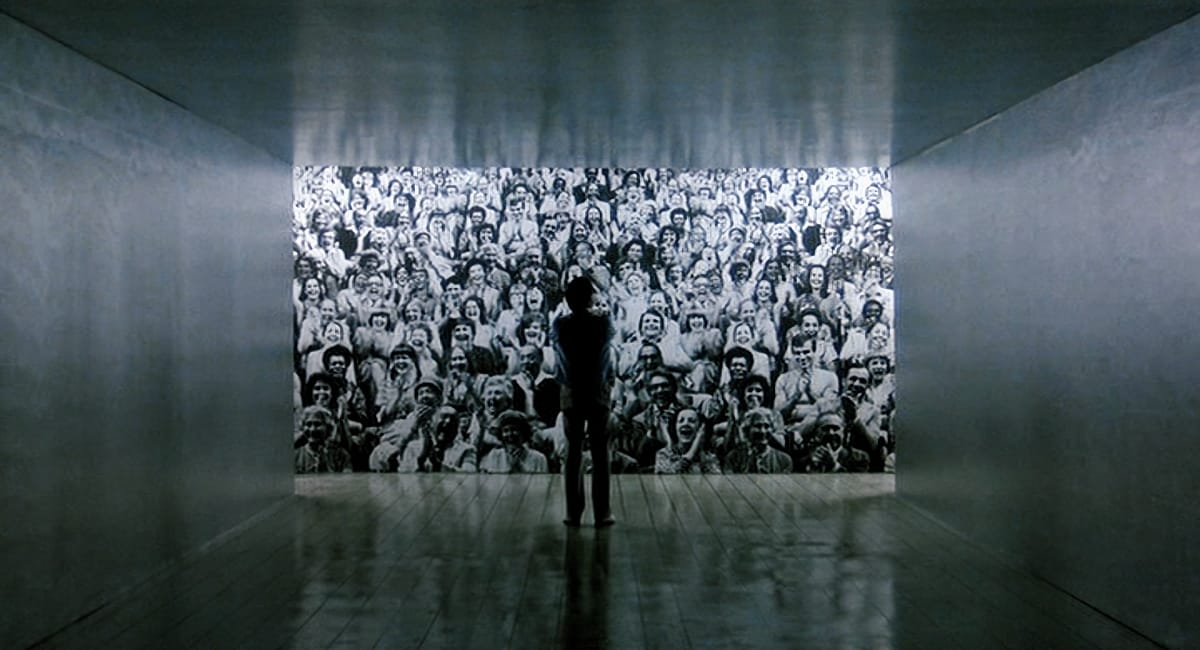
Let's bring this back to the final scene of The King of Comedy now, where Pupkin is basking in his success due to the 'virality' of his one night on stage. Though he's waving and seemingly happy, his facial expression could be read as multi-layered. It's possible to see fear and doubt about keeping up his position as the ‘king’ in his eyes, similar to the oh-so-many content creators who are unaware of what made their creations take off in the first place, and how to compete with a new level of competition. Despite Pupkin's doggedness, which brought him to this position, his act, the key factor that Langford originally expressed, always needed work.
Let's be clear—Pupkin's act isn't terrible; it's just mediocre. Though it's expressed when Long tries to give Pupkin honest advice after he gives her his comedy tape, a stronger example occurs when one of Langford’s people on set laughs at Pupkin’s opening monologue, believing some of the jokes are good. In contrast, Tony Randall, a TV comedian who appears as a guest host and must read the opening monologue after Pupkin’s staged armed kidnapping of Langford, is disgusted by the entire thing. Here, between these two men, is a subtle example of experience: Randall, who had worked in the business for years, has seen many more mediocre comics and surpassed them, whereas the other person on set likely has not.
Though this can be (and was most likely) seen as a subtle jab at the TV-watching audience, it's a much more extensive critique when looking through our modern-era lens. This is because it implies that, though experienced viewers may see through Pupkin's mediocrity, the wider populace may not. Take this to the seas of content creation, and you can see this first-hand. Despite the outspoken frustrations on social media with some expressing the sea of 'slop' content, the landscape doesn't seem to change, as there is still a larger viewership that doesn't seem to care. To go even further, this presents another problem when the latest innovation, AI, is added to the mix.
With this technological advancement, content creators and artists, by extension (if we can even consider them similar), are afraid they will be replaced. In some instances, it's possible they could be. It's unlikely that AI will make great art, as last year’s AI-generated psych rock group, The Velvet Sundown, illustrated. But that's not the problem here. People were more worried that AI-generated music sounded 'passable.' If you weren't listening with discernment, it could be easy to miss, which is, of course, easy to do because this is how streaming services, and to a greater degree other streaming platforms, set up their system.
Take Spotify, for instance, the streaming service giant that Liz Pelly writes about in 2025's Mood Machine: The Rise of Spotify and the Costs of the Perfect Playlist. Instead of the algorithm pushing music that might challenge the listener or broaden their horizons—one of the things real art can do—the algorithm is more intent on pushing frictionless content that increases listener retention. All that matters for platforms such as Spotify is how long you spend on the platform, so they can retain subscribers or boost ad revenue. To do this, corporations must create an experience in which music functions more like easily ignorable, yet functional, background noise rather than as something actively listened to for enjoyment. It is far from the only music service, or even the only media service, as most see retention as one of their strongest factors that algorithms reward. It makes sense, as companies profit off the frictionless; they want their users to accept what is served to them. To do this easily, companies must promote mediocrity and sameness, while systems are honed over time until the masses can be duped, even if connoisseurs might not be.
So how do you separate yourself from the 'slop era' of content and rise to the top? Is there an algorithm 'hack' that will save your art from this apocalypse? It isn't a hack, but there is a way. Unfortunately, perhaps like Pupkin, artists and content creators may not want to hear the answer. It's the same advice Langford gave at the beginning of the film, which Rick Rubin built upon in The Creative Act: A Way of Being, and Julia Cameron expounded upon in The Artist's Way. [Ed: To further this connection, Julia Cameron was once married to Martin Scorsese!] That is, working on craft will get artists further in the long run. Instead of relying on 'hacks' to please the algorithm, artists must create for themselves because they need to. Only then, along with a dogged persistence (something Pupkin has and could have redirected toward his craft), can they strive to create works that stand out beyond the mediocre and possibly become longer-lasting.
So yes, following Pupkin's actions indirectly by focusing one's attention on the algorithm may get creators somewhere in the short run. They may even rise to Pupkin heights and be 'king for a night.' However, with the rise of mediocrity and AI, they may also inevitably become the other key aspect of Pupkin's phrase: 'schmuck for a lifetime.' This is because, despite their brief moments of fame, these influencers’ creations provide nothing of value to grasp onto for more than a few moments. In this way, The King of Comedy's message persists, transcending to the modern era in ways Scorsese and De Niro never foresaw.
Check out more like this:
 Lawrence Peryer
 Bill Cooper


Comments