


During this conversation, when Whitney Johnson, Lia Kohl, and Macie Stewart, the trio behind BODY SOUND, all agree that the Chicago arts scene was a major influence on the improvised sound that makes up their first record together, I can believe it. It may be a result of having podcasted about Chicago band Wilco since 2020, but I've become, and remain, captivated by the assemblage of musicians who have emerged from the Windy City in the intervening years: Liam Kazar, Zachary Good, Makaya McCraven, Ratboys. It feels like the Chi is having a moment right now, but maybe it has always been this way, and I'm merely a latecomer to the scene's brilliance and cohesion from my sunny California perch.
I want to be careful not to reduce Johnson, Kohl, and Stewart to their hometown or their various musical collaborations, though there are many. They're too talented and expansive for that. Whitney Johnson composes solo as Matchess and also serves as "musical sociologist" of the six-piece Winged Wheel, Lia Kohl ("the people's sonic historian") has applied her cello and synthesis skills to create singular worlds of sound on various EPs and LPs of her own, and Macie Stewart, who was most recently seen on tour as part of Jeff Tweedy's stacked ensemble, is both co-leader of the band Finom alongside Sima Cunningham and a composer with two solo albums to their name. They can all play multiple instruments expertly, and on this shared work, track by track, they enter a collective flow state, improvising not only with their instruments but also with their voices—becoming, in effect (as Kohl explains in the course of this interview), a sextet. They’re also fearless in their experimentation with and manipulation of tape in the recording process, layering and looping, even literally touching and pulling on the ribbon, until a sound all their own emerges from it.
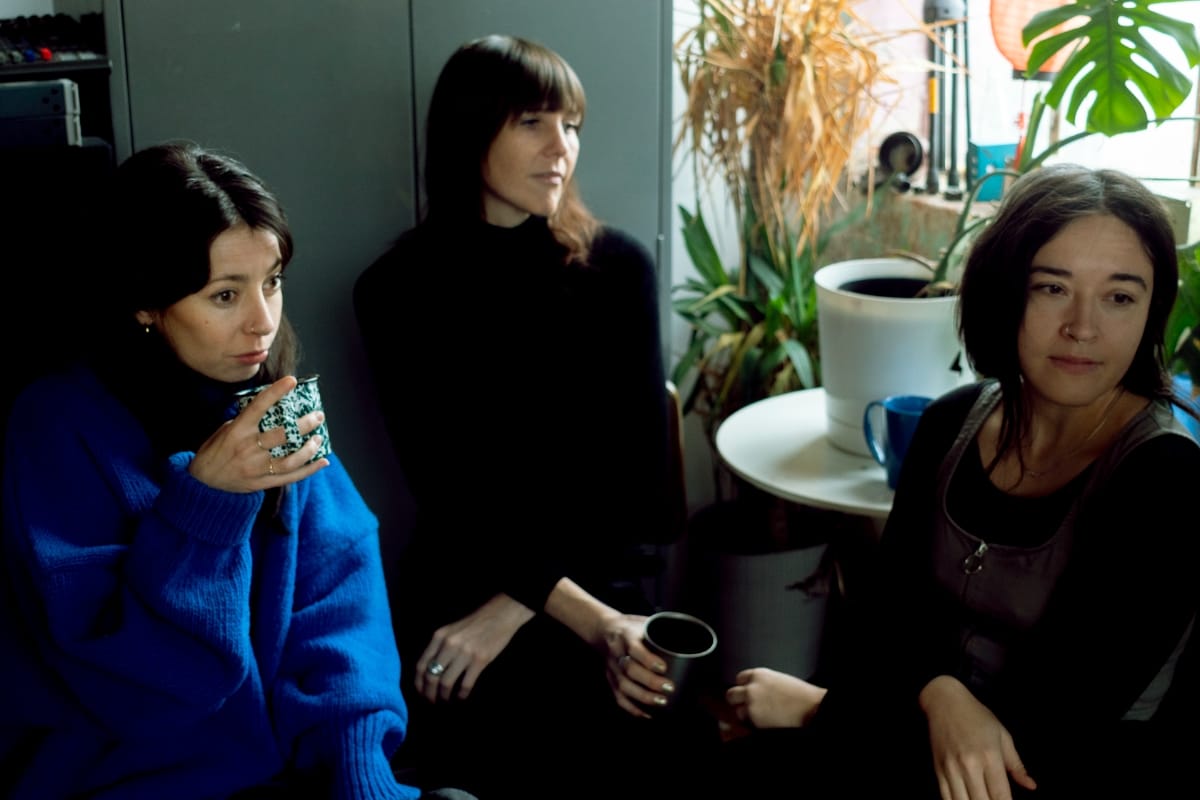
The three of them are great friends, which was dazzlingly clear in our conversation. They had all just come from a cozy trip to the sauna—nice and warmed up for the occasion—and their good humor was infectious. Adding a further relaxed quality to the interview's tone: Stewart's Matthew McConaughey mug in Kohl's hands, each side of it presenting a different photo of the actor striking a characteristically chill pose. After a little lighthearted banter about this unique piece of porcelain, we dug into their work on BODY SOUND, the Yoko Ono-inflected philosophy they had applied to its creation, and their deep friendship.
Meredith Hobbs Coons: I couldn't help but think of the Fates of Greek myth (and Hadestown!) listening to your music. Are there any famous trios you relate to? Did I nail it with the Fates?
Macie Stewart: There's such an innate balance in having three points of a creative shape. Trios have always been my favorite form of music-making. I don't know if there's any specific trio we relate to, but I like the Fates comparison.
Lia Kohl: I also can't think of any specific trios, but echo the feeling that it's a nice entry point for collaboration, because it feels like everyone can have a voice. You have to weave together. It can't be polarizing.
Whitney Johnson: I like the idea of different timbres that work together: something that's kind of rough, something that's resonant, something that's a little tinny or shiny. I feel like we exchange a lot between those three timbral spaces. Those qualities are in a lot of vocal trios: throaty, chesty, and tinny.
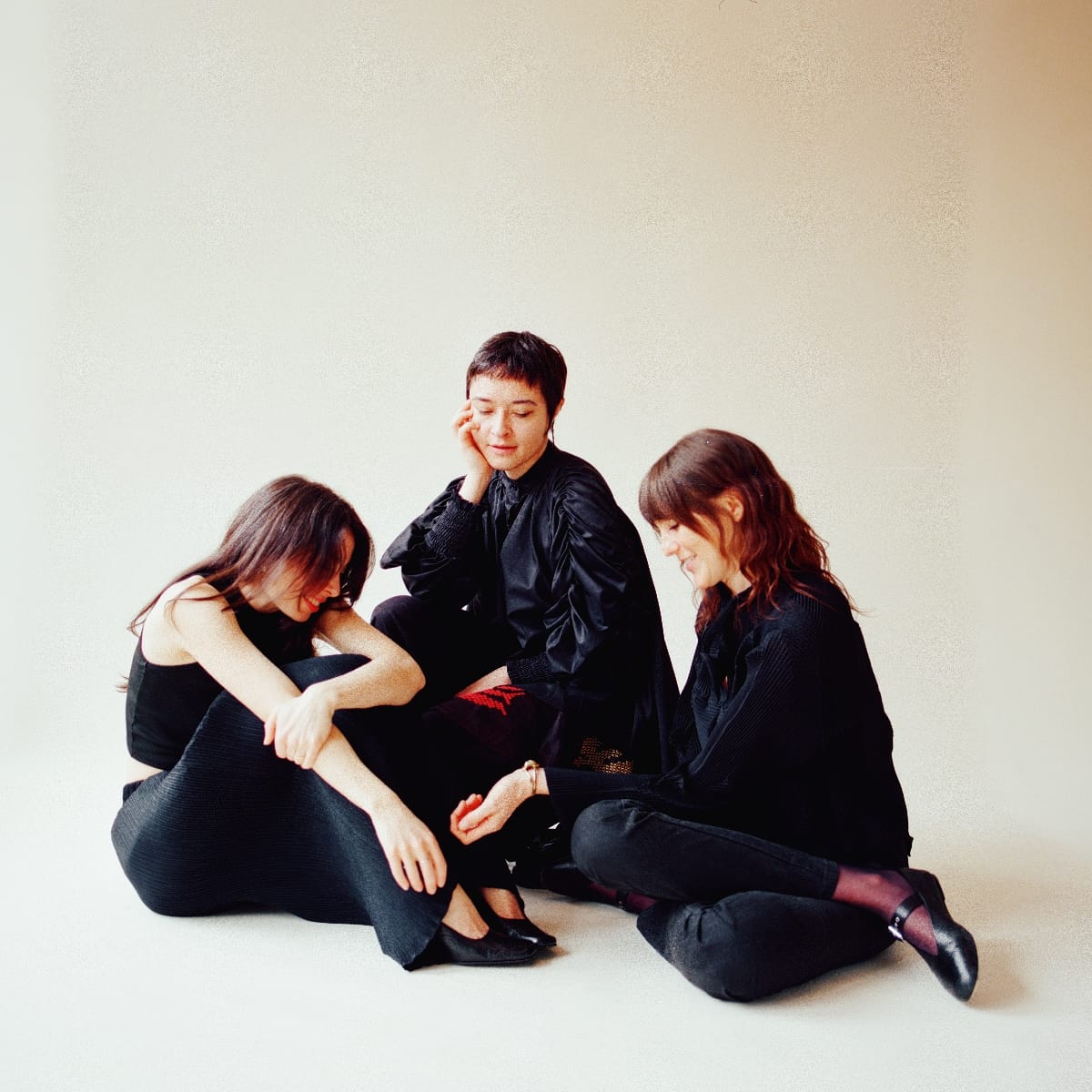
Lia: We are often a sextet, actually—all playing strings and all singing—so I think that we end up sounding like more people than we are, and even feeling like more people than we are. So, as much as our trio is amazing, it can expand.
Meredith: Now we can go into the Yoko Ono element: titling the tracks after poems in her book Grapefruit. What does she mean as a figure to you and as an inspiration for the work on BODY SOUND?
Lia: Well, that started because there was a book of Grapefruit scores in the studio when we were mixing and producing the record. We were all flipping through it as we were making the music. It's funny because we weren't making the music from those scores. It's not music directly inspired by her work. We were just inspired by that way of thinking.
Macie: There was something beautiful and synchronistic about having made this record, mixing it and putting some of the different tracks together, trying to figure out what we were going to call things or how to order them, and—as we were flipping through the book and reading through her scores—realizing their emotional resonance was something that we were similarly feeling with the pieces that we'd just made. There was this continual synchronicity.
We finished our record as the Yoko Ono exhibition was opening in Chicago, too. It was not directly correlated, but it was this thing where, at the end of the process, we realized that we were finding this kindred spirit through a lot of her scores. And a lot of the ways that she thinks about music and sound and art were ways that we were thinking about making this record and approaching this project together.
Lia: One of the things that I love about Yoko's pieces is that she was kind of creating a space between the viewer and herself. Those imaginary paintings exist in an imaginary space between her and you, and there are so many different versions of those paintings in people's minds—our music resonates with that a little bit. We are creating a world that exists between the listener and us, in a way that's true of all music, but this music especially has a kind of expansive emotional capability. I love that kind of in-between space. My first experience with that was reading the book Grapefruit.
Whitney: Something I love about those scores is they have the ability to get to the essence of the thing and create space for you as the new creator of that work—when you perform the score, when you interpret the score—to find that essence for yourself. That's something that we do in the trio. We're getting to the bottom of something. There's a surface approach that is a default mode that you can fall into, but then there's something beneath it, and those scores are great at unearthing that.
Meredith: As you said, you didn't do anything literally inspired by her, so you didn't record the snow falling or anything?
Whitney: (laughter) The pieces are as close as it came. She has, like, four or five tape pieces, and all of our record is somehow touching tape, except for one track. All the tracks touched tape at some point.
Macie: And that one track still was recorded to tape. It just wasn't manipulated tape.
Meredith: I really want to hear about that process, too, your post-production and production process of translating the sounds that you made together.
Macie: We went in with the intention of wanting to record everything to tape. We had that session at SHIRK Studios, where we had recorded with Dave Vettraino, and we just recorded a bunch of improvisations straight to tape. We had a few pieces where we each wrote a short story prompt before playing and then improvised with that prompt in mind, the three of us. When we went back, we took some snippets of those improvisations and started playing with looping them or slowing them down in the tape machine. There were a couple of times when we were literally pulling at the tape as it was rotating around the spools.
Whitney: Something cool about those specific tape machines is that a couple of them were in various states of disrepair, and so the point of failure of the machine is something that we recorded and emphasized. We definitely didn't shy away from that, those partially broken elements. Some of the machines were in great condition, but some had quirks and little gremlins that came out in the process that we loved. A lot of those gremlins show up on the record.
Macie: There was a specific gremlin where the tape machine was squeaking like crazy, then we recorded it with our phones and put it back onto tape. So there was the recording of things to tape, the recording of the tape machine back onto tape, and then the tape recordings slowed down and sped up. We really liked the idea of using tape, because it is such an organic medium, and it felt nice to have things that you could move with your hands. Like, when we were manipulating the sound, it was directly correlated with pressing a button or with touching the tape and wrapping it around something else. We made a few cassette loops, too. Everything has touched our hands and has touched tape. That was something that felt really special to us, because the tape was used as an instrument, much like how the spaces that we play in are also used as an instrument—I guess the tape can serve as a space that we're existing and making things inside of, as well.
Meredith: There's an incredibly tactile element to it all. It's almost as if it goes from atmospheric to more tactile by the end of BODY SOUND. The plucked strings start to stand out, and a feeling of intimacy starts to come in around "paper folding/disappearing" and "cough, laugh”.
Macie: Definitely. And we ended the record, too, with a piece that is unmanipulated. It is an improvisation, taken as a whole from beginning to end, recorded straight to tape. It felt like the right way to end the album, just the three of us with our six instruments, playing and improvising together. It was the most pure form of the project.
Lia: It's a lot of fun to make an album out of so many improvisations in so many different spaces, and to cut it down into a little journey. I'm glad you experienced that.
Meredith: I'm glad I picked up on it. Also, watching the three of you together, I'm thinking about all the different collaborations you each are part of and wondering about the origins of this project.
Lia: We never totally know how to answer this question, because some of the origin is just being in Chicago together and orbiting around each other in various capacities. We've been playing together since 2017, but very intermittently. It was always this special thing that happened when we were all in town.
Macie: Like, once a year, we would play a gig where we would improvise together.
Lia: Yeah. And then sometime last year, or even the end of the year before, we were like, "We love this so much. Why aren't we doing it all the time? Why isn't this one of the main parts of our lives?" So we decided to actually make a record, and our label, International Anthem, was on board right away.
Whitney: Something I would add is that the improvised and experimental music scenes of Chicago are just so rich. There's so much good stuff going on, and so many good players and people I love to play with. It sets a really high bar for that connection, because you can play with so many people and have a really good experience, but it's a very special thing to be like, "We want to make this a band. We want to put our energy and our time into it."
Lia: There are also many non-musical parts of being a band, and we enjoy those things, too. We work well together. We like each other a lot.
Macie: We like to travel together.
Meredith: Do you have a memory that sticks out or an experience that you particularly enjoy together? Maybe the sauna's your favorite, but maybe it's not.
Macie: Honestly, that was a highlight as something that we've done together. (laughter)
Whitney: A story that comes to mind for me is we were playing in Antwerp on tour, and there was a carnival right outside the venue, and no time to get to it. My inclination, just my personality, is to be like, "No. Not possible. Can't do it," but they were like, "We're going to the carnival." And I was so glad that we did, because sometimes I get very stuck in my ideas of what's possible and what's impossible. That was really fun. We just cruised through. I think we rode one thing.
Lia: The Wild Mouse. (laughter) I love the Wild Mouse.
Meredith: What does it do?
Lia: For me, it was a really big deal. It's, like, one of those roller coasters that's on a truck run by an old Serbian man.
Whitney: Spinning cars, on a track. Sublime.
Meredith: That sounds perfect.
Lia: Also, we all love food. We all love cooking. We feed each other a lot—not literally.
Meredith: Well, why not? Maybe you should try it! (laughter) It's actually incredibly hard to do. I used to be a Certified Nursing Assistant, and that’s one of those things you don't think will be hard, but it actually is.
Lia: It's like how tying someone else's shoes is also really hard.
Meredith: Yes! What have you learned from each other through this project?
Macie: I have learned an immense amount about sound in general and as a technique, from both of them—definitely from Whitney! I feel like my baseline of knowledge has exploded through playing with the two of them. Also, I've been in so many different bands, and learning how to be in a band with people is always a process, always something new, and this is a new version of it for me. The way that we work together is different from the ways that I've worked in other bands, and work in other bands. I appreciate it a lot.
Lia: There's a lot of trust that I experience. I haven't been in bad band situations much, but there's a new level here of making things together, where I can trust them both to have better ideas than I have, or at least equally as good. I'm a control freak, and I think that they've both taught me that other people are incredibly smart and amazing. It's a wonderful experience to sit back and hear what you guys have to say and what you want to make. I've learned how to trust creatively.
Whitney: Yeah, the idea of possibility is powerful to me. I think I sometimes have a limited brain and a limited spirit of what reality is and the range of what's possible. If it's going to the carnival before the show, there's that, but musically that applies as well, where you can repeat this figure to the point of discomfort, and then it becomes something transcendent the next moment. I back off of situations musically, sometimes, too quickly, and I think both of them expand my brain to what is possible.
Meredith: Macie, you said you've learned a lot from Whitney, specifically?
Macie: Yeah. Whitney, you're so good with sound, knowing how things work and how things operate alongside each other. It has taught me a lot and given me a lot of confidence, too, in knowing how to set things up or what's possible. There are definitely things where I'm like, "Oh, that sounds really hard. I probably can't do it." But within the trio, it's like, "Oh, we can figure it out, actually." We can figure out how to set up tape machines and do all of these things. I've gained a lot of knowledge about that.
Meredith: Is there anything that you had hoped to talk about that we haven't had a chance to get to yet?
Lia: I really want people to know that this music is improvised, because I think that it's not necessarily clear, and also because there are layers of production over it, but the heart of the music is that we made it in real time. I think some of the trust and possibilities that we're talking about live first in that space—in "time space."
Whitney: The closest we came to a score was a narrative and sensorium that we described to inspire a certain piece, and we did that just for a short part of one session, but I hang on to that. I feel like that was an effective sort of score, just a little situation that we would describe and use as our spirit to bring into the improvisation.
Meredith: Sensorium is such a good word.
Macie: I want people to know the word sensorium. (laughter) Also, to second what Lia and Whitney have said, when we are doing live performances, like the tour dates that we have coming up, we are improvising. We are working with the elements we have—tape, looping, and things like that—but our performances are improvised using the elements we have chosen. We're relying on the trust between the three of us and listening, with whatever space that we're in as the instrument, to inform how we're going to play together as a unit.
Meredith: Do you want to name any influences that you brought to this project, individually or collectively, that you haven't already named?
Lia: One thing we did talk about is that many of our influences are visual or spatial. As much as we're inspired by music, we also think about light sculptures and James Turrell. We're always inspired by the space that we're playing in. For me, music is a very visual, architectural experience—particularly this music.
Whitney: Hilma af Klint, I feel, has a relation to this music. Her biography and her art, spatial relationships, elements that kind of combine, but are still perceived as distinct elements visually.
Macie: Yeah, that absolutely relates to us as a trio. We're a trio, and we're also our individual selves coming together to create something totally different from what we could make of our own accord. We're three individuals within a unit.
Check out more like this:
 Carolyn Zaldivar Snow
 Jonah Evans


Comments