


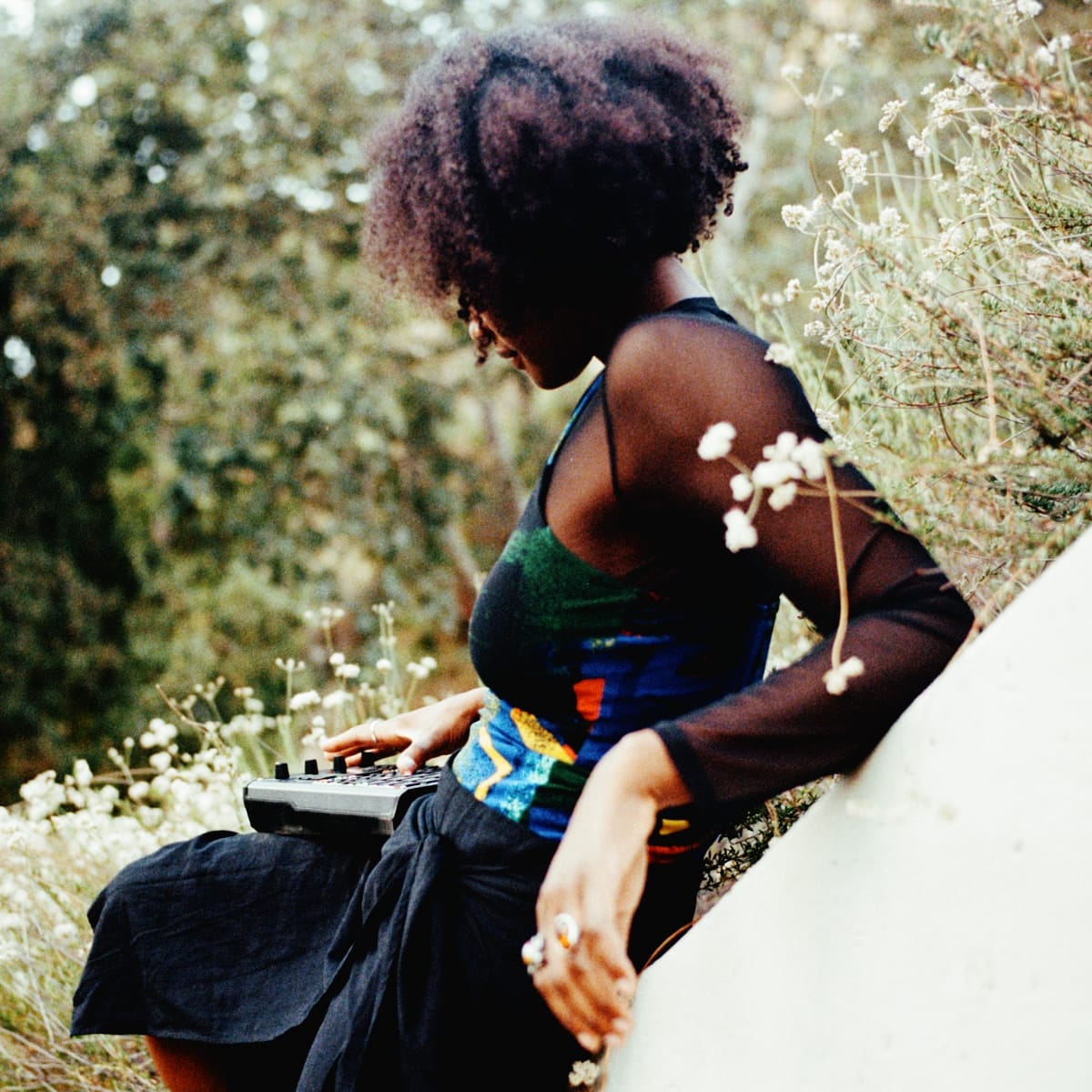
megiapa’s enthusiasm for the people, sounds, and art forms she loves forms the foundation for all she does on Intentions and, more broadly, in her creative practice. More than once in the course of our conversation, she refers to herself as an “enthusiast,” and it’s this aspect of her selfhood that seems to have sparked her desire to approach beatmaking to begin with, back when she first encountered sounds she loved, vibing to them alongside her brother, attending shows in Chicago≈s underground scene. Looking back to this moment from where she now sits, having opened for Makaya McCraven and brought forth over twenty releases by Bandcamp’s count, each with vivid cover art collaged and/or created by megiapa herself, the key components that still sustain her are all there: family, community, and sonic jubilation.
There’s at once a sci-fi element to her work—whirring whistles, spacey pitch shifts, and washes of galactic reverb—a low-end groundedness provided by her beats and bassier tones, and the steady, guiding presence of her vocals, solo and stacked, offering up encouragement to persevere through (but still acknowledge) the uncertainties of our unjust world. There’s an emotional groundedness to it, too, best encapsulated by the song “wishing (u) well,” a vision board of a soundscape created with voice notes and messages carefully catalogued to buoy megiapa in dark times, now offered as a tribute to these loved ones as well as to share their collective wisdom with her listeners—beloveds of a different kind.
There is a theme of prismatic light and bright color in the imagery that surrounds megiapa. It shows up in her press photos, her musical releases’ cover art, and her music videos. In “on the spaceway (frfr)” (directed by Eric Coleman), friends’ drinks, lollipops, instruments, and sunglasses each carry a glow; their tablecloth sparkles purple and silver, and megiapa, decked in yellow, sometimes appears bathed in violet light. In “Open Your Eyes,” directed and filmed by the artist herself, megiapa sings, illuminated by sunlight filtered through leaves, rainbows rotating in the right-hand corner of the screen, broadcasting her message of positivity. Even rendered entirely in black and white, the light still comes through in her video for “(SMT).” Fireworks, sparklers, flickering candles, sunstreaks, and close-ups of sunlit bouquets pop up interspersed with filmed family moments and stills from protests, participants donning keffiyehs and shirts that read “No Human is Illegal,” holding signs that say “Am I Next?” and “Defund the Police.” Even through struggle, the light persists.
Her very presence is radiant as we connect virtually for our conversation. She lights up when discussing not only her process, music, creative community, and the opportunities she creates for beatmaking mentorship in her current home of Los Angeles, but also when we geek out a little over our shared interest in language—she is a linguist by profession, and I am a speech-language therapist. Her joy is infectious; her celebration of Black joy, in particular, a beautiful offering.
The transcript has been edited for length, flow, and clarity.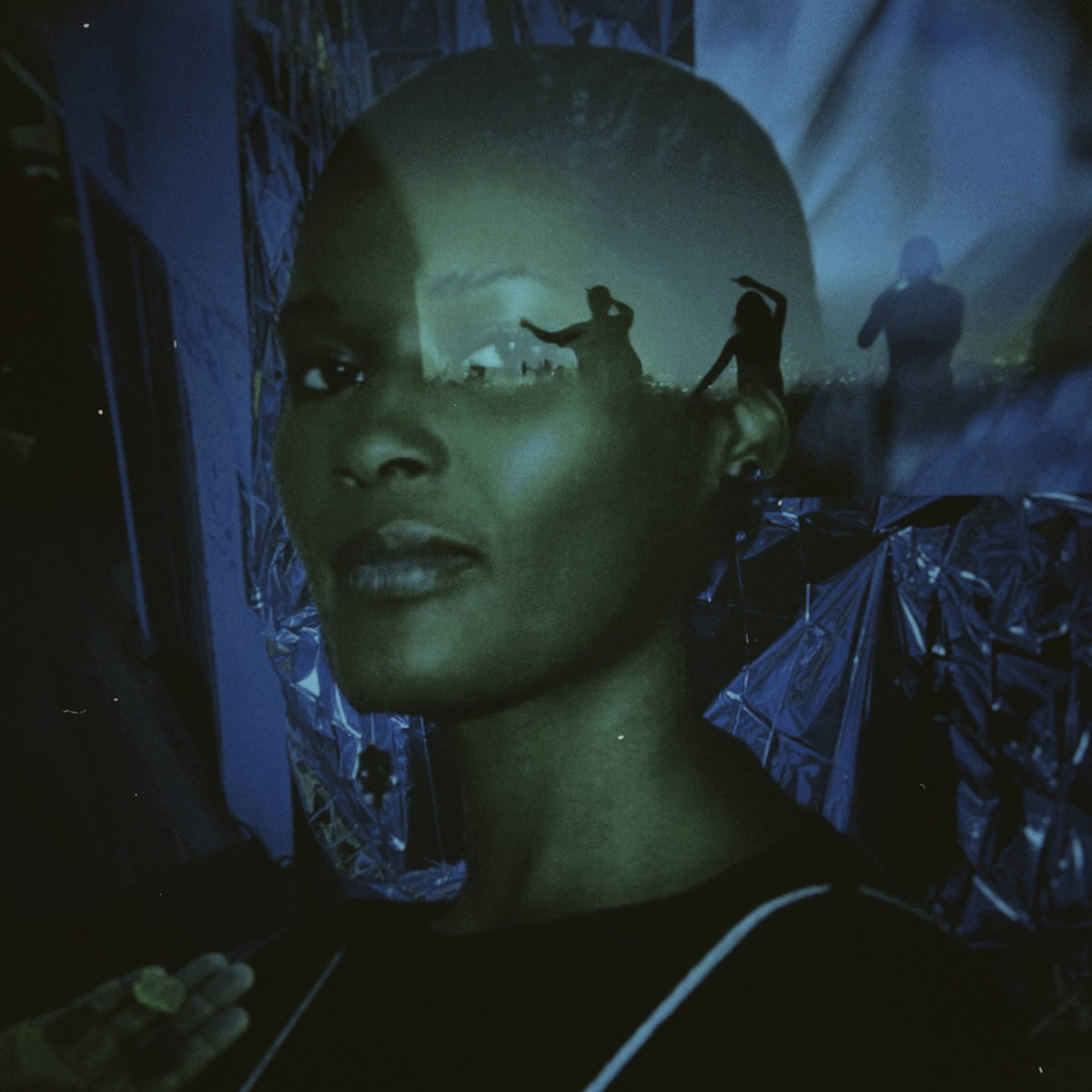
Meredith Hobbs Coons: I’ve been listening to Intentions, and your back catalog as well, to prepare for this, and I appreciate your approach to layering sounds, how you carve out space for the different textures to come through. I know that your work is linguistic in nature. Do you think of your work as textural too?
megiapa: I would say more so than linguistic, actually! I always imagine my music in aural space—where it will be in the space or as filling the space—and with Intentions, I thought more about that aspect. My earlier work was more experimental. Things would just happen, and I’d be like, “Oh, I like that.” But with later stuff, it’s been like, “Okay, where are things sitting?” I just had more knowledge making this last one.
Meredith: Tell me about that process of exploration and expanding your knowledge through this project.
megiapa: As a self-taught producer and singer working from my bedroom as my main source of learning, Intentions has had me spending more time with my music and wanting to do that as a goal and deliberate action. The other goal was to invite others to work on this music with me or help shape the final product, to learn from people who’ve been doing this for a while. There’s so much I’ve learned and am still learning through making this record and releasing it.
Specifically related to this music and how it came about, I invited collaborators to send me music or to play over my tracks and add to them. I had no idea what to expect on the other side. It was like, here are all these stems, these beautiful things that people have contributed; now how do I work with those and add those to my work? How do I step back from what I’ve been doing by myself all this time, running on my own trajectory with my sounds, and incorporate them or let them take up even more space than I was intending? I didn’t expect to have to make all these big decisions about the music, because I’ve been working by myself for the past ten years or so, but I’ve learned how to do that, and I’m excited about what that could mean for the future of my music.
Meredith: Your bio mentions that you’re one of the few women who were making music in the underground beat-making scene in Chicago. In general, women are marginalized in music-making spaces—in audio, in production, everywhere—and it’s interesting to me how many women in particular have that experience of starting out so insularly and having to expand outward. How did you gain confidence to expand in that way?
megiapa: I really do thank the underground beat community in Chicago that was active at that time when I was living there. When I moved to Chicago, I was an enthusiast, recording stuff here and there. I would make music with exes, but not really anything on my own. I had some tracks on SoundCloud that I would just throw up there for myself.
I got introduced to beat-making at a Kaytranada show or something like that. There were only a couple of people there at the time, and my brother and I were up front, just vibing to the beats. The way I remember it, Djuncle El and somebody else approached us like, “Okay, obviously you like good music. We do beats in the city. You should come out to some of our events.” So, we went to a Push Beats show, and I was like, “Oh my gosh, this is definitely what I’m into.” I felt like I had found some community, started attending events they hosted, and ended up showing my beats. Then, they were like, “You’ve got to play a show. You’ve got to do a set,” and I did not know how to do that at all, or how to present my music, but I had heard about Ableton Live, learned that, and kind of just played my beats at this set. That was the beginning, feeling like I had people who were like, “Hey, what you’re doing in your bedroom should be played out for people to hear it.”
I didn’t know many women who were in that scene at that time. That would have been really amazing to have known other women who were doing it. I’m just really glad that I had the support of the guys who were sharing their sounds, being experimental and open-minded enough to have me in the space doing the stuff that I was making in my bedroom, being like, “Yeah, this is amazing,” alongside their really thought-out and intricate sounds.
Meredith: As your music has found new ears, have you found community with other women who are doing what you’re doing?
megiapa: Yes, I feel like I’m always searching for that community feeling with women who are connected through music, who champion each other. It’s just hard to come by. I could go deep on why that would be—my theory is that it’s competitive—but I have found more of that community through the Chicago scene and through meeting people and sharing my music. Since moving to Los Angeles, I have finally found a group of women who are like-minded. We enjoy sharing our music with each other and supporting each other. Linafornia is an artist I would name who is amazing. I’m so glad I found her and am in community with her. Georgia Anne Muldrow, too. Just seeing these women out every day in Los Angeles, sharing their sounds and being who they are, is so inspiring.
I recently created a beat-making group for women who are interested in learning production. I’m so excited about this. It’s like, if I can’t find one, then I’ll create that environment and community for women to connect with each other, make music, and feel empowered through it. I was watching a reel on Instagram and some girl was like, “Girls, it’s been too long. We don’t need these men in the studio anymore. We’ve got this ourselves. You need to learn production,” and I was so excited by that! I made a comment; I was like, “Anybody who wants to learn Logic, I got you. Just send me a DM. Let’s do this.” And it’s taken a while, since I’m a teacher as well.
I love music, but hadn’t found a way to combine those interests of mine, so this was like, “Wait, what if I could get all these women in a room who want to learn beats? Then I could combine my teaching with music,” and I got very excited about that. That was the message, and people responded. It was, like, 30 women one week, then, like, 50 women. Now I have a small group of 20 to 30 women who actually want to learn production. I was just by myself until this Instagram comment. Then I was like, “All right, let’s just take a chance and see what happens.”
Stay on top of The Tonearm.
Subscribe for exclusive interviews, cultural tip-offs, and community fun.
And your support keeps our site free of advertising and paywalls.
Meredith: That’s amazing, and it seems like a consistent thread in your creative practice, because that’s how you started making beats in the first place: taking a chance, betting on yourself. So, the teaching is where the linguist background comes through?
megiapa: I teach English as an additional language, but I have a master’s in applied linguistics, which is really just how to teach languages. I’ve been doing it for the past 15 years. I love language, I love teaching, I love talking about language. I just came from a pronunciation class that I teach to immigrants and refugees, and it’s one thing that lights me up. Obviously, teachers aren’t well compensated most of the time, but throughout my life, I’ve always favored what fulfills me at the end of the day over what’s going to make me the most money, and teaching is one of those things. If I’m having a bad day and I go teach a pronunciation class, I’m buzzing after that. I’m like, “This is so fun.” So for me, that’s a point where I’m like, “Hey, I’ve got to keep that in my life.” Music gives me that same energy, that same excitement. Half of my life is teaching, and half is music.
Meredith: Everybody has a multitude of gigs these days, right? One of my other ones is doing speech therapy, so I’m right there with you. That was part of why I was eager to do this interview, because we must have common interests to have been pulled into working with language and making music.
megiapa: I think they’re related. I do. Obviously, they’re related through lyrics and songwriting—you could take that route—but I’m less of a songwriting and lyrics enthusiast and more into how things sound and the meaning, feeling, and emotion captured in that. My focus in English language instruction has been teaching pronunciation. I love talking about the shape of the mouth, the mechanics of how you move it, and how you achieve sound, and I get so excited helping learners understand how it all works together. I just did an intonation workshop on question forming—our voice going high and low—and the ways you can achieve that in both music and language are related for sure. I get excited about that stuff.
Meredith: What are some of your favorite sound combinations that you enjoy putting together when making music?
megiapa: Water and piano are a classic combination that I have been playing around with in my live sets. With Intentions, some things keep revealing themselves as I revisit the songs over time. I’m very connection-oriented. With little things that may seem trivial or like coincidences to other people, I’m like, “No. There’s something to that.” I’m constantly making connections between things. Intentions has a blue vibe to it, a blue hue, and there are some analogies to water throughout. I also used this old voice note that I collected when in a relationship with this person in Italy. I added it to the record and use it in my live performance; for others it may be just a soundscape, but for me, it ties a lot of this together in an interesting way that feels good.
I also love things that sound old, whether it’s crackling vinyl or detuning things, even slightly, to make your ears go, “What was that? I heard something was a little off.” I love pitchy stuff. And I love any space-sounding synth thing, reverb, anything that creates that feeling of being in space and things existing around you, of being fully encompassed by the music.
Meredith: You mentioned using voice notes and collecting things that people have said, which makes me think of your song “wishing (u) well.” It’s such a beautiful song. You really paid attention to the sound quality of the different samples. Were they EQ’d differently, or did that difference in sound come from how each sample was collected?
megiapa: It’s most likely from how they were collected. If it’s me talking, I might have been walking in the street. Some of them were sent to me by whoever the speaker is—one of them is my grandmother, and I noticed a sort of hiss in her recording. She’s probably calling from her house. It’s kind of crunchy-sounding, and you can hear her hang up the phone. I love how that sound is in it. It puts me in the moment with her, where she is. She called my mom, and my mom sent it to me.
My grandma sounds more desperate than she really is, which is kind of an inside joke with my family. She’ll call and be like, “I need help with something,” and we’re like, “Grandma, no, you don’t. You’re fine. Everything’s cool.” She sounds very sad in the recording, but she’s already called maybe 12 times that day. It’s sweet.
The voice notes are all different. Some are from my friends, but my favorite is from my mom. She’s in Cleveland, which is where my grandparents live, with my grandma, my grandpa, my auntie, and her; all in a room together, she’s like, “Yell at Ashley,” and they’re like, “Hey, Ashley!” If I’m having a down day, listening to them all be like, “Hey, Ashley!” is just so cute.
Meredith: What was the process like layering in things like that? What put them together for you?
megiapa: Wow. I haven’t really thought about how “wishing (u) well” came together, because it just kind of formed, and then I had this track. Over time, I saved voice notes, and I didn’t know what to do with them, but they had a special place in my life, in my heart, and in my healing process. Some of them, in a cliché way, I wanted to put on a record at some point or have them incorporated somehow. “wishing (u) well” was the culmination for me, the way they came together. I started pulling from that album of voice notes I had, dragged things in, and dumped them all in there. Then I had a process of pulling them back and keeping only the things that I would want to hear over and over again. For some parts, I even wish I’d left more space around them so you could hear them all, because they overlap in some way, but I understand them. To me, I’m like, “Oh, that’s my sister-in-law,” and, “That’s my grandma,” and, “That’s my brother, talking about some stuff from a long time ago.” To hear them all together is really sweet.
Meredith: With the album title Intentions, and the way that the messages are layered in “wishing (u) well,” that song stood out to me as the heart of the album.
megiapa: That’s an accurate read for sure. I couldn’t have made this music without the people in that voice note. It’s almost my way of being like, “Hey, you guys, you’re on the record with me!” Everyone who has heard it already has been very touched to hear that they’re involved in this thing, and I’m like, “Well, that’s how it is. I couldn’t do this without you.” It includes my family members—my grandmothers on both sides, my parents, my brother—my closest friends who’ve been on this journey with me since we’ve known each other these past ten or fifteen years, pep talks from when I was like, “I don’t know if I want to keep doing this stuff,” random moments when people had come into town, post-breakup pep talks from my closest friend. I would totally agree that the heart of the record is in “wishing (u) well.”
Check out more like this:
 Mariam Abdel-Razek
 Meredith Hobbs Coons


Comments