


In a recent Q&A, a certain response by Black Bananas’ Jennifer Herrema left me flat-footed. I asked Jennifer to elaborate on her curveball admission. Inquiring minds want to know:
Steven Garnett: I read the Guardian Q&A with you. Much was what I thought you might remark on, but this stood out to me because it's not something you hear from folks with any frequency—that you wore corrective leg braces as a kid. I did too.
Jennifer Herrema: Oh yeah. High five.
Garnett: And then onward to orthopedic shoes. But you said your dad took you to get something a little classier, like official Buster Brown Mary Janes.
Jennifer: Yep. And they called them cookies—the orthopedics they put in were called cookies. So it didn't sound bad to a child. We're just going to Buster Brown's because they can put your cookies in.
Garnett: The decisions our parents made. I've got some years on you, but I will say I think braces worked. And now that I've hit a certain decade . . . well, the correction at least lasted a long time.
Jennifer: I was just pigeon-toed. Very pigeon-toed. And I only had to have them—once I was out of the crib, I didn't have them anymore. Although, evidently, according to my mom, I found a way to flip myself out of the crib with the braces on.
Garnett: That’s not a stretch of the imagination.

Prefiguring rock music along historical parallel paths to what was sold during the late 1980s to present has been a Jennifer Herrema thing from the get-go. With partner Neil Hagerty in Royal Trux, the band didn’t take roads less traveled by; they made paths, inviting the curious to tag along.
Civil War deserter blues, the complete Pebbles collection for skeet shooting, side two of KISS’s Destroyer, all Rolling Stones, hip-hop . . . what Trux ingested, refashioned, and other bands aspired to make a lengthy list. They were polyphonic Leaves of Grass. Everything, all the time, in excess. Royal Trux disbanded around the turn of the century, and Herrema moved to Southern California. An apt fit for the former Calvin Klein model. Sun, surf, sounds. Though in her signature hand-stitched denim, white tee, snakeskin boots, adorned in jewelry of her making, Herrema is her own climate.
She’s continued making music for twenty-five years with like-minded rockers in the bands RTX and Black Bananas, though it’s been twelve years since the latter’s Electric Brick Wall. Herrema’s voice—a rattling, growling, and purring instrument itself—is instantly recognizable whether RTX delivered Ratt-a-tat octaves and Sunset Strip crunch or slipping inside an upside-down arcade, more so a Black Bananas gesture. Perhaps no musician save the late Tom Smith (of To Live and Shave in L.A.) has honored the now-chic “genre is obsolete.”
With Black Bananas’ latest, Bad Bunch, it’s OK to feel you’re in the coding of some gaming world moving something alongside the horn-rimmed programmers who first loved Cameo, house music, and Eddie Hazel’s “Maggot Brain” solo. Inside this unclassifiable matrix are gnarled wisps from roach ends. What goes up gets down into a grease trap sound. So fair warning.
The transcript has been edited for length, flow, and clarity.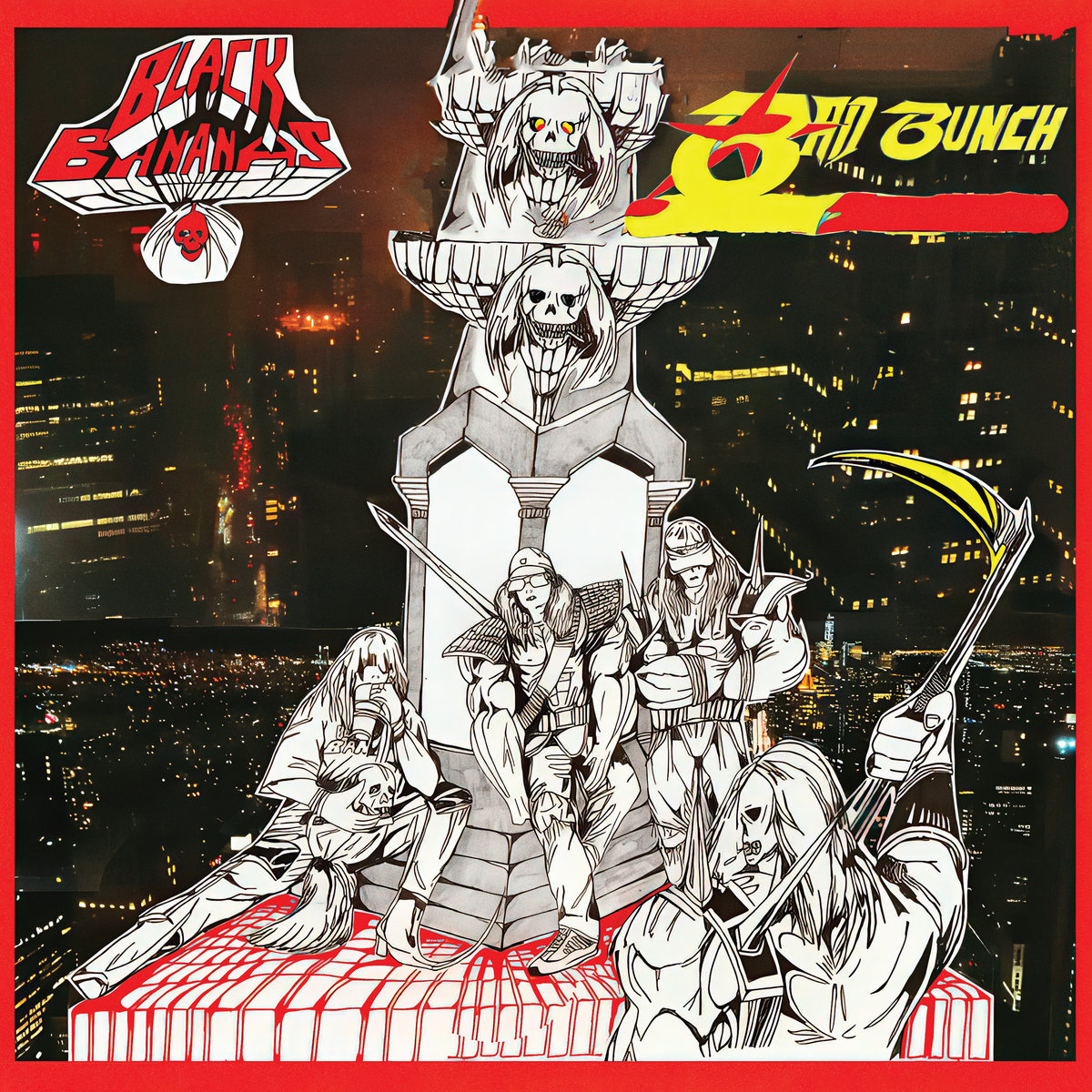
Garnett: I've listened to Bad Bunch quite a bit.
Jennifer: Oh, good.
Garnett: Not yet at the volume I would like, but incrementally louder. The sonics are dense. It's truly a peel-back-the-layers recording. The signposts are obvious to me, yet it was still a surprising record. Maybe piggybacking off "Physical Emotions" [from 2014’s Black Bananas album Electric Brick Wall], but then some serious Coltrane Giant Steps after that. I'd love you to share more about the record.
Jennifer: I think the process that brought it to a resolution, to an end where, okay, this is done, we're turning this in—it ended up being a lot more about removing things and opening up space that we had filled and filled. Of course, I like dense music. But at the same time, because of the layers—I'll say infinite, but obviously not infinite—we had started recording some of it right after the second Black Bananas album, when we still did have the studio, and before the Royal Trux break, as it were. So it was stuff from back then. Stuff from, say, twelve years ago, stuff from ten years ago, stuff from eight years, six years ago. And then we really hit it hard again about three years ago.
There are a lot of songs that we left off the record too, but at a certain point it was listening, and then the ability to remove stuff. I think that's really the first time I've ever finalized a record by editing, by removing, as opposed to by adding or changing. There was a lot of removal.
Garnett: Omission.
Jennifer: Yeah. Yet it still sounds pretty dense to most people. But to me, I'm like, oh, it's so light and so airy now.
Garnett: The song “Dust of Ages” is a few songs before "Tiny Chewbacca." Both stand out to me. “Dust of Ages” is cuckoo. The world of sounds at the song’s end was splintering. Sounds started going upward and then horizontally, and then it started feeling like being inside the game of Tron; everyone's racing at once. You remain a futurist. You very selectively gather from the past to make really wise, curated choices about ideas and sound. And we'll have to get over to your Substack newsletter in a minute.
Jennifer: Oh yeah. Just recently, like a month ago, I started reading my friend's thing, and that's the only time I ever really dealt with Substack. Then I remembered how lazy I am, and I was like, no, let me just write. I gave myself a few assignments about robots and artificial intelligence, and basically tried to really nail down my opinion.
Garnett: One of the things I remember you and I talked about before was your strong opinions and your sense not to offer them unsolicited. And I thought that was really mature in an age when everyone's always giving their hot take. But sometimes I wonder, if nobody speaks up, then maybe something sensible never gets heard.
Jennifer: I hear you on that. My thoughts and ideas are what they are, and they often morph and change with time. I'm always wide open to change. I'm the first person to want to be inclusive and include whatever I can. But at the same time, that's why, with my first Substack newsletters . . . I would love it if somebody had a totally different take that could eradicate the systematic way I see humans being devalued. I would love to hear it. But at the same time, I've thought about it a lot, and what I'm putting down is how I think about it right now. We're mining ourselves to death. There's just going to be nothing left. Who's going to be left to even want to listen to music?
Garnett: The degree to which the culture is memetic is absurd. Okay, I hope that you'll tackle another one. I'll be interested to see the feedback.
Jennifer: I'm also only going to put stuff up when I've got something. I'm not going to just jibber-jabber. I'm not trying to monetize my brain. It's going to go at the pace that it goes.
Garnett: In the second Substack essay, which was much longer and was more interesting to me, you address—I just think of the work you did with Neil and with RTX and Black Bananas—blood, sweat, and tears. And in today’s world we're missing something.
Jennifer: The human element.
Garnett: Yes. And I don't like the idea of flawlessness anyway.
Jennifer: Yeah, there is no such thing.
Garnett: We're all broken, and that's also what's entirely remarkable about the experience of being here. This nullification of humanity is showing up in so many ways. It's the nullification of what vernacular you or I would consider—well, what we just grew up with and understood. Not hierarchies. I imagine there are people walking around who, for whatever reason, don't know what happened before 2000—at all.
Jennifer: Oh, no. Some people were born into this. Some people were basically born into cell phones and social media and never had anything before that. Some people have never seen a record before. It's all Spotify. And the way Spotify did it so sneakily—it wasn't sneaky; there was really nothing you could do about it.
It's so mind-boggling what they have done to devalue human knowledge, art, and work, and bring all the value to themselves, the gatekeepers. Now you can't get out. I've been thinking about this a lot. That's why I finally wrote the Substack essays. I was thinking about it like tomatoes.
Garnett: I love that.
Jennifer: You get an heirloom tomato, and it's crazy looking, with different colors. But someone who's never gone anywhere except to the same grocery store that gets the GMO tomato that looks perfect would see the heirloom and think it's rotten. But it's actually way more nutritious. Things are so upside down. And then at a certain point, once all of the inherent nutrients, or the inherent human aspects of anything, have been turned over so many times, they're gone. And that is finite. You can't get that back by recycling the same thing over and over.
Stay on top of The Tonearm.
Subscribe for exclusive interviews, cultural tip-offs, and community fun.
And your support keeps our site free of advertising and paywalls.
Garnett: Let's talk about synthetics and resisting such. There have been prior conversations about Black Bananas and recycled clothing. What's going on there?
Jennifer: It's all within the same wheelhouse, from the very first record I ever made. I hold on to things that mean something to me, that have purpose, that have the tenacity to continue to exist and not fall apart at the seams when you put them in the washing machine. Things of substance.
I'm not a hoarder, because I do go through every year and get rid of stuff, but this has been a thirty-five-year archive. It's pretty vast. And when you see the kind of clothes people are making today, it's so much junk, and so much of it is synthetic. People are trying to legitimize this shit trash clothing that comes out of sweatshops in China. Nothing is made the way it used to be. Even Levi's, you know what I'm saying?
Garnett: I do.
Jennifer: Things were made to last, up until a certain point where they probably wouldn't say there was planned obsolescence, but there most likely was. So I feel like it is not just a penchant for materialistic things. I want to pass them on into the future. My jeans, I've done so much sewing on them, so much patching. And I know people will appreciate it. Somebody might look at them and say, "Throw that in the garbage," but another person would be like, "Oh my God, this is a creation." So one's trash is another's treasure. That keeps coming up throughout my entire life. Even with Black Bananas.
Garnett: So, the value of these jeans, yours that have been loved on and preserved—will there be a proper venue for them? Will people be buying them? Will it be a brick-and-mortar store?
Jennifer: I have a gallery installation in Tokyo next year. The way I envision it—it'll be an installation, so I'll create the whole room, the scenario, and then a lot of handmade, one-of-a-kind pieces. I'm not sure how I want to display them yet, but they will be displayed along with all sorts of prints, old music posters, and things that people haven't seen that I've collected, that I have from Black Bananas, RTX, Royal Trux, and stuff like that. So it'll be an installation of my life's work, visually, so to speak.
And then I will be selling the pieces next year. At some point, I'm going to figure out how I want to, but there are a few pieces I'm actually going to try to reproduce and put into small production.
Somebody would be like, why would you want to buy that bloody Powell-Peralta T-shirt? There's a story about that blood. Got hit over the head. So I'm not saying, "Oh, I'm so special that my bloody T-shirt is worth more." It's about history. It's about storytelling. It's about preserving the tangible aspects of a life. Because everybody's putting it on the cloud. I don't trust a cloud. It can just disappear, and then everything will be gone. I'm still very much about ownership and tangible things.
Garnett: One of the things I really appreciated, and I'm surely not the only Royal Trux fan, or fan of your successive music after the fact, who felt like the music was something prepared for them. Time and energy went into it, and maybe there are codes to crack. Maybe you'll just put down the windows in your car and play it loudly—say "Waterpark," for instance. But either way, there it was. It was there.
I noticed with Bad Bunch there's no lyric sheet.
Jennifer: Has there ever been?
Garnett: That's a good point. I guess not.
Jennifer: There's never been a lyric sheet. Because—and that's the other thing—my voice, a lot of people say that I slur; they can't exactly say. I'm like, that's fine. You can interpret whatever word you want it to be, because I'm not teaching any kind of lesson here. These are just words I chose mostly because of how they sound coming out of my mouth. At this point I'm not trying to be didactic.
Garnett: So, you're still in Southern California, I believe, not terribly far from the beach. The simple things, like the sand. I think that’s where it’s at.
Jennifer: I absolutely agree. Even when Neil and I chose to be in Virginia, it was to get away from the chaos and dirty streets, whether it be San Francisco, New York City, or Washington, DC. I just didn't want it. And it's not because, oh, I'm better than that. I just can't take it anymore. It is taking up too much of my brain, and I am too much of an empath. I can't see a homeless person lying there all fucked up and not be affected by it. And I'm sorry, I just don't want to be anymore. I don't want to have those kinds of depressing days just because I look down.
And to just enjoy nature—that's what I do. We go to the park numerous times a day with my dog. We can walk to the beach in ten minutes. Right now we're not going to go, because the sand is so hot. But we'll probably go later in the day when the sand has cooled. That's what I do. I don't go out, really.
Garnett: Your life appears vanilla, which seems really crazy to be saying to Jennifer Herrema.
Jennifer: But it is. I don't feel like I'm missing anything. I feel like, holy shit, let me just wait till the rest of the world catches up, and maybe I'll be in lockstep one day. Just by putting my own brakes on, I don't feel like I'm missing anything at all.
But I'm not supposed to feel that way. And younger people and kids definitely aren't supposed to feel that way. They're always supposed to feel that there's something going on, and they've got to be part of it, and they just can't sit still. Sitting still is the best thing in the world when you can do it, relax, enjoy it, and not have FOMO. Then you know you're in a good place in your life.
Garnett: Will Black Bananas tour for Bad Bunch?
Jennifer: We could. I don't tour, basically. I won't leave my house for more than eight days at a time. Maybe five or six shows and then home. I'm not doing the long haul anymore. But yeah, we're open and available. If people act and they've got the money, we will play. It's going to be cool—I think it'll be a really cool live experience. But we don't have anything set up currently. I'll let the people handle that.
Making the record itself is not a vehicle to initiate a tour. It's just an artifact. But I enjoy always having that project and those things in my head where I'm like, oh man, I can hear that, and wanting to bring it to fruition. It's just because I thought of it and I want to do it.
Garnett: That's evident in your art all the way to the beginning, to your point. It was, we're going to do this thing, and people will have an opinion or they won't, and they’ll buy it or they won't.
Jennifer: If you're so inclined, listen to the record—not you, because I know you have—but that's really all it amounts to. There's really not a whole lot to talk about other than just hear it. There's a lot to talk about, but really, if you want to hear it, you hear it.
Check out more like this:
 Jonah Evans
 Steven Garnett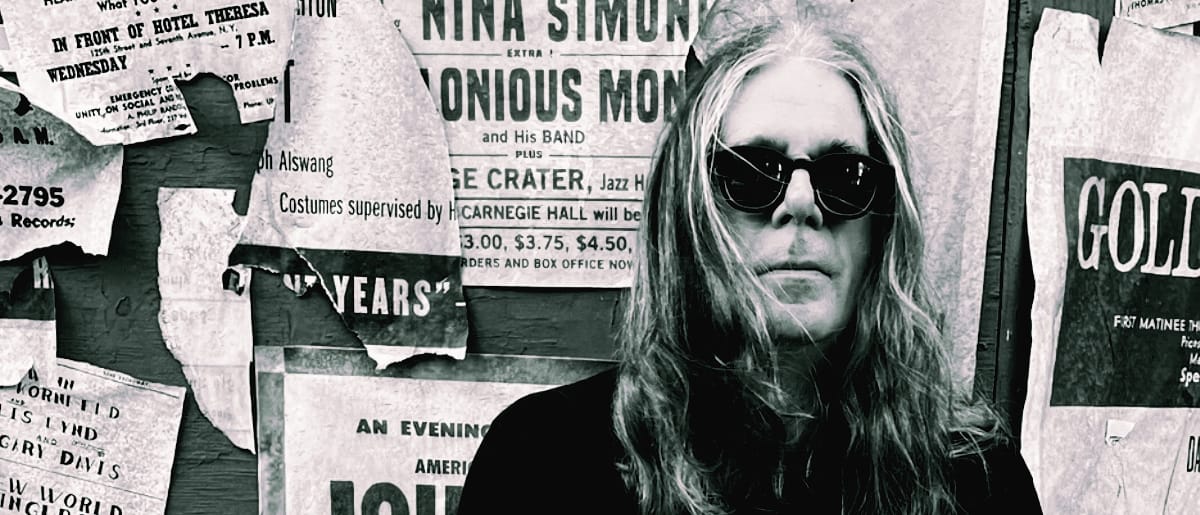


Comments