


I chickened out the evening of November 17, 2017. In a packed local club, Retrovirus members were ambling about the room. I knew this would be one hot show and a history lesson, with Lydia Lunch's rock-and-roll discography performed live. The band included Tim Dahl, Weasel Walter, and Bob Bert. I'd not seen Bob Bert perform, missing live incarnations of then-Sonic Youth, overlooking Pussy Galore gigs, and related misfortune as concerns Action Swingers, Chrome Cranks, and Wolfmanhattan Project. All these bands were better because Bob Bert consistently advanced the sound from behind a drum kit. His kits were sometimes modified with scrap metal, à la PG or streamlined, garage-style. Whatever sundry school.
Understand me; that November night Bob Bert walked right past me, and I stood slack-jawed and flustered. I'd been unable to muster a hello to a musician I've long admired. But it turns out he's eminently approachable. I learned so via video chat, discussing his first solo album, released by Bar/None Records and titled Beach Bongo Bloodbath.
Some notes about this record. It's artsy, damaged, sentimental, campy, serious, a standalone aural vision across the river from the Bob Bert of "Undertaker" (PG) kablam where Nuggets transfigure to bullion or whiskey-soured charm slithers in "Soda Pop Girl" (Knoxville Girls) and closer to a spattered silkscreen from Warhol days washed ashore at Pier A Park. With BBB, he covers Mountain and Richard Hell, brings Julia Cafritz in for a Pussy Galore cover, and liberally doses the album with proto-Devo originals projecting head, heart, and humor, and without guitars. It's incomparable; only Bob Bert's muses could inspire a sonically reduced "Won't you join me?" of his rich life experiences. Ladies and gentlemen, Bob Bert.
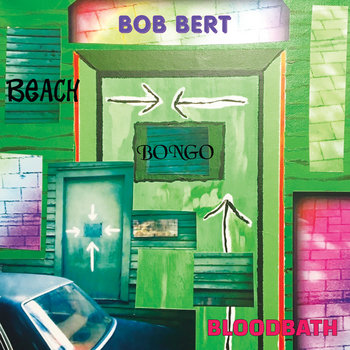
Steven Garnett: I read the 2018 Please Kill Me interview you did, which was dynamite and gave me some background on your upbringing. You talked about the SoHo jazz loft era, which is something I didn't know much about.
Bob Bert: Yeah, and it wasn't primarily SoHo. I remember seeing Don Cherry play in a loft somewhere—I think it was more in Chelsea. And even some punk rock shows were just held in these lofts. But yeah, there used to be loft things going on all the time back then.
One time—it must have been around '75—I saw this little ad in the Village Voice. There was a picture of the poet Rimbaud, titled 'Rock and Rimbaud,' and it just had an address on 14th Street. So I went there, and I saw the Patti Smith Group in somebody's living room. Things were much cooler back then.
Steven: I'm waiting for that third pressing of your book, I'm Just the Drummer. Of course, you're not just a drummer. You were there for Patti Smith Group, No Wave, and there's perhaps nobody who's a better signifier of all these NYC music origins than the guy up on the stage behind the kit who's watching it all happen. Riff on that if you have something.
Bob: I played drums and took drum lessons for a year when I was twelve. Then, when I moved out of my house at eighteen, I had no intention of being a musician. I was obsessed with Andy Warhol, so I went to the School of Visual Arts and learned how to be a silkscreen printer. I actually ended up having a job printing Andy's artwork.
Before that, I worked in SoHo at a printing shop. It was great because SoHo in the late seventies was all art galleries and record stores—real bohemian. One day, this girl I worked with showed me the No New York compilation record that had just come out. I became obsessed with it and soon started going to see any formation of anybody who had their mugshot on the back cover of that record. And even when that record came out, Teenage Jesus and the Jerks was already done, and Mars was already done. I became a big Lydia fan and started going to see 8 Eyed Spy all the time. It wasn't until that period that I realized you didn't have to be so technically skilled to make music.
I was always going to shows. I discovered CBGBs in '75 and started going there like four times a week, seeing all these bands—the drummers were all like Clem Burke and Jerry Nolan, everybody was just amazing. So it never even occurred to me that I could be part of that. I was just a fan.
I was living in Manhattan at the time, where I met my future wife. One night, we were at a show when one of the band's members didn't show up. They said, 'Is there a drummer in the house?' And my Linda was like, 'Yeah, Bob is.' So I got up on stage and started playing with these two guys, and that ended up being my first band. I just never stopped. I enjoyed that more than painting in my room or whatever.
Steven: Tell me about your time with Sonic Youth.
Bob: I was still working in SoHo, and I was familiar with Sonic Youth because of an article I read in the New York Rocker, where Glenn Branca said he was starting a label and that his first release would be the band Sonic Youth. So I bought their record as soon as I saw it and really liked it—the first EP, still one of my favorite Sonic Youth records. I went to see them a few times with Richard Edson [their first drummer].
Then one day I went into the same record store where I bought that record, and there was a flyer on the wall that said 'Sonic Youth Needs a Drummer.' I took it off the wall. I still have it. It's funny because I didn't realize until I just read Thurston Moore's book a couple of years ago that I was actually the only person who called up. But that's how I got into playing with them.
The thing is, I was still pretty primitive when I joined Sonic Youth, and I was with them when they were writing all the songs for Confusion Is Sex. I went on their first tour, which was down south with the Swans in 1982. There was a second part of the tour, and after the first part, they fired me and hired some guy who couldn't do the second part. So then they asked me to do that. It was very nice of me, after they fired me, to get back in and play with them. So I finished that tour with them, and when we got back, they replaced me with Jim Sclavunos, who ended up doing only a couple of shows but played on 99% of Confusion Is Sex. Then he split.
In the meantime, while I wasn't in Sonic Youth, I was rehearsing with other people, and my drumming improved a lot. Sonic Youth had this show coming up—a little festival in an art gallery called the Speed Trials. It was like five nights of shows: the fifteen-year-old Beastie Boys, the Swans, the Fall, Lydia, Arto Lindsay, all these different noise bands. So I played that show with them, and the day after, Thurston and Lee were leaving to tour Europe with Glenn Branca. While they were there, they were setting up the first Sonic Youth tour. So after I played the Speed Trials show, we went across the street to the bar, and they were asking me to go to Europe with them.
I said I'd go under two conditions: A, it's not going to cost me a penny, and B, you're not going to fire me when we get back. Agreed. And so it went on from there. After we got back, I recorded the Kill Your Idols EP with them, and then we did Bad Moon Rising, which was the first full album I ever played on. It's amazing that people are still talking about it and keep coming up to me to tell me how that record affected them.
Steven: What also affected me very much was when you collaborated with Jon Spencer and the gang. Right now, the Pussy Galore records—the way they move and especially the production on Dial 'M' for Motherfucker are really interesting to me. The weird cutups and, I guess, the hip-hop kind of stuff, but your percussion is prevalent. Even that last record you did with just Neil and Jon and songs like "Mono! Man" are just so straight-ahead and weird. Boogie metallic, Pussy Galore.
Bob: It was interesting playing that weird setup. By that point, I was starting to kick ass, and it wasn't easy because hitting a piece of metal with a metal rod doesn't have the same give as hitting a drum with a stick. So yeah, that was a pretty intense bunch of years. And I was also ten years older than them, which was a generation gap right there—going from Sonic Youth, where we came out of the same scene and went to a lot of the same shows.
Steven: So I'm listening to Beach Bongo Bloodbath, I'm reading Lydia Lunch's liner notes, which are lovely. I know that you two are close, and I think there's a mutual fondness that's evident. As always, one with words, she probably wrote the best possible record review.
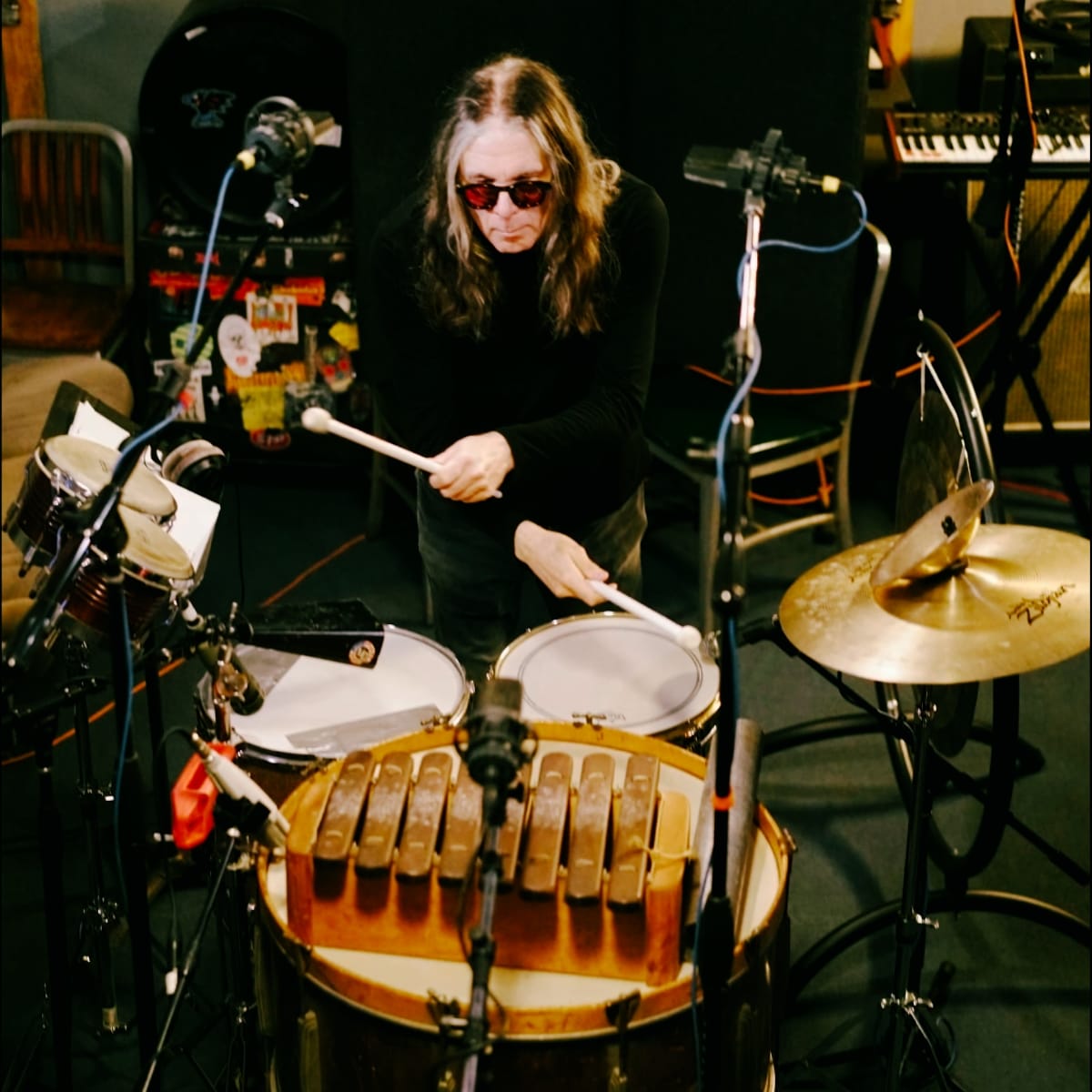
But some sonics caught my attention. I also did a deep dive into ESP-Disk' when those reissues rolled out—Fugs, etc.—and I was into Silver Apples. And I always had a fondness for—not always, but as an adult exploring the undergrounds of the past, camp, but also hijinks and slapstick. There's something about all of the world you've lived in, reduced in this record to your few friends, this percussion, and some electronics that are pretty awesome. You get the cowbell intro to "Mississippi Queen," but instead of Leslie West's riffs, you're playing the drums for it—which then reminds me that, yeah, Leslie West's riffs were percussive. And then when his guitar solo comes, you audibly mimic, perhaps, somebody's own vigorous solo act. And your version of the Velvet Underground's "Foggy Notion" reminds me of the opening of "Little Darlin'" by The Diamonds and Lou Reed's Pickwick records. Anyway, those are a couple of record-reviewer feelings, but please throw some more light on that process and what you were going for.
Bob: From 2012 until 2023, I was touring a lot with Lydia and then again with Jon Spencer and the HITmakers. They both came to an end around the same time, which was good for me because my girlfriend had some health issues. Once again, for the second time in my life, I became a caregiver, and I couldn't travel anywhere.
Then someone asked me to do some solo shows. So I took it on, put together this weird percussion setup, and did about four shows. Most of the songs I did during those shows are on the album. I'm very lucky that right here in Hoboken, for the longest time, I've shared a recording studio and practice space with my close friend Mark C from the band Live Skull. I just thought, "Yeah, I'm going to lay this stuff down." It wasn't like I went in there and made this record. It was like I laid down basic tracks, then I would listen to them for a month, go back, figure out what they needed, and go back. So it was actually recorded over many months. The actual recording time in the studio was probably about six days if you add it all up.
It wasn't like any kind of ego thing; I was just having fun. I wasn't taking it seriously. I didn't even know if it would end up being a record. But I kept working on it, and then all of a sudden I'm like, "Hey, this is pretty cool." Bar/None Records happens to be right in the same building, so I passed it along to them. They really dug it, and offered to put it out, which was awesome because it's also their fortieth anniversary.
Steven: So it strikes me then—since you're an oral historian who has also now written this history [I'm Just the Drummer]—that the music is a nod to your personal musical lineage. The album has this Bob Bert-is-from-New-Jersey-and-here's-all-this-AM-radio-music quality in which he consolidated fifty, sixty years of living and performing into a really small and cozy record.
Bob: I'm glad you feel that way, and I'm glad other people do too, because I wasn't sure. It's funny—I gave it to Bar/None Records, and they didn't respond for a couple of days. Finally, I wrote them and just said, 'Crickets don't sound good.' Then Emmy, who's now taken over the label, wrote back in all capital letters: JUST THE OPPOSITE. And I sent it to Lydia, and she came up with that great blurb. She's the highest form of approval I needed.
Steven: It's a nicely distilled history lesson, and it clearly speaks to things you care about. One of the things I'm wondering about—I'm going to take you back to when you were a kid. You've left, you told your folks you're not going to go to church anymore, you get the drum set, but you're in a stable household. Your father had a notable football career. I got the impression that your mom was around and that you were loved.
Bob: Oh yeah. I was the youngest of four kids. There was an age difference between me and my next sibling—a good five years or whatever. So by the time they got to me, everything was pretty mellowed out. I grew up in the sixties and was immediately attracted to the counterculture. I was like fourteen in 1969 and started taking acid, smoking pot, listening to psychedelic music, and being a hippie. But even though it was only ten miles outside of New York City, it was like Leave It to Beaver-ville in the suburbs. I remember Lydia Lunch once telling me I was the only one she knew who liked my parents.
Steven: You said you'd been a caretaker before. Were you helping your folks there, or—
Bob: No. Linda Wolfe was my first experience as a caregiver, and that was really heavy-duty. She probably lived five years longer than she should have. At the point where it was constant hospital—she was in bed hooked up to oxygen twenty-four/seven—there were a couple of years where I couldn't leave the house for more than half an hour, and that was just to go to the pharmacy.
Steven: Lydia is right. There's something really nice about the ordinariness of your upbringing that allows you to be somebody who's an adult, who can travel the globe, be a hitmaker, and then take care of the people around them.
Bob: Yeah. I'm very fortunate for a lot of things. Lydia refers to me as a saint.
Steven: She is a sinner.
Bob: Yeah. That's for sure.
Check out more like this:
 Jonah Evans
 Steven Garnett


Comments