


When I listen to Internal Drone Infinity by the Winnipeg, Manitoba, band Living Hour, I think about memory and what it might mean to each person in the world. There are ways to carry fond nostalgia in memory, ways to be stuck in memory and removed from the present, ways to heal from a memory, or ways for a memory to be glorious. A picture, an action, a sensation like smell or sight, or sound. Incorporated with their easy-on-the-ears, fine-tempered dream pop and shoegaze sound that evokes the imagery of long drives and autumn leaves tracing the contours of the wind as they fall willingly from branches, the lyrics are sticky, thought-evoking expressions that leave room for interpretation. Such as lyrics in the title track and the first song, "Internal Drone Infinity," near the end of the song: "Bloated, metal, summer, planning, remembering / Like a shell inside another one / It's ambient, it's harmony / Skin inside a jacket / It's internal drone infinity." I get so many sensations hearing and seeing those lyrics. It feels like being happy, cold, contemplative, sad, tingly all at once and all at different times. It's memory too, or it's the thought of these sensations through memory.
The band also has a tangible, bellowing tenderness in their sound. Such as in the song "Texting," Sam Sarty sings in the most mellow, misty tone, where sometimes it's easy to wonder if she'll finish the words as they're drawn out to the tip of the tongue. The song introduces different instruments gradually through its progression, becoming ever-so-slightly more involved minute by minute. Or, such as in "Best I Did It," when Sarty starts singing, there's only one guitar playing with her before the drums come in, a simple strum. And a strum that outlines the texture of the song, while giving space to Sarty's voice. Distortion and more guitars come in the chorus, but the purpose of the instrument doesn't waver in its steadiness until the outro of the chorus with beautiful, subtle wailing. Isaac Tate's drums are at ease while escalating with the instruments during the chorus. Sarty's voice oscillates effortlessly between pitches, with a tinge of rasp and a smooth, booming resonance.
Thinking about how the songs are composed and listening to the spacing, it becomes clear that Living Hour are incredibly thoughtful in the arrangement of their songs and instruments. Every instrument has its time to serve the song, but the band tempers spacing and placement, I think, with love. It's an ethereal motif that leaves space for all that humanity, emotion, and feeling it all. Some bands do this through anger, but Living Hour does it through love and patience, and sitting in all of it. I like that because sometimes it's easy to contemplate life through rage, but it can feel good to process with love, grace, and patience as well.
In an article called "Yearncore: Why Songs That Ache Are Going Viral on TikTok and Other Social Platforms," one of the resonating factors is that "yearncore reaches back toward a softer, safer time, recalling analog sounds and filters from decades past. It's not just about memory. It's a memory of a place that probably never really existed." I don't know about the memories that never existed because association to memory or desire, or yearning, can be just that, associative, or literal. And many times, memory can be quite foggy. Still, Internal Drone Infinity reaches its arms out to touch, to feel something inside, to remember, to be okay, and maybe, to heal.
The following interview has been edited for length and clarity.
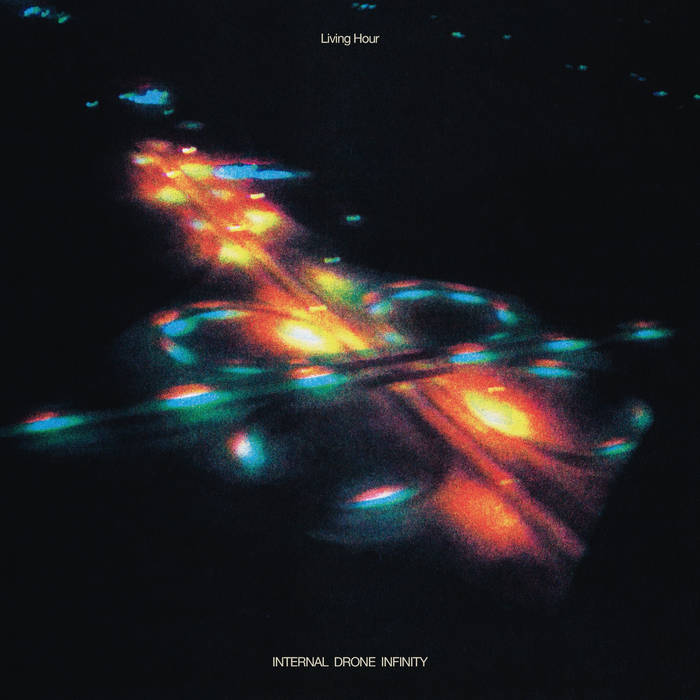
Jonah Evans: How are you guys feeling about the release of the album, Internal Drone Infinity? And I’d love to know the story behind the cover photo.
Sam Sarty: Yeah, it feels good that it's released and it exists in physical form. It's been done for almost a year. We have one right here. It's staring at me.
This is like a picture I took out of an airplane window of a highway outside Winnipeg; they call it the Perimeter Highway because it encircles Winnipeg. To get on and off, you have to go on these weird, little on-ramps, but they all look like a clover at four different corners of the city. I took this picture on my phone, and then our friend Claire made it look beautiful. She put it through a risograph machine and made it all textured.
Jonah: What drew you to making that photo the album cover art?
Sam: Winnipeg was a place that we moved to when I was super young, and I just grew up here. It's very much home and like a place I love, but it's also sometimes difficult to live in, just because we're so isolated and it gets so cold. But it's also what makes it special. We're outside when we're outside, and then when it's freezing, we're inside. There are so many seasons in this place, and really, I think they affect the community and the general vibe in the city. It affects the songwriting, too.
Gilad Carroll: And I feel like using the photo taken from the airplane—there's some symbolism there. With coming home and also being away, and complicated emotions that come with that, and the idea of flights.
Sam: I liked that it was taken on a phone, just quick, and then we made it beautiful. I don't even know why I took that picture. It's just, “Oh, that's—look at that thing.” I see it all the time from like ground level. But to see it from above, that shift of perspective of when you leave home . . . you think the grass is greener, and then you come back, and you're like, “Oh yeah, there's a reason I'm staying here.”
Jonah: Can you name any direct inspirations from Winnipeg that inspire the music?
Sam: There are these little spots that never really change in Winnipeg. For example, at the end of our street, there was a fire two years ago, I think. Half of this house was set on fire, and it hasn't changed for two years. Seeing how that weathers throughout time helps me find lyrics. But also living in this house has been a really big inspiration for us, like just constantly being around the instruments and having that access to each other. So, Gil will hear me playing guitar, come downstairs, play drums, and we'll figure stuff out that way.
Gil: And I think Winnipeg has a unique music and arts scene in the sense that it's a very supportive community. We've benefited a lot over the years from being a band here, getting out to play new songs, experimenting, and just being around cool, supportive people. Not just musicians, but visual artists and filmmakers we're friends with and look up to. This has shaped our music and our view of art quite a bit.
Jonah: I saw a video clip of the band where everyone was playing the drums, switching back and forth. And then I think you [Gil] were doing cartwheels, and then Brett was emo screaming. It seems like you guys have a lot of joy and care for each other.
Sam: Totally. We've had different members and eras, and this feels like such a new chapter. It just feels like we're in a really good place, musically, but also, in a relationship with each other; it feels very positive, and we're locked in, especially when we go on tour. It's exciting. I get to hang out with my guys for weeks, and it's so fun.
Gil: We're like a little family, and especially when we're recording. When we're in the studio, we tend to do very long sessions and marathon days. And I don't think we could do that if we didn't get along and respect each other. And then on the road, we're like a family unit. We all stay in one hotel room, we all know each other's food preferences and sleep patterns, and all that. And so it's very intimate in that way.
Jonah: When I was listening to the album, the last song, "Things Will Remain," stood out. There's a lyric: "Almost didn't take a photo / But I'm glad I did." It made me think about using social media while still appreciating the things around you. Recognizing you actually do want to take that picture and remember it for yourself, not for everyone else.
Sam: Ever since I got a cell phone, I’m like, "Ooh, is this a picture for me or is this a picture for Instagram, or is this gonna be perceived later, or is this just what this moment is like?" I think something’s so beautiful that I can't describe it, so I'm gonna have to take a picture, but I'm also compulsive, so I have to document. But then I look at it 10 minutes later, and I’m almost nostalgic for that moment that just happened when I took the picture. I’m like, “Why couldn't I have just been present in that moment and just look at it?”
But then I remember I wanna see it later. And I also wanna share it. I get home, and I have my special person, or I'll say, “Gil, hey, check this out.” And to just have that connection of "Oh, you think it's cool too?" Yeah, I guess that's what that's about.
Jonah: Then what are you guys thinking about when mixing digital with analog or earthy sounds? In "Stainless Steel Dream," there's an electronic beginning. Also, in "Fire Trap," there are electronics near the end.
Sam: That's pretty top of mind. We're talking through a computer and then having a phone nearby all the time, just constant. It's just so ingrained in what you do day to day, and I feel like maybe there's a way to exist in it without it having all the control. I could use it as a tool or collaborate with whatever's happening, like a guitar pedal or a weird drum machine that's short-circuiting. We can make something out of it and collaborate. Instead of it just being like, cell phone sucking all your energy, doom scrolling, that feels like a very one-way conversation.
The digital sounds you're hearing, like in "Stainless Steel Dream" and "Fire Trap," are very much a collaboration with the instrument, and seeing what can happen. Like Isaac, our drummer, finished all of his drum takes, and he was quiet for days while we were recording other stuff. He had headphones on, hacking into this really messed-up drum machine. And he presented—like presenting to a class—all the beats that he made, and we're like, “These are amazing. We should put them in the album.”
Gil: I think that is an example of the creative world that we like to exist in. When we're in the studio, everyone is encouraged to figure out cool new things and try new instruments. Then we often end up incorporating them. Like the thing right at the start of "Stainless Steel Dream." It piques people's interest, grabs them, and then cuts hard to Sam's pretty voice. Doing that kind of stuff is always just fun from a musical standpoint.
Jonah: How would your songwriting processes come into play?
Sam: For this record, I would write a beginning idea on guitar, baritone, or bass. Gil would come down and play drums, and we would work on it until it had a bit of a form and maybe some AB parts—ideas that we could just stick together. Then, Isaac and Brett and Sully would come over, and there'd be five of us in this little room and try and play together. We would figure out parts from there, and everyone has ideas. I don’t put lyrics to it until the end.
Jonah: How do you develop meaning and connection in the songs?
Sam: It almost feels more surgical or something, where this happens, and then this happens, just to massage out the ‘how.’ But then the ‘why’ will always exist in there.
One song we played live for a while but didn't record until this record is "Half Can," and I remember I wrote that one on bass. It was a solo song, something I liked to sing. And then we fleshed it out. For me, a big part of the connection is the words that I put in there. Especially "Texting," that one is so long, and it was a challenge to myself and the band, where I was like, “What if we made a song that has a lot of words?”
I'm imagining how much I've texted—just all the words that you write into a cell phone. Where are they now? But also thinking of texting in another way, like where I'm trying to describe Winnipeg or what I see to someone who has never been here.
Gil: It’s sometimes intense, I must say, to be in the band where Sam writes most of the lyrics, and then we'll play a song, and I look over, and Sam is near tears. A lot of the words are emotional or draw from inner feelings, even if they're not the most specific thing ever. You feel it.
Sam: Yeah. I'll be saying “milk crate,” but to me, it's tied to this specific memory. And then I'm like crying, and they're like, "Why are you crying? You're just saying ‘milk crate’."
Jonah: Do you test the lyrics in songs even before they’re done?
Sam: Yeah, big time. I have lots of journals and notes. I got this huge roll of paper from Ikea's kids' section. It's so cheap. I recommend it to everyone. I just roll the paper and pull it out. It can be as big as you want it, and then I'll write all my favorite sections of notebooks. I'll rewrite them, then have them out in front of me, playing guitar, and try out different things.
Jonah: That's such a cool way to experiment with lyrics. It's like allowing yourself to self-revise in your head what works and what doesn't.
I'm going to pull up a quote from an interview in the Thanks For Coming blog. Sam was asked what you hope listeners take away from Internal Drone Infinity, and you said, “There's a lot of remembering and recovering—getting better and understanding who I am based on who I have been. I hope listeners find some peace in themselves while listening to our new songs.” What is it about recovering, getting better, and finding peace that is important to you and Gil?
Sam: When we were writing a lot of the songs, certain words kept coming up before there were lyrics, and one of the words was "better." "Even" was another big one. "Even" and "better." It's like a lifelong journey to get better or to aim in that general direction of just feeling good, especially if you don't all the time, which I'm sure is common with lots of people. I also say "medicine" a lot, trying to figure out how to get better.
It helps a lot. I see it as little mini microdoses. You sing a song, you listen to a song, and it just hits your brain for two minutes, and sometimes changes your thoughts. I hope that maybe happens to people who listen to our songs.
Gil: It's really amazing, honestly, because Sam and I have been musical collaborators for so long, for over 12 years. It’s super cool to hear Sam's lyrics and how they've shifted over the years. Her ability to express such vivid lyricism and poetry is really cool, especially seeing it in real time, when I see her holding a journal and trying out different phrasings and words. Sometimes it's even sad to hear her reference things or suggest processing difficult times, past relationships, or whatever. It's sometimes heavy, but in a good way, because I know from being around her and playing the music that it does have that kind of healing power. It doesn't necessarily change bad things, but it can help heal, I think, and also shift perspective or give hope.
But not all of it is that heavy. Some of it is just fun wordplay or cute stuff. But that's cool, too, because I can hear influences and references of artists that we love or have listened to together over the years coming out in the music we write, and that's also a neat thing.
Sam: I've had a lot of people throughout the years, even at merch tables, just talk. Whenever I feel down about music, because I sometimes get down about it in general . . . ”The industry's fucked! What's going on? Why am I doing this?” It's so messed up. But then, to remind yourself that music is such a powerful entity. I feel like humans deserve to hear and experience music. And yeah, people at the merch table have been like, "This song has helped me." And I'm like, okay, that's really cool.
Jonah: So, what's Yearncore? Do you still subscribe to that also?
Sam: (laughs) Yeah. I do.
Jonah: Tell me about it.
Sam: I feel like I struggle with a lot, just living in Winnipeg. Sometimes you feel really far away from things, not only geographically, but just opportunity-wise. We're also a Canadian band, and we have to get visas to come to the States. It just feels sometimes so out of reach. It's so different, what we're experiencing day to day, yearning for another life or situation. And then snapping back to reality and reminding yourself, “Okay, now everything's fine.” It's that flip-flop feeling of over there, over here.
There's another Winnipeg band, The Weakerthans, who have an album called Left and Leaving. That really resonates with the experience of being here. It's who's left, who's leaving, who's come back, and just that. So yeah, yearning.
Gil: And I think you can also just hear it in your voice sometimes, like on "Texting." It's got that kind of reaching-for-something quality to it.
Sam: Yeah, yearning to get better or to move forward or just to reach. And "Things Will Remain," like yearning just to keep that in your mind almost forever. I'm yearning for that too, I guess, to hold.
Check out more like this:
 Peter Thomas Webb
 Jonah Evans


Comments