


Dark and light are a false binary; that's what I came to realize during my conversation with composer, fiddler, and vocalist Zosha Warpeha. In familiarizing myself with her work, perhaps drawing from my own macabre-leaning sensibility, I got so swept up in its details that could be construed as spooky that I nearly missed its truer focus. Though her recent album I grow accustomed to the dark indeed references darkness in its title, the emphasis is not to be placed there but on the "grow accustomed" part. Though Orbweaver, Warpeha's collaboration with Mariel Terán, may reference a spider, oftentimes considered scary, what is an orb-weaver but a small animal, its spiderly brethren strewn across the globe; one that builds intricate webs that catch dew and glow brightly in the sun; one that adapts to a changing planet and finds its ways to thrive?
Warpeha's manner and approach to creating music are much more in line with turning toward the light than brooding in darkness. Her presence throughout our virtual conversation is warm and generous. She responds good-naturedly to my observations that there are some somber tones and nods to shadowy places and arachnids in her work—she has heard it all before. It is much more interesting to hear her gently nudge these perceptions aside to illuminate the process behind capturing her instrument's unique resonance (sympathetic strings and all) in studio spaces of various sizes, and share her infectious enthusiasm for fiddles and folk traditions.
As passionate as she is about preserving the folk music she has learned and loved—first at the New School of Jazz & Contemporary Music and Eugene Lang College in New York City, then as she obtained her master's degree in Nordic folk music performance from the Norwegian Academy of Music in Oslo—Warpeha takes care to approach it through a contemporary lens rather than to freeze it in time. The result is a channeling, a gentle orientation to the current moment informed by a time-honored approach to craft.
Meredith Hobbs Coons: Your new album is called I grow accustomed to the dark. What is your relationship to darkness?
Zosha Warpeha: Darkness is really interesting. I've started thinking about it a lot from a photography perspective. I do a lot of film photography. I don't work much in a darkroom at the moment; I only have a little bit, but I really love the detail, depth, and shadows in black-and-white photography. As far as the title, this is more about growing used to something dark and murky, the idea of dilation, if you're sitting in a dark room and your eyes are slowly getting adjusted to that room, bringing out all the details and the shadows, like developing a photograph. In my music, I've realized that as you listen, or as I am playing, more is revealed over time in a similar way.
Meredith: You've mentioned shadows a few times, and you have some spooky themes in your work. Are you kind of a spooky person?
Zosha: People have said that a lot about my music. I remember one time when I was young—early college—I played a show back home, and I had played a lot of slow, kind of sad songs the whole time. Some older person from the scene I came up in was talking to my parents, and he was like, 'Is everything okay?' It was so sweet. But I'm not a melancholy person at all. I am drawn to those sounds and the depth of a melody that is melancholy. I guess I do play a lot of what you might consider dark music, but I'm not spooky. Maybe I should be more mysterious. Maybe I should brand myself as a spooky person.
Meredith: Maybe you are working toward some subconscious branding. You've released an album called Orbweaver, which is a reference to spiders; this album is titled I grow accustomed to the dark; you've played in a former mausoleum . . .
Zosha: My first time playing in a resonant space was in an actual mausoleum (Emanuel Vigeland Museum in Oslo, Norway), but that was just the experience that turned me on to this idea of playing in resonant spaces. I swear it's not spooky, though. It's just the glory of the reverb and the spirit of a room, not really in the sense of something supernatural or anything. I think a room has so much life to it, such a personality. When I entered that mausoleum, I was like, 'Oh my God, there's twelve seconds of reverb.' I was hearing the echoes of my playing, and hearing the room speaking back to me in a way that I'd never experienced before. We recorded this album in a very grand, cavernous, marble-lined room—not in a spooky place. I thought it was an old bank, but someone recently told me it was the old New York City teachers' union or something back in the day. That's ISSUE Project Room in Brooklyn. It happens that a lot of resonant spaces are these very dark, creepy, stone spaces—like crypts and mausoleums.
Meredith: That's so interesting. I think some of these key words stand out in the description of your past and current work, like 'mausoleum' and 'dark,' but it's more about finding the light.
Zosha: Yeah, for sure. Always. Finding the life and the breath in the room, in the music, and the more organic way that the sound comes out and takes on a life of its own.
Meredith: What does it feel like for you to experience that?
Zosha: Amazing. It's inspiring. One of the things that attracted me to the instrument I play is its sympathetic strings, which have resonance and built-in reverb. Sometimes the resonance is so strong and lingering. When I started playing this instrument, it was like I could focus on the breath in between phrases and the transience between things, and that really feels the same as being in a reverberant space where I can slow down a little bit, not having to rush into the next thought, and continuing in the stream of consciousness. There's so much power in stopping and letting there be a breath. It feels calming for me.
Meredith: That's beautiful. How does that translate for you, spiritually or socially?
Zosha: Generally, whether I'm playing in a reverberant space or not, I think that my performance practice these days is the only place where I can reach a totally meditative, clear-minded state. I'm not thinking about what I'm playing when I'm performing. In my day-to-day, my mind is bouncing everywhere, and when I'm talking to people, I go off on little tangents here and there. But when I pick up my instrument and sink into that flow state, that's the most clear-minded I will be all day or all week. It's not necessarily a spiritual practice, but adjacent to a meditative practice—a centering and grounding practice.
Meredith: I feel like I'm learning from you right now, maybe pauses are more powerful than we think—and resonances. Can you describe the relationship of singing and playing this instrument in these spaces that carry their own sort of resonance?
Zosha: Singing and playing my instrument at the same time feels very fluid and organic. I think that string instruments are vocal in the way that they sound and the way that they're played. These days, the fiddle is an extension of my voice, and vice versa, so when I'm doing those things together, I'm always trying to create a unified tone. The voice is never meant to be on top of the instrument; it's creating a woven core of sound. Sometimes, when I'm playing and hearing the sound of the room, the way that the room speaks back to the fiddle is different from how it speaks back to the voice. So even though I'm making that unified tone with my fiddle and voice together, sometimes the voice is what's carrying most—the way that it projects, or the way that it's directional—rather than the instrument. I'm able to cast my voice into the ceiling, whereas the sound of the fiddle might live a little bit lower. It opens up a different form of exploration for me.
Meredith: So there's a spatial relationship to it. How do you capture that when recording it with that concept in mind?
Zosha: With any reverberant space, you have to figure out where the sound is traveling and what you want to bring out. The engineer who worked with me on this record, Pete Lanctot, and I explored the space. We had a trial run setting up mics in every position in the room and listening back to what was reaching them. We moved the same microphone around so we could test all the locations. When it came time for the recording itself, we probably used ten microphones in total—or eight with a couple of stereo options—with one near me and one behind me, forming the core of the tone. Then some were maybe ten feet away, then another pair were positioned twenty feet away and fifteen feet high in the corners of the room to get the sounds projecting toward the ceiling. We also had some mics way behind me in these creepy little alcoves of the room to capture the weird sounds bouncing in those corners. Then the mixing engineer worked to figure out the blend that would give the feeling of being in the room, creating a dynamic journey through the sound's evolution on the record.
Meredith: That sounds like such a unique and intentional process.
Zosha: A lot of my process in exploring a space is just walking around and playing and singing in different parts of the room, hearing how it is coming back to me when I'm in the middle of the room versus the side, versus sitting on the floor; how it spatializes as my body moves around, and how it would be spatialized to a listener in a different area of the room.
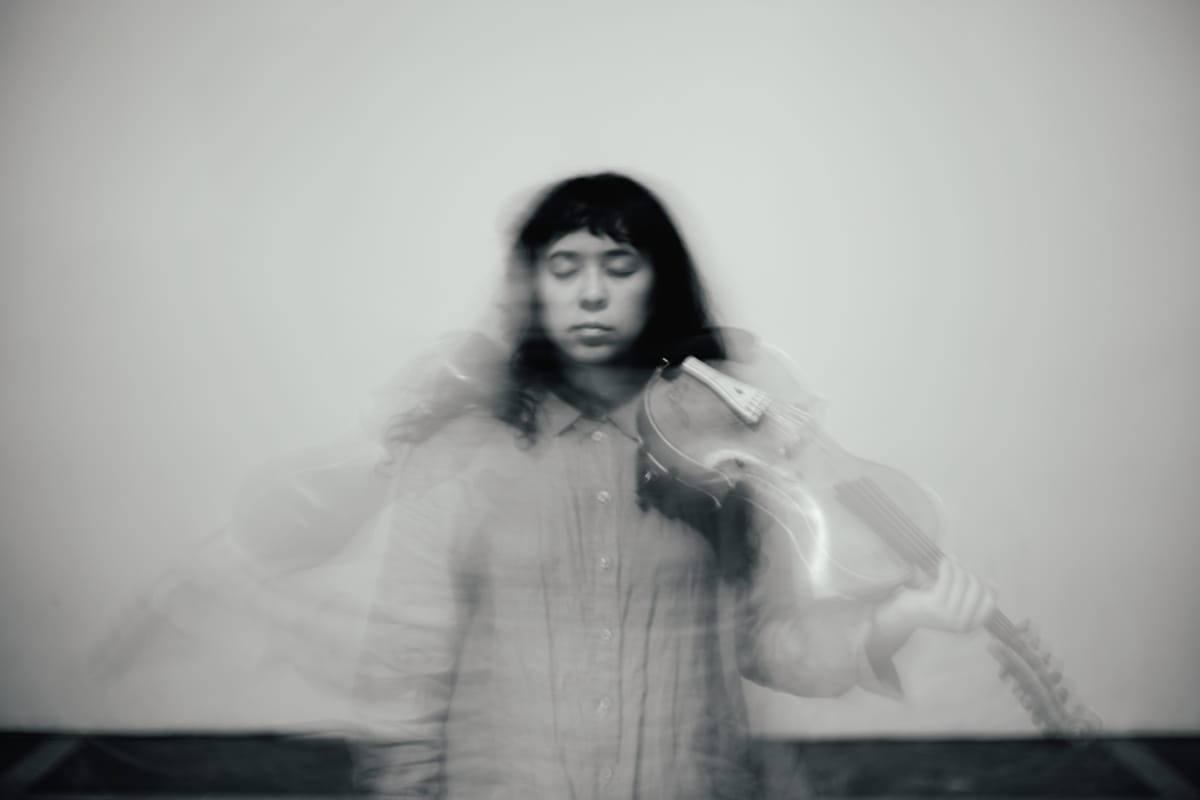
Meredith: Do you find that you've developed a preference for recording in the big reverberant spaces? Or is that more of a byproduct of the residencies that are available to you?
Zosha: I love playing in reverberant spaces, and when a space opens up to me, or there's a performance opportunity in a reverberant space, I always go for it, but I also really appreciate a very intimate, more dry recording. And actually, the last two things I've released, like Orbweaver, were recorded in small, not very reverberant rooms, with intimate mic'ing setups. And my first solo record, Silver Dawn, also used many mics scattered throughout the room, but in a much drier space. You get a different kind of intimacy and vulnerability in that recording process.
There's a record I've been listening to recently by Eyvind Kang, who's a great violist and viola d'amore player that I've looked up to for many years. It's a solo viola d'amore album, so you really hear the sympathetic strings in that. It's very similar to my instrument, just bigger and lower, and it's such an intimate recording, not in a resonant space at all. You hear the instrument and its resonance, this tactility where it feels like you're holding the instrument.
For me, there's such beauty in both experiences: are you holding the sound or are you swimming in the sound? It's like an inside-versus-outside experience. I would love to make another record now that is intimate and dry, so you can really hear the actual instrument rather than what's in the room coloring it.
Meredith: I notice that you referred to your instrument, the Hardanger d'amore, as a fiddle a couple of times, and it seems like that's kind of an affectionate term. What does the term fiddle convey to you that saying the full name of the instrument does not?
Zosha: It's definitely an affectionate term and easier to say. The bigger explanation is that it is derived from a Hardanger fiddle, or a Hardingfele, and the word fiddle rather than violin, is always reaching into folk and aural traditions, country music, and any of those that are not classical violin studies. I am a fiddler, and I've had some classical training. I've had some jazz training, but most of what I'm performing now comes from my folk music studies. The way that my body and ear have been trained into my current solo performance practice is very tied to folk music, so I think it feels appropriate for me to call it a fiddle. It is a fiddle! And the way that I approach it and learn by ear is connected to this greater folk tradition. Hardanger d'amore just feels too fancy.
Fiddle can be a general term. I have a friend here who plays the double bass, and he calls it a bass fiddle sometimes, because his grandmother used to call it that or something. It just rolls off the tongue easier.
Also, I think it's important to recognize that it does come from an aural tradition. Sometimes I struggle in the bowed-string world because there are such hierarchies in place in Western classical music. It's always assumed that I studied classical performance because I can play my instrument well, and I find that offensive. It's demeaning to people who are masters of a fiddle or folk tradition. I'd like to acknowledge my training and that I've been part of a generations-old lineage that is just as valid as any Western classical conservatory tradition.
Meredith: That's a different kind of reverberation: a historical, ancestral one. The echoes of the past. You've done a lot of work, not only as a composer, but as a collaborator, and I wanted to elaborate on that application of affection. How does affection show up for you as a player?
Zosha: I like playing in duo projects. It's the most intimate sort of collaboration you can have: one-on-one, building communication styles, trust, and vulnerability with another person in a room. That sort of affection and care for another artist shows, especially in those situations. It takes so much trust and vulnerability to play one-on-one with someone. Doing it for the first time can be really nerve-wracking—sometimes intense, amazing, and terrifying as you go deeper into that practice with someone. When you're in that room, and you're playing with each other, and there's no one else around—or there's an audience of fifty people—that's care and affection right there. You can support one another. Those relationships feel really true to me.
Meredith: It's clear that you have a lot of care and affection for the traditions that you are carrying forward as a musician.
Zosha: I try to show my care wherever I can. It's funny, I don't play a lot of fully traditional music. I do play Norwegian traditional fiddle. I play for some dances now and then in New York, and every year I go to a workshop where I can be among more traditional fiddlers and dancers and just dance for seven days in Norwegian and Swedish dance traditions. It's a way I can pay my respects to the tradition, give back to that community, and be part of a more multigenerational community. At the same time, in my own music, I'm definitely not adhering too strongly to tradition. For me, there's always a balance.
Part of what I'm trying to do to pay respect to the tradition is to avoid grasping it too tightly. That's one of the difficult parts about preserving folk traditions in diaspora communities, like the Nordic American communities in the US that still have some traditions. It's really hard when you take the tradition out of its context, where it was born and cultivated for many generations, and you transplant it somewhere else. Obviously, you don't want to lose the tradition. You don't want to lose the tunes that your grandparents brought over, and you do see that fewer and fewer people are playing that music, so you fight harder to maintain and preserve it. But then, once in a while, this can look like preserving in a museum sense, like we're going to try to freeze it in 1843 and not let it continue to develop. The most care that I can show to that tradition is to let it guide me where it's going to guide me. I won't say I'm pushing it forward, but I'm allowing it to push me where it wants to, to give back to that tradition in the best way I can.
Check out more like this:
 Arina Korenyu
 Meredith Hobbs Coons


Comments