


“I just knew I needed to be around women. All kinds of women. A lot of women.” This is how Shana Falana, who created The Goddess Party in 2023, defined the ache she felt from which her progressive-theater project (with a forthcoming album of music and a scripted television show adaptation) was born. After the pandemic made making a living as a musician feel impossible, her health took a turn, and perimenopause “hit hard,” Shana craved something different from anything she had done before, including playing in bands, working in public service, and even painting houses. What she has created is something much bigger—and sparklier.
TGP isn’t religious, though it is billed, in a somewhat tongue-in-cheek way, as “a cult worth joining.” It is, instead, entirely playful. The goddesses invoked are not those of legend—Diana of Rome, Tawaret of Egypt—but the attendees, artist-performers, and non-artist performers themselves who share space at these gatherings. And while Shana has shared some suggestions for how one might prepare to enter fellowship with fellow goddesses at these events, including studying priestesses both ancient and modern or taking your crystals in the bath with you, the true purpose of TGP is simply to sing—it’s fun and good for you.
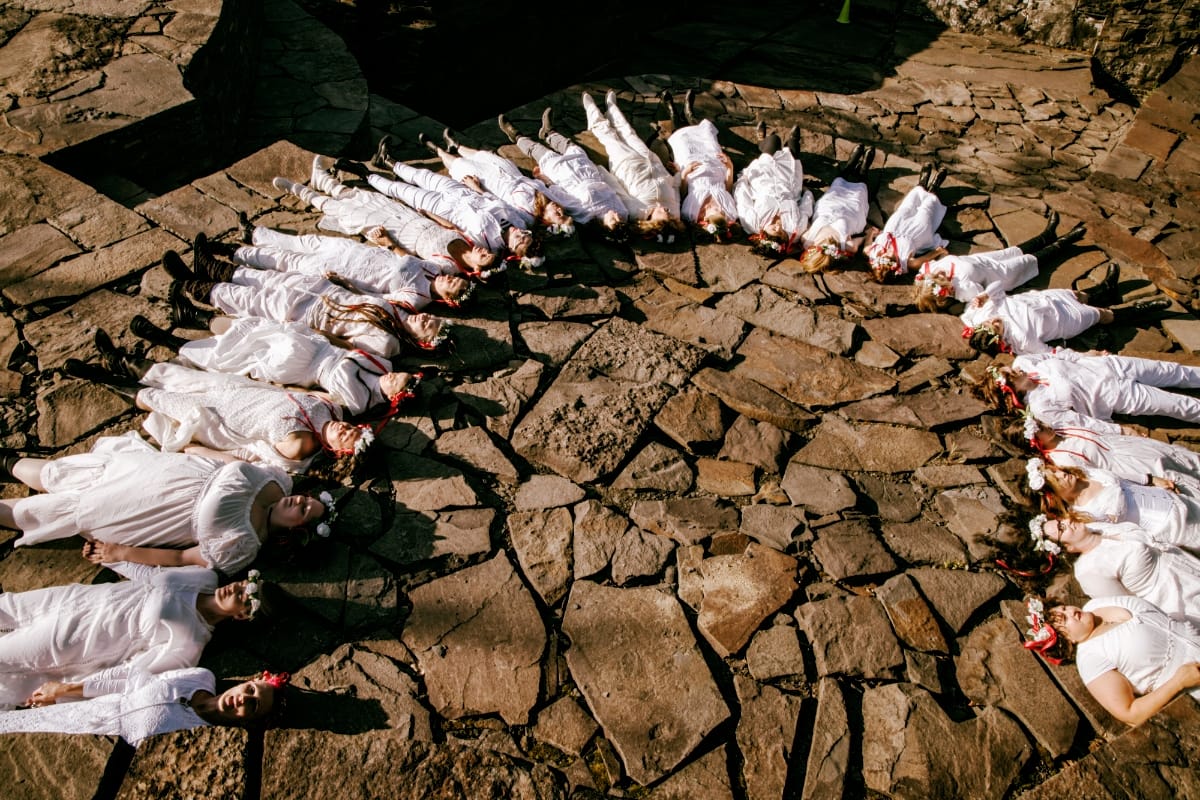
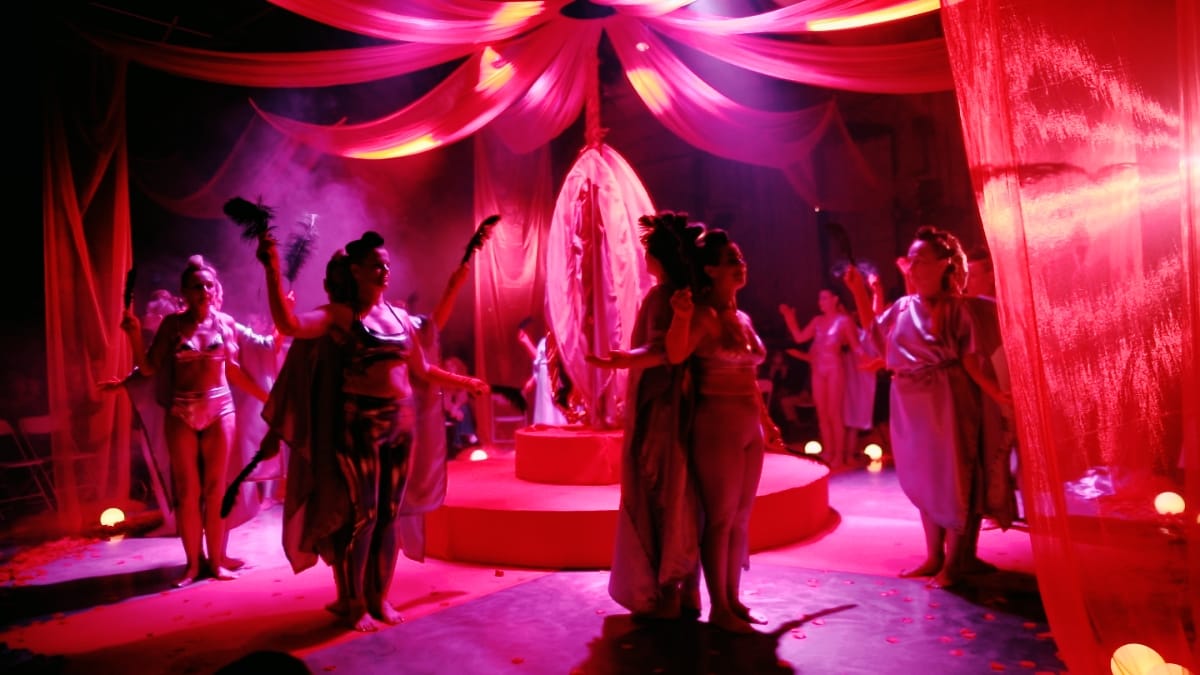
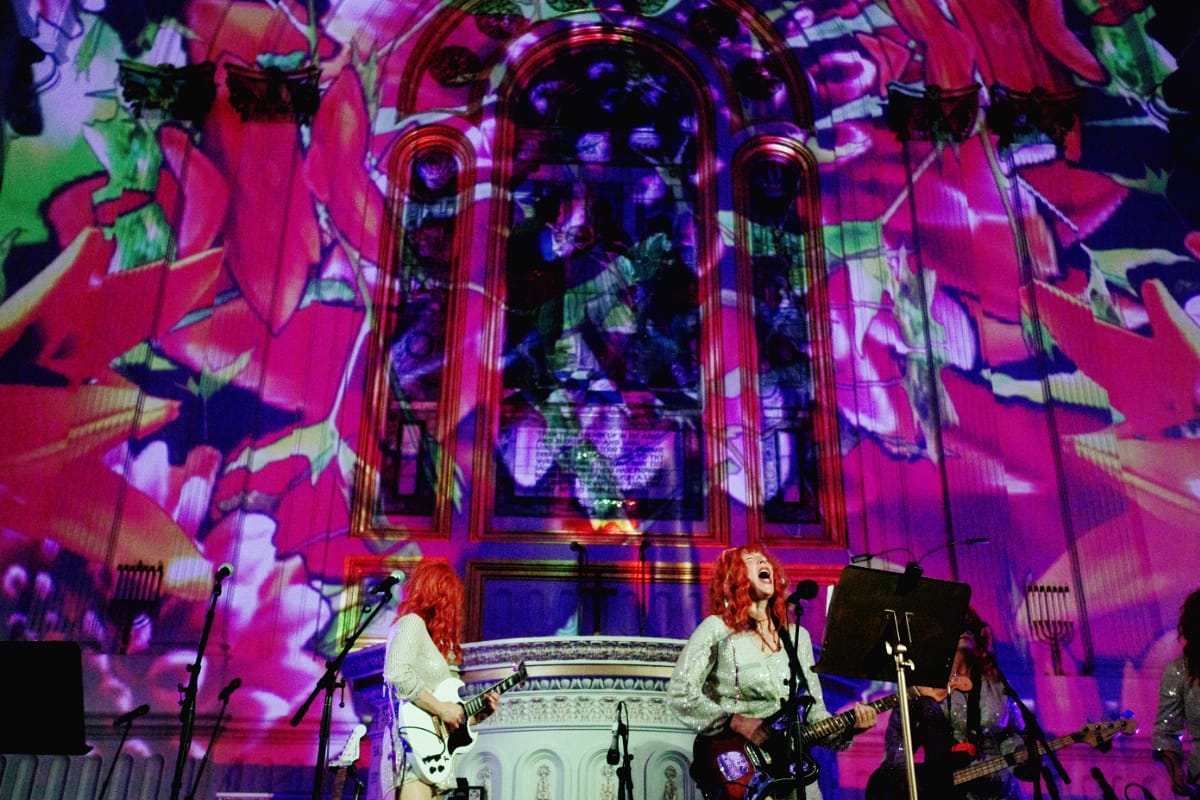
Of course, you can also dress yourself as best you can bespangle and engage in self-worship and ceremony together while you’re there. Take it all in as the six-piece band and choir festoon time with songs by PJ Harvey, Donna Summer, and Kate Bush as well as a Bulgarian song or two; as projected images, bold lighting, costumes, and art installations decorate the space; as the company of fellow humans at their most joyful lifts the morale of all who are there to experience the energetic shift of it. And at this next TGP event titled The Wedding, taking place the evenings of July 31 and August 1, self-love is the name of the game—specifically self-marriage. Wedding dresses are encouraged. Vows will be made to one’s own image in a mirror. Shana beamed with pride while we connected virtually as she explained the origins of her beautiful community collective and her plans for its next iteration. This conversation has been edited for length and clarity.
Meredith Hobbs Coons: When did you first encounter the concept of an art choir, and what drew you to create one yourself?
Shana Falana: I sang Bulgarian music in San Francisco in the ’90s. I had a Bulgarian women’s choir with this other woman; she and I ran it. We made it arty and called it Handmaiden America. We would wear our own version of Bulgarian costuming. One time, we were going to sing in a bike messenger bar, and I wanted us to sing in drag, because we were going to be around all these dudes, so we did this Bulgarian music and a drag performance at the same time. Maybe my answer is that I inspired myself to build my own art choir, because I’ve always been creating things that I haven’t seen before.
Meredith: Right, like how people say, “Write the book you’d want to read.” What else was going on in that area around that time? What other creative influences have you drawn in from the communities you belong to?
Shana: The Brian Jonestown Massacre, Miranda July, and John Dwyer from Osees were in my scene. It was this incredible music scene in San Francisco that lasted from 1994 to 2000—that’s it. It was really sweet. We had our own space called Star Cleaners, and all these bands who played there. There was this one guy who videotaped all of our shows. It was a great, nurturing, creative collective of people. And because I’ve toured, I’ve played a lot of other DIY venues, which I’ve loved.
Meredith: How would you compare that to the scene that you belong in now? Have things shifted about belonging to a scene since you’ve entered the perimenopause/menopause season that The Goddess Party embodies?
Shana: I moved from the Bay Area to Brooklyn, then I moved upstate as soon as I could figure out how to live in the Hudson Valley, and it’s beautiful here. There’s been an influx of all these people from Brooklyn, San Francisco, New York City—all over the place—to the Hudson Valley, oddly enough. There’s all this creative energy here, all of these wacky artists, musicians, filmmakers, and TV show writers. It’s a rich, layered, endlessly inspiring sort of scene. Then, when I created The Goddess Party, purely because it is what I needed and it didn’t exist, it fed the community in such a specific way. It spread like fire. Everybody kept inviting their friends. It got messy for a while. People were drunk at rehearsals. On our third show, the art director was screaming with the costume designers. That’s when I knew I wanted to write a show about the drama. It spoke to me.
Meredith: You were like, “If story is conflict, then this is rich terrain for a story to unfold.”
Shana: In a loving way, though. I made an effort to create a space where a ton of strong women could creatively exist. It’s not a collective where we’re all sharing ideas—it’s not like that at all. I make decisions with two other people.
Meredith: A bit of a hierarchy, would you say?
Shana: I am the hierarchy. I’m at the top, and then I work with people, but the way that I work with people is intentional and shared.
Meredith: The people attending expect that from you, if you’re the host. So you began The Goddess Party in 2023. What has this event taught you since then?
Shana: First, I’ve decided that I always want to do two nights instead of one. Our biggest show was at Basilica Hudson for the election that happened in November of 2024—that very sad day. We sold out at 800 people. We could have sold more tickets, but didn’t, because we were doing a circular show and had to have seats taking up all the floor space. And we had a horse in that show. (laughter) That one cost me $19,000, which we made back at the door and through merch sales, but we only did it for one night, and it lasted for 55 minutes.
I just don’t want to put that much energy and time into one show again. When you do two nights, the first night you do it, you’re just trying to make sure you get everything right. The second night is for those of us putting it on to really enjoy it. What I’ve learned is that the audience wants to be a part of a Goddess Party show. They’re coming to see a spectacular thing—we do choreography and dress in costumes—but they are also looking for a warm, fuzzy feeling. I’ve been learning what the community needs and what The Goddess Party needs.
Meredith: Your next iteration of the Goddess Party is called The Wedding.
Shana: Yeah. In San Francisco in the ’90s, we were reading the famous astrologer Rob Brezsny, who would talk about self-marriage. I married myself then, and now we’re bringing it back around, though this concept has been around for a very long time. The priestess Gabrielle Heron, who has been in The Goddess Party these three years, is writing a book on self-marriage, because she has also been studying it and loves it. She is going to be the master of ceremonies at The Wedding. I’m going to be in the band: a six-piece band, with a harpist and flute player, wearing gold sequin dresses, doing songs by PJ Harvey, Madonna, and Donna Summer, plus originals and Bulgarian music.
Meredith: Another name that came up in the press release was Ntangou Badila.
Shana: She’s in the band Lady Moon & The Eclipse.
Meredith: And they are also a collective, as I understand. Do you find that your projects are in conversation with each other?
Shana: We’ve both known about each other, and we crossed paths last summer when we won a CREATE grant and took part in “The Goddess Show” at the Athens Cultural Center. There were all these artists who made artwork, and then we performed. That’s where I met Ntangou. Her artwork is fucking amazing. She’s collaborating with us for just this one show. She’ll do some of her own music right in the middle of the event, then she’ll sing with us, too. She’s Congolese, and they have their own versions of marriage practices, so she’s going to create something special for the show.
Meredith: She’s also working with the theme.
Shana: Exactly. And she’ll be right in the middle of the show instead of being an opener. When she performs, the whole choir will sit down with her on the stage, all these women in wedding dresses.
Meredith: You’re modeling attentiveness for your audience, too, by giving her the floor. The audience will already have been part of the performance, interacting with you all, and then you’ll provide that example for them to emulate by gathering around Ntangou.
Shana: She’ll have a spotlight and everything. It’ll look really cool.
Meredith: That’s a very intentional way to welcome someone who’s new to the space, to shine a spotlight on her so that everyone can see that she’s welcome.
Shana: Thanks for that reflection, because we’re still writing the choreography. We’re still figuring a few things out, so it’s all very fresh.
Meredith: Will it continue to evolve like right up until the performance?
Shana: I hope not. (laughter)
Meredith: You mentioned Bulgarian music. Is that related in some way to your ancestry? I’ve noticed on The Goddess Party’s Instagram that you have a highlighted section where every one of the goddesses introduces themselves, and one of the questions asked of everyone is “Who is your favorite ancestor?”
Shana: It is from my ancestry, but I didn’t know that when I got into it. The first time I heard Bulgarian music was Kate Bush’s The Sensual World—“Rocket’s Tail” is the name of the song. She uses the Bulgarian choir on it, and it’s maddening when you hear it. You’re just like, “What the fuck is that sound?” Then I fell in love with Dead Can Dance a few years later. Then I started learning Bulgarian music and singing it, and years later it turned out my grandmother understood everything we were singing because she spoke it and was part Bulgarian. That’s kind of how music is, right? It’s just behind you.
Meredith: How amazing that she got to witness that through you.
Shana: Yeah, I got to witness her witnessing it. I don’t know that she processed it, really, but she was like, “Oh, I know what you’re saying.” It was amazing. I always include Bulgarian music in every set that we do. The music that I choose is so vast, so the Bulgarian fits in.
Meredith: So you’re going to have Congolese and Bulgarian influences this time. What other cultural influences will you be including?
Shana: Musically, we’ll have a pop influence, because we have some big music. I wonder what the history is, though, of self-marriage. There’s been something calling to me for a while, coming from a part of me that’s ready to marry myself, so I’m just dragging everybody else along with me—we’re all going to marry ourselves!
Meredith: What do you set out to do to make it an inclusive environment for people?
Shana: It is accessible; there’s air conditioning. It’s going to be the heat of summer, so that’s a good thing. There’s seating for everyone, so nobody has to stand during an hour-long performance.
They’re all going to be handed a mirror when they walk in, because they’re going to be making vows to themselves. We’re encouraging people to come in costume, wear a wedding dress or wedding outfit, and even bring vows. There’s a workshop that Gabrielle is doing a couple of weeks before the event that we’re all going to go to. It’s great, and it’s going to prepare everyone. They’ll come in, get a mirror, and be led through the vows. There will be a moment where we do that, and then a nice, hour-long love bubble.
Meredith: What are your thoughts on how society views womanhood in 2026, and how do you view womanhood?
Shana: I think women are under attack, especially now, because they’re rising. People are rising. More women are in menopause all over the world right now, and giving no fucks. There’s this little window in which I believe we are gaining a lot of power, and people are waking up because they’re in menopause/perimenopause, and they’re like, “I don’t want to deal with this shit anymore. I don’t want to have someone talk to me like that anymore. I don’t want to feel like this anymore. I don’t want to live like this anymore.” It’s changing things. It’s tough right now for women. They’re resisting it, because it’s a really big shift, but it’s the shift that the planet needs, and everybody’s talking about it. I’ve been doing women’s issues my whole life. This is nothing new for me, and so I’m ready for it, but I’m also a little nervous. I hope we don’t do something that pisses somebody off; I would hate for that to happen.
It’s the women who are going to find each other in these smaller communities. I have this vision of women in churches, women in climate change crises, women from different parts of communities coming together for this purpose, and because they’re women, they’re going to bond and create bridges to other parts of society. It’s a big, crazy vision, but I just can’t let go of it. I feel like we need to protect it so that we can keep growing, because we’re all growing so much right now, and waking up. Everybody’s waking up. Do you feel like that?
Meredith: Yeah. I love the idea that we’re all waking up. The thing that’s big on my mind is welcoming people who are trans and non-binary as well. Trans women are especially under attack. They’re getting murdered—especially Black trans women. That’s an area where I’d like to see a lot of solidarity, coming together, and bridge building.
Shana: I totally agree. We’ve always been open. We live in such a small, rural area. Just this year we’ve been able to have women of color join The Goddess Party. More people are finding us. We’re creating a safe space, but a creative space, too. There’s always time, 15 minutes or a half hour during rehearsals, for people to connect. Then we do some fun name-game stuff, or whatever we do, but then we’re going to create something together, and we’re going to sing together; we’re going to focus in and have joy together. Everybody leaves feeling so rejuvenated. Every week, like 30 people show up, because it’s joyful, and a big part of activism is joy.
Meredith: What myths and misconceptions have you had to dispel about The Goddess Party?
Shana: This makes me think of a time when this woman was in the group, and she created some other groups against The Goddess Party, because she was saying that we were supposed to be more of a collective, and we weren’t supposed to have a leader. But we’re not old enough to have too many myths and misconceptions about us. I feel like our tagline, “a cult worth joining,” was an off-the-cuff thing that my husband said once, and he puts on shows in the area, so it just kind of stuck. But then there were people in the group who were ex-cult members, and they were like, “But this isn’t a cult, right?” Then someone else is like, “It’s not not a cult!” There are misconceptions, but it’s all very playful.
Meredith: Yeah, but even being in the early stage of establishing yourself, people do develop quick assumptions of what something is and isn’t, who’s represented in it and who isn’t, so you’re not too new for that to have happened. The things that you’ve shared about these misconceptions are interesting, because that’s real. You have a beautiful vision for what you want to do and how you want to bring people together through this space, so naming the misunderstandings is a cool thing.
Shana: I think the myth for people coming in might have been that it was going to be some big, collective, creative thing, but it wasn’t going to be that. It was always going to be me working with one or two people on a show, and not having the entire room have ideas. Now there is this whole list of things that people have to read and sign before they come in, to give them a really clear understanding about what The Goddess Party is and what it isn’t.
Meredith: All power to people who are able to facilitate that and have those projects that are collective in their leadership, but it is a whole endeavor in itself. It can be a form of accessibility to have leaders that you’re looking to, even as you’re encouraged to have agency in a space. Giving people an agenda can be an accommodation, letting people know what’s coming so that they’re not hit with something that their nervous system can’t tolerate.
Shana: Yeah, it’s interesting. Someone left because she was starting to realize that she didn’t want to perform. She was like, “I love singing with a group, but I don’t think I actually want to do this in front of people.” I always make room for that stuff, and I make room for moms to bring their kids. It’s a warm and welcoming vibe.
One thing I make sure of at rehearsals is that when moms come and are there for a very specific time, I run that rehearsal like you would not believe. Last year, ten moms joined together as a group. They came to the Basilica show, then they were like, “Oh, they’re gonna do another one. We should all sign up and do it together,” so they signed up, and there were like ten young moms that joined at once and did it with us. It was so much fun. I feel like that’s sort of the vibe: a lot of family stuff happens in the Hudson Valley. Because people have kids and still need to go out, see shows, and socialize, there are a lot of outdoor things here. There’s a need for people to enjoy live music, even if they have kids.
Meredith: That’s beautiful. And the way you can think of it, instead of in boss/hierarchy terms (unless that’s what feels good), is that you’re creating an offering and cultivating a space as a gift for people to experience.
Shana: Yes, that is it. Somebody needs to be in charge, so I’m going to be in charge. I’m easy to work with, I’m a good communicator, and I give everybody tons of freedom to be creative, but somebody needs to be in charge. Also, I’m not going to want to do it unless I can control the whole thing and oversee the music and where we’re performing. I have good taste in music, and so far it’s all working out. People want to work with me and do this thing, and they keep coming back.
Meredith: And it sounds like it’s growing.
Shana: It is growing. It’s funny, I have this television show idea, and it’s not the time to pitch, but one of my clients in my job as a house painter is this famous television show writer. I keep writing my show, and what I want is for it to someday fuel The Goddess Party project to then create more for the community. It’s a bigger vision.
Meredith: What advice do you have for others who would want to begin an endeavor like The Goddess Party?
Shana: Yeah, I contributed an article called “How to Have Your Own Goddess Party” to a zine my friend made called Sonic Spells: Musicians + Music Lovers on the Magic of Music. It basically says to find a place and invite your favorite people. I want people to make their own Goddess Parties where they are, and we’re trying to do work online to open it up to people worldwide.
It’s such a fun project to work on. The point is finding people in your area who want to get together and sing some songs. Singing is a way to communicate without saying anything specific. It’s really good for our physical bodies, good for your organs and heart and all of those things, and it raises your energy and vibration.
And The Goddess Party doesn’t have to be women only; it can tap into the goddess or goddex inside of you. I chose the S’s specifically because I didn’t want to overcomplicate it. I’m a child of 1971. I’m just going to stay in my lane, but the concept is really open. It refers to your inner divine feminine. The group is here to cultivate more of the feminine energy that the planet needs right now, and gathering, having a potluck, or singing together once a week—once a month—will change your life.
Meredith: You made that point about how “the goddess within you” doesn’t have to refer only to women, and I love the idea of a cis-het man who would be so down and respectful of the space that he would go to The Goddess Party and commit himself to embodying goddess tendencies and traits there.
Shana: When I started The Goddess Party, I invited men. At the time, they were not into it.
Meredith: You know what, though? You’d rather that: Excuse yourself if it’s not for you, but if it is, and you can get more in touch with your feminine side, then that could be nice.
Shana: I feel like it’s coming, whether they want it or not. I’m protecting the joy.
Check out more like this:
 Lawrence Peryer
 Meredith Hobbs Coons


Comments