


Josh Mason designs and builds custom circuits under the name Primitive Coastal Electronics, and his engineering life is never apart from his composing one. He has been releasing music since the early 2010s, on Students of Decay, Longform Editions, and Dauw among others, and he paired a record with a book once before, on Utility Music in 2021.
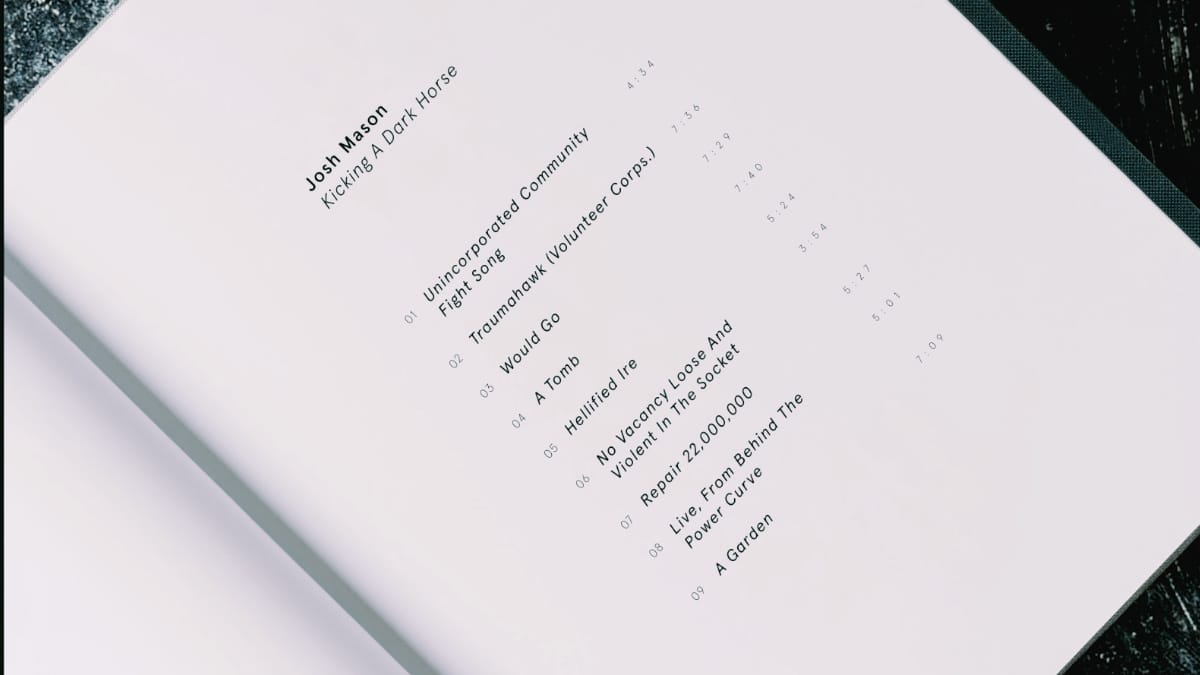
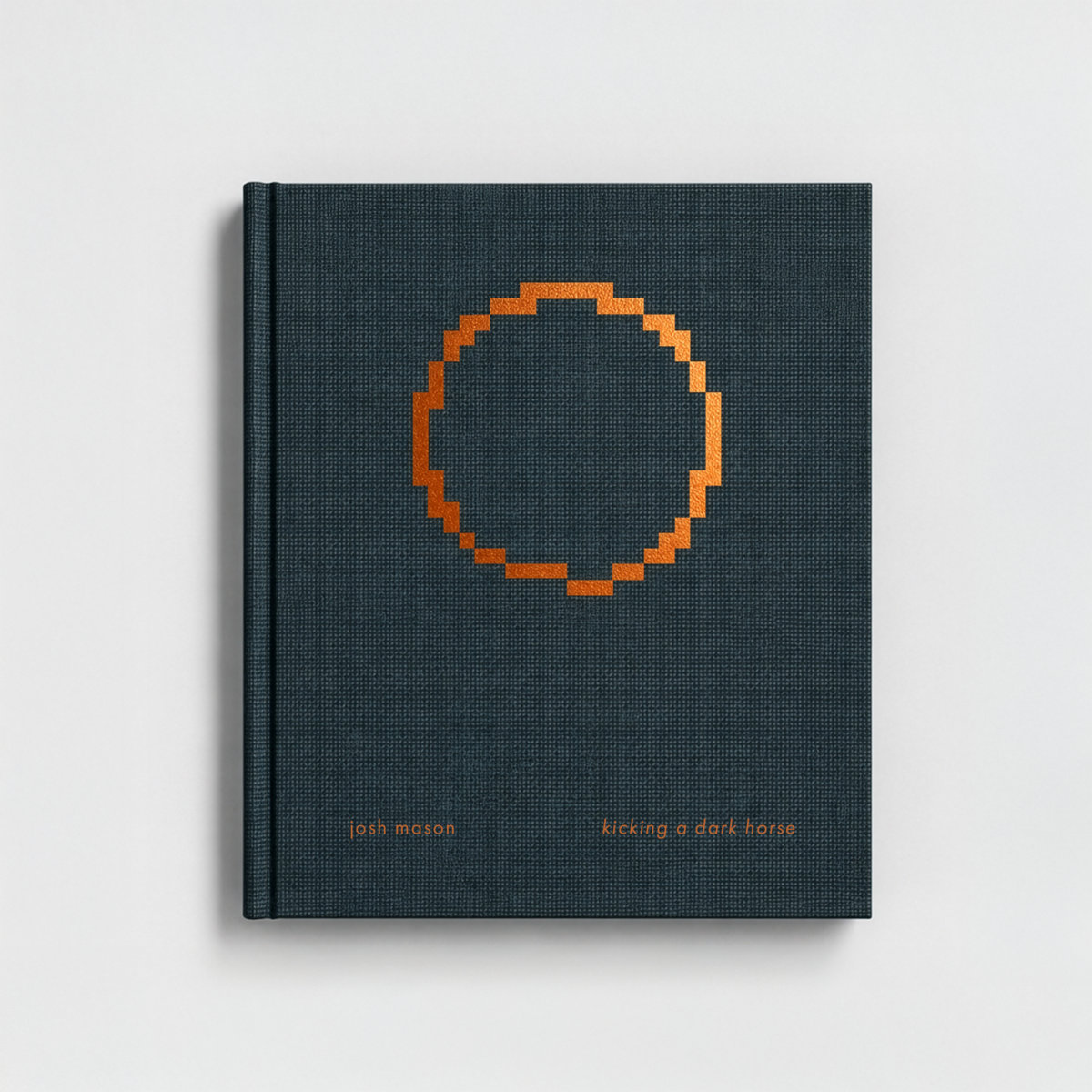
Kicking A Dark Horse is his debut for greyfade, as the third title in the label's FOLIO format. The nine tracks run for 54 minutes, and the package is a linen-bound hardcover book in an edition of 300, with a high-resolution download sourced from the studio masters. Mason wrote the text and designed the cover, and Joseph Branciforte produced the record with him, mastered it, edited the book, and laid out its interior. The label's press release is blunt about how the halves relate. "Kicking A Dark Horse is not an album with a book, or a book about an album. It is one thing, and it asks to be encountered that way."
The music comes from a modular system running on streams of binary data, with oscillators clocked far below their operational thresholds and delay lines treated as percussive instruments. The book carries the subtitle "a nonlinear travelogue of the states of Florida," and its settings are the highways, motels, and coastal edges of the state where Mason has spent his life. Documentary detail and invention sit side by side in the text with no visible seam. "The things I've written, especially in this book—there are many lies by omission, I'll say," Mason says.
Josh Mason was a recent guest on The Tonearm Podcast. Host Lawrence Peryer spoke with Mason about Florida as both a place and a condition, the punk-rock ethos that still governs how he works, his long apprenticeship to modular synthesis, and the problem of pressing a nonlinear sensibility into formats that usually have a start and a finish.
You can listen to the entire conversation in the audio player embedded below. The transcript has been edited for length, clarity, and flow.
Lawrence Peryer: I wanted to start by asking you about the mashup of idioms in the project's title, Kicking A Dark Horse. Is it just fun wordplay, or is there a deeper meaning?
Josh Mason: There is a little bit of both. It's fun wordplay, but I think the title also speaks to how I look at Florida and my home—both the state and the state of mind.
It's this idea that it has so much potential. It has the possibility to do great things and come back, but it's also very much a child that refuses to tie its shoes and then trips, unsurprisingly. It can't seem to get out of its own way. So it was a way for me to acknowledge both as equal in how they affect me, my work, and my day-to-day life in terms of how I interface with other people.
Lawrence: Are you a lifelong resident?
Josh: Yes, I was born and raised here. I spent a couple of years in Georgia for school, and then I lived in a couple of other random places, but for the most part I've been here since I was born.
Lawrence: In my lifetime, Florida seems to have changed so much. As an outsider, that's just my perception of it, and how I thought of it as a younger person.
Josh: Yeah. If you look at the state's history, it has always been essentially the backyard playground of the wealthy. Since Flagler built his railroad down here, it has slowly become untenable for the average person. I think there's this sense that people see stuff on the news and they just assume that it's the Wild West, and the reality is that a lot of us are living a very suburban life in a medieval sense, in that we are living on the outside of the castle walls, so to speak, because we just don't have access to certain levels of income or opportunities.
I think most of us are just trying to get by, and sort of make sense of both our government and how we're perceived by the rest of the country, and to kind of make a name for ourselves in a place where we have so much access to things like environment and opportunity within that environment. But we constantly have a voting populace and a general community sense of voting against our best interests. So it cuts off a lot of people's access to things that I have found, at least in places like the Pacific Northwest, are just sort of understood—that everybody should have access to them.
Lawrence: I've read some other interviews of yours. You mentioned that what you're doing here is essentially a flavor of punk rock. What does that mean in ethos and in execution?
Josh: My first real exposure to music was the punk rock community. I think the first punk band I was in was in seventh grade or something like that. Ever since then, I have existed in this world, made up of a lot of people who are not only supportive of other people, but who fostered this sense of the DIY ethos—the idea that there is nothing you cannot do, and if you cannot do it yourself, we'll help you.
Growing up in that world taught me to give myself license to do things I didn't really know how to do. Some of my first bands were just screaming, throwing guitars against the wall. It wasn't really even about playing the right notes. It was just about those people in that room that night.
It was cathartic, and that was really important. In addition, I learned a lot about music as a vehicle for communication. Anything I've ever done musically—whether it was throwing a guitar against the wall, or making a tape loop, or whatever it is I'm doing now—has always been about giving somebody a reason to reach out.
That carried into the music I'm doing now. I'm no longer screaming about political injustices or social injustices or whatever else, but I do it with that same thing in mind—connecting to people, and giving somebody a place to feel like anybody can reach out to me if they want to talk about the record, if they want to talk about the gear I used on the record, if they want advice.
I've always tried to be as much of an open door as possible when it comes to that, because all of the things I know how to do have been because somebody else opened the door for me. It just seems like a natural extension of that. It's less violent, a little less random, but it's still just as chaotic and meaningful for me to continue this process.
And I feel like, especially in the modern world, people feel very removed from the artists who create the art they care about. That's sort of another extension of the punk rock thing: when I was a kid, we played on the floor with everybody. You were an extension of what I was doing, and I was an extension of what you were doing.
Lawrence: When I was younger, and I played music, I can remember situations like what you just articulated: being on the floor with the audience versus being on a stage. When there's a stage, the act of walking up those two or three stairs—by the time you're onto the stage, you're in a different mind space.
Josh: Yeah. It was something that always seemed to me unbalanced and out of place. I play shows with the work I'm doing now, and I still would prefer not to be on stages. I would prefer to be on the ground, quite literally, with other people sitting with me. I mean, I think the more steps, the more feet, the more barrier between you and what's possible for you.
Lawrence: Speaking of connection, I'm really curious about understanding the connection between your new project as a book, your new project as a listening experience, and the relationship between the words and the music of Kicking A Dark Horse such that they exist. Can a reader experience the book without the music, or is that incomplete in your mind?
Josh: I would say, without being harsh, it is an incomplete experience. It was really designed to be two sides of the same coin—the way the music was composed and the way the words were written. I think of it like a zipper.
There's space in the book, the way it's written, but also the way it's typeset, the way it's laid out on the page, and the way the music was composed, taking into consideration things like dynamic range. The idea is that it's supposed to fill in the gap. As you're reading, there are lulls in the page—whether it's a couple of lines, or sometimes pages entirely that are blank.
Lawrence: So with all that said, did you know it was going to be this companion work, or did Joseph [Branciforte of greyfade] propose that? How did that all come to be?
Josh: When he originally approached me about working on this, it wasn't really "Hey, do you want to do a book?" I think he was interested in the work I've been doing over time, and that it would be fun to work together, and I think I might have actually been the one to suggest the book part.
I don't really have any classical training in writing. I don't have any education towards that. It's not something that's a normal part of my practice. But I like words, and I like talking, and I like connecting with people. So I figured if he was willing, then I could probably find a way to try a more experimental approach, where I gave myself permission to say, well, there are no real rules with what I'm doing with music, so why should I apply rules to what I'm doing with writing?
Lawrence: Modular synthesis in particular seems to me like it's prone to influencing the creative process in terms of the man-machine interface, if you will—the work that goes into the generation of sound and tone and manipulation. Are these just tools you pick up to articulate a sound in your head, or are you an explorer in front of the machine?
Josh: It's a little bit of all of that. I have been called monomaniacal about this to a degree. There's always been a part of me that has taken whatever I'm doing and tried to push it without really having to totally understand it.
At the outset, I had no idea what was going on. The idea of control voltage was totally foreign to me. At best, I understood it as helping hands—an extra pair that would work for me so I didn't have to dial stuff in. It would just do it automatically. But I spent a lot of years early on with it just, as you say, exploring: plugging stuff in, sometimes inputs to inputs or outputs to outputs, having no idea how this thing's supposed to operate. I've been working with it for close to 15 years now, and it no longer surprises me much.
During COVID, I had a lot of time on my hands, so I taught myself electronics from the ground up and started designing my own synthesizers and building circuits from scratch. After a while, you start to see that there are only five different paradigms. You can only connect these things in so many ways, and after a while you realize, "Oh, this isn't actually that complicated." It looks like a bunch of spaghetti, but there are only so many things you can do with it.
So now I'm at the point where I would say 99 percent of the time, I know exactly what's going to happen when I connect A to B. In some ways, that's great and productive, because I can get to what I need to get to more quickly. But it also is missing the magic. I'll go back to the punk rock thing: you go to a show and you never really know what's going to happen. You have an idea of what this band sounds like, but you have no idea what your experience will be by the end of the show.
That was why, with this album specifically, I chose the pieces that I chose—because it was the last part of this ecosystem that I didn't really understand. The guys who built the modules I used had a very interesting way of going about how they all worked, and I didn't understand it. It was helpful for me to have that impediment in place, and it gave me rails to basically say, okay, you can experiment within this sort of pen of animals; they can run around, but they can't go outside this perimeter.
Lawrence: Is that good or bad? Does that imply mastery, or does it imply boredom?
Josh: That's a great question. (laughter) It depends on what mood I'm in at the time and whether I am missing a deadline.
Lawrence: You mentioned that COVID got you into building instruments and playing with circuits. Were you on that course? Would you have gotten there anyway, do you think, or was it just opportunistic?
Josh: If you ask my parents, who are both engineers, they would say eventually I would get there. I've spent many hours with my dad over the phone talking about the things I've taught myself to build, and he just gets really frustrated because he's waiting for me to jump from analog to digital. I keep trying to force analog stuff to do things it's just not really designed to do.
Lawrence: My original framing for asking you that question was about whether it was filling a need or a want for you. Were you compelled to do this, or were you hearing sounds you couldn't otherwise articulate, so you said, I got to make it myself?
Josh: I think it was more about proving to myself that I could do it. There's a tendency, especially with the modular stuff, to think about it as if it's black magic—like it's some black box that you just cannot crack. A lot of people really enjoy, "Let me just plug a bunch of random stuff together and hope that it sounds good." That was never really enough for me.
From day one, when I first started working on circuits, I was like, "I've got to figure this out. I've got to make sense of this. I've got to understand." So it was definitely a need so that I can sleep at night.
Lawrence: Do you play with chance, or with chance games, or, like the I Ching? Do you use that in your personal or creative work?
Josh: Not as such. There are ways that I introduce chaotic things, usually because I have been so focused on the modular thing. There are devices in that paradigm that will emit chaotic and random signals. In many situations, the gear tends to drive itself, and I then have to corral it.
Lawrence: It's like the physics of the machine, almost.
Josh: Yeah, kind of. One way I like to talk about it is spinning plates. I tend to get as many plates spinning as I can until it starts to coalesce into what I hear in my head, and then I spend the rest of the time the way a conductor might be conducting an orchestra—trying to make sure the plates keep spinning without all crashing to the floor.
Lawrence: You've explored this sort of new format world now with this project. Are you done with that, or is this an interesting new way to create? Do you see this continued pairing of words and music?
Josh: I could see a path forward where I'm just focusing on words, where I'm not writing any music at all, which I think would be really interesting. When Joseph and I were working on this album, I would send him a new version or an updated proof I had written, and he would ask me, "Are you close to finishing it? Do you still think you want to work on it some more?" And I said, the reality is, this thing, Kicking A Dark Horse, is never going to be done. I could write this book, I could write this record, for the rest of my life. But at some point, I was going to have to just call it done for now, so the object could be produced, and people could experience it.
Lawrence: There's this idea of, I could take this book, and I could put it in one of those little free libraries. I could divorce this book from the other half of it in a way that you guys can't control. And yet you talked about how it would be sort of an incomplete work then, but the book doesn't make that explicit anywhere.
Josh: Yeah, it's an interesting idea, and I think it's something that is sort of an inherent problem with physical media. This is something that Joseph and I have talked about a lot, and I know Joseph is thinking about it all the time: how do you bridge the gap between availability and the experience?
The same way that you might find instruction from a sculptor or a painter when you go to a museum, saying this is designed to be stepped on, or stepped around, or looked through at a certain angle, or however. Rothko famously wanted his paintings lit a very specific way, and the gallery could choose to ignore that entirely. The viewing public might not even realize it's a necessity, and they'll experience it and take away what they want from it, but at least he said that. "I made my wishes known," I guess, as it were.
Lawrence: If I had been the publisher of this, I would have done the completely hack thing and included a bookmark with a QR code, or I would have made the connection permanent and explicit. And I think it's really impressive that it's not.
Josh: In that way though, there is a QR code in the book.
Lawrence: Really?
Josh: And you can listen to it, theoretically. It's still connected. We tried to go as far as we could to not separate them.
Lawrence: That's amazing. That's the downside of my random access in the book—I didn't come across that page. That's actually kind of fun.
Josh: That's good. That's the idea: it's designed to be explored, regardless of what you get from it.
Lawrence: To a certain extent, a book is linear, right? It's got a front and a back and a middle, a beginning and an end. Records, barring shuffle or random, are kind of the same way—they're sequenced, they're in an order, they're put into the world at least in a linear way. What's the role of narrative in something that can be dived in and out of, and doesn't have to be experienced linearly?
Josh: I think it's possible to experience narratives in ways that are not necessarily linear. A great example of this is the book Hopscotch by Julio Cortázar. It is a straightforward novel that you can read from beginning to end, or you can go into the beginning of the book—there's a page that has a bunch of page numbers, seemingly scrambled—and if you go back and read that book in that page order, you get a different story, using the same text.
Another example of this would be The Unfortunates by B.S. Johnson, which is a book—quote-unquote—that's actually a box. It's shaped like a book, with a bunch of separate folios, so a couple of pages stapled together, and a loose page that was the beginning of the book and a loose page that was at the end of the book. You have to read the first page first and the last page last, but everything in between you can read in whatever order you choose. It's fixed text, but it'll still more or less give you a story that, again, is within that sort of pen of animals that can't get outside of the perimeter. I find that that lights up a part of my brain that reading War and Peace doesn't.
Check out more like this:
 Chaz Underriner
 Lawrence Peryer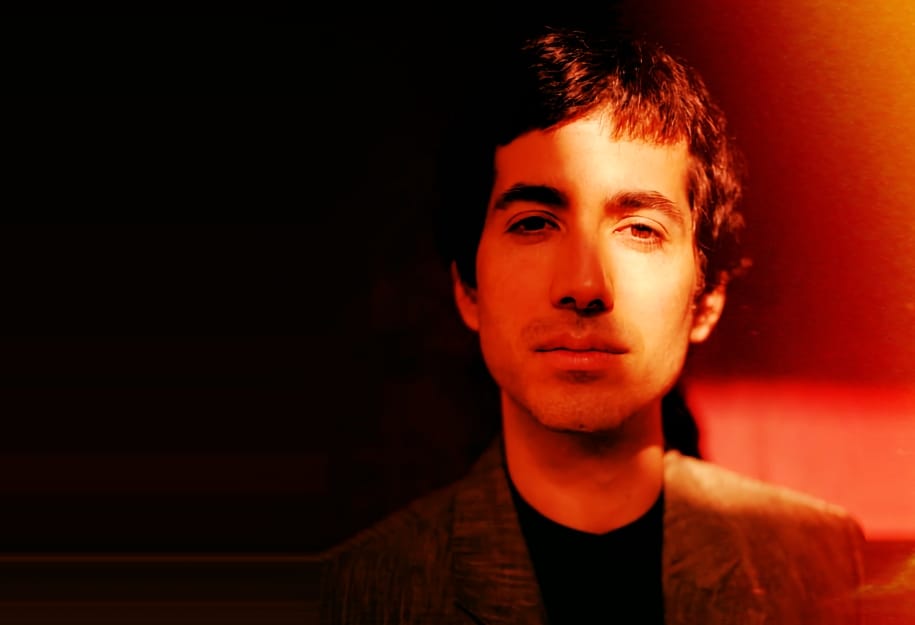


Comments