


Joseph Branciforte is a musician, composer, designer, and sound artist whose work explores how structured systems and emergent phenomena meet through custom-built technology. He works fluidly across performance, composition, and installation in both acoustic and electronic media. He founded the greyfade record label as a platform for exploring process-based composition, alternative tuning systems, and digitally mediated forms of improvisation. As both curator and designer, Branciforte brings careful attention to sound, concept, and visual form, crafting a cohesive identity that bridges music and art. He is also a Grammy Award–winning recording engineer and producer who has collaborated with many luminaries of the jazz world. He is the owner of greyfade studio.
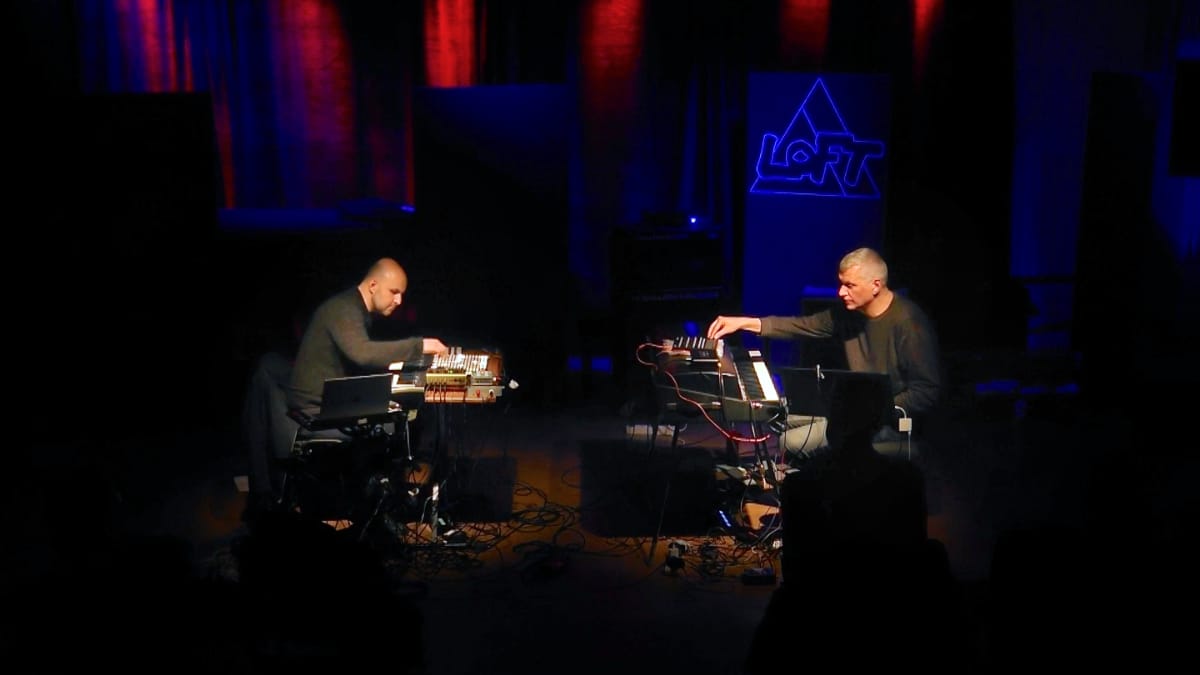
ITERAE is a 2026 collaboration between Branciforte and Belgian jazz musician/composer Jozef Dumoulin. On the 70-minute album, both Branciforte and Dumoulin play Fender Rhodes and electronics through Branciforte's live editing system created in Max (more on that later).
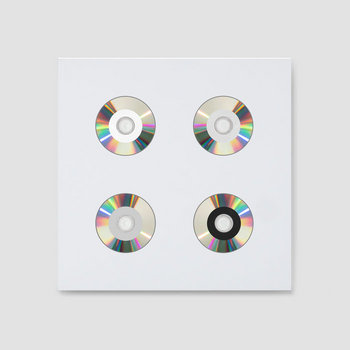
The title and track names of the album reference mathematical operators: the square image of (and super square) and the original square of: ⊏ and ⊐. These operators alternate into 4 loops—track 1–2, track 3–4, etc.—distributed onto the 4 mini discs in the physical release. The definition of ITERAE is to repeat a process, as in a computer program. In this way, the titles reflect how the music functions, with repetition and looping as the album's primary language.
Despite exclusively using input sounds of Fender Rhodes played by both Branciforte and Dumoulin, there is a wide palette of sounds throughout the album. The clear sound of a note played on the Rhodes (with its characteristic attack) is relatively understated in the first two tracks; it usually sounds manipulated. Early in the work, pitch material from the Rhodes is primarily shaped using electronic processing. A somewhat identifiable Rhodes sound doesn't emerge until track 3, and a more easily identifiable Rhodes sound finally comes in toward the end of track 5 and after. The album plays with the recognizability of the Rhodes as a primary aspect of its musical language, significantly expanding the sonic possibilities of the instrument through multiple layers of electronic manipulation.
ITERAE is a highly focused improvisation, one that sounds composed, with a set structure in mind, yet brims with the spontaneity of real-time performance. The music is restrained, yet rich and elegant (and, like the package design, minimal and stunning).
My overall impression of the album is that of multiple loops—some containing a collage of noise-based sounds, and others with more easily discernible harmonic material. This multiplicity of loops spins out past one another in time, creating complex patterns that never quite repeat. We have broken loops, shifting and splitting loops, degrading loops, and multiple simultaneous loops of different lengths and numbers of repetitions. The effect of this compositional methodology is a precise, slowly evolving texture that never quite settles in one place, an enigmatic ambience.
One of my favorite aspects of the album is the jazz lines that Dumoulin plays only a few times throughout the 70-minute work. They first emerge at the end of track 3—a single ascending, bebop-inflected melody that doesn't repeat and isn't looped. The ascending jazz line reappears on track 7, this time with more distortion to cut through the sonic texture. And lastly, in track 8, we have descending jazz lines that repeat with variations. Once I hear the descending line, I realize that I've had the sensation of floating or ascent for the entire length of the work, which is gracefully counteracted at the end of the album.
I spoke with Joseph Branciforte via video chat from his studio outside of New York City. Our conversation has been edited for length and clarity.
Chaz Underriner: In your email newsletter, you mention that you've been using Max [a modular programming environment to create custom software by Cycling '74] for 20-plus years now to produce and compose work, and I know that you used Max for your live editing system for ITERAE. Can you tell me about your approach to using Max or your patch design?
Joseph Branciforte: My relationship with Max has been a long and winding road, from being really engaged and obsessed with it to avoiding it completely for periods. I started getting back into it after becoming more interested in loop-based music and live-looping approaches, which have gotten more interesting to me. I started to realize there was this divide in my work between being in the studio, where I have access to all these knobs that shape the sound, and this idea that I'm a performer or musician who plays an instrument. I wanted an identity that bridges those. I'm still trying to find it, but I realize that the editing I do in the studio, and the carving and sculpting that happen in terms of material, are a huge part of my own compositional process, rather than choosing which pitches and timbres to pick. It's more of a process of selection.
The basic thing I tried to get working was the idea of asynchronous loops, which is pretty common in more ambient and experimental music. That's pretty trivial to do with just a couple of hardware loopers. But the issue was that you get to a place where the material is captured as you're performing, and it's looping. From there, there's really no sophisticated way to engage with the material. It's fixed. You can add more, start and stop the loop, start recording again, overdub, or process it. But as far as what's in the buffers, there weren't a lot of ways to manipulate. So then I started thinking I could go back to my Max programming and PD programming background and try to work on this problem.
The system I'm using now, which I'm calling a live-editing system, grew out of that. But the crux is that I can record a variety of inputs. With one-button gestures, I can capture any of those inputs at any time—sound sources from my own performance or from other performers. I've done this not only on ITERAE, but also in a larger ensemble context. There are a few projects brewing where I'm applying these processes to a full ensemble.
And then there's the idea of creating discontinuities in the material, creating rests, which you can't really do in traditional hardware loopers. But in my system, I can define proportional rests between the loops. So you can have a loop play for X and then rest for 3X, and this can happen on multiple channels. Between all that and using effects, the system really bridges my role in the studio as an editor or systems thinker and the live improvisational aspect of material that's happening spontaneously. It situates me in a fulcrum between those places.
Chaz: How do you think about loops? Do loops have a meaning to you? Or why did you decide to use them as a primary part of your system?
Joseph: It's a question I think about a lot in terms of where this could keep developing, because I don't know that loops are necessarily central to what I'm trying to do. They allow a kind of coherence in terms of repetition. I think of loops more like a memory. In traditional composition, you could think of memory as one of the devices that creates coherence because it allows you to reference things that were already heard and create chains of expectations based on that, which I think is important to the way the syntax of music functions—creating expectation and deviation from a pattern. Loops are just a way of creating patterns, nothing more than that.
But in a live context, it's a way of creating and holding on to certain textures, and of drilling down into the details of the material as it goes by in time. So rather than in a traditional improvisation without any technology, events come and go, and coherence is created totally by the performer's memory. But with the technology of a looper, you have this technological memory, and it creates a third dimension for me to go into as a performer, and it slows down the improvisation.
That's another important thing to say: it takes us into another temporal place where we're now interacting with copies of ourselves.
Chaz: A mimetic artistic technique.
Joseph: When I think about loops, not necessarily that having a strict loop is an important part of my music, but it's just a shorthand to get to other things that I'm interested in, like pattern recognition and slowing the material way down.
Chaz: In this record, how were you thinking about structure? To me, when I listen to the piece, I hear one continuous work from tracks 1–6, with a big change at the end of track 6, when an unmediated Fender Rhodes sound comes in, and then tracks 7–8 as a single unit. Recognizing, of course, that you have the four mini discs, which I assume are paired like tracks 1–2, 3–4, et cetera. With all that in mind, how are you both thinking about structure?
Joseph: Good observation. There is a break between tracks 6 and 7. I didn't mention this in the press materials, but the way this was recorded was that Jozef came to my studio while he was in New York and we recorded for two days, pretty loosely. It wasn't like we were recording all day, but on my computer, it was divided into four improvisations—A, B, C, D.
The first day, we did A and B, and the second day, C and D, and these were each around 70, 80, 90 minutes, around an hour and a half for each improvisation. So there are five to six hours of material in total. In my records with Theo Bleckmann, we would do a similar thing, but then I would find a little 5- to 10-minute section and develop it further into a track. Then we'd overdub and keep working on it. Something about that way of working didn't feel correct for this album; the horizontal aspect of how the music developed over a long stretch seemed really important.
What happened is I was improvising in my studio before Jozef even came down to start working. I had some loops going, I was messing around just to prime myself; that was basically the beginning of track 7. And then he came down into the studio, so I hit record. We didn't talk or anything, we just began. That became the beginning of tracks 7 and 8. When sequencing the record, it didn't feel good to have track 7 be the first one. So you correctly noticed that there were two separate things, but it wasn't like we took a break for an hour; it was literally all in the same sitting. There are chunks that were still in the buffers from tracks 7 and 8 that came back, so it's all one thing. I kept that little break because that's how we actually did it. And then there was a little editing, which is one of the reasons I prefer studio stuff to live recording.
In terms of structure, there really wasn't any. We didn't talk about it. It just had a good structure. I don't know how to say it other than that. That's why I chose the third session—C—as the album's basis, because it seemed like you could drop the needle anywhere and you were in the same world, whereas other improvisations traveled further, but there wasn't as much internal self-similarity. This one kind of feels like variations on one idea, more or less.
Chaz: That's really interesting about tracks 7–8 being the beginning of the session, because to me, I heard the whole record as a very coherent composed or improvised structure. At the end of track 3, we have this one jazz-like line that ascends into the instrument's high range, which I assume was played by Jozef, and it isn't repeated or looped. And then we get more of those lines in track 7. So, to me, I heard a reference—the thing goes away, and it's not repeated, and then that culminates again. But now that I know the way that it was edited, it's kind of blowing my mind.
Joseph: But as I said, what was interesting was that it's playing with the memory thing. If you listen closely, there's stuff in 7 and 8 that definitely comes back in the earlier stuff. So it's playing with the idea of what precedes what. But yeah, most of the elements that are soloistic, not all, but maybe 80% of them are Jozef. If you know his other music, you'll know he's a virtuoso pianist and keyboardist. He's a complete badass. This record doesn't really show that at all because we reduced it. But you hear a couple of moments where he gets to rip some stuff.
Chaz: I love it. Especially in track 3, it was so nice because it pops up and then goes away—it doesn't repeat, doesn't loop—and I thought that was such a strong compositional decision.
Obviously, you've created a strong artistic statement through the label, packaging, and the artists you've included. I was researching, and I looked under artist submissions, and it said you're interested in work shaped by system design, formal constraints, microtonal tuning, and custom technological frameworks. Do you have anything to add about why ITERAE belongs on greyfade or the relationship between the record and the label?
Joseph: I think the label's identity is coming more into view with each release. With this album, I'm trying to broaden the vocabulary a bit in terms of what could work under the Greyfade banner.
The idea is to have a common thread between the releases conceptually, while keeping it interesting so it's not just a bunch of musically self-similar records. So I think this one brings in the elements of structurally mediated improvisation, compositional ways of dealing with improvisation, and using technology to bridge that gap.
Check out more like this:
 Lawrence Peryer
 Chaz Underriner


Comments