


Ian Chang was born in Hong Kong in 1988 and worked out of New York for ten years before settling in Mexico City. In New York, he played with Moses Sumney and Joan As Policewoman and joined the band Landlady, at a time when, as he recalls, “a lot of genre boundaries seemed not to exist so much, at least between musicians.” He built his solo debut 属 Belonging (2020) on improvised sampled percussion and brought in three guest vocalists, including Kazu Makino of Blonde Redhead.
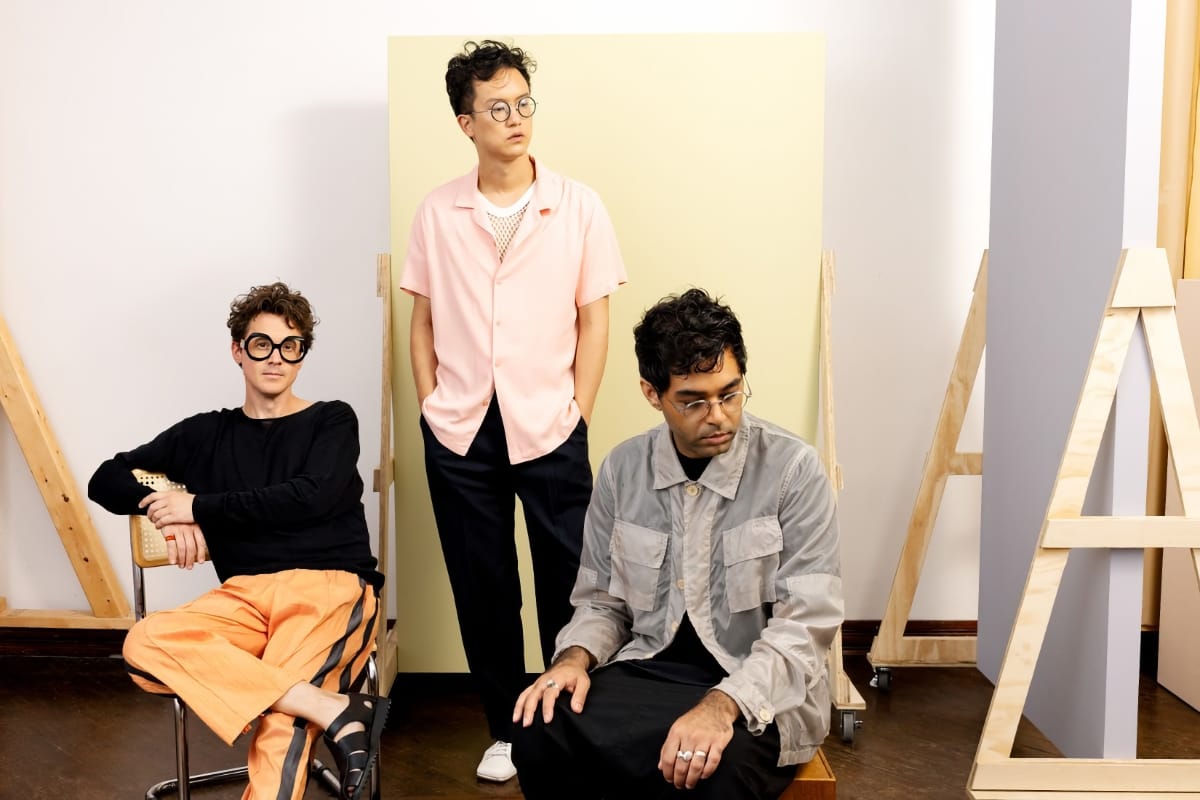
In 2014, Chang and guitarist Rafiq Bhatia joined Ryan Lott in Son Lux, which had been Lott’s solo project until then. The trio’s score for A24’s Everything Everywhere All at Once earned nominations at the Academy Awards and the BAFTAs, and Marvel Studios brought the band on for Thunderbolts* in 2025. Chang has also scored films on his own, including Forge, which premiered at SXSW that same year.
Son Lux made their ninth album, Out Into, in bursts between film projects over two years, and This Is Meru and City Slang released it in September. Only after finishing it did the band notice that, in Chang’s words, “the album is the most collaborative between the three of us, but the least collaborative with anyone else.” A week later came their score for Your Mother Your Mother Your Mother, Bassam Tariq’s film starring Mahershala Ali, which premiered at the Toronto International Film Festival.
On The Tonearm Podcast, Lawrence Peryer recently spoke with Chang about the road from classical percussion through jazz school to New York’s working scene, the rhythmic language he and Bhatia have built over a decade, and the temperament it takes to write music for someone else’s film. Listen to the full conversation in our audio player.
The transcript has been edited for length, flow, and clarity.Lawrence Peryer: Earlier this year, I spoke with Dave Douglas, and when he was talking about the band of his that you were in, he said standard jazz practice is not where they come from. I’m curious, where would you say you come from?
Ian Chang: I guess it’s a question with maybe a multi-sided answer, because I did spend time with jazz and its history, especially in college. That’s what I got my degree in, jazz drumming. And I feel like sometimes, in jazz school at least, there are the kids who are in jazz school because they’re really deep in on learning the ins and outs and the history of jazz, and that’s the main focus. For me, it was a wider array, and I got interested in a lot of things through meeting folks at school, playing in different projects, and stuff like that.
So it’s a bit hard to pinpoint exactly what my background is, because before going to school for jazz, I was actually very solidly on the path of being a classical percussionist. In high school, I was in the Juilliard pre-college program and all that, and then, at the last minute, I decided I didn’t want to do that, so I made my audition tapes for jazz instead.
I went to school at NYU, and when I got to New York, I kind of started saying yes to everything. That spanned a few years, and I became a busy gigging drummer in New York, but I was mostly getting called for non-jazz work. I used to have a weekly hip-hop gig. I played in all kinds of rock, pop, and indie bands. And then I got really into electronic music and producing that, and how to translate that in a live setting. And I think that’s maybe where I come from.
Lawrence: If I go to the symphony and I see the classical percussionist, my impression is that doesn’t seem like a lot of work for all that training. What is the experience of a classical percussionist, and did that experience cause you to shift your focus? Did you just want to play more, or am I misperceiving what’s going on there for the percussionist?
Ian: It’s easy to have that impression, especially in a lot of orchestral contexts. Classical percussionists sit there most of the time and get up to play a bar or two here and there. For me, I pivoted away from that world because I realized it just wasn’t where my strengths were. My first instrument was piano when I was very young, and my relationship with music was very much one in which reading was the main medium, and I was never great at it. A lot of the time, even when I was younger, I learned by hand and by ear. Somewhere around high school, I started to realize how much more I gravitated towards improvisation, or coming up with parts and things like this. And with reading, there was a ceiling that I just couldn’t quite break through.
I could see where some of the teachers, and maybe other people who had graduated before and gone on to Juilliard, were at with reading, and I was just like, “I’m never going to do that. I’m never going to be that good at that.” I was also having a lot more fun doing this other stuff, so I kind of shifted towards that. One thing I will say is that the classical percussion world gave me an appreciation for classical music and new music, which I really am grateful for. I think classical percussionists, and a lot of drummers in general, because the nature of our instrument isn’t limited to an object, like a violin or piano or a tuba, are natural physical sound designers, and classical percussionists definitely have to think about this a lot.
The nuance in which they operate, back to your original question, is pretty deep, even if no one can really notice it. I remember when I first played a triangle, my teacher was like, “That’s not how you hit a triangle. This is how you get the most beautiful sound.” By all accounts, it’s quite subtle, and there are different schools of thought on how to hit a crash cymbal. And I think that trained me to be sensitive to certain things that I carry forward in ways I probably don’t even totally understand.

Lawrence: Something else that Dave said to me is about the actual performance space of playing in the Village Vanguard. He said it changes the way you play. I’ve heard other musicians say it in different ways, but it all has to do with, I think, being cognizant of the room and those who stood on that stage before. If you’ve listened to a few Village Vanguard albums, you can almost tell when it’s a live Vanguard album. I’m curious about your experience on that stage. Did it change the way you play, or did you feel the ghosts?
Ian: Yeah, absolutely. At this point in my life, I don’t ever feel nervous performing. But night one, I definitely felt butterflies that I hadn’t felt in a long time, and I do have a relationship with recordings from that space, so many of them, like the Bill Evans recordings. And I also saw a lot of stuff there when I was in school. So even the first moment in soundcheck, when I hit the cymbal, I was like, “Oh, this feels like the space.” And then there’s the knowledge of who has stood on that stage before. It’s also a place that hasn’t changed much in many decades. It’s still within the same family.
So you do feel the ghosts. There are portraits of folks who have played there before in that space, and you can be like, “Oh, they stood right there,” or, “They sat right there while they were looking at this music,” or whatever. So there’s a great kind of weight, and I very clearly felt confronted with imposter syndrome, like, “Wow, do I deserve to be here, because all these people that I view as heroes have gone through?”
That’s one side of it. And I would say that by the second set of night two, a lot of those ghosts and the butterflies—and also, everyone else in Dave’s band, in Transcend, none of us had played there before aside from Dave, and maybe he mentioned that in his interview. So there was a camaraderie there. We could talk about it and get through the scary part together. Also, we were sounding better every set, and it felt good. One other aspect of it that I would say changed me maybe has less to do with the space itself and more to do with the format in which shows are put on there, which used to be common and now is extremely uncommon: playing two sets a night for six nights in a row. It sounds simple, but by the end of that week, I was like, “Damn, this is why motherfuckers sounded so good back then.” Everyone was just doing this all the time.
The amount of growth within any given group of musicians doing that, especially ones who care to take care of the music and keep striving for more, is just different than anything I’ve experienced. And I’ve done a lot of touring, the way touring looks nowadays, where you’re playing in a different city every night, with maybe a night off or a travel day every three nights, which is a lot of playing. But 12 sets in one week is a different story, especially with deeply improvised music, and you’re in the same space. You get an opportunity to get super acclimated to the space, and to the people you’re playing with within that space. It does a different thing.

Lawrence: Tell me a little bit about you and Rafiq as a rhythm pair. I’m curious what the two of you might know or understand about each other that is unique to you, that maybe the other players in the room don’t know or don’t need to know. There has to be something the two of you have developed as a unit at this point.
Ian: We’ve been playing together in Son Lux for a little over 10 years now. We’ve definitely developed a language within that. I’ve also played in his projects, his own solo music, quite a bit, and that spanned a few different sounds, I would say. One thing that’s definitely happened over the years with Son Lux is that he’s been playing more and more of a bass role in a lot of cases, mostly using his guitar going through effects to sound like a bass.
There are all the things that come with playing with someone for a long time: I know his quirks, he knows mine, and we can read each other. And his bass sound is very specific, and that’s a big part of it. It’s kind of hard to talk about in literal terms. We’ve definitely developed a thing, and it’s something I’m very proud of.
A lot of the language we’ve developed is definitely indebted to hip-hop, particularly of the boom-bap era, where rhythms can live and breathe, and there’s an elasticity to the groove. Certain feelings of pushing and playing with the time between bass and drums have come from that language and are really specific to us.
Lawrence: As you were speaking about the boom-bap era of hip-hop, you were articulating the notion around it of it being tight but loose. It’s sharp, but it swings. Is that a physical manifestation for you? Is that a somatic experience?
Ian: It’s somatic, and the way I would describe it is that there’s emotion behind it as well. But it is a very specific kind of feeling, and there’s room for a lot of specificity there, and people can find their own things within it. To me, it has to do with engaging with the lyrical quality of rhythm in a very specific way, and the feeling that it produces can be really different than what you hear in a lot of jazz contexts.
The boom-bap thing, when applied in a certain way, at least the way I feel it with Rafiq, is that there’s sitting back. You’re not pushing the time; it’s more like pulling it back, but there can still be urgency to it when done in a certain way. It’s hard to explain. There are also analytical ways you can think about how the pulse can be interpreted that way, almost like a backward swing or something like this. Over the years, I’ve studied it in ways that break things down. You can try doing rhythms on a quintuplet grid, and you can kind of get a different kind of swing that feels a little more lopsided or whatever.
Lawrence: You talked about the idea of responding to the rhythmic nature of lyrics. I’m curious about the actual lyrical content. Do you engage with that as a player? When Ryan gets more political, maybe in some of the newer lyrics, is your drumming changing, or are you just listening to the melody line?
Ian: I would say the ways in which I’m probably engaging with it are more subconscious than conscious. I generally don’t actively engage with lyrics. I’m not helping Ryan write lyrics and stuff like that. Insofar as there’s a relationship inherent between the sound of a piece of music, harmonically and melodically, and the lyrics, in general, I’m taking all of that into account in terms of how I want it to feel. But sometimes I don’t know what Ryan’s talking about until months after a release. I’m like, “By the way, what did you mean by this lyric?”
So it’s a little loose, but I wouldn’t say it’s something I’m completely not engaging with, because it’s just part of the thing. But also, it’s funny, because we generally make our music instrumentally first. At least in the context of Son Lux, the lyrics tend to come last. So, in a way, the lyrics respond to the playing, and then when we play it live, it goes back around, if that makes sense.
Lawrence: Ryan said something to the effect of the voice memo version of an idea being the most sacred iteration. What does a Son Lux voice memo sound like, and who’s typically sending it? Is that just Ryan’s modality of walking around and recording himself, or is that how you interact at the genesis of a project?
Ian: It certainly can be, and it can come from any one of us. Now that I think back on it, we’ve built a track off of a voice memo of me just playing some beat at a soundcheck. We’ve also definitely built a song off of Ryan sitting down at a piano and playing something into a voice memo, and the same with Rafiq playing a progression or something on guitar. So it can start with any one of us. It’s definitely not the only way we start making music, but it’s one way certain ideas get captured as we go through the world. And more often than not, when we go back to listen to it, there is something about that first voice memo that has a special something to it.
Lawrence: So you don’t dispute his affection for it?
Ian: No, I wouldn’t dispute it. There are definitely cases where he’s captured an idea that way, and we’ve then built on it. Because one of the ways in which we’ve treated them as sacred is this: most of the modern songwriting, pop music, and indie music world exists in a place where you’re recording to a click, and things are gridded and stuff like that. One way we’ve engaged with voice memos as a guide differently is by building things off the timing of whatever that voice memo is, rather than a click.
One example of that is the end credit song for Everything Everywhere All at Once. Ryan played it into a voice memo on piano and voice, and it was played the way a solo piano and voice would perform something, so the time was really flexing all over the place. We decided to try, at least, and it ended up being what we did: I played drums to that voice memo, matching the timing of what he did rather than trying to sort it all out and strain it all out. It ended up giving it a very particular feeling and effect that we had a lot of affection for and moved forward with.
Lawrence: I would think it’s a different set of skills and capabilities to be successful in film scoring, not to do it once, but to keep doing it. There have to be some temperamental elements in terms of being able to handle all of those stakeholders. Lots of opinions, lots of ideas, maybe in a very real way someone else’s vision, right? Because, like, you’re almost in a supporting role. As a group, I won’t say you’ve mastered the art, but are you now proficient at navigating the skill set necessary to be successful in scoring?
Ian: I would say so, yeah. You’re right that it takes a certain kind of temperament, and on some level you have to be very comfortable, first of all, with the idea that what you just came up with in the moment feels brilliant, but you get completely shot down over and over again. And in that, I would say, being in a group with Son Lux is really helpful, because then you’re not alone. You’re serving a larger vision. You’re serving the vision of the director, the expectations of the studios, and also sometimes just what the movie is becoming and wants to be.
Some sage words that I heard from a music editor we worked with were that there’s a movie that is written, there’s a movie that’s shot, and then there’s a movie that’s edited and put out, and those things can change wildly over the course of the project. It’s hard to understand exactly why or how, but I guess it’s the alchemy of reacting to something as it comes into being for a director, which is truly an impossible job.
So as composers, you definitely have to check your ego at the door. You have to be comfortable with being able to react to things, and generate ideas, and trust in your ideas, and you have to be able to sometimes hear folks say, “We love this idea. We think this is going to be perfect.” And then a month later, “Ah, we’ve got to go in a totally different direction.” You know?
That’s very different than being an artist where you’re on tour and playing a show every night, and everyone is buying everything you’re selling, for the most part. Obviously, when you’re putting out records, you do get scrutinized, and there are good reviews and bad reviews, but it’s just very different.
Lawrence: What role, if any, does the notion or the intention of service play in the film work? Because it is a selfless act to submit your artistry to somebody else’s vision, or even to let somebody else have a vote in your art. Never mind such a maybe overriding vote.
Ian: It’s definitely a position of service, and where it can differ from project to project is the trust and rapport we might have with the people we’re working with. This also comes into play a lot with film work for us. In a lot of cases, film work is purely service-based: whatever the project needs, you figure it out, and you serve it. And if what you sent isn’t right, send it back to the kitchen, and you’re coming back out with the new thing. That is always going to be the case.
But with us, we’ve attempted, and been successful so far, in not necessarily taking the biggest projects that come our way, and being more selective in terms of what we feel is a good triangulation. Because we do still want to be able to be ourselves on some deeper level in a film project. So we’re always trying to triangulate what the project seems to need and the ways in which we might be interested in that. If there’s enough overlap, we feel like it’s something we can pursue. Whereas if a project comes our way that’s maybe very big budget-wise, but we feel like it’s something we’re not interested in, or something any decent film composer can do, oftentimes in a very idiomatic way, then maybe we’d be less inclined to take it. So that part of the process, deciding what projects to be a part of, is a big thing for us, and so far it has helped us still be ourselves through it.
But that being said, you’re still in a service position to this larger thing. In Your Mother Your Mother Your Mother, Thunderbolts*, and Everything Everywhere All at Once, we saw enough of ourselves in what the project was calling for. And ultimately we’re also trying to make it so that whoever we’re collaborating with is getting the best that we can offer, and vice versa.
Lawrence: To me, Your Mother Your Mother Your Mother doesn’t require the film to be enjoyed as a complete piece of music. I wonder how important that is to you. Do you care? Do you like the idea that it’s an album I could go put on?
Ian: I think we do care. A lot of film doesn’t require a score to be that, you know what I mean? In fact, there are probably a lot of films out there that would be stomped on by music that is more heavy-handed. Back to the conversation about it being a service position: if the film doesn’t call for that, you probably don’t want to go there.
But for us, it is important, and we do try to take big swings and find something that can land as a listening experience, music only. And another part of the process that people don’t talk about that often is the creation of the soundtrack release, because there’s a lot more music in Your Mother Your Mother Your Mother, the film, than there is on the soundtrack, and it’s about editing down and highlighting the parts that make more sense for a listener. If a 10-minute scene is seven minutes of drone, we’re going to edit it down to make it more listenable as music. So that’s also a part of it, for sure.
Check out more like this:
 Sam Bradley
 Lawrence Peryer


Comments