


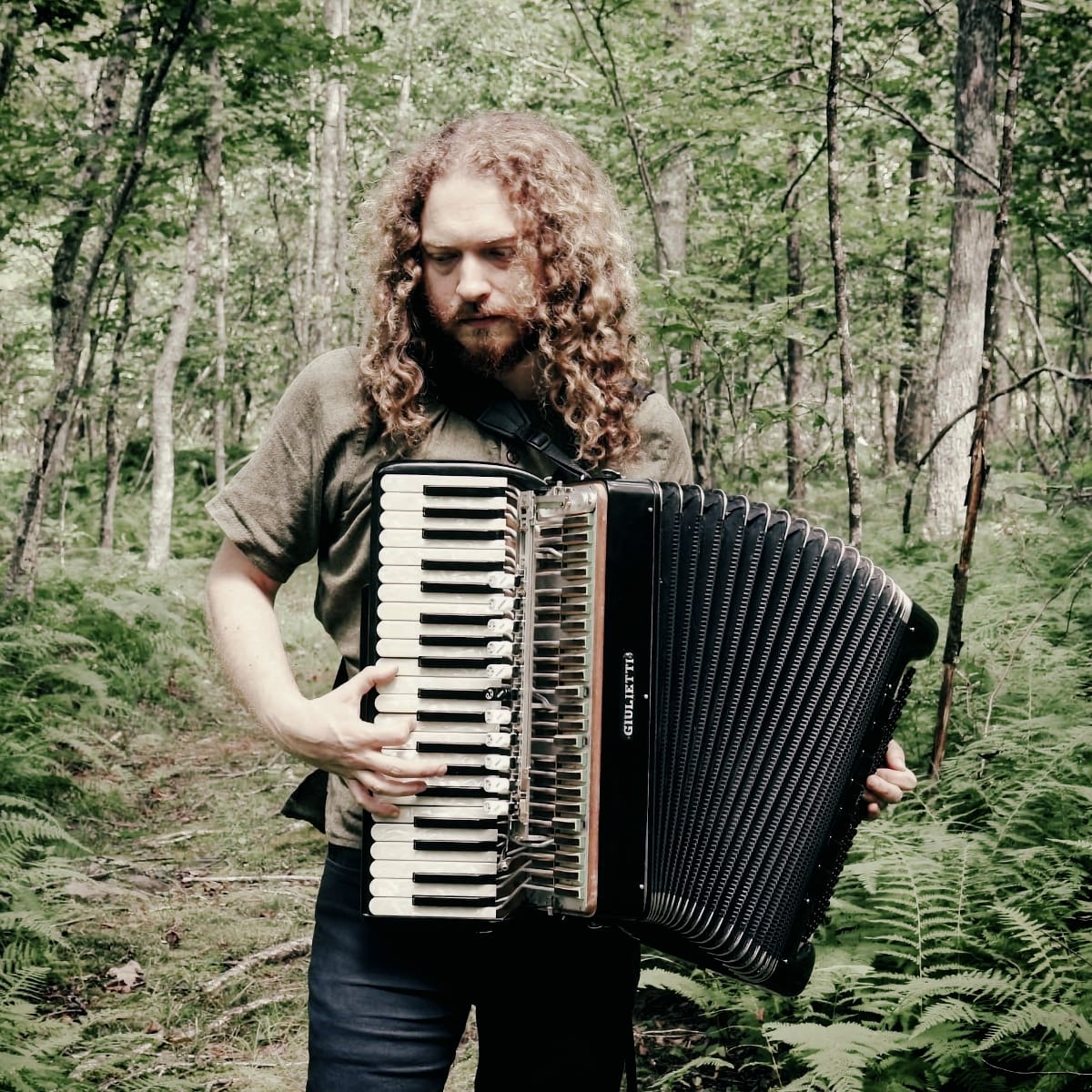
Ben Richter is a composer, accordionist, and ensemble leader based in Massachusetts. Ghost Ensemble, which he founded in 2012, focuses on microtonal and deep-listening-based music, including works by Pauline Oliveros and Catherine Lamb, as well as compositions by composer/performers in the ensemble like Richter and Sky Macklay. Ben has composed for numerous ensembles, toured extensively as a solo accordionist, commissioned several new works for Ghost Ensemble, and released numerous recordings since the early 2010s.
Ben and I first met at the Ostrava Days in 2012 and later worked together on a piece I wrote for Ghost Ensemble in 2018. I've always enjoyed Ben's music, but I took the release of his latest album, Mymerian on Sedimental Records, as an opportunity to do a deep dive into his work. Due to Ben's generosity in sharing scores and recordings, I've been able to spend time with five of his albums, two ensemble compositions, and his early works published on his Bandcamp page. A brief survey of Ben's catalog gives listeners an overall sense of his aesthetic achievements.
Fear Not Becoming Invisible is a chamber orchestra work Richter wrote for the Nieuw Ensemble in 2012 during his master's degree studies at the Royal Conservatory of The Hague in the Netherlands. It is the most fully notated or prescribed composition in his output, as is often encouraged when formally studying composition in higher education. (Composers are taught to be as specific and articulate in their music as possible when learning the craft.)
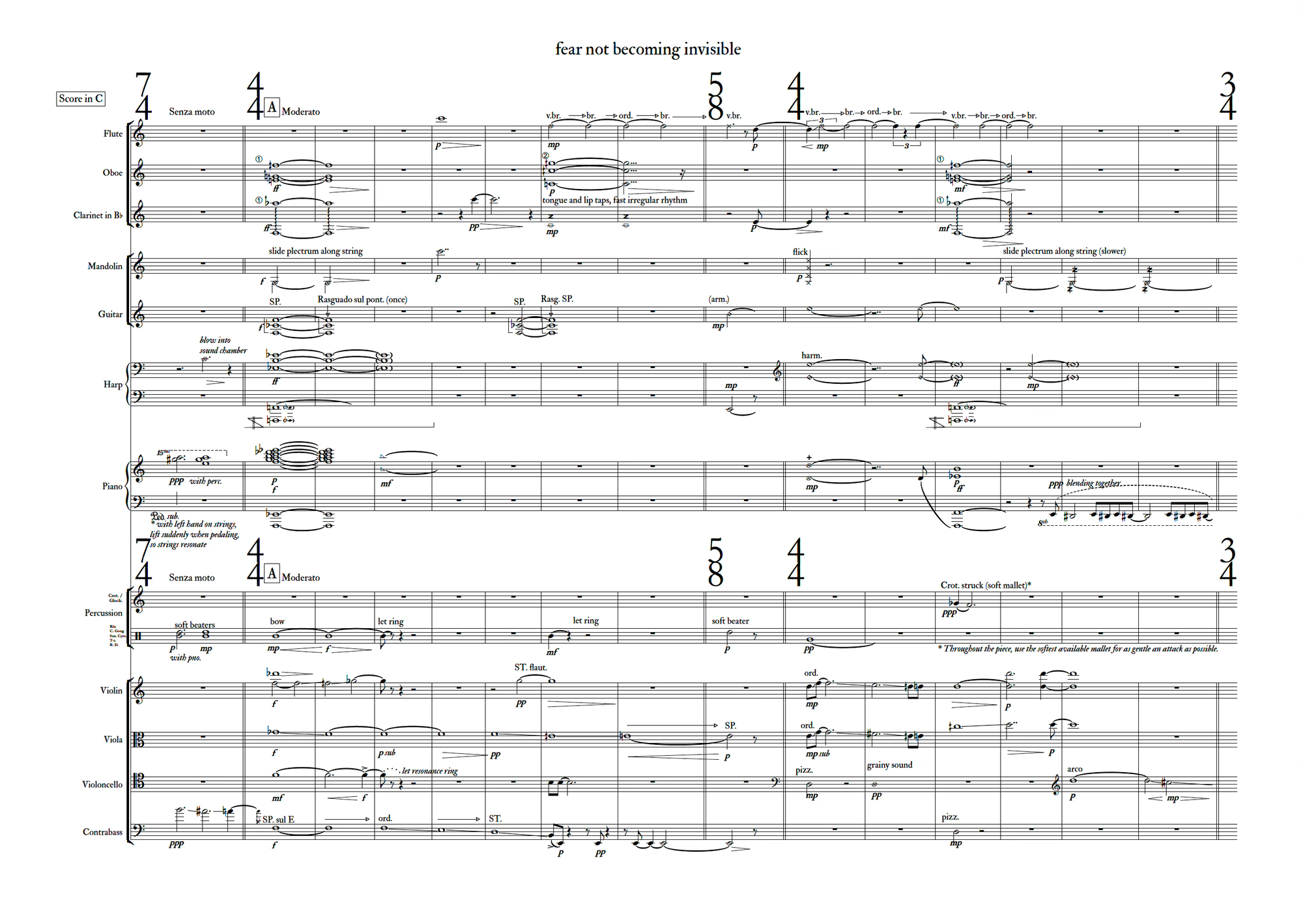
It's interesting to hear this early work because it teems with potential for what Richter will produce in the future while also demonstrating a talent for carefully working with fragile materials. The piece captures one of Richter's main aesthetic achievements throughout his work—the sound of the process of formation, a woven texture like a tapestry viewed close up. You can see individual threads making up large shapes and figures that appear completely different than when you view the whole. Of course, this early work doesn't fully prefigure Richter's output over the next thirteen years—the Ben in this work seems like a different personality, more formalist—but it is a notable starting point for an artist with a lot of potential.
Panthalassa: Dream Music of the Once and Future Ocean is a 45-minute work for five accordions released on Infrequent Seams Records in 2017. From the beginning, you hear a focus on tuning, pitches that slowly glide up and down, and just intonation. The movement of air in each tone played on the accordion interacts with all the others in the recording, sounding alive and resonating in the listening space, even in a recording. This is music I want to keep with me, one that reminds me of the true scale of existence, of how small I am in the universe.
As you can see in the score-follower video of the work, each measure is portioned by the minute and contains a lot of detail about how the sounds were made. However, the score is less a moment-by-moment prescription for what's supposed to happen and more a guide for improvisation. Richter recorded the work by multitracking his performance five times, and the results are simply stunning. Many moving parts come together at once, a polyphonic texture of harmonic colors that contrast with the drone on A natural and gradually coalesce into unison with it. The album is a huge artistic statement to start off Richter's professional musical releases.
"Cryptobiosis (Uncanny Sines)" from the same record is a showcase of imagination with extremely limited means—the only sound used is that of a sustained sine tone, the simplest possible sound in terms of frequency. Richter creates a real study of microtonality and acoustic beating, with glissandi and tones that carefully emerge and disappear in the texture. It's a compositional exercise that illustrates Richter's dedication to his craft and does so much with the most basic material available.
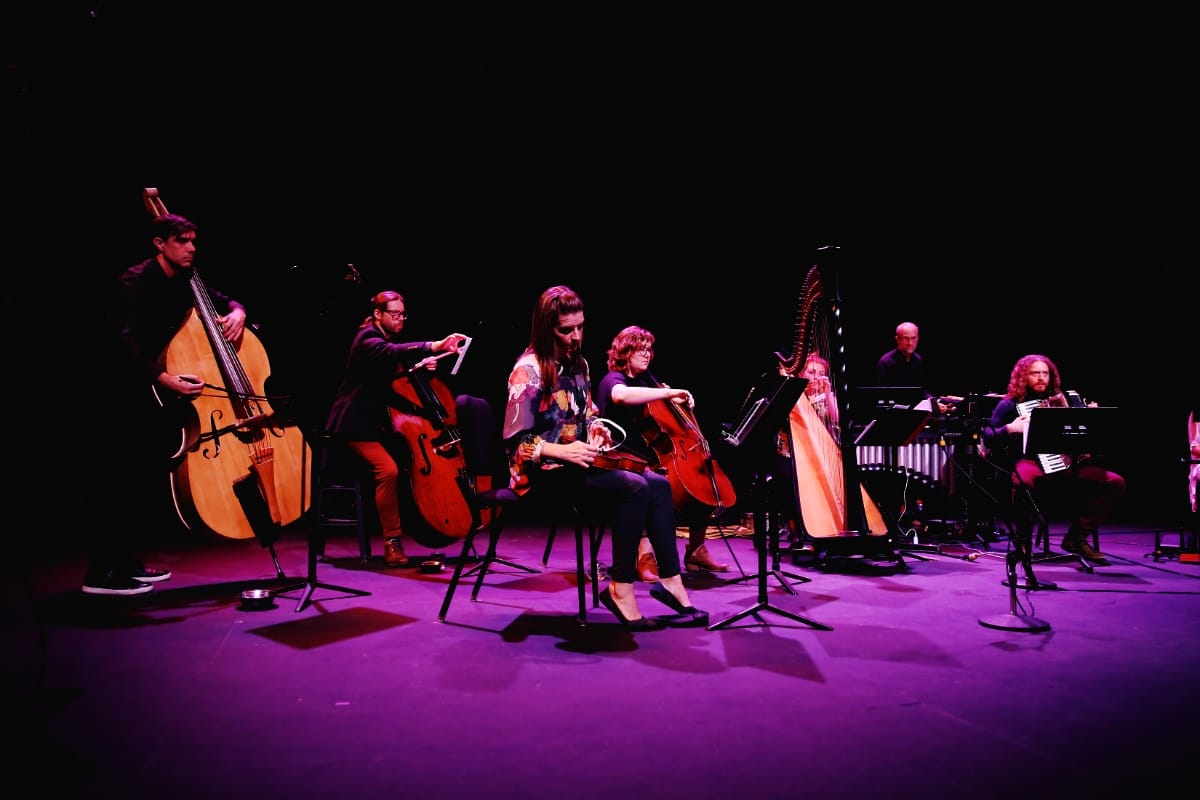
Richter's Rewild for Ghost Ensemble was written in 2022 and was released on New World Records in 2024. This work for Richter's Ghost Ensemble shows the utmost commitment from an ensemble in performance. All the performers dig into their parts with great intention. There is no guesswork, nothing unsteady, and everything vibes together into a cohesive, crackling whole. As a listener, throughout the entire work I'm wondering, "What will emerge?" There is a constant slow progression, brooding, a contemplative morphing (never boring), waves upon waves of tension that gradually transform. Ben and I discuss the work a bit in the conversation below.
Ben's latest album, Mymerian, was released this year on Sedimental Records as a result of Richter's residency at Epsilon Spires, an arts space and nonprofit performance center in Brattleboro, Vermont. The work is written for organ (a 1906 three-manual Estey pipe organ), accordion, contrabass, and cello, performed by Richter, Mike Bullock, and Laura Cetilia. Richter plays both the organ and accordion together in the live performance recorded for the album. In keeping with his earlier works, Mymerian deals with sustained drones that interact with shorter melodic figures that come and go. The strings are performed sensitively by Bullock and Cetilia, carefully following Richter's score while also freely exploring the harmonic space of the piece. Ben has developed a performance practice in which his scores are a jumping-off point for what is made in the moment, and the music is a stream of palpable moments.
I spoke with Ben about his work via video chat from his studio in the forest of rural Massachusetts.
The transcript has been edited for length, flow, and clarity.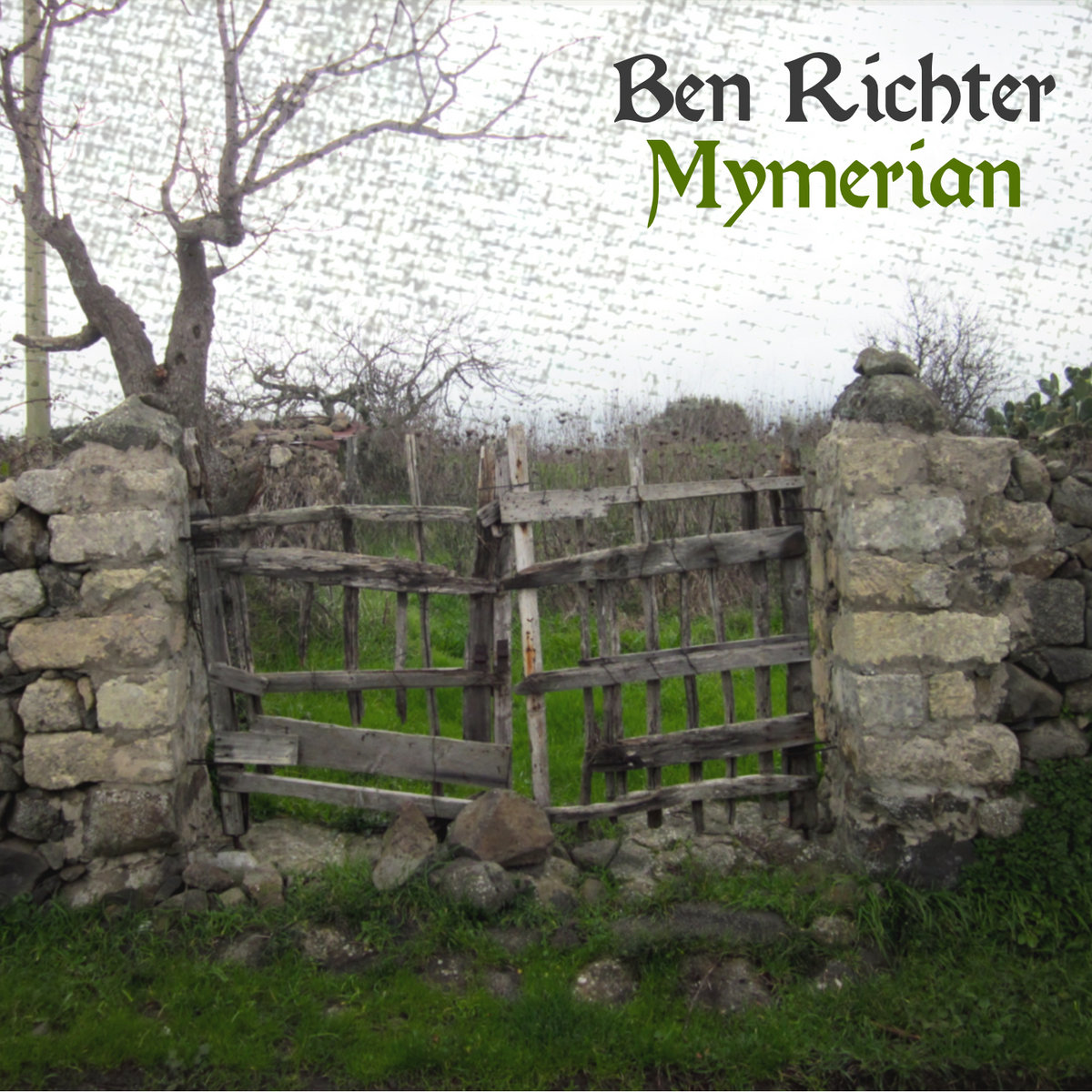
Chaz Underriner: I was reading the score of Mymerian with the recording, and I perceived the piece differently looking at the score than listening to the recording. Because in the score it's so simple. These notes are going to come in; this thing is going to repeat. It's really obvious how it comes back, or how it evolves. Something about the simplicity of the score made it more mysterious to listen to, somehow, because I loved that it was obvious what was coming next and how things were related, but it's almost like the piece does something else despite that.
Ben Richter: Especially with that piece, and with a lot of other things I've done, some more than others. Dissolution Seedlings—a lot of parts of that are more like this. Not so much Rewild, which is really written out. But I want to create a little garden where things can grow without being overdetermined, so there's a lot of space. Not just space for improvisation, like through listening moment to moment, but that's still what the piece is. And the score is there as a gathering place to start from.
I've been doing a lot of work along those lines for a while, when it's something I can really do either for myself—Panthalassa is like that, where the bars are a minute [the measures in the score take a minute of time], but there's obviously a lot going on in that minute that's not part of the score—or when I can work with the same performers for a long time. So Wind People, or the earlier Ghost piece from about ten years ago, is like that. And Mymerian's like that. I really like working that way, because then the music that emerges has this sort of alive, moment-to-moment, different feeling, where it's not like everyone's trying to carefully recite something. It's really about listening in relation to each other.
Chaz: I got that sense the more I was looking at the scores, the more I saw how they were functioning and how you all use them. The performance practice is very much alive, which is exactly what we want as composers.
I'd like to learn about your approach to pitch, frequency, and tuning, and your interest in glissandi. I want to get into that interconnected group of topics. Where would you like to start—pitch, frequency, tuning?
Ben: The general umbrella theme there is that one of the most consistent aims I have in making music is trying to expand outside of any accidental boxes that I might have, or that might be around what we might think of as typical ways to conceive music or think about music, depending on the dogma of the musical cultures that we've absorbed.
You look out in the world—how many straight lines do you see in the natural world? There are some. They can be gorgeous. They make these amazing practical patterns. But I love curls, curves, and whirls. And the idea of a pitch that stays at exactly the same frequency is such a strikingly strange thing. I use them too, of course, but I feel like glissandi are the default in nature, in that mostly things don't stay the same. Everything's changing all the time. So why shouldn't pitch be changing all the time, most of the time? And then if it's staying the same—oh, that's an interesting thing to do, to have something stay the same. Or stay the same, as in maintain the almost exact pitch.
It's also an acknowledgment that maintaining a precise pitch is pretty unlikely if you get super granular with it, with acoustic instruments. That's a starting point.
Chaz: And one way to tie it into the recent record: from what I understand in reading the notes about it, you all showed up to work with the organ, and it had gone flatter.
Ben: I had the opportunity for this residency at Epsilon Spires, which is a gorgeous, lovely place in Brattleboro. Because it was winter and it was really cold in the space—it's this giant old church space that would be impossible to heat, or astronomically expensive and environmentally horrific. Organ pitch varies based on temperature. I'm still, for sure, not an expert on exactly why this happens, but that seems to be a fact of life. So it was like sixty cents flat. I forget whether it was naturally 440 or 432 or something, but it ended up being basically A equals 400 hertz or something like that.
And then I had just gotten this quarter-tone accordion, something exciting I've wanted for a while. I found this old free bass accordion for really cheap, and then had one of the registers retuned, so it's got the full quarter-tone range in the right hand. And that's in 443. Accordions that are tuned to 443, really, if you play quietly with the right kind of pressure, it's actually 444, because accordions go flat while you play a little bit all the time—the pitch-bend technique is the same thing as the dynamics technique, to an extent. Especially these older accordions, where the reeds have been in there for a while, will bend a little bit automatically.
So this weird situation became the starting point for the piece, because I thought, okay, what sort of pitch landscape is possible here? And then of course, the organ is almost entirely static. Speaking of static tones being striking—there are some little tricks you can do to make it bend a little bit in certain registers, but not a whole lot. And then the accordion could bend more, and the strings could bend. So the piece also partly emerged from the interplay between those different possibilities of pitch behavior.
I will say the organ warmed up a little between writing the piece and then the premiere, the concert which was recorded. We also just adapted that day: oh, we're only forty-eight cents flat now. Okay. Which, they're like, no problem. But with the accordion, I was bending more than I expected to.
Chaz: That's wild. And I think that gets to what you were saying about pitch and frequency as they naturally occur being so much more flexible and conditions-based, or contingent, than the idea of "our A is 440, therefore this is tuned in equal temperament this way." A very deterministic way of thinking. More like going with the flow of how things are happening.
Which actually leads me to another question. In Aurogeny, the string quartet, I was curious about how much control you wanted over the resulting sound at any given moment. Because for me, you have this very clear structure of going up, coming down, but then there are moments in the recording where it's like, boom, you have this super bright sonority that comes out. Like this beautiful major chord with some other stuff inserted into it. And then it slides into it and then slides out. Is that the result of a process that you've set up, or is it articulating something you specifically wanted—oh, I want this major chord to emerge at this moment?
Ben: Both. In that piece especially, and some others, but that's a kind of hardcore study on just intonation. I'm hoping to create the conditions for these specific things to emerge at points, with a bunch of brambles and birds along the way, and for them to slide in and slide out again, in terms of specific harmonies. And that's the most austere realization of that kind of thing.
Chaz: What was your music like when you were studying in The Hague? Was that your Andriessen phase?
Ben: It never quite sounded like that. But I was drawn to The Hague because of its anarchist reputation. This was a Kyle Gann recommendation, and that certainly has a lot to do with Andriessen and the others of that school, whom I studied with there, like Cornelis de Bondt. It was definitely an anarchic place, both in the political sense and in the sense of just being chaotic.
My music grew enormously there because of the projects I could do and the collaborations I could have. I got the idea for Ghost Ensemble. I got the sense that I wanted to make music through long-term working with the same people, and that sort of collaborative exploration, during my time there.
I don't know if you saw the piece—Fear Not Becoming Invisible—which is a silly title, but I'm still happy with it. That was a chamber composition I did back in those days for the Nieuw Ensemble.
It was a real privilege to work with them because they completed a practicum of three workshops over an entire academic year. So that's, of course, how I love to work now, and that was my first opportunity to do it. And I wrote what, at the time, felt like by far the most fully realized piece I had ever been able to do, writing with other musicians. And I thought, oh, this is how it should be. And I would like to start a group like this with my friends in New York.
Chaz: One question I like to ask artists—especially when they're visiting campus, or they're coming and doing a show in small-town Florida where I live—is, what does doing the creative work mean to you? I'm curious about your thoughts about it, because it's one thing to talk about technique or approach or methodology, like we've been talking about, but it's something different, I think, to talk about personally: what does it mean to you to compose?
Ben: I think of the work as gardening. It's creating, trying to tend—and this is human community and beyond, and your own attitudes, ways of thinking, and ways of relating to the world. It's creating situations for the kind of listening, openness, and relationality that let the music emerge as its own being.
There are exceptions here, in some of the projects we talked about, like the string quartet. But most of the music that I've been happiest having a part in has emerged through a lot of that kind of exploration, and things bouncing around subconsciously forever, and then making little sketches on napkins here and there. The House On Fire piece is an interesting example, where it's all these different things that sprouted up a little. And Rewild started this way too—a bunch of totally different things that gradually grew together into this little garden-forest ecosystem of different, what feels like different little creatures. Musical creatures.
I think about the creative work like that. I want to frame this positively, rather than the negative of getting your ego out of the way or whatever. But watering some soil, and keeping in mind what sort of soil has created really magical, beautiful musical surprises, and keeping that going. Tending that way of relating. It's really about relationships among people, I think.
Chaz: For sure. That's beautiful. And it actually answers some of my other questions about your working methods, because especially with the two pieces you mentioned, Dissolution Seedlings and Rewild, were two that really stuck out to me for different reasons. So it makes sense to me that you were testing things out, trying things, letting it percolate until it finally fully manifests itself as a work.
So, with a piece like Rewild, were you trying out passages with the musicians and then recording it? Or just remembering it and writing things? I tend to make demos of everything myself.
Ben: Rewild is a special case because this is the most I've ever done for a single piece. This took a couple of years to make, and it was a little delayed by the beginning of the pandemic—by "delayed," I mean given more time to germinate. We incubated several pieces with Ghost at the same time. So this is alongside Catherine Lamb's piece, one of Sky Macklay’s pieces, and Miya Masaoka and Lester St. Louis. These were all sort of incubation projects during the pandemic, 2020 to 2022.
So early on, we did workshops and recorded a bunch of sketches for all of these pieces. And then I had all these different segments of a few minutes, little sound worlds. At one point, I had all the different score segments taped up on my wall, and I could switch them around and everything. And I listened to them a ton—the sketch recordings, in different orders and slowed down and superimposed and so forth. And that's how the gardening of that piece happened. It's like, what are the different relationships present between these different musical moments, or regions, or however you might think of them?
And it assembled itself into one form, in the case of Rewild—which was part of the idea for that piece, that it would be one consistent sort of written-out piece. But in a piece like Gatherer, the harpsichord piece I just finished, it's a similar sort of thing, except there are an infinite or enormous number of permutations of different ways that you can find your way through the piece. Because there are different ways to move from one section to another, and it's not linear. And that was a little more possible because that's for a solo performer. So it's up to that one person. Whereas Rewild is a conducted nonet.
I'm really interested in working that way, because then the music can take the lead. And whatever idea I might have had in the beginning, if that had determined it, it would never have become what it was.
Chaz: I want to talk about the oboe solo in the middle of Rewild. Because to me, out of all the music I've heard of yours, it stands alone as being, to me, the most modernist kind of thing in your work. And it comes out of nowhere in the piece and then doesn't come back. And I don't really hear that in any of your other work, so it seems very singular. Can you tell me about it?
Ben: That's interesting, that it stands out so much. I feel like I've done this a lot, where I'll feel like I have a vibe going in a piece and I want to shake it up a little bit and introduce something completely different. Maybe this is the only time that's been a wailing oboe solo.
Chaz: And Sky sounds amazing, of course.
Ben: She's a close friend I've worked with for a long time, so I wrote it to her personality, abilities, and everything. I want her to be free with it. So it sounds a little different every time, which is definitely the idea.
This is also part of the idea of Rewild. I was just saying, letting the music take the lead, and also letting it emerge from these organic relationships, and that needed to happen. If Rewild is like a forest, the oboe solo is like this big squawking, enormous bird that flaps into the trees around you.
Chaz: Mymerian sounds chant-like to me, especially with the figures you have. So I'm curious if working with the organ changed the type of sonic material you were using. Or were you intentionally in dialogue with the musical history of the organ?
Ben: It was definitely different in the sense of those relatively static tones, pedal tones—and that's one popular way to use the organ. Also, knowing I was going to be performing on the organ, and I'm not an organist, this was one way I could do as much as possible with it: hold some organ keys down, droning, while I also played the accordion. In the live show, I played organ and accordion at the same time, but I did that using pedals and then pencils that hold the organ keys down.
And that necessarily meant, okay, pedal tones, static tones. But they can also change through gradual register shifts and so forth. So I took a lot of what I do on the accordion and brought it to the organ, in the sense of those register changes.
But it definitely affected how the piece unfolded, because a lot of what I like to do with what's often described as drone is have it gradually change pitch, along with many other parameters. It's more about something unfolding on a slower timescale. With the organ, it was more like, no, this is going to be static until you change it. You're holding a key down. And so that affected the backbone of the piece. A lot of what I would do was start organ drones and then improvise over them with the accordion. Find some melodies, find some relationships. And there's certainly still a little bit of exploring, as you can hear.
Check out more like this:
 Kallie Marie
 Chaz Underriner


Comments