


St. Paul’s Cathedral, London, may soon host raves, and the pipe organ has been resuscitated for various ‘creative music’ purposes. That data alone directed my writer’s instincts to friends serving at my local parish. After The Tonearm editorial gave the green light, I reached out to Drs. Andrew Minear and Phoon Yu, the music director and organist, respectively, at All Saints Episcopal Church, Winter Park, Florida.
My request of the Drs. was direct: May we discuss what you do and what you like, notably for our Tonearm readers? I saw this as an opportunity to learn about a specific niche of non-commercial music many don’t consider.
Drs. Andrew Minear (DMA from Michigan State) and Phoon Yu (DMA from Juilliard) are beloved by 600-plus parishioners at All Saints Church, Winter Park, Florida. Neither has an extensive discography. I also have doubts about their dancefloor skills, but during a 75-minute conversation, I learned what two high-IQ, big-hearted musicians have to say about then-and-now sacred music, serving a community through music, and Big Ears 2026. Honestly, little seems as niche as interviewing unironic church folks.
The transcript has been edited for length, flow, and clarity.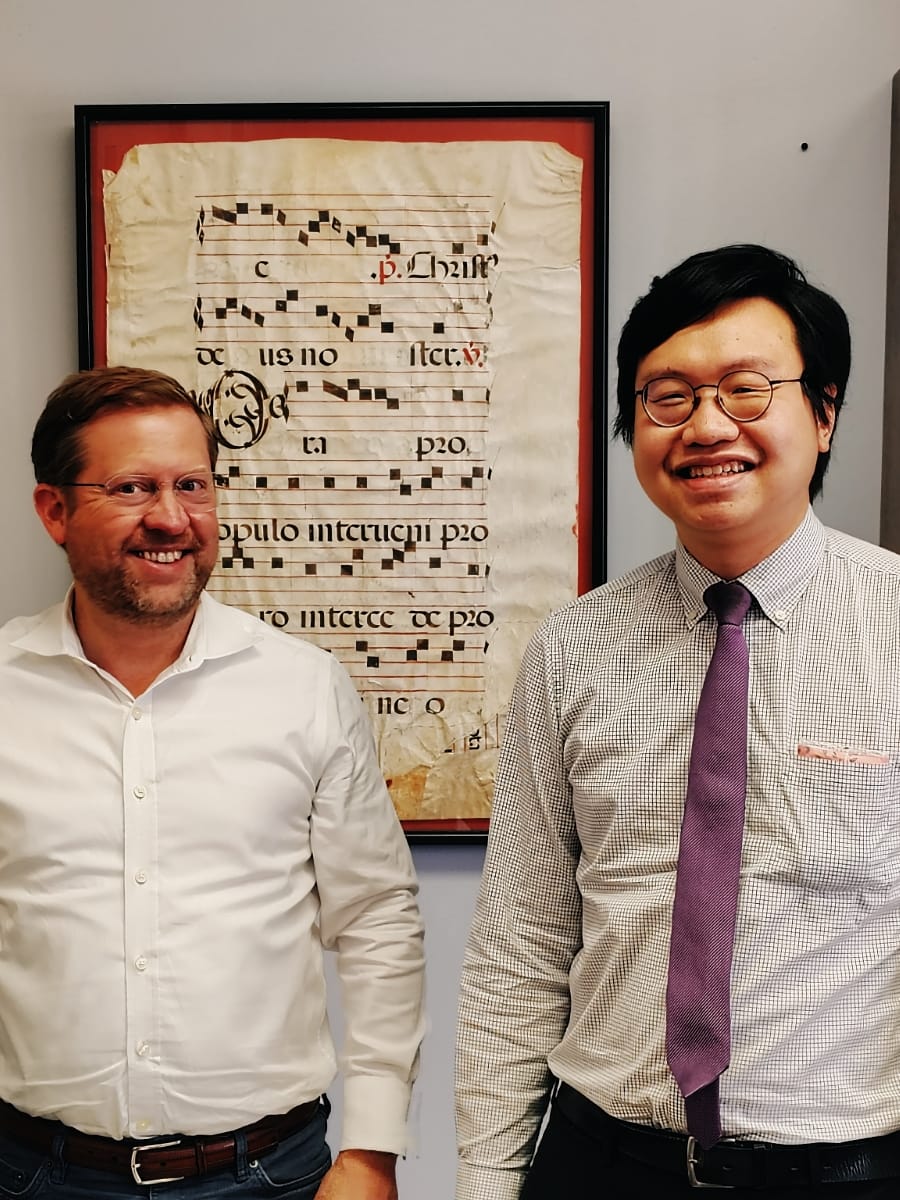
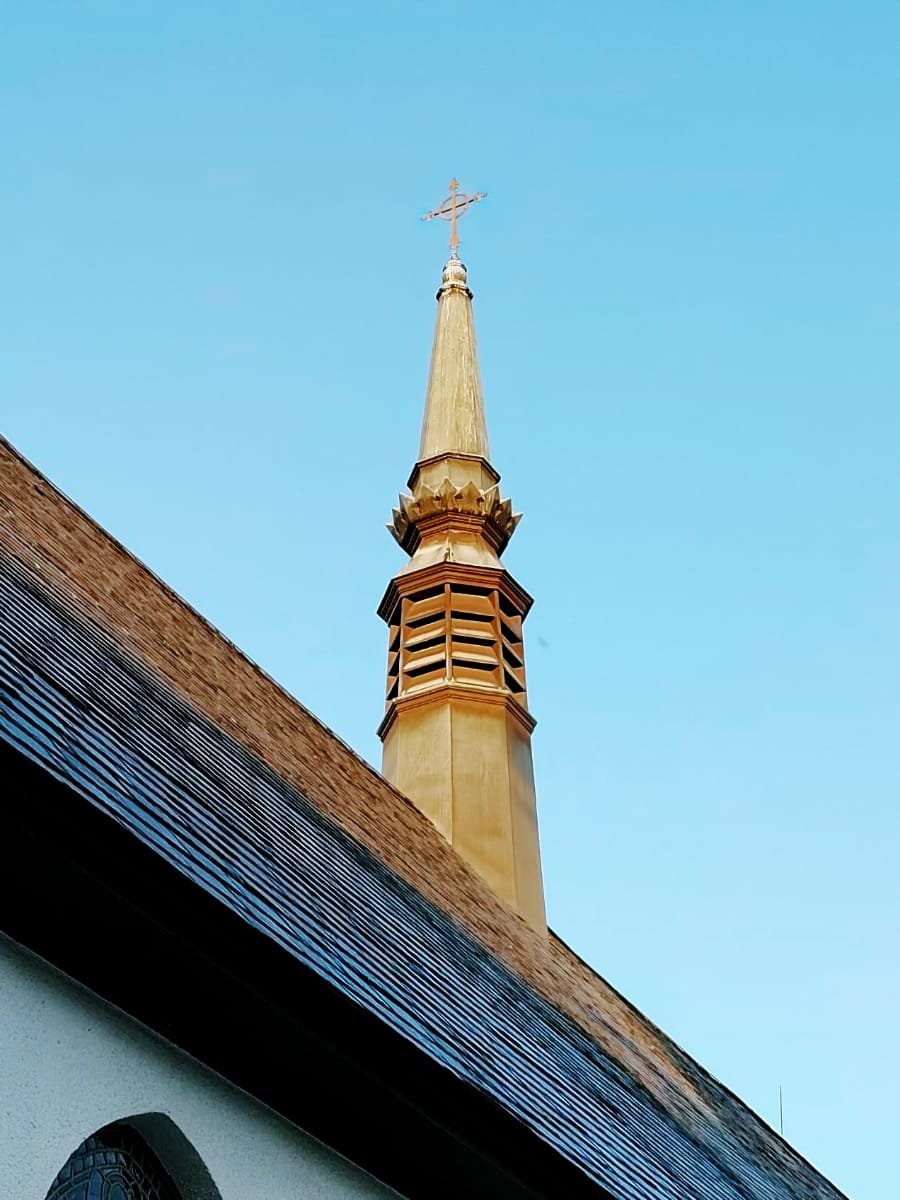
(L) Andrew Minear and Dr. Phoon Yu; (R) Spire at All Saints Episcopal Church, Winter Park, Florida
Andrew Minear: One of my favorite things at the 2026 Big Ears—and I love jazz and some of the experimental things and electronica—but one of my favorite moments of Big Ears was at the Episcopal cathedral, fittingly. They had a whole day of Indian ragas. To go that morning and just be still and experience a full morning raga—it was centering and beautiful. And to be in that really beautiful room added to it; the acoustics of that room really added to the experience as well. And there actually was classical music there: the professional choir The Crossing, from Philadelphia, sang, and that was exquisite.
Phoon Yu: I’m one of those very few musicians who do listen to a lot of classical—usually baroque stuff, like baroque organ and baroque big orchestra music, and some vocal music I like. I like Vivaldi. I sometimes just put that on. I once did a cantata listening survey, where I tried to listen to every cantata.
I also like listening to the Japanese group YOASOBI. I like listening to their songs. Their whole schtick is basically that they turn stories into songs. They often start with a written story and turn it into a song, usually with a nice animated video. I find it’s actually quite classically rooted. They have certain chord progressions at the outset. So there’s actually something there, and I’ve put some of that into organ transcriptions and played some of that at All Saints.
Steven Garnett: Those stories are just Japanese folk tales that they—
Phoon Yu: No, it’s all modern literature written by someone who’s still alive. Usually a short story, written by someone. Some of the short stories are sometimes aligned with other franchises. Growing up, I played a lot of Japanese game systems, like the Game Boy, and I heard a lot of this music. A lot of these famous franchises, like Pokémon and, I would say, Final Fantasy—even though I don’t really play Final Fantasy—are written and composed by Japanese people. So there’s this Japanese permeation. I get this music of my childhood, this style where they take Western music and engage with it in their own way.
Andrew: I also love rock and roll, jam bands, Sonic Youth, all that. I think everything relates to everything. Feeling amplified rock and roll, like a big moment, or engaging the intellect with some really experimental improvisatory music, tickling the brain—I bring that into the choral rehearsal as well. Knowing the power of rock and roll makes me a better choir director, because I try to tap into that same power when it’s just a group of voices together, especially when we’re singing with the organ and can pull out the thirty-two-foot bass from the pedals. It all feels very similar to me.
I particularly like jazz. A couple of recent live performances I’ve attended featured Christian McBride on bass. I was so struck by his performance: the phrase endings, and the way he and his ensemble would so exquisitely taper an ending. The fade-out is not hip anymore. Helen Kemp has an old saying: “Body, mind, spirit, voice—it takes the whole person to sing and rejoice.” And I also think about not just the phrase endings but the really big moments, when you build up to something, and then you have this big arrival. I can’t help but channel my youth, as a young man going to a rave dance party. When a great DJ can get the whole room into this big crescendo until the beat drops again, and that emotional release happens, it’s incredible, spine-tingling. When we do it right, we can have this very similar experience with a choir, where it builds and we kind of stretch time a little bit, and then finally we can release into a big mountaintop moment, a climactic musical moment. And it sends goosebumps, chills down my spine, the exact same way.
Phoon Yu: Whereas as a composer, I think about it in terms of form—the structure of how pop songs would go. I also like listening to some European-language stuff. For a while, I was into this German a cappella group called the Wise Guys. I think they’ve disbanded now, but I used to listen to their songs, and that was really interesting.
For me, what draws me in is primarily the harmony and the form, because as a composer, you think about these two different things. So I would listen to: okay, how would they bring the chorus back? How do they reshape the lines? And with very innovative groups, you can always find something different that they do.
Somebody told me that composition is a tension between the new and the old. So whenever I listen to any kind of music, I always think about that.
When we talk about sacred music, I think we think about the institutions that run it. One parallel I can think of: when I look at music, I think of the overall form and structure, especially when you’re an organist—sometimes, but not always—you plan your registrations in advance. So you look at the whole thing and map it, and then you plan out where you want to go and what you want to do. In that sense, you think of it on a strategic level.
A church is not just a bunch of people and the music they do; it’s also an institution that will outlive us, has come before us, and will continue after us.
Andrew: It’s the same with form and structure in choral music. We sing all kinds of genres of music; there are choral settings of pop and all popular music, jazz, or anything. But if you study the history of music, one of the things that you do is trace different forms and structures and stylistic elements and see how they appear throughout history. When you zoom out and see the big picture, contemporary music is built on the same rudimentary elements that music from five hundred years ago was built on.
Phoon Yu: Change and stasis.
Andrew: Yeah. Moving away from the center, then coming back to it. Or not. And I feel like we’re in this golden age of choral music right now, with so many composers that are writing beautiful and interesting things, and it’s so easy to publish and distribute it today. So there’s just a lot of new music coming out constantly.
I lead music for a community arts nonprofit (Orlando Sings) with a symphonic chorus and a professional choir, where we perform all kinds of music, sacred and secular. I’ve been paying attention to Jocelyn Hagen. She’s a Minnesota-based composer. We’ve helped commission a couple of her new works, which are really fascinating. They’re multimedia symphonies, so choir and orchestra. Then she works with this new software that was developed, and artists who develop these moving images—sometimes it’s animation, sometimes it’s more abstract, sometimes it’s more using a human model. But the images move in coordination with the music.
What Jocelyn has developed that’s innovative is this software that follows the conductor. So any of the intuition or instinct in the live interpretation of the music, any of that sort of spontaneity, can happen. There’s someone over there with an iPad following the conductor to make sure the moving images stay exactly coordinated with the music as intended. We did one based on Leonardo da Vinci’s notebooks, and Orlando Sings will premiere a brand-new one this season called Creation. It’s all about creation through a feminine lens. It’s going to be a really fun project to bring to life this year.
I think Ted Hearne is doing really interesting stuff; it’s really out of the box. It doesn’t require an orchestra with a very traditional instrumentation; there’ll be multiple electric guitars, extended percussion, and a lot of electronics. It’s unique, but he also tackles some big, timely topics and issues.
Garnett: Please tell me about your respective parish obligations.
Andrew: The Director of Music Ministry is ultimately responsible for all the music happenings at the church. My primary work is with our choirs. I also help families plan the music for weddings and funerals and coordinate with the other departments and folks who make things run here at All Saints.
In my role with the choir, it’s not just choosing music, hymns, and anthems, and planning what service music we’ll be doing, et cetera. I take the ministry part of my job title really seriously—taking care of our choir family. Our choir family is really close, and we really take care of each other. So it’s not just planning and rehearsing the music, but taking care of the heart work that’s involved in it as well.
Phoon Yu: I basically provide the music. Primarily, I play all the services. As a parish organist and pianist, I try to use this opportunity to learn and provide as much different music as I can. I’ve been playing a series of Bach cantatas on Sundays.
Garnett: Dr. Minear, you pointed out tending to the hearts, and Dr. Phoon Yu, I think your heart is certainly engaged when you’re working on those Bach pieces. I guess there’s a depth and breadth that you’re both being maybe modest about, because it’s not just a job—not just to say, here’s the congregation, here are the hymns we’ll sing, and we hope they’re right for the season.
Phoon Yu: To buttress Dr. Minear’s point about attending to the heart, I think I can speak to the minds of the congregation—not that ministry is a mindless thing, but for me, I always try to engage the minds of the listeners. Some of it, of course, comes through the prelude and postlude and how I play, but some of it comes through improvisation. I try to do things differently. For example, when playing psalms, Dr. Minear suggested changing the registration to match the mood of the text. If the text mentioned a storm, I would use a tremolo, or tremolo octaves, to represent it. Or if the text mentioned riding horses, I would play a passage to symbolize them. It’s engaging the minds of the congregation, so it’s not just that they listen to the music and that’s it.
I guess you could say this music goes all the way back to the time of Christ, right? I think it’s in the Gospel of St. John—I think after the Last Supper it says, “And when they had sung a hymn, they went out.” They had worship music back then, even if the organ wasn’t a part of it.
Andrew: The psalms themselves are songs. So you have this idea of singing, and the psalms—we imagine David with his lyre or his harp, singing to worship and glorify God, but also to express the whole spectrum of the human condition, from rejoicing to suffering and pain and anger. The psalms have all of it in there. Just deeply human. This idea of pouring out your heart in song has been happening as long as humans have been on earth, I imagine.
At a moment when the music becomes really big and grand, we can talk about the heavens opening and our hearts on fire with the Holy Spirit. So that’s one of the reasons why I’m here: to be able to do that music in a way where there’s no holding back or being careful, but just going all in. Here at All Saints we can go vertical with it.
Garnett: I’m hearing—maybe my bias being that we share this love of sacred music and consider it to be vertical and transcendent—but that music writ large really could and should function that way at its best.
Phoon Yu: I was just reading, if I remember correctly, this book about the history of English cathedrals by Nicholas Orme [The History of England’s Cathedrals]. He talks about a series of services, some sung by the resident canons and vicars. So you always had this rich history of vocal music, and afterward they added the organ to accompany and sometimes play voluntaries. But it’s a very wide span of history to generalize.
Back to reimagining church music. I think on one hand—to use a cliché term from, I think it was Michael Tippett, A Child of Our Time—we’re kind of like children of our time. On one hand we have this tradition; on the other, we are all people from a different era.
Just one more random anecdote: when I was in my last year at Juilliard, I sometimes played at a church in Bedford-Stuyvesant. The congregation at this church—I think they were a breakaway from the Episcopal Church, with their own hierarchy. It was a very weird mix. The congregation, which was small, was all Black people—it’s in Bedford-Stuyvesant, right, the heartland. Then there was me, an organist of Chinese descent. Then you had the priest, who was Jewish. So that’s a really weird mix. That was, once again, engaging with tradition on your own terms, with so many confluences of different elements. That was an interesting experience.
Andrew: That makes me think about another composer that I’m listening to right now: Reena Esmail.
Phoon Yu: Oh, yes. For what?
Andrew: Malhaar: A Requiem for Water. We did it a couple of years ago—it featured choir, tabla, and a Hindustani soprano. This composer’s family heritage is Indian, but she grew up in the United States, so her music blends those two styles beautifully.
Another composer I definitely should mention for The Tonearm audience is Caroline Shaw, whom I got to see at Big Ears this year in collaboration with Sō Percussion. What she’s written for the vocal ensemble Roomful of Teeth is super innovative. I’ve never heard anything like it. Fascinating stuff.
Phoon Yu: But I think it’s true that music is very alive, and people—when we make music, we don’t look at a formula that tells us, okay, do this at this time, do that at this time. That’s a score, but we engage with it on our own terms.
Check out more like this:
 George Grella
 Steven Garnett


Comments