


This record is what happens when friends who have been meaning to get together finally get together—after 30 years. In essence, they've been meaning to do lunch ever since Fred Thomas (too many bands to list here, but we will mention the 40-year expanse of His Name Is Alive to Winged Wheel) walked into Windy Weber and Carl Hultgren's record store (who also helm too many projects to list). They're a little fuzzy on the details (Windy hates this whole aging thing), and then there's Frank Rotondo from the improvisational jazz world, who is a little fuzzy on details too. I'll let them tell the story in their own words.
I have to overplay my hand. This is my third time interviewing Fred Thomas. Fred is unavoidable when you start talking about Michigan. I think of him as an enthusiastic high school yearbook editor who is a walking record of a scene that begins in the late 1980s around Ann Arbor and Detroit (or, if we want to get specific, Ypsilanti) and moves into the early 2000s. You're going to run into Fred on many projects, whether he's hitting record on a multi-track, or playing in the band, or the band leader. It's obvious to me that Fred was that industrious kid who cold-called his career by showing up in town with an armload of demos. It's part of the lore. He's that kid, and Windy is going to scoop up his records and hopefully sell them on consignment as an olive branch to the scene they serve.
Windy & Carl, established pillars of this time, come to the table with a fierce DIY ethos, a salient guitar drone discipline, and a little bit of what Windy terms "new-agey hoo-ha." Drone is difficult, and this is indeed a dark ambient drone record of improvising pairs. Frank and Fred comprise Optigan Conservatory and meld into the Christmas-light-clad basement of Windy & Carl with vintage synths and a sheet of ideas.
Then there's the down-to-earth element. I can't help but smile at the familiar upper-Midwest inflections, a grouchy dog barking at the UPS truck in the background, jokes about getting a pair of Skechers to tour in. The quartet skates between the mundane mutuality of clerking jobs and paying bills, then the absolute inner shadow work of being elder goths and embodied jazz guys moved by the spirit. (Except in Frank's case, the spirit may be an actual ghost haunting him at bicycle frame-building school.)
While I glossed over Frank's interest in building bicycles in our interview, I couldn't help but consider cycling, drone music, and the way our bodies respond to pacing and that subtle, contemplative state. Drone is hard. Ambient and atmospheric long-form work is hard. It requires attention and command. Somehow, we as listeners receive the gift of a long-form session as a document of one day in their lives, by four of the most casual humans doing something difficult. Windy & Carl Meet Optigan Conservatory is that record.
The transcript has been edited for length, flow, and clarity.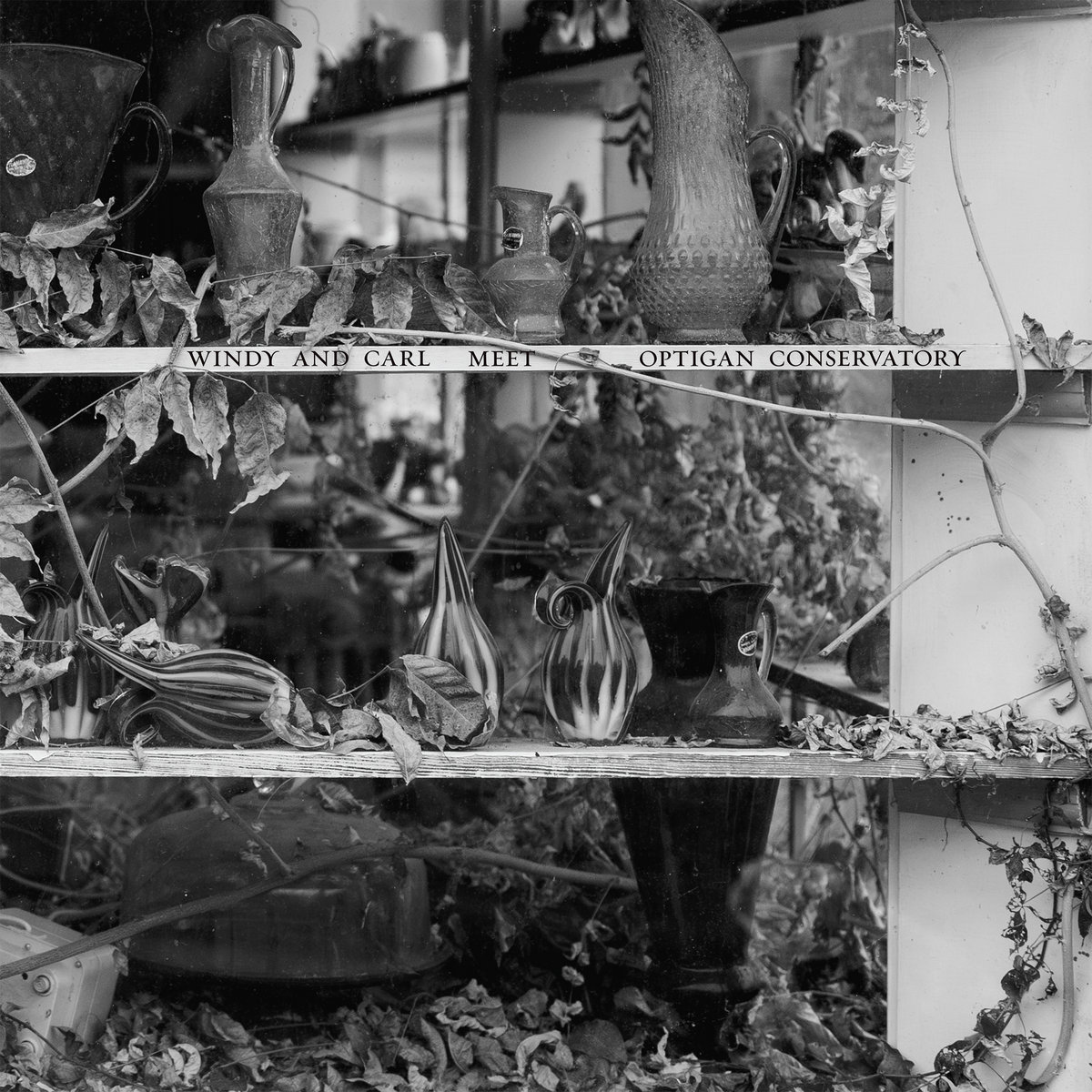
Carolyn Zaldivar Snow: Is everybody in Michigan right now?
Frank Rotondo: We're not allowed to leave.
Carolyn: Can everyone show me with their hand where they are in Michigan, just so I'm clear?
Carl Hultgren: We're in the same area.
Fred Thomas: No more than 40 minutes from each other, though. I could get to any of their houses pretty quickly.
Carolyn: I was wondering how the collaboration came about. Did somebody ride their bike over to someone's house and say, "Can you come out and play long-form drone with me," the way kids do? Let's start there. What I didn't know is that you actually had all known each other for many decades.
Carl: Yeah, since the mid '90s.
Frank: I think I met Windy and Carl, and was it '94? Then I think Fred and I met in the late '90s?
Fred: Mid to late '90s for sure. In 1998, we knew each other and were bumping into each other all the time. By the 2000s, it was like we couldn't get away from each other. (Group laughter)
Fred: I played a show with Windy and Carl and Labradford at the Green Room in Ypsilanti in 1995 or 1996, maybe.
Windy Weber: We did a whole week with them in 1996.
Carl: I should have had some [show] flyers ready to show the proof of dates, so we had some memory of that.
Windy: You know, as you age, stuff gets fuzzy. We've all known each other for so long, and run into each other at shows all the time. We've had this general idea of, "Why don't we find a day that we can all sit down and just play music and have fun?"
Carl: It took a very long time for us to get together, too. For 30 years we discussed, "Yeah, maybe one day down the road we can do something."
Carolyn: Because Fred was touring too much?
Windy: You know, you see each other. Hey, we should do blah blah blah, and then another year goes by, right? Because everybody's busy. So yeah, Frank and Fred, what are your memories of this? How did we manage to put it off for so long?
Frank: It's weird because I remember saying to Fred, when we were together working on something, that I wanted to reach out to you guys and see if you were interested in doing stuff. I think, in passing, we would always say, like, "Oh, let's do something because we've all played shows together over the years." In 2023 or 2024, we really started saying, like, "Oh, we need to nail this down."
Fred: It's also the nature of the music, too, because I know Frank and I have been working on Optigan Conservatory for about 10 years, but we get together once a year for it. I know that with Windy and Carl, sometimes it's like five or six years between records for you guys because the inspiration just isn't always happening. The time isn't always happening. It's just kind of a patient art form.
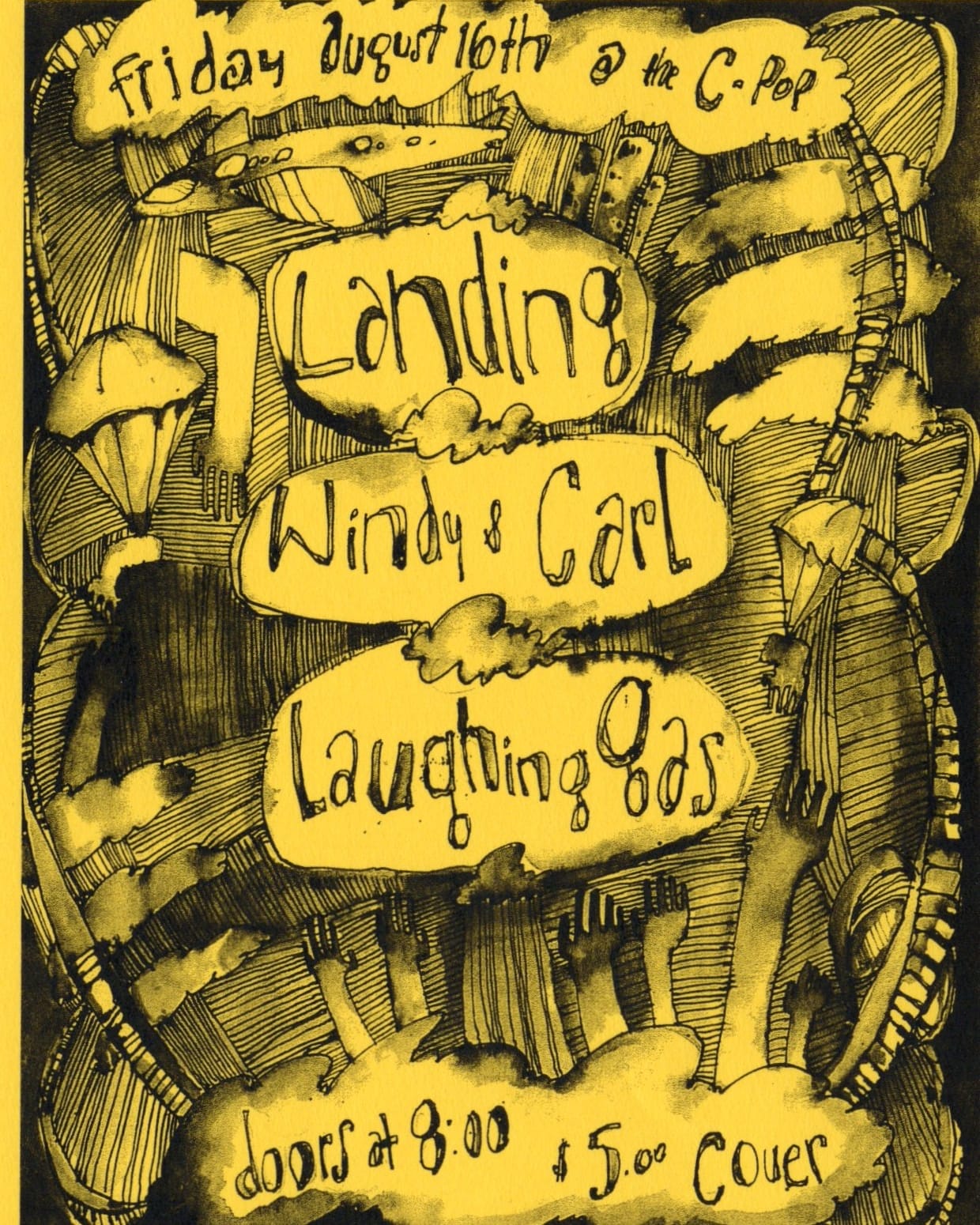
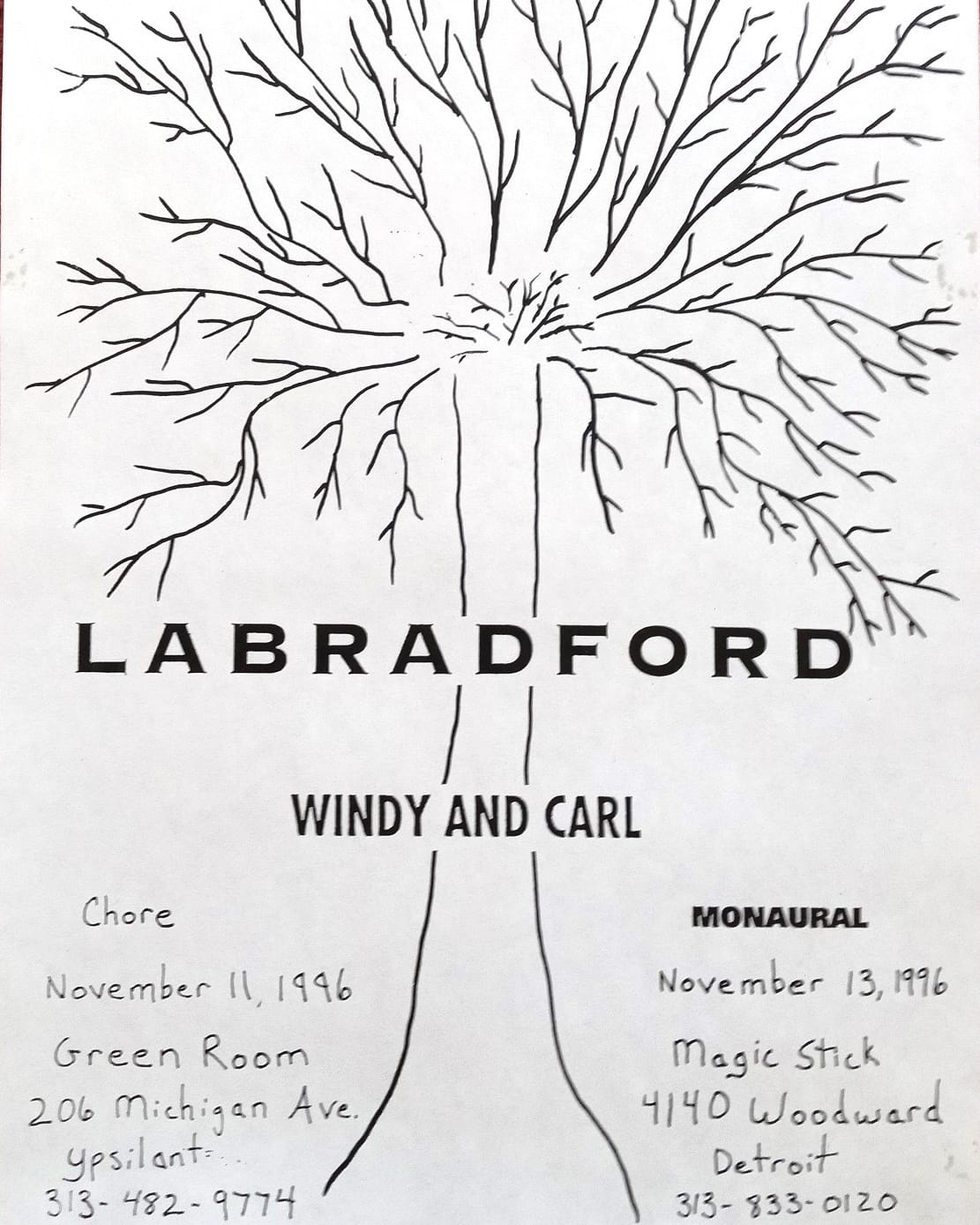
Vintage flyers presented as evidence.
Carolyn: In continuing with what you said about these patient things, what is it like making long-form music, longer compositions for a shortening attention span? When you make things, who do you imagine is listening?
Carl: We just do it because we enjoy it, and hopefully somebody listens.
Windy: We just sit down and get taken away. And the idea of anyone listening to it afterward is secondary. So the fact that people do listen to our music and enjoy it is a super bonus because we create music because we have to. It's this thing, and it has been since we were teenagers, the feeling of needing to make music, so that's what we do.
Carolyn: Fred and Frank—what do you think about that question?
Frank: Coming from my background, mostly playing improv music, especially leaning towards jazz—I mean, the longer the composition, the better. When Fred and I get together to record, we've worked on pieces that were an hour long, and we've broken them into shorter, individual pieces that connect. We make music for ourselves, and if people enjoy it, it makes us happy. This has always just been a fun thing for Fred and me. If it wasn't for Fred, I would have stopped playing music for a long time.
Fred: To kind of address the context of the question, I feel like long-form music and, for lack of a better term, ambient music—the type of music that takes up a lot of space—is patient. It's similar to a painting, or something like that, where the artist is certainly not thinking about the audience, thinking about the gig, thinking about the gallery, and the experience that the observer has with the painting, like a Rothko or something like that. So it can only be personal. I feel like long-form drone spectral music—this type of ambient or spiritual long-form sound — is similar.
A really good friend of mine who lives out west saw that this record is coming out, and she was like, "Oh my God, you're playing with Windy and Carl. I've never seen them, but when I lived in New York, I listened to them every night to deal with the loud sounds everywhere and to drown out the city when it was too much for me." And I was like, "Of course you did." Of course you had a completely personal experience with that music, that wasn't about wearing a T-shirt or being into the cool thing. It was just for you, just like the people making it. It was just for them.
Carolyn: From the context of this project, it sounds like you're comfortable coming together and putting something out in the world. How did you know it was okay to collaborate with one another, given that you'd been seeing each other around over the course of 30 years? What signals to you someone is safe to share this experience with? There are people I see around all the time, and they're my friends, and I would never make anything with them because I think we would kill each other.
Fred: That's an amazing question because I've collaborated with a lot of people, and a lot of them I wish I'd never met. A lot of them are not friends anymore. A lot of them are people who were harmful, and that music is tainted with those harmful relationships. I think it's to our benefit that it took us a long time to get together, not because we could, you know, vet each other out, but because we have stood the test of time. Frank and I worked together in a kind of crappy office job, and I would go into Windy and Carl's record store when they had shows. I was a fan, and over the years and decades, the friendship grew from, like, "Oh, these guys seem nice," to "These guys seem complex in a way that I like." It sort of became a thing that, by the time we finally got together to play, we were time-tested friends, so it wasn't even a question to me.
Carl: We're all pretty laid-back people, and we seem to get along really well.
Windy: As we've aged, we've gone through a lot of different personal issues that we've supported each other through. You know, losing family members, losing pets, moving, and the pandemic. I oftentimes am not comfortable enough to play music in front of anybody or with anybody other than Carl, and so knowing Frank and Fred and being as comfortable with them as people and friends as I am, it was really easy. I was still a little nervous, but it was also an excited kind of nervous, not a "what if I fail or what if this sucks." They came over, and we all set up our stuff and had a really good time.
Frank: It was very organic. We all know each other so well; nothing was forced. I really enjoyed that because it made it easier for me, since I'm probably the least talented one in the group. It reminded me of my years playing improv jazz. I knew when we were recording it that it was right, without even having to listen to it.
Fred: And I'll say something else about that. We recorded one time. We got together. We recorded for a few hours. We didn't discuss it. After that, I sent around some rough mixes. There are things about it that were weird and a little bit haunted, and that we couldn't control, and we just kind of let it all go. It's minimally edited. It's not a toiled-over album at all. It's about just one day of our lives.
Stay on top of The Tonearm.
Subscribe for exclusive interviews, cultural tip-offs, and community fun.
And your support keeps our site free of advertising and paywalls.
Carolyn: Sounds like you set up at Windy and Carl's house. Were you in the living room, or is there a home studio or a porch?
Windy: I wish we had enough room in our house for a real music studio. So, in our basement, which is awfully cramped and full of records from the record store that we owned, and our own records, and a whole bunch of amps and keyboards and stuff, we all just went down there and turned on some Christmas lights and plugged into amplifiers. It's a basement, you know, it's not fancy. But we had a purpose for being together, and we put our energy into that. We finally had the time to be together and make something, and it felt really lovely.
Carolyn: Was it winter time? You said Christmas lights.
Frank: I would say it was like the first half of December because I remember Fred was getting ready to go on tour, and the holidays hadn't happened yet. It was a nice, peaceful Sunday. I remember we just hung out. We had food.
Fred: Yeah. It wasn't forced, nor was it just like dicking around with the boys. It was actually an artistic communion that didn't feel painful and had a lot of energy. I really feel like we, without talking about it or even pushing at all, drove each other to do things that we wouldn't have on our own. And it's really hard to explain it. It was a peaceful, lovely Sunday with a lot of laughs and conversation, but also a special creative summit.
Carl: We just started playing together, and it kind of developed from there. We fed off each other and created from each other's ideas.
Windy: We have some beautiful old synthesizers. Frank and Fred sat down at the keyboards and started improvising and just doing things right there on the spot. Somehow that all worked really well. It didn't need to be busy, and it didn't need to be fussy. It just happened.
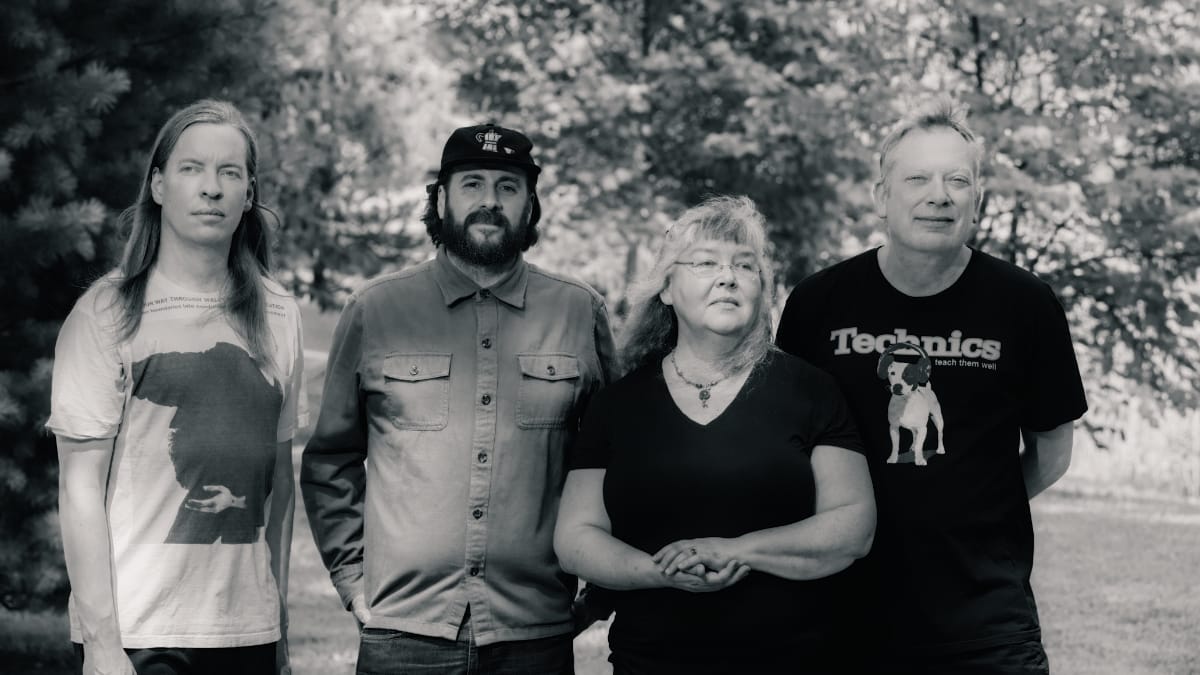
Carolyn: In my first listen of your record, it felt like winter to me. It felt dark and kind of heavy. I moved to Baltimore from Chicago, so I kind of remember just being right flat in the middle of winter, and it's a beautiful, stark thing. But also, it's a heavy feeling in Chicago. Winter feels like it's never going to end. Do you think maybe the weather informed some of the mood?
Frank: I think it's just our dark demeanors. (The group erupts into laughter.)
Fred: There's a melancholy to the Midwest that touches Chicago and certainly touches Michigan. I did an interview one time with Michael Morley from The Dead C. That's my favorite band in the world. I was like, "What is it about your music?" And he was like, "I live in New Zealand. It's a bummer. Our music sounds like my life sounds. I'm here on this little island that's gorgeous, but it has no economic prospects, and I've felt this way for 40 years." I was like, fair. There's a shade of that to Michigan as well.
Carolyn: A moodiness. A haunted self. You have a track titled "Apparition on 3rd Street." Where is Third Street? I guess every town can have a Third Street.
Frank: Every town could have one. Back in 2014, I had to stay in this house, and it was haunted. I never really believed in that stuff until I stayed in that house. There was kind of something floating around at night, and it really spooked me. And you know, when we listened to that track on the playback, I was like, "Oh, this reminds me of that time over in Niles, Michigan, staying in the haunted house."
Fred: Were you visited by an apparition in Niles? Did you see a ghost there?
Frank: I didn't see it, but I felt it, and I wouldn't open my eyes because there was something in my bedroom, and it scared me so bad. I was like, I'm not going to open my eyes because I'm a very light sleeper to begin with, and I could hear something moving around.
Carolyn: Do you have any ghosts or haunts in your life, Windy and Carl? Even if it's the specter of the past?
Windy: We have a ghost in the house that we live in, who shows up every so often.
Carl: Some people detect it right away. Others have no clue, but there's something here, definitely.
Windy: All of our dogs have been able to see and feel it. You just get used to it. If it's not causing trouble, you just get used to that.
Carolyn: Fred, you mentioned that sometimes these haunted artifacts would show up, too, as you listened to your playbacks of tracks—things that maybe shouldn't be there.
Fred: None of it should be there. It doesn't make any sense. Occasionally, there's a sound that's like, oh, that's certainly electric piano. I don't remember whether it was me playing it or Frank. There's one of the songs, Carl's got a really long ringing set of interesting chords, like kind of jazz voicings for chords that are very clearly a guitar. Every other sound on the record, I'm not really sure where it's from, and I mixed it, I helped mix it, and I helped record it, and I don't know if it's like extra phantasmagorical sounds or just that's the soup of ambient music. It certainly doesn't feel completely like it's just our making. It feels like somebody else was jamming with us.
Carolyn: Do you have any shows ahead for this record? Are you going to tour together, even if it's just, you know, three dates in Ann Arbor or something?
Windy: We have a show set up. We're doing a record release party on September 25 at a venue here in Detroit that we love, that has taken really good care of all of us for a long time, run by Joel Peterson, called Trinosophes. The show is inexpensive because we just wanted a lot of people to come and have a good time.
Carolyn: Are you rehearsing for it, or, given how you guys work together, are you just going to show up that day and improvise?
Carl: That's a very good question. We have not discussed that yet.
Fred: I think Frank and I are going to rehearse for Optigan Conservatory. But the idea for the show is that there'll be three acts that all kind of bleed into each other.
Carl: I think we're pretty like-minded, and we know exactly where we're all coming from when we start to play.
Frank: The fun thing about this is, after Fred and I have been doing this for 10 or 11 years, this is going to be our first live show. We've always just been in the studio, and it's been years since I stopped playing live, so it's going to be interesting to see what happens.
Carolyn: Collectively, is there a track you agree on that's beloved by all of you that you feel like that was the one that best represents this union? Pick a favorite child.
Fred: Personally, no. I don't. I haven't thought about it that way. I also don't feel like there are hierarchical tracks where one is better than the other, or that some are filler or interludes. It all feels like a piece to me, and I'm pretty sure that the chronology of the record is the order in which it was recorded, too. I think it's almost documentary of the day. So no favorites.
Frank: There's not one track I can single out because I think collectively as a whole, it's all part of a system that fell into place, and it just all works together. I don't really know if they could work as well on their own as they do together.
Carolyn: I have a question specifically for Windy and Carl because I'm curious. What is it like to work with your partner for 30 years? You live in the house. Does it bring you together? Does it pull you apart? Does one of you wake up in the middle of the night and have an idea, or, you know, rustle the other one awake?
Windy: Unfortunately, Carl does wake up in the middle of the night, thinks about playing music, and has ideas, but then he doesn't get up and do anything with them. We actually used to get up and go, "Hey, I have this thing in my head, and we should work on it right away." But Carl does this thing that makes me absolutely insane. He will sit down with his guitar, and he'll start playing, and he'll play something absolutely amazing, and then he puts the guitar down, and I say, "Hey, did you press stop on the recorder?" and he says, "Oh, I didn't even press record on the recorder."
Carl: We have a little portable handheld digital recorder just to get ideas down. But we never seem to do it. And when I have ideas and try to do that, once I know it's recording, then I don't have the same feeling about what I'm playing. I'm more worried about, like, not making the level too loud. I get distracted when I have to worry about stuff like that.
Windy: Generally, we can both just start playing, and it works out well. For many years in the beginning, Carl would have an idea, and he would either teach me a part to go with it or present me with tracks, and I would find things to add to them. And very rarely—he once played a piece of music for me, and I said to him, "That sucks," and he was like, "What?" And I said, "I know you too well to have you play something like this." I don't usually feel that way about what he's creating, but on that particular piece, I just didn't like it at all, and he totally reworked it. It turned into something beautiful, which was great. It is not the easiest thing to say to the person that you love dearly, who you've spent most of your life with, "Hey, you know what? I think you could do that better." Right? Because how rude is that?
Carl: That's necessary, though.
Windy: We accept it from each other. It isn't always the easiest thing to hear. Sometimes we get pissed; we get mad at each other. One of us storms out of the room, and then 30 minutes later you come back and go, "Well, actually, that was a pretty good idea. Why don't we try it?" The whole thing about having the recorder going reminded me that when Frank and Fred came over, Fred was in charge of recording. He made sure all the levels were right and did all the engineering.
Carolyn: Makes me think of Arthur Russell just making sure the recorder is going the minute he enters the room.
Windy: A lot of times, the best thing you're going to create is the first time that you go through it. It's that magic of something being instantaneous.
Carl: The freshness of it.
Windy: The other thing that we tend to tell people is that when we sit down to play music, we don't have a preconceived idea of what it is. We essentially open ourselves up and let the universe direct what should be played, so we treat our bodies as vessels to accept whatever communication comes, and then that's what we play. That can sound really cheesy to some people, and that can sound really stupid and new-agey—but it's part of the spiritual experience that we have when we're creating music. Especially when we're performing live, this fantastic thing happens: the energy flows from us into the audience, then comes back, creating a loop of experience and emotion for everybody. I think that's a big part of why when our live shows work well, they work really well—because the audience ends up involved through their own electricity and emotions coming back to us. So there's a whole lot of hoo-ha for you.
Check out more like this:
 Garrett Schumann
 Carolyn Zaldivar Snow


Comments