


On the occasion of Arthur Russell's would-be ‘diamond jubilee’ birthday (seventy-five years), I felt celebratory. Celebratory at legacy, celebratory at the infinite body of work and recordings that have shaped much of who I am becoming in late adulthood. Or who I would like to be. Sometimes there's a dissonance between a life you report to and the creative, free self you wish to inhabit.
The Iowa-born, Midwest wonder boy would find himself in passage between the two coasts of the United States, cello in tow, at a time when home recording was exploding and becoming possible. There's the fusions of avant-garde pop and an underlying framework of Buddhism, coupled with a sweet mysticism while doing the sweaty DIY work of organizing shows, spaces, and recording with friends in apartments with stolen electricity (sometimes from Allen Ginsberg's apartment).
I met poet Reuben Gelley Newman last year in Philadelphia at a Ghost Harmonics reading in Fishtown. I was struck by Reuben's sincerity as he played sea shanties on a melodica and read from a chapbook of poems about Arthur. I asked Matt Marble to join our conversation—I had read his book Buddhist Bubblegum, in which Marble chronicles Arthur's spiritual life and influence held in his music.
Here is a fitting vignette of serendipitous moments, because there is a mysticism always touching the world of Arthur Russell. I no longer have my copy of this book. A few years ago, I played a tape loop and some synthesizers at a show, and a noise artist named Ceremonial Abyss asked to crash at my house. Over the evening, talking over the most basic sandwiches I could muster at 1 am, I learned Ceremonial Abyss (Bryan) had TAed at Naropa with Ginsberg and was traveling across the US by train, relying on strangers to make the whole tour go. Bryan is a poet, and as I dropped him off at the train station in Baltimore, I pushed Buddhist Bubblegum into his hands. At the start of the following conversation, I learned that Reuben had left a copy of Buddhist Bubblegum on a park bench in New York City that morning.
It's a peculiar thing to speak for or construct the memory of someone who is no longer with us. Reuben, Matt, and I share the distinction of being a younger generation that has never interacted with Arthur firsthand, but who exist in an interconnected web of piano and cello teachers, friends, fans, and archivists who love Arthur. More importantly, a club of humans so moved by Arthur's work that we become forever altered.
Since we had never met before, I invited each author to share a tarot pull or a horoscope to honor Arthur’s mysticism and help us get to know one another. Our conversation ends up as a speculative account of whether Arthur Russell would have a Dinosaur L finsta account.
Carolyn Zaldivar Snow: So, tell me about yourself and your creative practice this morning. What's the weird thing you do to situate yourself in the day? Some people pull tarot cards. Some people collect feathers. There are horoscopes. I'm an Aries, but I don't actually pay attention to horoscopes.
Reuben Gelley Newman: I'm also an Aries who doesn't pay attention to horoscopes. I listen to Arthur's music regularly, but I've been listening to it a little more intentionally than usual.
Matt Marble: There's so much now.
Reuben: I was listening to Tower of Meaning. I feel like that kind of fits with the spiritual stuff as well, and some of the live recordings that Audika put out recently, like The Deer in the Forest.
Matt: I'm a Scorpio, like 120% Scorpio, like a poster boy, and I was just looking at Arthur's astrology, and he's kind of on the cusp of Taurus and Gemini. This year he would be 75, and in historical anniversaries, that is termed the 'diamond jubilee,' which I love. It relates to Buddhism with the diamond (the vajra). I also pulled the tarot card this morning. I asked, “How can we best honor Arthur?" I got the king of pentacles, which is wealth, success, mastery—it can be material, but it could also be spiritual. There are lions and bulls carved into the seats of the king.
I was listening to some of Arthur's music where he's describing lions and tigers. This morning, I did a focused listening on Open Vocal Phrases Where Songs Come In and Out. There are some magical moments there.
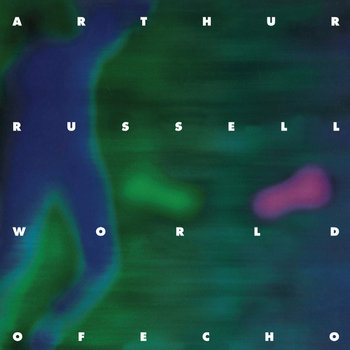
I fell in love with Arthur when I was studying abroad in Paris, and a friend—this was like 2006—sent me a link to World of Echo, which had recently come out through Audika. I just put my headphones on, and I lay back in my bed, and I listened to the entire album all the way through. After it was over, I was almost crying, but I was smiling. I was like, "What was that?" I'd never heard anything like it. I got obsessed—I never tire of it. I like revisiting his music, his story, his everything.
Carolyn: I think Arthur, for me, is a shining light about how difficult it is to become fully yourself, but also how loving and wonderful that can be done in community, too. I've been listening to “Let’s Go Swimming” a lot because I am in love, I live next to a river, and it's wading time. It's getting warm. What is something about Arthur's personhood that really resonates for you, and maybe not seated in the context of music, but more about who he is, or what is held in his narrative?
Matt: I always come back to the gentleness of his music and his persona. It stands out in more contrast in New York City at that time. That's what I connected to personally, this radical gentleness. That's something I've tried to hold on to in myself, something I've always identified with, even when culture was very ready to dismiss or deride it.
Carolyn: It feels hard to be gentle right now.
Reuben: I think there's an underlying resolve in that gentleness that comes through in his music and his personality or personhood. "Follow You" comes to mind—just like following a river, you know, a path in whatever direction. That's a playful thing, too. When I was first getting to know Arthur's music in my late teens—I'm 27 now—it was the traditional stereotypes of melancholy and sadness that stood out. I think that as I’ve increasingly immersed myself in it, his playfulness stands out to me.

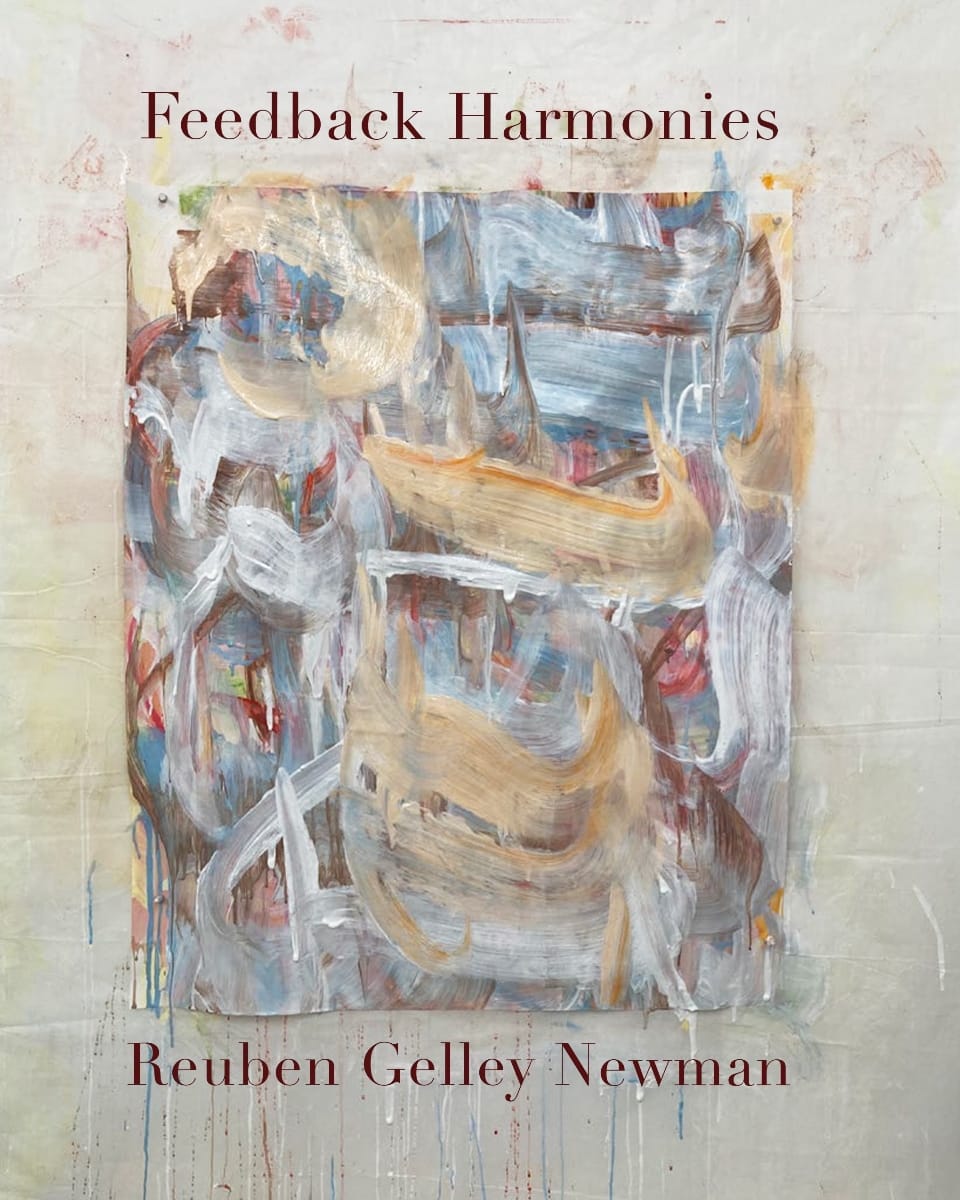
Reuben Gelley Newman (photo by Mira Gelley) and his Arthur Russell-inspired chapbook, Feedback Harmonies.
Matt: What led you to want to focus on him through poetry?
Reuben: I'm a poet, and that's what I started as, but I was also a musician. I was writing a little bit about music; this was during my junior year of college. I had written one poem about Arthur. There was a summer funding grant from my school. I was like, “Oh, I could actually do a project where I go to the archives at the Library for the Performing Arts." I'm based in New York, and I grew up here, and it became more biographical. His life is fascinating, his music is fascinating and so rich, and then there's the Allen Ginsberg connection that piques your interest.
Matt: I was at Princeton. I was not fitting in there very well; I was clinging to things that gave me comfort. World of Echo was one of those things. I wanted to get into the melodies a little bit more," because I was always fascinated by how they just constantly changed, so I started writing them out. It was another way to get inside the music. Then I decided to write an essay about World of Echo for my first graduate essay there. After that, I was like, I want to know more.
I was near New York, and I knew the archives were with Audika Records before they were at the library. I asked Steve [Knutson of Audika] if I could research the archives, and he said I could come over. He would pull out a box at a time and let me go through it for multi-hour periods—there was so much. I would just scan things for hours, then go home and look at what I got, like a kid in a candy store. That's how I fell in love with archives, and that's where I discovered that Buddhism was this kind of thread running through everything.
Carolyn: I think of going through archives as almost a spiritual practice. It's reconstructing someone's memory, and it's strange, because sometimes you don't have anyone to ask about these memories you're going through. How would you find things? How would you feel as you found things, and then who would you go debrief with?
Matt: For Buddhist Bubblegum, I talked to Arthur's friends and collaborators. I interviewed people, but some of the information came from surprising, very contemporary sources, like comments on Amazon book sales. Somebody would comment, "I used to go to the Buddhist temple, and Arthur would walk me around and teach me Buddhist philosophy," or something. Just these little gems of testimony hidden in an Amazon sale item. I'm sure there are more serendipitous encounters, too.
Reuben: Serendipity has been a thread throughout this, which feels very fitting for Arthur. A thing that I was delightfully surprised by in Tim Lawrence's book, Hold On to Your Dreams—I saw somebody in a photo of Arthur and another cellist in, I think, a concert of Jon Gibson's. He died a few years back and was a contemporary of Arthur's. So I saw this photo, then I looked at the name and the person, and it was Martha Siegel. She was my cello teacher in elementary school, and in this book about Arthur. I emailed her and told her. It was a funny, funny coincidence. I hadn't interacted with her for a decade.
Matt: I was taking piano lessons in New York, and my teacher asked, "So what are you listening to?" I was like, "I'm listening to a lot of Julius Eastman right now." He just went ghost white, and he was like, "Julius used to sleep on the couch that you're sitting on right now. When he was homeless, he would come stay with this piano player."
Reuben: The other thing is that Tom Lee taught first grade at my elementary school. I discovered that after Tom got my chapbook through Steve Knutson, and then we emailed a little bit. We met in Brooklyn, just serendipity.
It was this period of writing a lot, reviewing all this digital archive stuff, and listening to Arthur's music, because I couldn't go there in person. The music librarian at my college helped me find a couple of archival live recordings that I don't think had been published yet, but were accessible in the online archive.

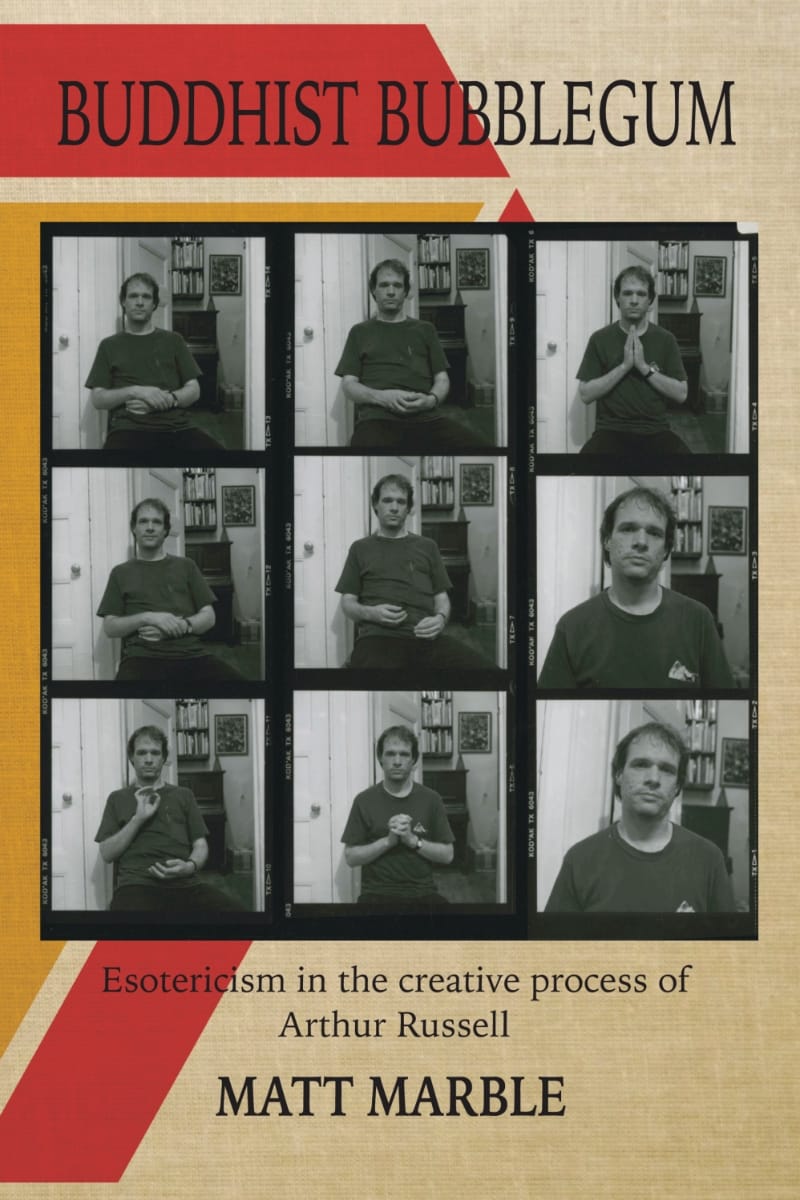
Matt Marble (photo by Kerry Constantino, Surf Point Artist Residency, 2026) and Buddhist Bubblegum.
Carolyn: There's so much documentation. I think that's the thing that has always amazed me about Arthur, that there are so many recordings. It makes me think of Prince; maybe part of it is the wonder of home recording becoming accessible at the same time. It sounds like you both have visited these archives.
Matt: There's this thing people say about Arthur, that he never finished anything. I've never liked that perspective because process was such an important part of his work, not at the expense of completion, but it really had to do with being in the moment. When you look at what has come out, there's so much he accomplished that now stands as complete works in retrospect.
When I first discovered Arthur, I fell in love with World of Echo. I was like, "Oh, disco? Okay," and I love that. Then I was like, "Minimalist orchestral music? Who is this guy?" The more diversity I found in this person as I saw them expressing themselves in different ways, the more special it was.
You talked about not wanting to categorize. One of my favorite things I discovered in his notebooks in the archives was . . . well, he would always write down ideas for music and stuff. But there's one thing I kept noticing that was just strange at first—he would say something like, "Do this in pizzicato, or don't do that." He kept undermining his own suggestions. This was something that came to be a telltale sign of his work. He was a promoter of pure possibility. Arthur was always keeping things open and not attaching himself to what he liked or what he didn't like. That was so beautiful.
Carolyn: I was thinking about the line in the Tim Lawrence book that talks about sonic repression:
Arthur refused to settle into the comfort zone of genre or the non-generic framework of new music, and he also worked continuously to subvert the idea that music should be organized according to commercial imperatives that came from beyond the musician, because that system amounted to a form of sonic repression.
Arthur didn't want to be classified. I think people are surprised by the disco, but I am not. It was such a movement. Studio 54. These spaces of unconditional love and freedom make sense in my view of Arthur.
Matt: As I dig deeper into these histories, I feel like every genre of music starts as a spiritual, cultural resistance. Disco began as a Buddhist psychedelic welcome mat for all people and for expressing yourself in different ways. It began as a listening party where they would just make mixtapes and kind of trip out, and then the dancing kind of led to other things. You see that in a lot of music genres: they start in a more visionary way, and once people like it, it gets commercialized, categorized, boxed in, and replicated. Arthur constantly changing his aesthetic and style made it harder to box him in commercially, to market him, and to make his name more well-known during his own lifetime. That's a noble sacrifice for the creative process.
Reuben: In terms of disco and just output as well, there are all the different names—the pseudonyms that he used. I think when I was first writing a lot of these poems, I was really interested in the pseudonyms. And I was thinking about his nicknames. I think his family called him Charley, and then there are all the different band names.
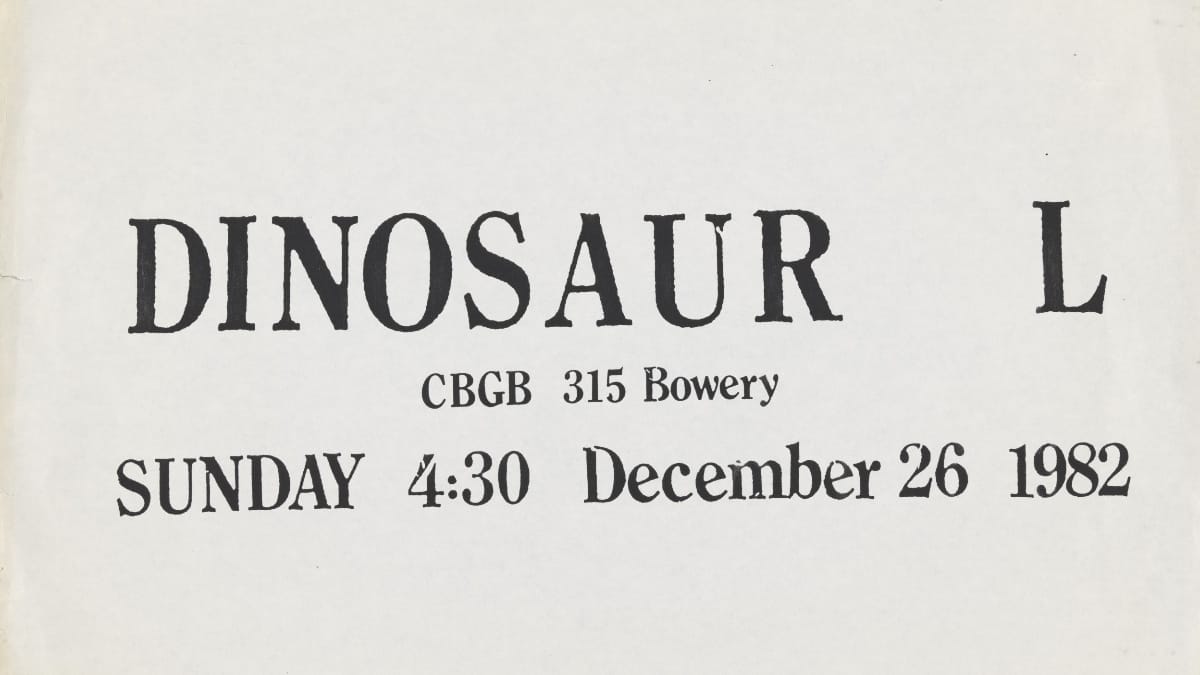
Matt: He used numerology for some of these names. I think Dinosaur L was previously Tyrannosaurus X. He changed it because he liked the numerology of the other one.
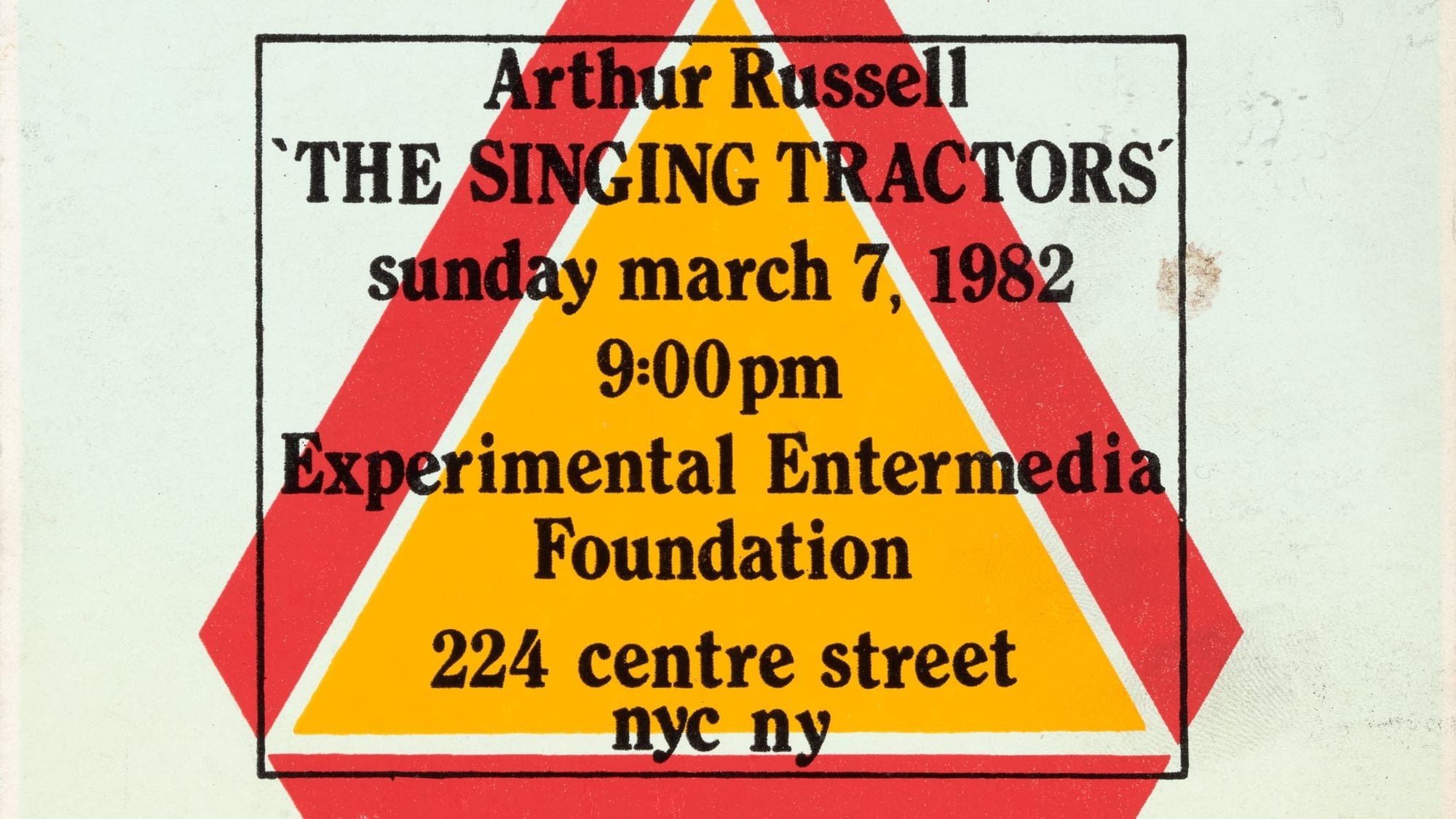
Reuben: Tim Lawrence talks about straddling scenes in New York. In terms of disco, I remember reading Arthur wasn't really a dancer, but he'd stay and inhale the music at the clubs. Just kind of being there for the spiritual experience as well.
Matt: That was one way he was ahead of his time: incorporating pop music into an avant-garde context, like at the Kitchen, where he's bringing in the Modern Lovers and people like that, which was a little taboo at the time. Experimental art had to be serious. Buddhism had to be serious. He was really breaking down those taboos, which is a very tantric technique, kind of like Chögyam Trungpa's 'crazy wisdom.' You flip the script on expectations to awaken people from delusional thinking and habitual thinking. Arthur was doing that constantly, in his curation and in his stylistic embrace of pop music.
Carolyn: What is it to be Buddhist in an American context? I remember going to Nepal when I was younger. I was working on a documentary about Elizabeth Hawley, who lived in Kathmandu at the time. I remember seeing a white American woman with dreads on a prayer wheel next to a monk in a stupa. It bothered me instead of making me curious, which is my own thing to unpack. What is it to be Buddhist in America, or to be Charles Russell Jr. (Arthur) from Iowa, and to go through New York City in this way? How do you maintain that?
Matt: Getting into spirituality, you often want to attach yourself to a tradition and take on the gear, the costume, the language, and the imagery. It's pretty easy to notice that Arthur's world isn't covered with Japanese deities or mantras—his world was private. He developed his own imagery through natural landscapes, animals, and everyday observations. I think a lot of us today could probably benefit from understanding that these spiritual practices, traditions, and teachings are meant to be personally refined. You're not meant to perform your spirituality. I think a lot of people do that in a narcissistic way. These traditions are really there to help you process for yourself and develop your own way of relating to the world. Arthur was really a beautiful example of not performing Buddhism, but living it through his music.
Reuben: Going back to Buddhism and serendipity, a friend of mine randomly was looking into Henry Flynt, and, you know, discovered that Henry Flynt had done something with Arthur, which I hadn't known about.
Matt: Yes. There's a cassette out there.
Reuben: There's something in the archives, so I'm gonna go listen to that tomorrow. There might be a bootleg somewhere. I don't really know much about Henry Flynt, but he also kind of had a spiritual practice, right?
Matt: Yes. He was actually from here in Greensboro, where I live. Talking with Elodie Lauten when she was with us, she emphasized that she and Arthur were looking at Buddhism differently from, say, John Cage's approach to Zen Buddhism. Cage was known for this anti-ego, no desire driving the composition. It's just chance operations and serendipitous encounters. But then, of course, he signs his name on the score. Elodie, Arthur, and their generation were like, "We want to involve who we are in the process, not in an egocentric way, but in a lived-in way." It was interesting to hear Elodie talk about that. Not shunning who you are, but incorporating that into the process.
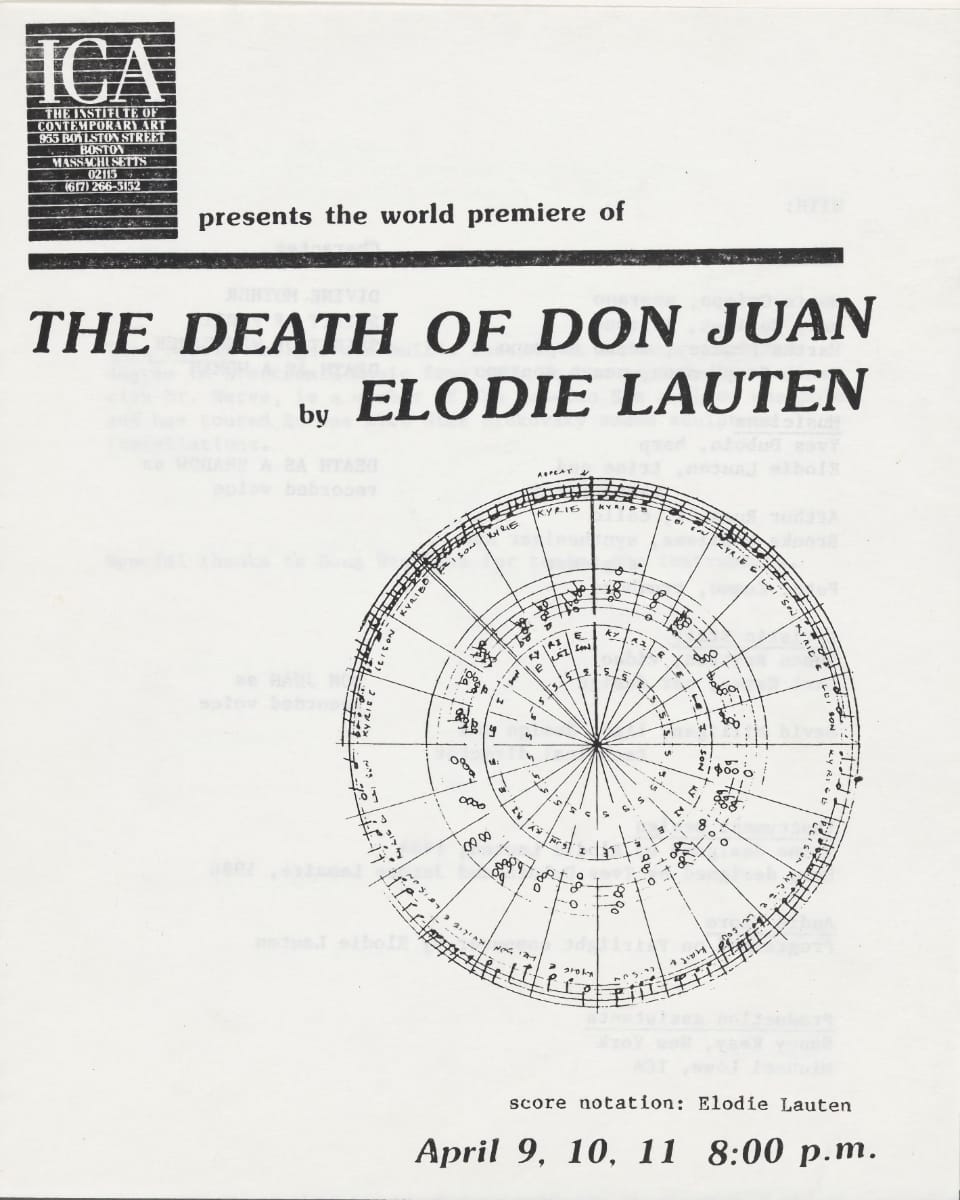
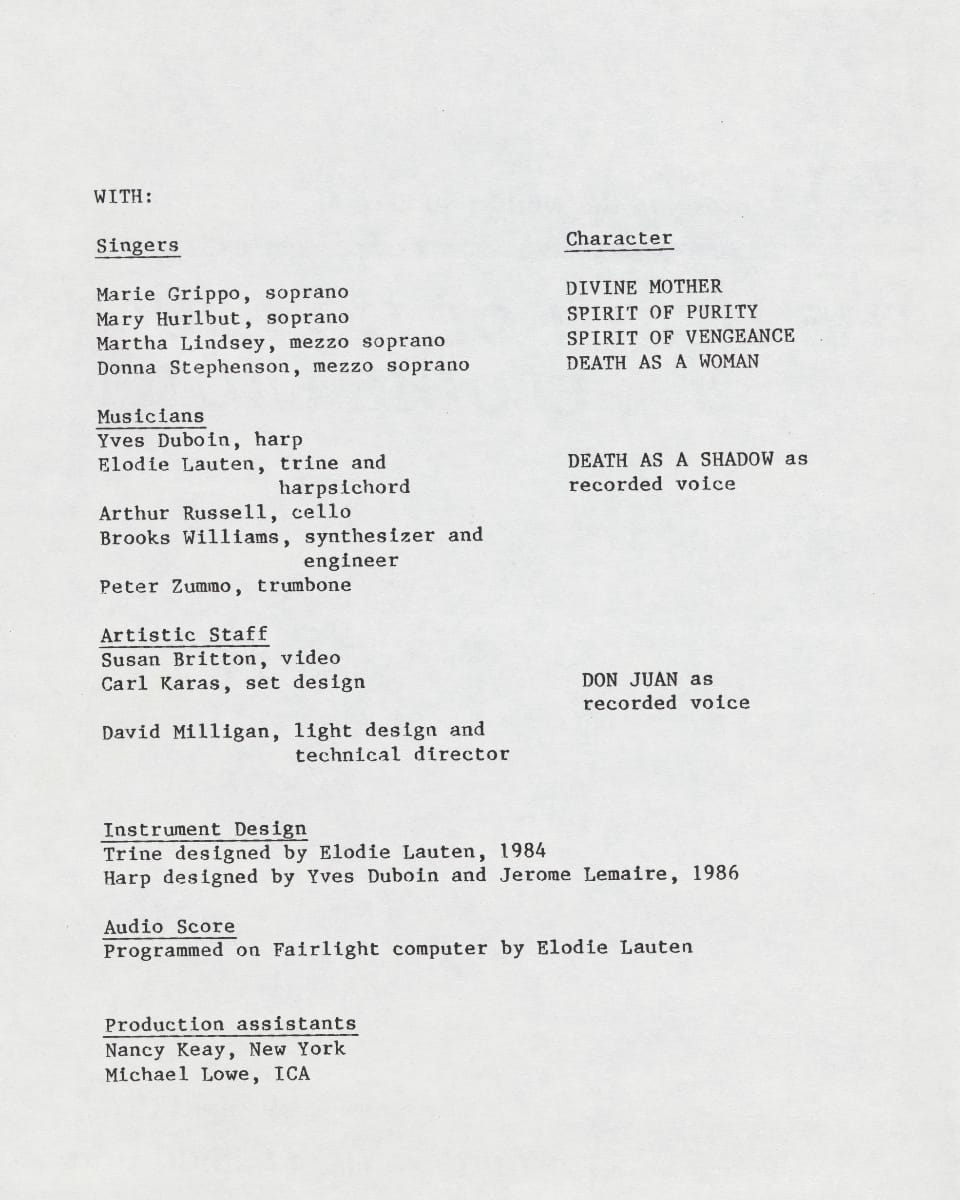
via the Arthur Russell Papers/NYPL
Reuben: There's a kind of political nature to it, too, that's not necessarily overt, like anti-capitalism.
Matt: I totally agree with that. Artists are familiar with this in the creative process when that spiritual element is active in our lives, because we're getting rid of all the bullshit, and we're allowing something fresh to come through. It applies equally to your social experience, your reception of other people and things you don't understand, and your openness and compassion for others and other perspectives. I don't think those are mutually exclusive at all. I think they're directly related, the political and the creative, in that sense,
Carolyn: Matt, you mentioned this wave of Buddhism and wanting to put yourself in it. I personally feel the way we are artists is by pouring ourselves into it, the way we are internally signaling this external output. It's vulnerable. We have conversations in music and art about never being 'cringe.' I have to tell you, as an educator, it's really difficult right now to work with younger people and this notion of 'cringe.' I'm like, how can you expect to try and fail or put yourself out there? How can you make art?
Sometimes I kind of chuckle and think of Arthur Russell having to navigate a social media campaign, or Arthur Russell going through booking and touring on the East Coast right now with Ground Control. I would love a speculative perspective on if Arthur were still with us today, but perhaps younger, maybe in his 30s, what would that look like in this current modern music and art landscape? If this is just the wrong question to ask, you can stop me, but this is where my head goes, because I think we should all become more 'cringe' and reclaim all of this.
Matt: Well, you mentioned earlier, Reuben, the melancholy that's associated with World of Echo, or in some of Arthur's music in general. I think that's inaccurate. I understand why people can feel like that. Culturally, we are trained that gentleness, vulnerability, softness—we kind of polarize it in that way.
Reuben: We package it as melancholy.
Matt: Today, more so than ever, earnestness and vulnerability are extremely 'cringe,' right? Maybe I'm misreading, but that seems to be earnestness as if it were the anathema of modern, contemporary culture. That's something I really appreciate about Arthur. I think the shaming culture—the way we document everything now, where you're always videotaped, observed, and judged constantly—I kind of question if he would even engage in that way.
Reuben: I'm not sure he'd want to be on Instagram.
Matt: Or he would take on a persona, you know.
Reuben: Or have a pseudonym, lots of finsta account-type things.
Matt: He'd have seven accounts.
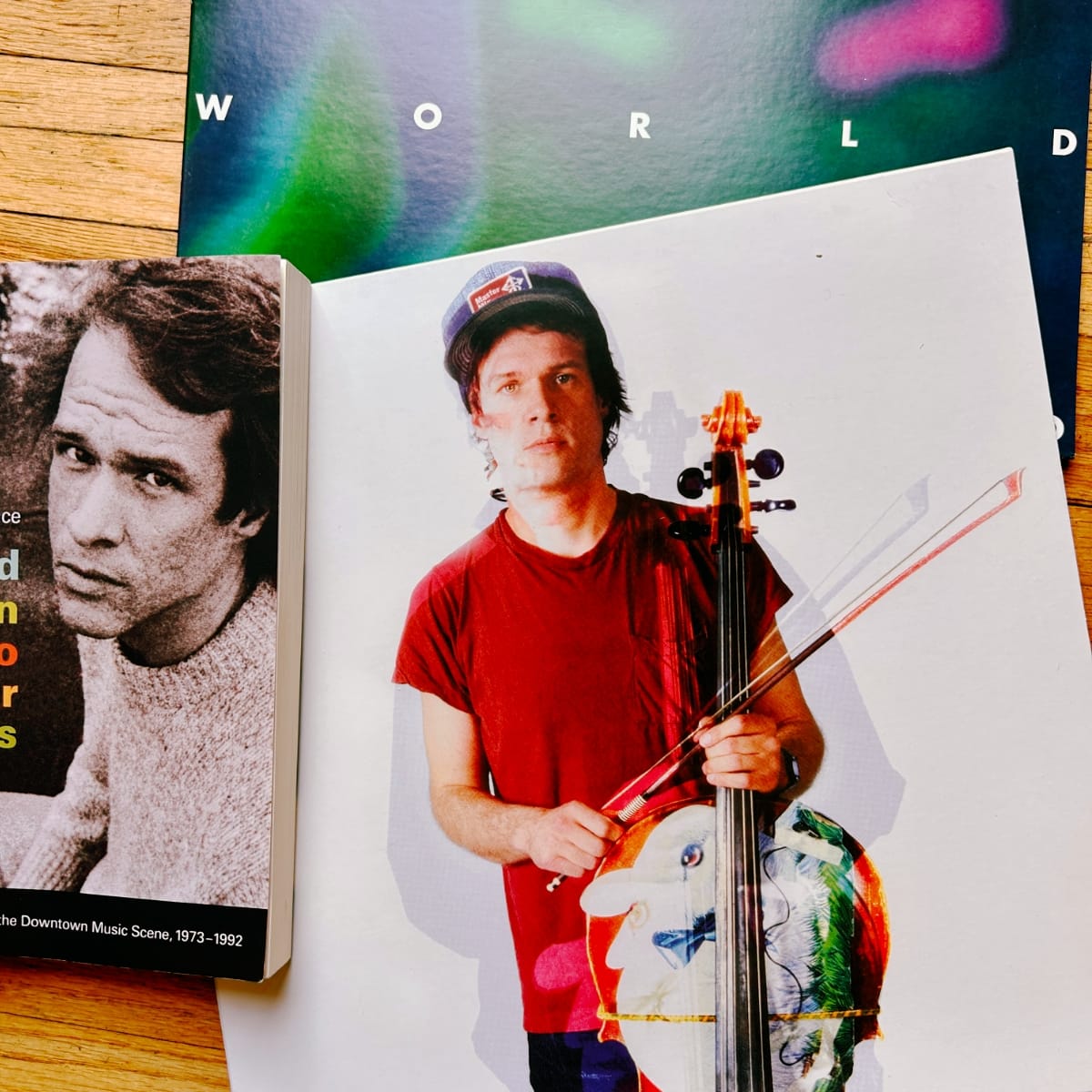
Reuben: You know, maybe Arthur would have a record deal now, maybe he'd be like a Mitski figure . . . who knows? I'll share an embarrassing, 'cringe' anecdote and an earnest one. I'm on Hinge, and dating apps are their own whole persona thing. I don't know how Arthur would have navigated contemporary dating, either. There's a prompt like, "What is the soundtrack in my life?" and I put "Wonder Boy" by Arthur Russell there. So somebody liked that. Then, of course, being very nerdy, we got into a conversation about Arthur Russell. And this guy was like, "Haha, Midwestern sad boy of my dreams," which, again, may speak to the stereotype of Arthur and his mythology.
He said that his favorite song was "In Love With You for the Last Time." In no other circumstance would I ever share this, but I did a cover of that when I was in college. So I sent him the YouTube link—and he hasn't replied. I apologized after. I'm probably being ghosted, which is fine.
Carolyn: That is glorious and 'cringe.' So, today, who in your minds feel like contemporaries of Arthur's? I know we kind of casually mentioned Mitski. I think of Fred Thomas sometimes—he works under a million project names. He goes where the winds carry him; there's an output of material we will probably never get through.
Matt: I'm a little hesitant to put an Arthur Russell pin on somebody, but I know what you mean. In terms of openness, aesthetic freedom, genre-hopping, and magical heart essence, two people who come to mind are Clarissa Connolly, a Scottish-Danish singer-songwriter-composer, and Julio Lopez, who I think is in Tucson. Both of their works are magical to me, and in ways that remind me of Arthur.
Reuben: The more kind of indie, mainstream people that I'm thinking of are Devonté Hynes of Blood Orange, or Sufjan Stevens.
Carolyn: Oooh. I am thinking of the Daniel Smith/Danielson adjacent universe. That weird art kid output.
Reuben: Sufjan Stevens and Blood Orange have also both done Arthur Russell covers, right? There are a lot of people who've done covers, which I think is an interesting thing.
Carolyn: Wrap-up question—is there something you'd like to share about Arthur I didn't ask?
Matt: I feel like studying Arthur and spending time with it the way I did changed my life completely and put me on a new path I'm forever grateful for. I feel like I'm always touching base with that as a kind of home—or reference point for home away from home. Listening to music this morning, there were just certain lyrics that spoke to that, and "Home Away From Home" is actually one of them, where I wrote some of the lyrics down.
The birth of the moment is never ending.
You know, phrases like that don't come in songs very often.
At the same time that they were letting go, they were kissing.
Those kinds of images where opposite forces are happening simultaneously or becoming the same thing make you feel all the emotions at once. It just comes back to everything being connected, and no one thing rules the mind or the experience, and that's something I just encounter every time I listen to one of his songs. What he's doing is just so unique and mysterious, and radically earnest.
Reuben: I feel like he will keep creeping into my poetry.
Carolyn: I read your Basinski poem this morning—you have some diversity in subject and material, even if it is another sad, emo boy. (laughter)
Reuben: If I become known as the guy who just writes about Arthur, I guess that's fine. I brought my melodica; I thought I'd play a little . . .
[For the reader of this interview—you weren't there, but our trio erupted into a sing-along with a shruti box, melodica, and one fish-shaped bell. It was 'cringe,' but we like to think of it as earnest.]
Check out more like this:
 Garrett Schumann
 Lawrence Peryer


Comments