


There is a certain archetype that persists in just about every music scene around the world—beloved mainstays that appear to be everywhere at once, a familiar face you may not know personally, but seem to run into at just about every show. These people become something like patron saints of localized scenes, their adoration of music on glowing display, always friendly, always eager to be imbued with sound.
One such figure in Chicago's always-bustling, hypertrophied club scene is Dr. Charles Joseph Smith. The pianist and composer has been frequenting the city's DIY spaces for decades, and his silhouette, a slight frame, clad in thick glasses, always close to the stage or in the middle of the room, and always dancing, has become not only an expected pillar, but a cherished validating presence. Over the years, he has appeared in countless posters and photographs, his affable face either drifting through the background or brashly up front.
Up until recently, arguably, few of the patrons who have come to know Smith through his dancing and radiant company could imagine that the person sharing these spaces with them is in fact one of the most talented and unsung piano virtuosos of the 21st century, a man who, over the years, has assembled more than 600 original compositions, a minimalist with a golden touch.
Born in Chicago in 1970, Smith's talents reared early and grew rapidly, and at an exponential rate. By age 4, he was able to play the piano along with the radio. Soon after, he was transcribing music by ear, delving into jazz, classical, and the avant-garde, long before any formal musical education was introduced into his life. He has often credited music as his way of forging paths of communication with the world, an adaptation that was a stark necessity for a child diagnosed with Autism Spectrum Disorder (ASD), and whose life otherwise would have likely been spent in consistent isolation from society, in line with the passive ignorance and outward aggression that dominated approaches and perceptions of the 1980s and 1990s.
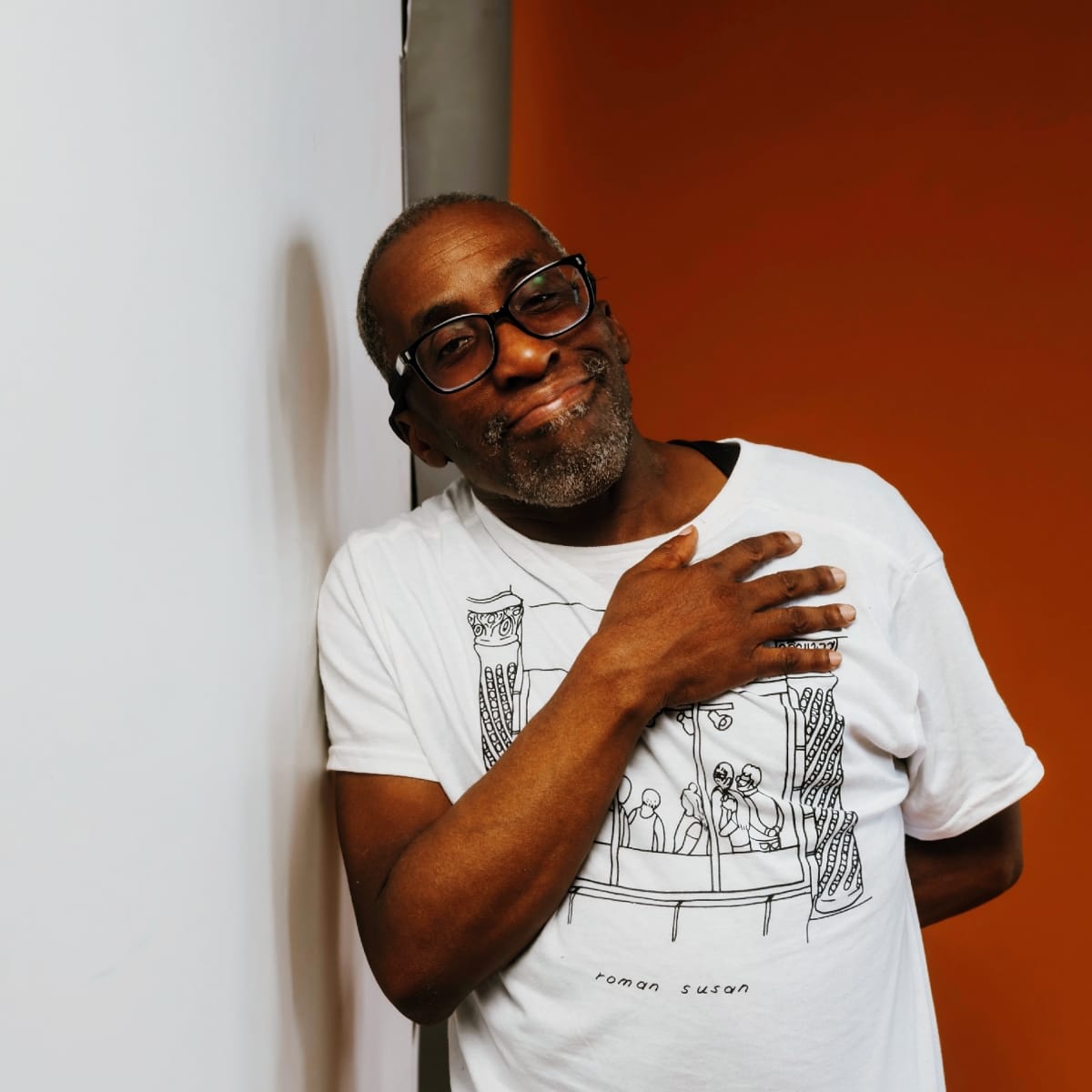
One might think that these wunderkind abilities would quickly lead to a plethora of opportunities as a musician, entertainer, or educator. Yet, the grim realities of weaponized geopolitics, socioeconomics, and the blights of public views took a predictably limiting toll on Smith's life. There was no one banging down the door to promote and catalyze the career of or make schmaltzy inspirational movies about a black autistic kid from the South Side—a kid growing out of time and place, isolated not just as an African-American, or a person on the spectrum, but ironically because of the sheer staggering level of his talent from an early age. And so, Smith began carving his own path, as the years trickled away.
That is the beginning of Smith's indoctrination into the Chicago DIY niche. Armed with little more than a backpack of CDs of his home recitals and his intoxicating love of dancing, he dove headlong into the city's club scene, which at the time was neck-deep in industrial and EDM. Decades later, with a doctorate and an astonishing catalog of original compositions, he is still a tireless presence around Chicago, a subculture in and of himself.
By the time I sit down to speak with Smith, though, the view from where he is sitting is starting to shift. Sooper Records, a local Chicago indie stronghold, has mastered and reissued a compilation of his work. Collected Works and the War of the Martian Ghosts is making the rounds online and through media channels, and Smith is doing an immersive press junket and dancing at listening parties of his own work. Slowly, the scope of his astounding talent is moving out of obscurity and into the light it always deserved.
This is where I find Dr. Charles Joseph Smith, asking him about his life up to this point and War of the Martian Ghosts, the ambitious space opera of his making. He speaks eagerly, giving detailed answers that sometimes cover an entire arc of his personal history. None of it seems belabored or unneeded. Smith's life has been something of a singularity, one that has seldom had the chance to be imbibed and interpreted at length.
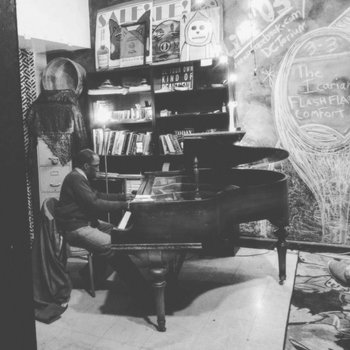
khagan aslanov: I remember reading about you many years ago, how you would go into industrial, punk, and EDM clubs around Chicago, dancing and selling your tapes and CDs from your backpack. What was it like for you being in those places? Did you find those environments over-stimulating?
Charles Joseph Smith: I was a trooper in those olden days. It all really depended on the venue. I think one of the first clubs I went to was Alcatraz in the early 1990s, when house music was coming in. That was the first time I'd ever gone into an underground venue. They would have DJs spinning music. I think what gave me an advantage was my dancing. Because I was musically trained, I was quite a good dancer, and I love dancing.
At the punk clubs, I would always wear ear protection. Some of these bands, especially the noise acts, would take their volume up to 11! And I need my hearing for my playing, my life. (laughs)
Obviously, back then, some of these clubs were in bad neighborhoods. You had to be 'wanded' by a metal detector or patted down to get in. So it was quite dangerous. There was potential for drive-bys or robberies. This wasn't long after the Ben Wilson shooting in '84.
And those clubs always smelled like cigarette and pot smoke. And pot was illegal back then. I knew that the smell would end up in my clothes. So when I would get back home, I would discreetly go straight to the laundry room and throw my clothes into the wash.
As his education in underground genres continued on his own time, Smith was also participating in formal learning and attending classical concerts and church music events. With every out-branching of sound his mind was taking in, the scope of his knowledge and compositional skills increased.
In 2002, he earned a Doctor of Music Arts degree from the University of Illinois at Urbana-Champaign. Instead of a traditional dissertation, Smith conducted a detailed analysis of the works of Franz Liszt, devoting himself to Liszt's operatic arrangements for piano. The extensive research and demonstration he put in added another notch to his growing legend.
khagan: When you were completing your doctoral dissertation, transcribing Liszt, did you end up using what you discovered in your own work? For example, how Liszt would translate orchestral colors onto the piano?
Charles: I actually ended up adding some variants to passages of the operatic transcriptions I did. It was about 60 to 70 transcriptions altogether. I realized that since Franz Liszt was the inventor of the modern piano recital, in the sense that he allowed pianists to experiment in school settings, he functioned a bit like a precursor to jazz piano, where there is so much heavy improvisation.
Like Beethoven, Liszt had three different periods, in which he would change genres of the piano, from the Romantic style to elements of impressionism. These are changes in harmony that you would later see in the work of people like Alexander Scriabin and on and on. It's quite amazing.
khagan: I would say in some respects, you have also had an impact on how people approach the piano. There are aspects to your playing, particularly in phase shifting and rhythmic layering without an ensemble accompanying you, which have changed how people play solo piano.
Charles: I think you're almost completely right. When I took a contemporary composition class in university, there was one composer that I fell in love with. A composer who, one could say, was a precursor to EDM. His name is Steve Reich. He would essentially write out loops on the staff for four positions. Looping and repeating, looping and repeating. I've incorporated that in a portion of my compositions. That's my style of minimalism, I guess.
It translates to jazz as well. You listen to something like A Love Supreme, even though it's not mechanical, the bass functions like a loop. I mean, even the music of Yanni, the new-age composer, has some of his numbers rooted in minimalism. You know "Santorini," from the car commercials? (laughs) There is some rhythmic minimalism and polyrhythmic loops there.
At this point, Smith briefly removes himself from our dialogue and goes into himself, humming out the composite meter of "Santorini," and tapping out its repeating ostinato. It's a pretty incredible moment to witness, as he gradually and fully arranges and reconciles "Santorini" in his mind. He then traces Yanni and minimal loops back through time to Béla Bartók and Igor Stravinsky, and then, seemingly satisfied, gives me the cue that we can move on.
khagan: When you play some of your more jagged, energetic pieces, what does your body feel like? Are you able to isolate that momentum within your hands, or do you feel something deeper?
Charles: I usually compose music that fits my limitations of physically performing it. I mean, sometimes, I add one-handed ninth intervals, or balance octave runs and arpeggios. One composition that uses high energy is "Uneven Agitation." It was inspired by Aram Khachaturian's "Toccata." I use a polyrhythm in the opening, and sometimes I use a fast 2/4 in some sections. It has changes in rhythm, but they aren't too excessive. There's a cadenza in the middle that creates some agitation and violence, but then it's back to order. Its agitated sections can sometimes sound like cartoon chase music. (laughs)
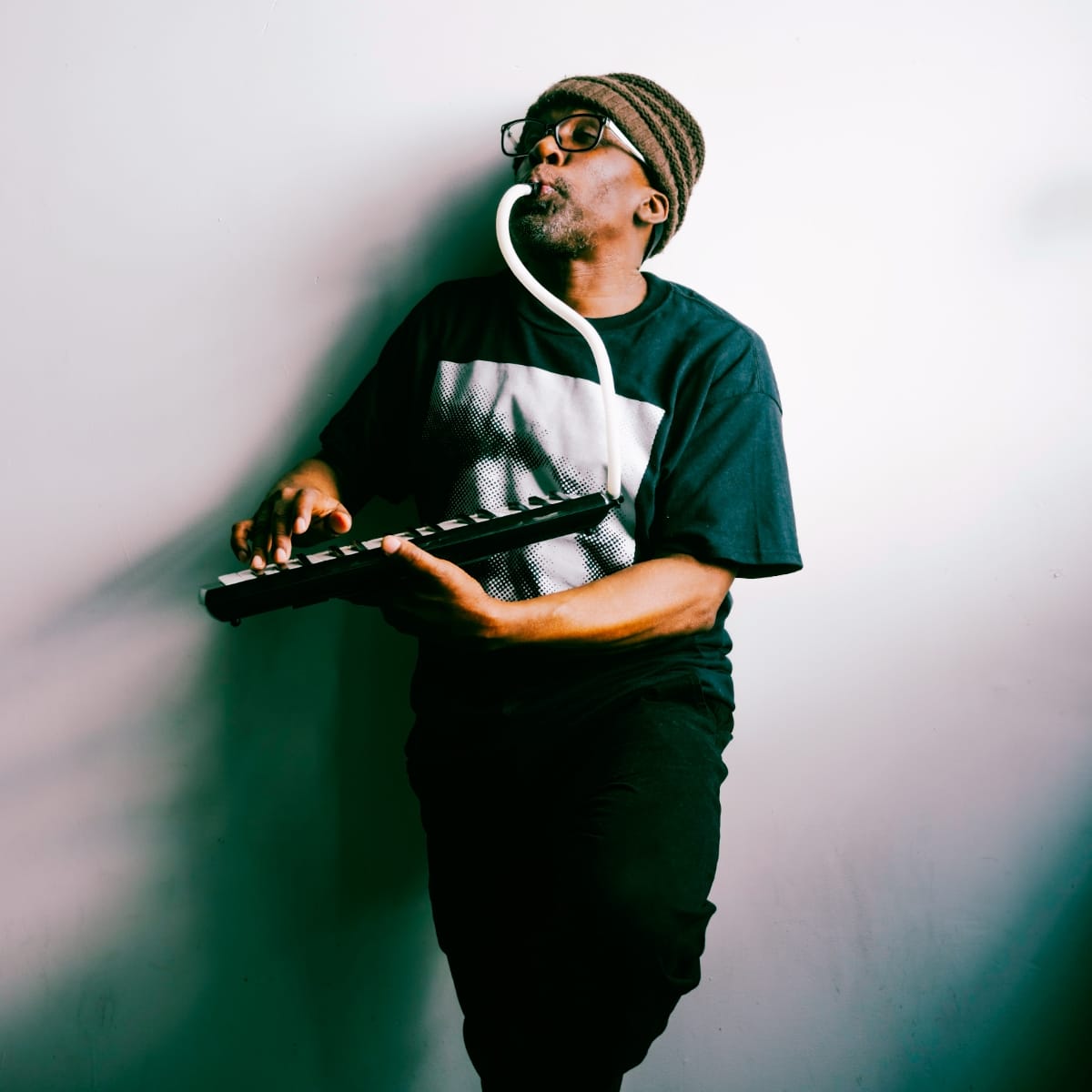
Invariably, as we speak about his education and upbringing, our conversation turns to ASD. Smith talks of it openly and with a somewhat practical slant. Without being overtly didactic, he walks me through the broader aspects of ASD, and then the particulars of his own space within it. He refers back to pop culture characters and celebrities, and draws a line between the fetishized '90s depiction of autistic people as either helpless individuals waiting for salvation, or misunderstood 'savants,' and a perhaps more nuanced and unflinching portrayal of David Helfgott, the concert pianist and subject of the Australian movie Shine, who suffered from similar symptoms, and was later revealed to have been diagnosed with ASD.
He speaks quite reverently of his parents, his mother specifically, for having the resolve, kindness, and determination to relentlessly navigate the medical and therapeutic praxes of the time period, and her valiant efforts to shield him from state hospital programs, and outdated and inhumane treatment methods like shock therapy and chemical restraints. One specific moment Smith returns to is from age 4, when he was mute for about a year and a half.
khagan: Do you have a memory of that time period?
Charles: I remember I was in Inglewood, on the South Side. It was the late 1970s, my grandmother's house. I remember tricycles, playing the piano. I was studying and trying to play sheet music. I remember finding a Raggedy Ann doll, playing with it, and trying to watch TV as much as possible. I had a brother named Stan. We were almost twins. He died in 1989.
I do remember not being able to talk. Being taken to a lab, where they ran some tests. I remember not wanting to speak to any doctors or nurses. They gave me Rorschach inkblot tests and spatial reasoning tests. I didn't even know the word "autism" at that point. At the time, ASD wasn't even classified as a spectrum.
Stay on top of The Tonearm.
Subscribe for exclusive interviews, cultural tip-offs, and community fun.
And your support keeps our site free of advertising and paywalls.
In a manner, minimalist piano might appear as a profoundly cerebral style of composition. It favors structural listening and incremental change over dramatic contrast, with your brain meant to track repeating cells. One can speculate that for someone who is cognitively drawn to predictability and stable pulses, it can be an idyllic foundational musical state. Yet, when Smith plays, there are moments when it feels like the air tightens and the room is collapsing around him. Even to a discerning ear, this seemingly recursive music can induce a sensation of utter abandon and tonal ambiguity when played so deftly.
All of this leads us to War of the Martian Ghosts. The conceptual avant-garde sci-fi opera exists in two distinct variations—a 2018 solo piano version and a 2023 electronic/MIDI realization. Its narrative-driven titles guide the listener through the stormy arc of Martians invading Earth and the ensuing aftermath.
The earlier piano version is something of an atonal masterpiece, packed with complex arpeggiated chords and shifting tempos. Smith's adoration of both Reich and jazz-influenced experimental techniques is on thundering display. He pulls off all sorts of fantastic subtle nuance here, using repetitive low-end chord clusters to evoke mechanical desolation, and penning both vast atmospheric moods and Chopin-like punky marches.
The MIDI version, however, is what Smith truly perceives as his labor of love, and what he envisions as the next logical step in his career. It's denser and more detailed, and perfectly straddles the line between high concept and outsider art. It also exemplifies Smith's continued path of learning. This version, whose roots trace back to early synthesizer experiments in 1996, crystallized when Smith found a Kurzweil patch that produced laser-like sounds. Building from there, he expanded War of the Martian Ghosts from its skeletal, minimalist variation into a pulsing beast, full of brooding textures and, recently, a libretto and arias that he plans to incorporate into the full-scale production of the opera. As we speak of the practicalities and idealized versions of this staging, Smith repeatedly refers to War of the Martian Ghosts as his "destiny."
khagan: How did you even begin conceiving something like War of the Martian Ghosts for the stage?
Charles: I've been exposed to opera for many years. I watched it on TV. I saw eight operatic stage productions. Puccini, Verdi. I've also been heavily involved in playing piano for operatic areas. When I first heard Bizet's Carmen on a radio broadcast (sighs deeply) . . . I love that opera so much.
I was always intending to produce Martian Ghosts as an opera. I was able to put on some early material from the opera at a DIY music teaching studio. There were about 24 people in the audience. Then there were plans to put it on in 2019, but COVID obviously ended that. Over the years, I added an overture, arias, and other elements, until it became an opera of two and a half hours. I've also finished a screenplay now.
The reality is that to stage it properly, as a two-piano orchestra, I would need a grant—a big federal grant. It's obviously difficult right now, money and the arts, generally. To fulfill what I have in mind, you need performers, an orchestra, a conductor, props, staging, and a crew. The average union worker opera production cost can run up to $500,000. Even with a synth setup, equipment can be expensive. Trying something like a public funding campaign is always on my mind. Or doing some non-stage readings, some projections of a version of the opera, perhaps a radio play. In the end, it all comes down to money.
The dream is to produce it with the Chicago Opera as a composer-in-residence. Then, of course, there is the Metropolitan. They obviously don't stage many new works. But in my dream, that would be the next step. Then, eventually, an independent film, maybe Broadway, Grammys, Oscars. These are big things I dream about. (laughs)
I know I might be a little too ambitious, and I know it's a long shot, but I'm prepared for that. I guess it will be some time.
To speak of Smith is to mention many things, aspects that have been woven into his narrative, either by choice or by social convention. There is a powerful redeeming moment to his work finally seeing wide release. After toiling for so long in almost-near obscurity, the agility and beauty his playing has embodied for so long deserve time in the light. More cynically, his background story is perhaps also much more marketable now than it was before.
But putting all that aside, it is also crucial to realize that his music exists as an astonishing end in and of itself. It is art of the purest form, written and played as something devotional and hard-earned—dextrous and curative, and achingly vulnerable. What Charles Joseph Smith began assembling all those decades ago, in his mother's house, is a monument to endurance, the arrival of a singular architect.
Check out more like this:
 Carolyn Zaldivar Snow
 khagan aslanov


Comments