


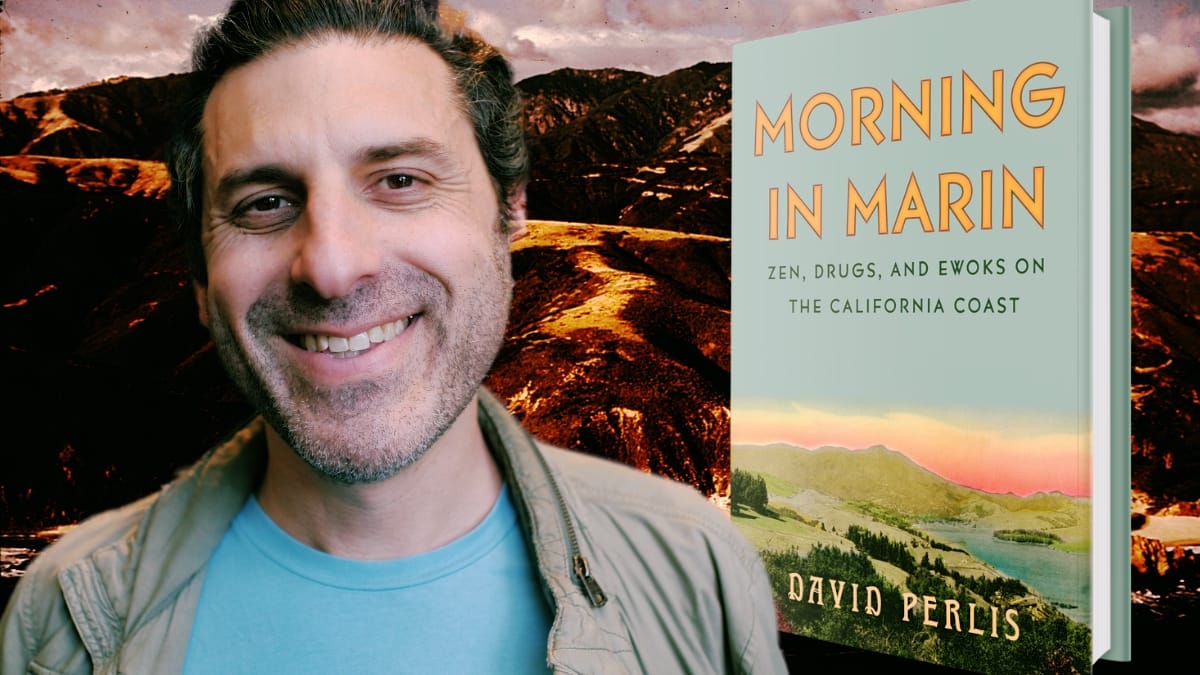
Author David Perlis started interviews for his first book, Morning in Marin: Zen, Drugs, and Ewoks on the California Coast, over Thanksgiving 2021. His earliest conversations were with Cyra McFadden, author of the 1977 novel The Serial, whom he met on her Sausalito houseboat, and Ed Stiles, the last and longest resident of Druid Heights on Mount Tamalpais. Many of the people he met along the way still live in Marin, and as Perlis puts it, “the guy with the ponytail ahead of you in the checkout line at United probably could have played at Monterey Pop.”
Morning in Marin: Zen, Drugs, and Ewoks on the California Coast is out now from independent publisher Heyday, and details the outsized impact this 828-square-mile region in Northern California has had on poetry, spirituality, music, art, and culture.
David Perlis co-hosted the late-night talk show Night People on WFMU for nearly a decade, and has worked for the New York Public Library and the American Museum of Natural History. He grew up in Marin County, California, and now lives in New Mexico. Lawrence Peryer recently welcomed David to The Tonearm Podcast, where they discussed the book and Marin’s outsized influence and magical appeal.
Listen to the full conversation in the audio player. The transcript has been edited for length, clarity, and flow.
Lawrence: You write in the book that if you look hard enough, everything you love is from Marin. It’s a great line. It’s the organizing principle of the book, I would say. I’m curious when you became aware of the story’s full scope.
David: If I had to pinpoint one moment, I think it would be when a friend introduced me to the lectures of Alan Watts, the British Zen philosopher. I listened to hours and hours of him discussing life and death, Zen and Daoism, permanence and impermanence, and it spoke to me directly.
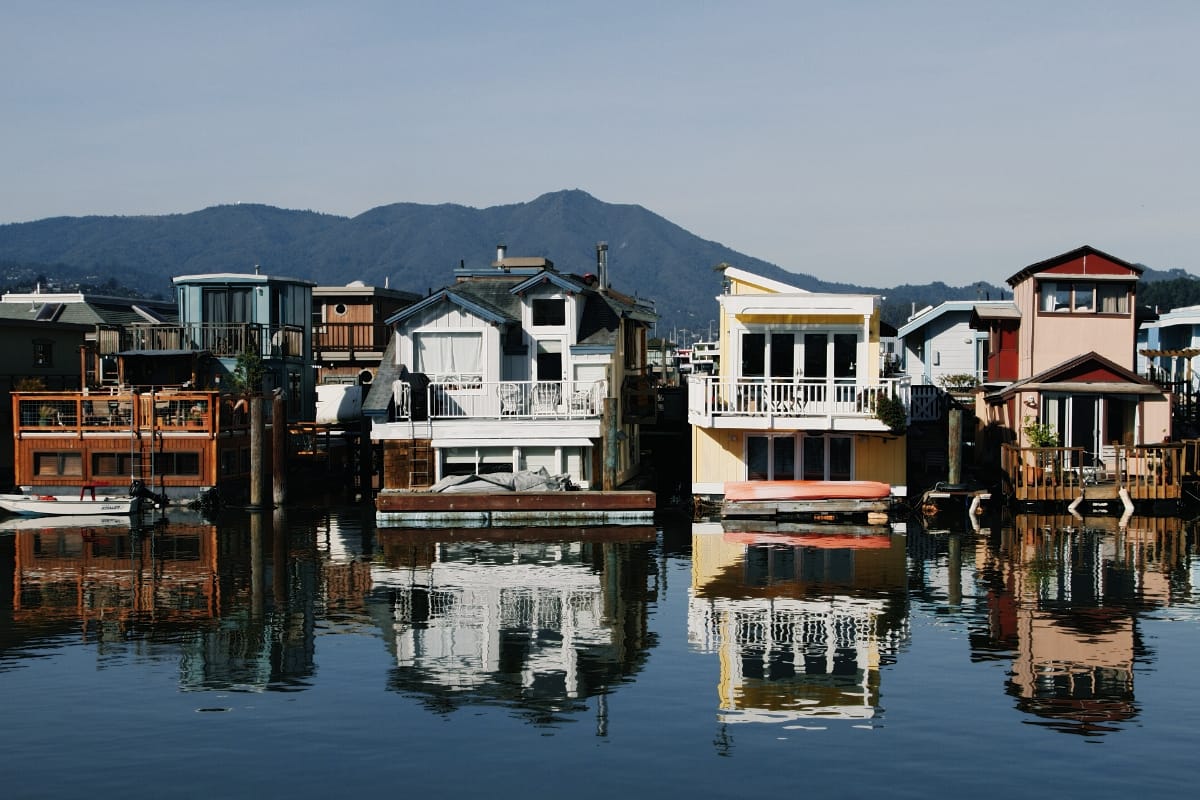
As Alan Watts often points out, many of those lectures were recorded on a houseboat in Sausalito, in Marin County, where I grew up. To me, it was the final straw after I discovered that Van Morrison had spent time in Marin County and that Industrial Light & Magic and George Lucas were there. You see in the credits of the movies ILM has worked on, it’ll say “Industrial Light & Magic, Marin County, California.” It tells you exactly where it is, and it’s rare for a credit to name the place.
Going back to The Dharma Bums, when I read it, Jack Kerouac was writing about Mill Valley and Tamalpais. So Marin was calling to me over the decades, and I didn’t quite know what it was saying. But by the time I got to these Alan Watts lectures and discovered that this, too, was from Marin County, I realized it ran much deeper than I’d known.
Lawrence: I’m curious what was in the air, and what was not in the air, for you when you were growing up: your awareness of the cultural context.
David: I was pretty young. I was born in 1978. In the book, I describe the movement, which I call the Marinaissance, as a seismic cultural, spiritual, even cosmic awakening that happened in Marin County between World War II and the 1980s, encompassing all kinds of things: literature, dance, theater, painting, philosophy, technology, architecture, film, and of course music.
I was a little kid during this. I had little glimpses of it, with a naturalist named Mrs. Terwilliger, who was a really important figure for us kids growing up in the Bay Area. One of the things she did was bring us out into our natural environment and teach us the interdependence of everything in nature: that we are not to be in conflict with nature, that we are not to compete with nature, but that we are a part of it, that we are Tamalpais, that we are the Pacific Ocean. That was a very Marinaissance lesson, and she taught it to generations of schoolchildren in Marin County.
Lawrence: Tell me about the road to this becoming a book. For many authors I talk to, it started as essays or other work. Was this always a book?
David: Yes. It actually started as fiction. I wanted to write a story inspired by many of these characters and places like the unintentional community of Druid Heights and the Sausalito houseboat community. I thought I could weave that into a novel, but it didn’t quite work. Then I realized that if I told the truth, used the real names and told the real story, it was far more fascinating than anything I could make up. Around that time, a friend suggested I try nonfiction rather than fiction.
I wouldn’t say it wrote itself, but the idea really took off quite quickly. Once I began researching, the movement’s scope became apparent, and I never looked back. I spent five years writing it, interviewed almost sixty people, did tons of research across California, and it was so much fun.
Fiction is a solitary pursuit, but nonfiction brings you out into the world, and in this case it brought me home again.
Lawrence: What were some interesting or compelling sources? You did extensive interview work, but you also found historical ephemera, letters, and similar materials. What surprised you most in all that research?
David: I started with primary source material: autobiographies, contemporary interviews, oral histories. But perhaps my favorite primary source was correspondence. I found it to be an incredibly intimate window into what was really going on in people’s minds during the period. It’s also a vital source of unpublished and often undiscovered material. UC Davis holds Gary Snyder’s archives, so access to his correspondence was a phenomenal help.
Think about all the people he wrote to, and all the people who wrote to him. All those letters are in there, too, especially love letters between him and his wife, Joanne Kyger, a fascinating poet in her own right, and letters to Philip Whalen, Lew Welch, Allen Ginsberg, and Elsa Gidlow.
It goes on and on. It’s incredible how much time people must have spent on correspondence. I wonder how Alan Watts delivered his lectures, wrote his books, cared for his children, took his drugs, and still had time to write all these letters to such important figures.
So correspondence was a huge thing. Through this primary-source research, I kept discovering that people I already knew had connections to Marin County I wasn’t aware of. Philip K. Dick, for example. I had read several of his novels but had no idea he’d written many of them in West Marin and in northern San Rafael. Another example is Naomi Judd. Who would have thought that Naomi Judd, of all people, would have formed the basis for the Judds with her daughters while living in West Marin, in Lagunitas? Marin really does have an authentic country music streak you wouldn’t expect from modern Marin County, but it runs very deep.
David Grisman, Peter Rowan—these are all facets of it, along with Banana Levinger from the Youngbloods. I’ve been playing with the name “yellow grass” to describe the country that comes from Marin, because if you haven’t been there, the hills of Marin often have a yellow tint. So rather than bluegrass, I like to call that genre yellow grass.
Lawrence: I love it. I forgot about the Judds. That part of the book blew my mind.
David: Surprising. Or Suzanne Somers, right? She was another surprise. I had no idea she had any connection to Marin County. She was a struggling actress and single mother in Sausalito, and George Lucas gave her her big breakout role in American Graffiti. Very local.
Lawrence: So much of Marin County seems microcosmic of America. I was thinking about the conservative, reactionary part of the population. Many people who hold the hippie or tech-optimist view of the Bay Area wouldn’t necessarily realize that element has always been there.
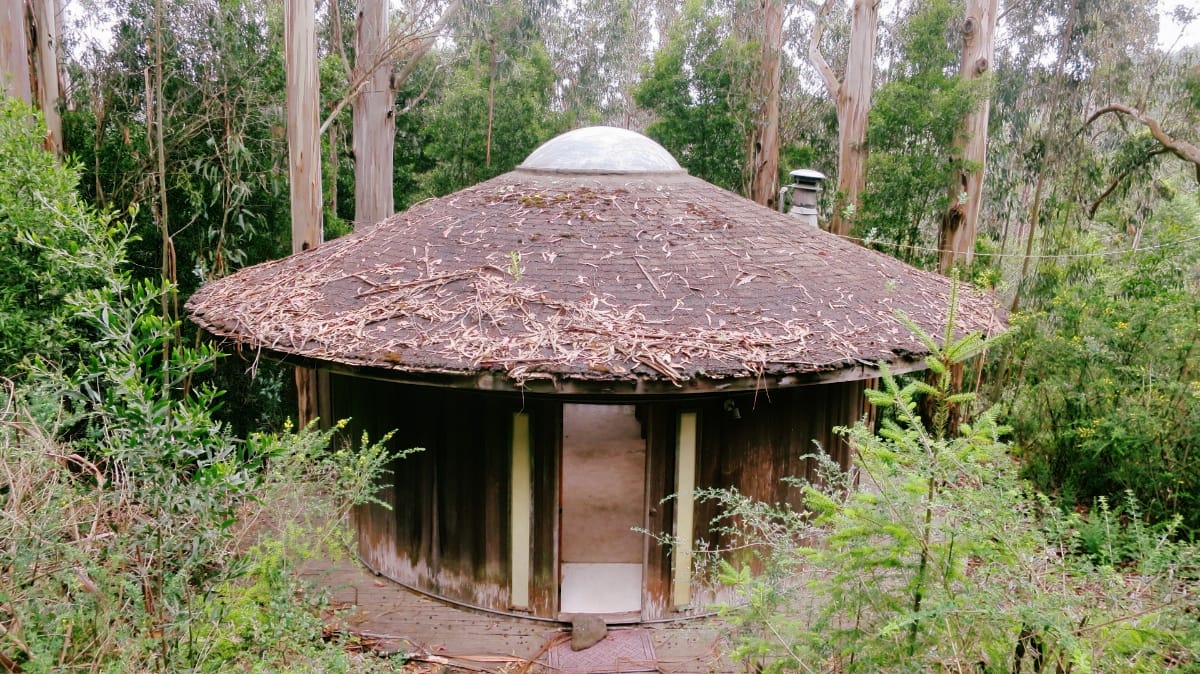
David: It’s interesting, because we want to say a person is conservative, or a person is part of the mainstream. But in reality, within each person, there are all these dualities. People are non-dualistic in that way, to use a Daoist term. So I think you had a very unusual kind of conservatism in Marin, one that actually favored conservation. There was a streak of loving nature, a deep relationship with nature, that goes all the way back in history.
Marin has always been a place of healing, going back to the mission in San Rafael, which was originally a hospital sub-mission for the Indigenous residents of the San Francisco mission who were suffering from all kinds of things: cholera, smallpox, TB, forced labor, separation from their communities and families.
There were retreats and spas. As I mentioned, there were summer homes. A sanatorium called Arequipa taught tubercular women to make organic pottery as they recovered, a clear precursor to the Marinaissance. So even though attitudes may have been politically conservative, this love of nature attracted people who were sometimes in poor health and needed fresh air, and it was generally a population that really loved nature. That makes it a bit unusual when we pin the conservative label on it.
Lawrence: Something fascinating about all these characters and figures is, first of all, the litany of them. At some point I thought, my God, this is an onslaught of post-World War II celebrity and culture. And they weren’t the minor figures in our pop culture. You have Fleetwood Mac recording Rumours.
David: There seems to be this phenomenon where people arrive in Marin and are inspired almost immediately to create some of their greatest masterpieces, whether books, records, or films. It happened again and again. Sometimes even just for a weekend: Jimmy Buffett was staying in a hotel, feeling lonely at the foot of Tamalpais, and he wrote “Come Monday,” which is probably one of my favorite songs of his.
And it’s true, you mentioned this litany. One of the biggest challenges of writing this book was trying to tame it, making tough choices about what went in and what didn’t, because so much more happened in Marin County, and there were so many more interesting people than I could include. You really have to choose between comprehensiveness and narrative flow, and that’s where my editor, who happens to be from Bolinas in West Marin, came in. She gave me permission to be more deliberate in my choices and showed me that I was responsible for making them, because I needed to make the book readable. If you included everything fascinating that happened in Marin County during this period, it would be an unreadable list of names and events.
Lawrence: You’re going to force me to ask: is there an anecdote, a character, a human being you had to leave out that you’re still kind of pissed about?
David: I wouldn’t say anger. There’s no anger. One thing I recently learned is that MKUltra had a safe house in Mill Valley in the 1950s. People posing as prostitutes were luring men back to this house, where they were involuntarily dosed with LSD as part of experiments in mind control. I was not aware of that, and now I am. That’s something that could be included in a reprinting or in a different piece.
Art Clokey was a tough one, because he came right at the completion of the circle. He’s the creator of Gumby, for those of you who don’t know. He built a studio called Premavision on the Sausalito waterfront, which started just after the point where I see the circle as complete. And since Gumby wasn’t invented in Marin County, I had to make the tough choice to leave him on the sidelines, even though he was a great friend of Alan Watts. That’s another connection.
Another would be the WELL, Stewart Brand’s electronic message board system. It also started in Sausalito right around the end. I was really trying not to start new stories in the last chapter, so that became a difficult choice, because there could almost be another chapter.
I don’t like too much afterthought and reflection after the ending. It kind of ended itself. So those are a few things that could go in other pieces. I almost had to stop researching Marin because I knew that if I kept looking, I’d find more and more. I will resume that eventually, but I wanted a little while to say, “Okay, this is it.”
You also make choices that really reflect this movement, this awakening, the Marinaissance. Those things I just mentioned don’t necessarily reflect that spiritual and creative awakening. Although they’re tangentially thematic, they don’t get to the core or help illustrate the book’s core premise.
Lawrence: The WELL is fascinating, because it does seem to fit the narrative in terms of things that made a massive impact. Even people who don’t remember or know what the WELL is have had their lives shaped by it, all of us now, by the internet. But I’d love to see you write The Tao of Gumby. I think you’re probably perfectly equipped.
David: There actually is a great short KQED documentary that hints at a lot of that. Art Clokey was deeply influenced by Zen Buddhism and Alan Watts in particular, and he named two characters, Prickle and Goo, after two concepts Alan Watts introduced. Watts described two kinds of stuff in the universe: the prickly and the gooey.
Lawrence: I’m curious about the structure of the book, because you bring so many people, strands, and movements together. It could have been a linear narrative.
David: Originally, I wanted to tell everybody’s story and include every detail, and I went way back in everybody’s history. By the time I got to the ’60s, I thought, “That’s definitely not going to work. There’s way too much information here. I’m not going to be able to do it that way.”
So you have a few choices. You can do it chronologically, thematically, or geographically, because what happened in Sausalito differs from what happened in San Rafael. What happened in Novato differs from what happened in Bolinas. Different arts, different people, although they do all interact.
What I ended up wanting was to create something immersive, something that felt like you and I were going back in our time machine, and I was going to introduce you to everybody. We would walk through the landscape and hang out, meet people, come back to them, and check in as their stories evolved over decades. I also used the present tense. That was another choice, because I think it brings an immediacy to the past that we don’t always get when we read the past tense. I wanted it to feel like it was happening in real time, so you could experience it and share in the joy of people’s successes and the disappointment when things didn’t work out.
I sometimes say my biggest regret was how many people I kept in, and my other biggest regret is how many people I left out. So perhaps that means I struck the balance.
Stay on top of The Tonearm.
Subscribe for exclusive interviews, cultural tip-offs, and community fun.
And your support keeps our site free of advertising and paywalls.
Lawrence: The tension between spiritual seeking and artistic endeavors, and survival and moneymaking: tell me what you learned about balancing the two, not only for these characters but in your own creative life.
David: I think what I learned is that it’s always trade-offs. I resented the people who became successful and earned the money. But the more I researched it, the more I realized it’s almost inevitable with this level of risk-taking. When you play this game and take these huge risks in the name of artistic clarity, as George Lucas and Francis Ford Coppola did, and you start to succeed, you end up with this weird trade-off: financial success and, amusingly, dependence.
What’s funny is that, in pursuit of independence, Lucas broke free of the Hollywood system and became an independent filmmaker, and he was more successful than he could have ever dreamed. But he ended up completely dependent on hundreds, if not thousands, of very talented individuals at Industrial Light & Magic, Skywalker Sound, and so on. Money becomes an inevitable trade-off between risk-taking and the success it can bring.
And I actually came to find a deep respect and even love for George Lucas and what he has done for Marin County. It almost completely reversed my attitude. When it comes to money and artistic creation, people are born into different situations, and you have to make very personal trade-offs when you decide to put it all on the line.
I think the important lesson is not necessarily about money but, again, about risk-taking. One lesson we can learn from the Marinaissance is that too much art today is made without risk, without putting anything personal on the line. I think our culture suffers for it, with people afraid to speak out because they worry they’ll be condemned or embarrassed for their opinions. What I’d like to see in American culture is a renewed embrace of risk-taking, of being bold and putting it all on the line to pursue an artistic vision. I think that would be very healthy for our culture. Too often these days, art falls under the category of vanity rather than clarity and risk-taking.
Lawrence: Tell me about Huey Lewis. For some readers, it’ll be a revelation. I knew a little about Huey Lewis. He’s almost a connective tissue between generations.
David: Huey is an interesting and important figure in Marin County. What you’re talking about—his connection, especially to the Beats—comes through his mom, Magda Cregg, who was an important figure. She was a painter. She was an entrepreneur. She was a very interesting figure who lived in Marin City, which, for various reasons, is Marin County’s only predominantly Black neighborhood. She wanted to live there, and Huey spent a lot of time there.
His parents were divorced. So he split his time, and he did end up going to boarding school for high school. But Magda was the partner of the poet Lew Welch, who went to Reed College with Gary Snyder and Philip Whalen, was an intrinsic member of the West Coast Beat scene, and was perhaps one of the greatest bards of the Marinaissance. He wrote poems like “The Song Mt. Tamalpais Sings” and “Olema Satori,” which is dedicated to Peter Coyote. Lew Welch bridged generations the same way Neal Cassady did.
So Huey Lewis actually grew up around all these poets. Magda would host salons and parties where Lew would be. Robert Creeley would be there. Allen Ginsberg would be there. Dizzy Gillespie was hanging out. Young Hugh Cregg, which was his name before he changed it to Huey Lewis, got a firsthand view of all this incredible stuff, and I think it really sank in and laid the foundation for the music that would come later.
It’s funny to imagine. We think of him as a major pop star, but in some ways he and Peter Coyote are really the last true Beats. They’re the extension of that, the final generation authentically and personally connected to that literary movement. You don’t think of that when you hear “The Power of Love.” You don’t necessarily hear it in the lyrics. But I think you see it shine through in his attitude and personality.
Lawrence: What a fascinating life. I mean, Huey Lewis, right? But that’s one of the book’s strengths: the endless anecdotes and characters, people you may already know, or think you know. These connections are really incredible.
David: As is Marin itself. As you mentioned earlier, the closer you look, the more you realize that everything you love is from Marin. I know that’s true of me, and it sounds like it might be true of you. I suspect that when people read this book, and I think this is one of the important things about it, they’ll realize it’s true of them, too.
Check out more like this:
 Lawrence Peryer
 Lawrence Peryer


Comments