


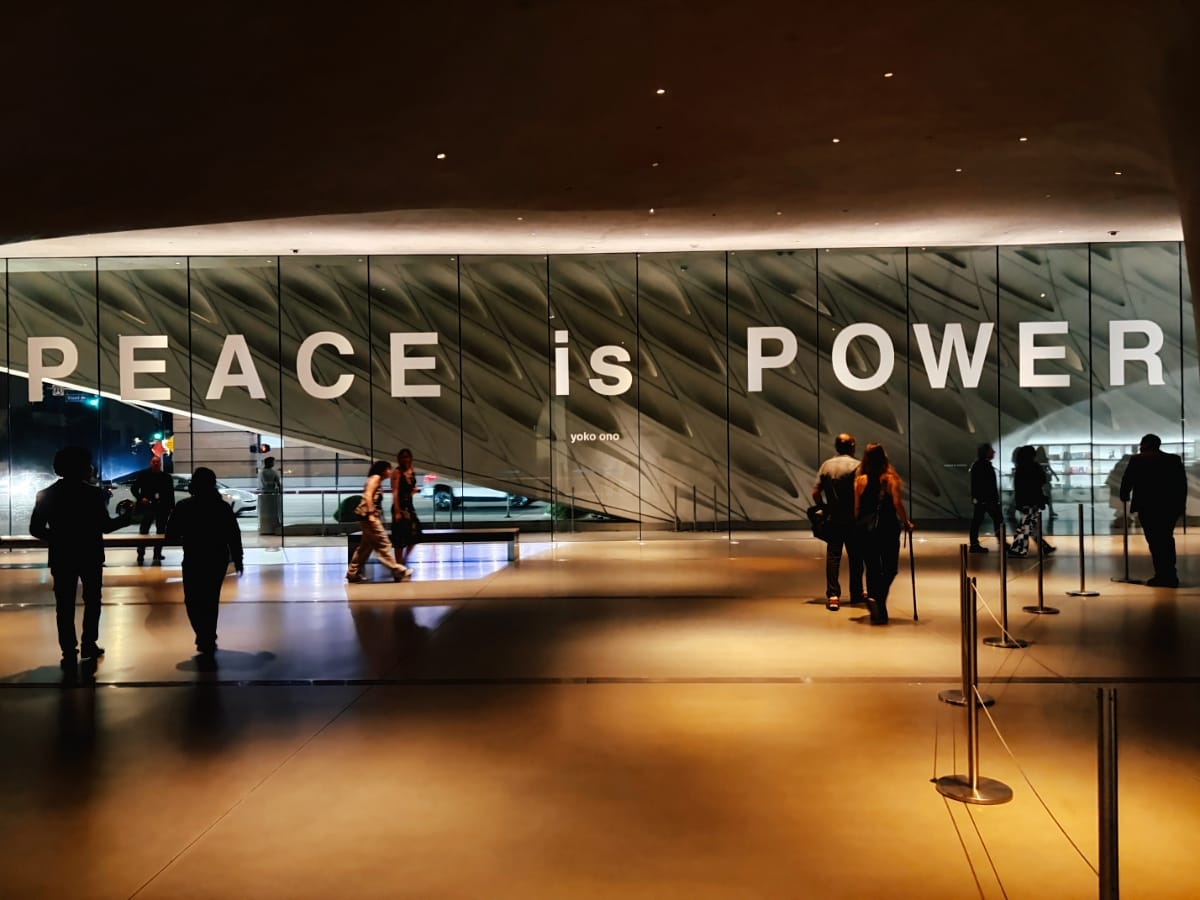
The line to enter The Broad museum in downtown Los Angeles had already looped from South Grand Avenue down 2nd Street and back again by the time I took my place. I had come to see an all-star lineup of musicians: Merrill Garbus and Nate Brenner of Tune-Yards; Satomi Matsuzaki of Deerhoof; Kathleen Hanna of Bikini Kill and Corin Tucker of Sleater-Kinney; Amelia Meath and Nick Sanborn of Sylvan Esso; Macie Stewart and Sima Cunningham of Finom; Ira Kaplan, James McNew, and Georgia Hubley of Yo La Tengo; Nels Cline of Wilco; balladeer extraordinaire Rufus Wainwright; composer/jazz singer Theo Bleckmann; and vocalist Emi Helfrich—all of them there to perform Yoko Ono's songs for the Yoko Only tribute concert, thanks to the loving curation of Yuka Honda, accomplished musician, producer, artist, and beloved friend of Ono's.
This concert; July's events, recreations of Sky Piece to Jesus Christ performed by Los Angeles Chamber Orchestra (LACO) and Cut Piece performed by the artist MPA; the theater piece Ocean Child: I Am Yoko, co-written by Honda and scored entirely by her, debuting September 19 at the Colburn School's Zipper Hall; and the multimedia exhibition on view through October 11, Yoko Ono: Music of the Mind—all presented by The Broad—take place amid a broadening appreciation of Ono's work. Honda, first and foremost a creator, has taken up the mantle of curator for the first time in her career for the purpose of honoring and celebrating her friend and lifelong source of inspiration. Unfortunately, for many years, Ono's work had evaded the recognition it now enjoys, and was even maligned, due to her relationship to a famous white man, which brought increased racialized scrutiny her way, and a 1960s/early '70s audience that was not yet ready for her confrontational yet whimsical artistic sensibility.
It feels embarrassing now, as Ono's work has experienced this cultural reclamation, to admit to having discovered it by way of her husband, the Beatle John Lennon. I had inherited a stylistic bias against her delivery as a singer—at times a squall, at others a breeze, ever quavering with emotion—but overcame that as I grew to embrace a fuller world of voices in my listening. Later, her 1964 book Grapefruit came to me as a gift. I devoured it and realized how much it had informed Lennon's most famous song "Imagine," for which she would eventually receive a co-writing credit. I found the 2022 Ben Gibbard-assembled tribute album/podcast project Ocean Child: Songs of Yoko Ono, featuring heroes of mine like Thao Nguyen, Sharon Van Etten, Japanese Breakfast, and Yoko Only house band members Yo La Tengo, and fell in love with the depth and economy of her songwriting. This led me to revisit her Plastic Ono Band contributions and the Lennon/Ono album Double Fantasy, to explore her solo releases like Season of Glass (released in the wake of Lennon's murder), to enjoy her Yes, I'm a Witch albums released in 2007 and 2016 for which she had invited collaborators to interpret her songs alongside her, some of whom were present on the Yoko Only stage, including Tune-Yards, Hanna (with Le Tigre), and Honda herself (with Cibo Matto). I now consider myself a full-fledged fan and Yoko Only one of the best concerts I will ever have attended.
I left that night, high on an evening of exceptional music, my "piece of sky" from Ono's Helmets installation in hand, knowing that in just a few days, I would get to sit down with Honda to discuss her Ono-related projects further. Here is our conversation—about music, Yoko, and her legacy.
The transcript has been edited for length, flow, and clarity.Meredith Hobbs Coons: I just got an email this morning about another show you're doing, called Ocean Child: I Am Yoko, and it made me so happy to know that it is even more of an enveloping project. How deep does it go? How many events are you curating?
Yuka Honda: This is the last one. I did three for The Broad: the opening party, which was private; then Yoko Only; then this I Am Yoko theater piece. All of them are important, but this I Am Yoko piece is my baby. The concert was important, too, because it was all my friends and people who love Yoko, and the unity of it—the collectiveness of it—was such a joy. This next one is a piece that I've been thinking about for years.
I really wanted to do this project, but I had never done anything beyond big music concerts. My original idea for I Am Yoko was a multimedia installation piece, but I wanted to have nine pavilions and people to be able to go back and forth between them and have multimedia experiences, which is basically impossible. I wanted to have my own Disney World.
Meredith: Maybe someday you should.
Yuka: Maybe one day. But I was really lucky to team up with this really great artist, Glenn Kaino, a Los Angeles artist of Japanese descent and a big Yoko fan, who has done massive installations. Somehow we ended up doing a theater piece, which turned out to be my childhood dream. When I was a high school student, before I wanted to become a musician, I wanted to do theater. I was a huge fan of avant-garde theater, which was huge in Japan. They were great, with a lot of music and wild scenarios, and I was strongly influenced by them, so I am going to present this story as a concert because that's the form I know really well. It's a musical/opera/electric drama piece. I'm excited about it. I've been working really hard on it.
Meredith: And you've done an opera before, No Revenge Necessary, which honestly sounds like a Yoko-esque title.
Yuka: Yes, exactly. I'm proud of that piece. We performed it in 2019, then COVID came, but it was a really exciting thing to embark on, and I'm really happy that now I get to do it for real—with a Yoko theme.
Meredith: What were some of the lessons that you learned from that project that you were able to carry with you into this one?
Yuka: I learned that I have to be practical, which is not always easy when making music. Music has a technical side that can be practical, but it also has this other side that needs to stay organic. It's a difficult situation coordinating I Am Yoko, because some of the musicians are in New York, one of the singers is in Chicago, and some musicians are in Los Angeles, so we can't really rehearse together. I have to do creative rehearsals: making demos, sending them out, having people sing on them, so they kind of know the song. I tell them how the music works and make a demo, but I don't play guitar, for example, so I write the guitar part on keyboard with a distortion sound. Then, when Nels comes home from touring with Wilco, we're going to work on the guitar part to finish it. There are a lot of pieces happening at the same time that are unfinished. But I have to work a little bit here and there, and will hopefully end up building this house.
Meredith: It's cool to hear about that process in the context of Yoko Ono, because her work is so multimedia, and seeing the exhibit at The Broad really drove home how tactile she gets in her work as well as conceptual. Do you want to speak to that specific influence on your work throughout your career?
Yuka: Yes. Yoko and I are similar in that we don't want to do just one thing. The art world can be a little bit difficult—be a painter, be a sculptor, be a musician, but they don't want you to do all of it. Yoko and I are the kinds of artists who are more about ideas, and the formats that we use are more like languages. We're thinking of something, and sometimes we express it in English. If I'm speaking to you, I speak in English. If I'm speaking to my brother, I probably speak in Japanese. If I'm talking to somebody and we don't speak the same language, then I may do a lot of gestures. The format is just a communication tool, and our art is more in our mind, so we don't really fit the system that the world has established very well.
The art world wants you to follow its guidelines, and I think we are interested in breaking these walls to be a lot freer, because these guidelines shouldn't matter in these times. Maybe you want to sing, play drums, paint, and make sculptures, and that's just you. Maybe you also want to cook, have children, garden, or farm. It's normal for us to do multiple things in our lives. We're not single-task robots. I'm not putting down people who do the one thing all the time. I admire them, and there's serious value in that as well. But there are different kinds of artists. There are musicians who are multi-instrumentalists; they play piano, drums, and flute, but they're the same person expressing the same ideas through different formats.
Meredith: That's a really tangible way to put it, because it puts your work and Yoko's work in that context where everything that you make feels like you, even if it's manifesting in a different art form. One word that comes up a lot in relation to Yoko is courage. You mentioned breaking down systems as being part of that. I'm also thinking of it in terms of permission. How do you feel like Yoko's work has given you, as an artist, a sense of permission?
Yuka: She's definitely one of the pioneers of doing what she's doing. She has opened up a lot of pathways for us, and we improve at what we do thanks to her going ahead of us, walking through the tall grass, and making roads for us. She's incredible for doing that. They call it courage, and I do think she's courageous, but that comes more from her being authentic to herself. She's being true to herself, not trying to do more than she's thinking of doing. It's not that kind of courage. It's that she fully believes in what she's doing, and she's doing it. She can't stand not doing it. She has an almost innocent knowing and belief in what's right, in what her idea is, and in standing by it.
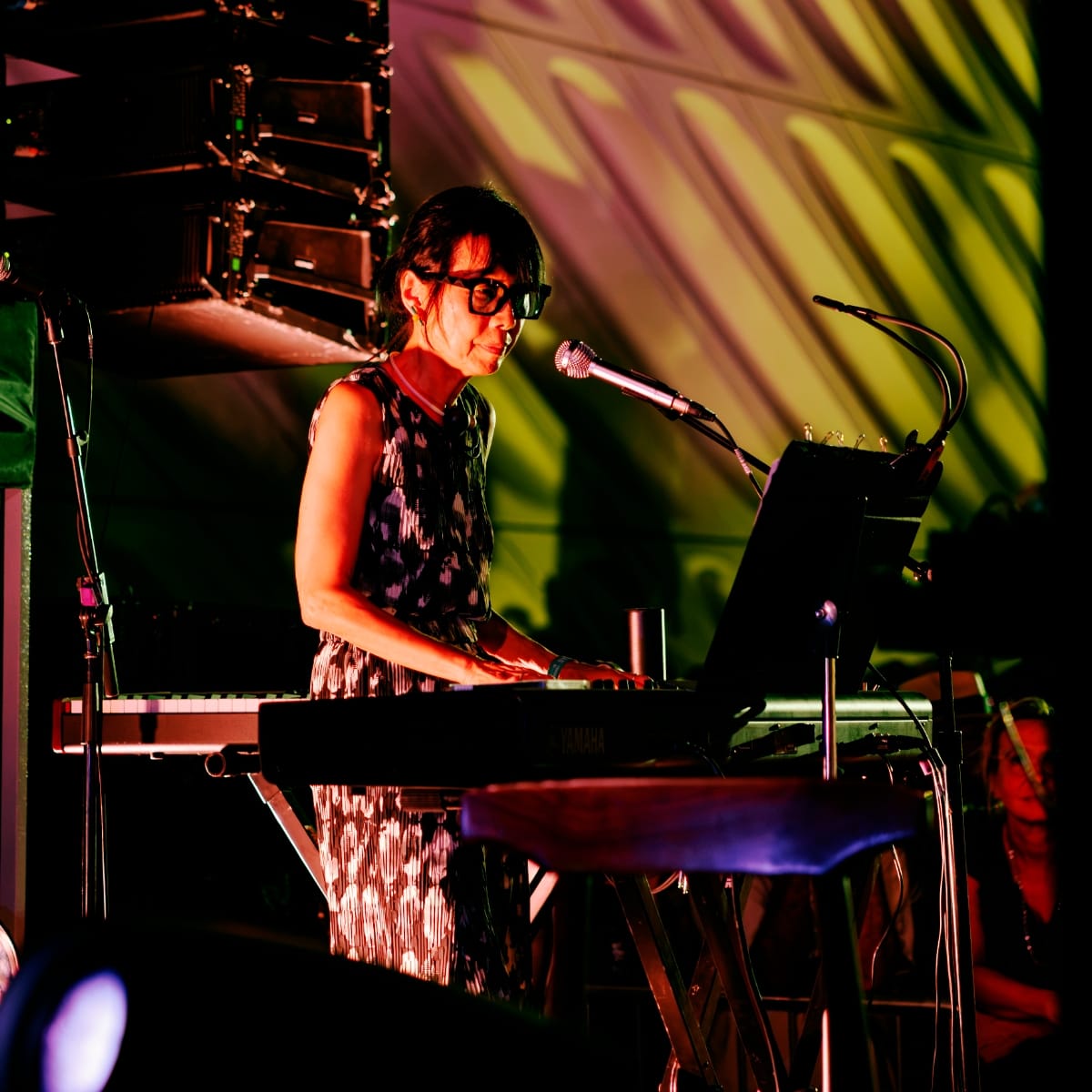
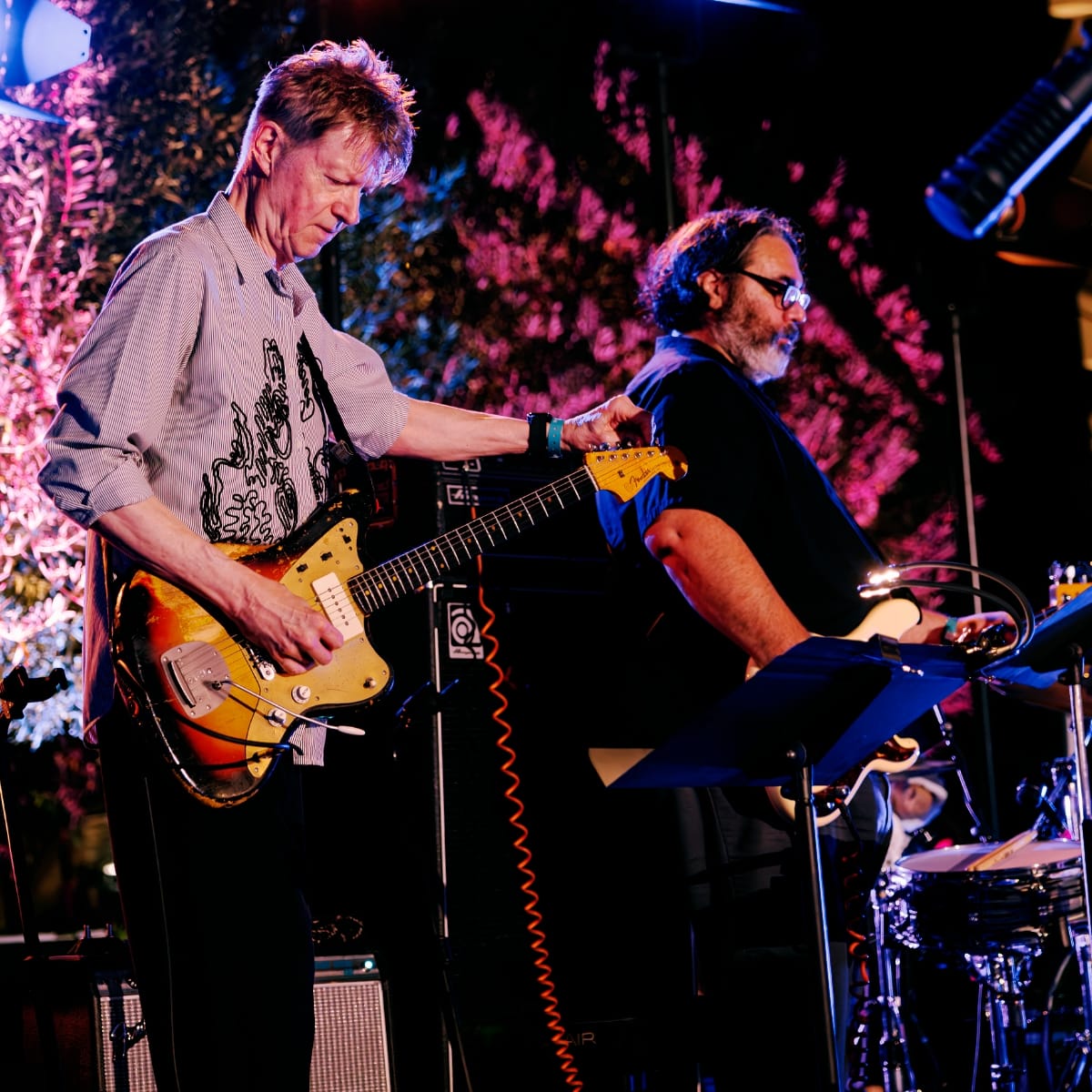
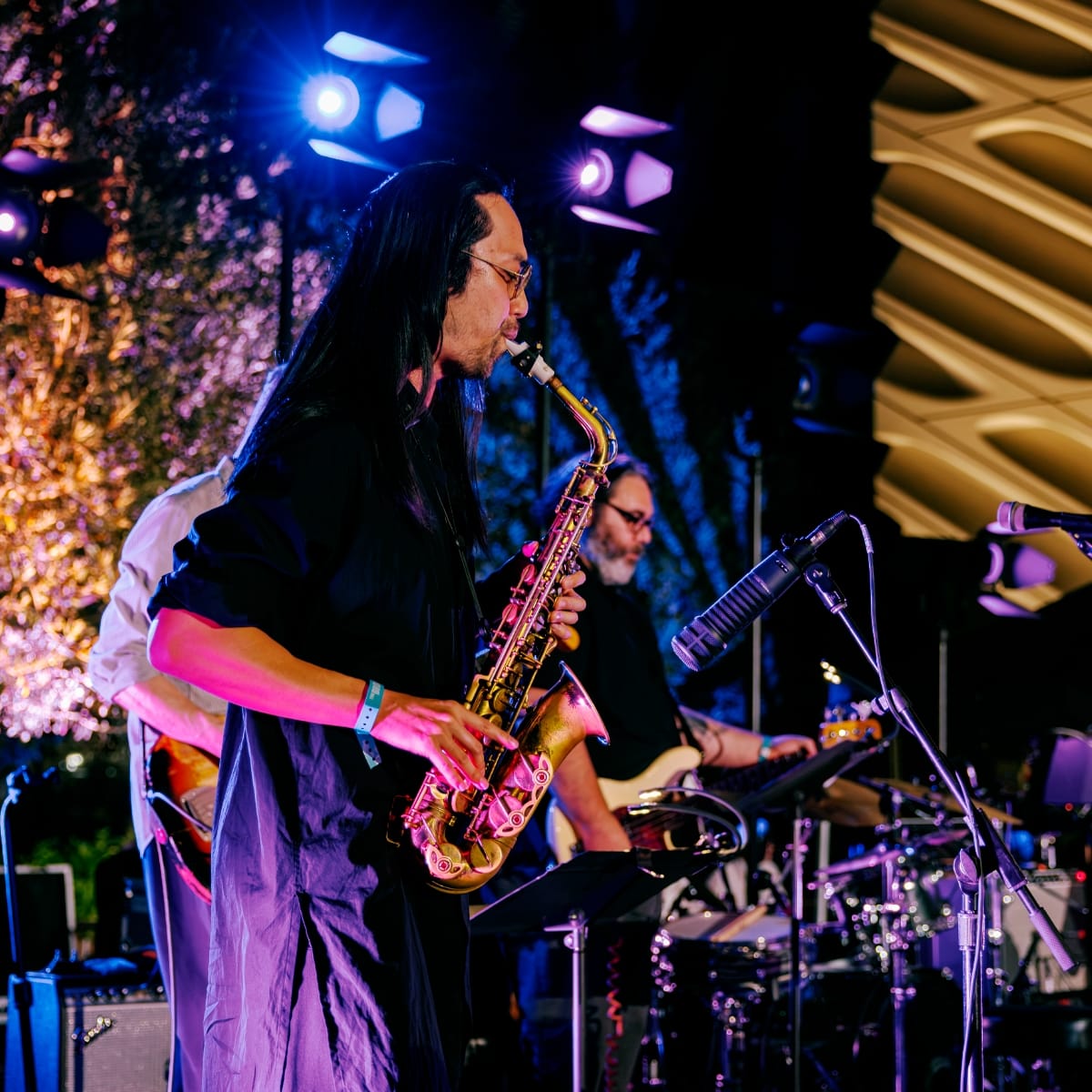
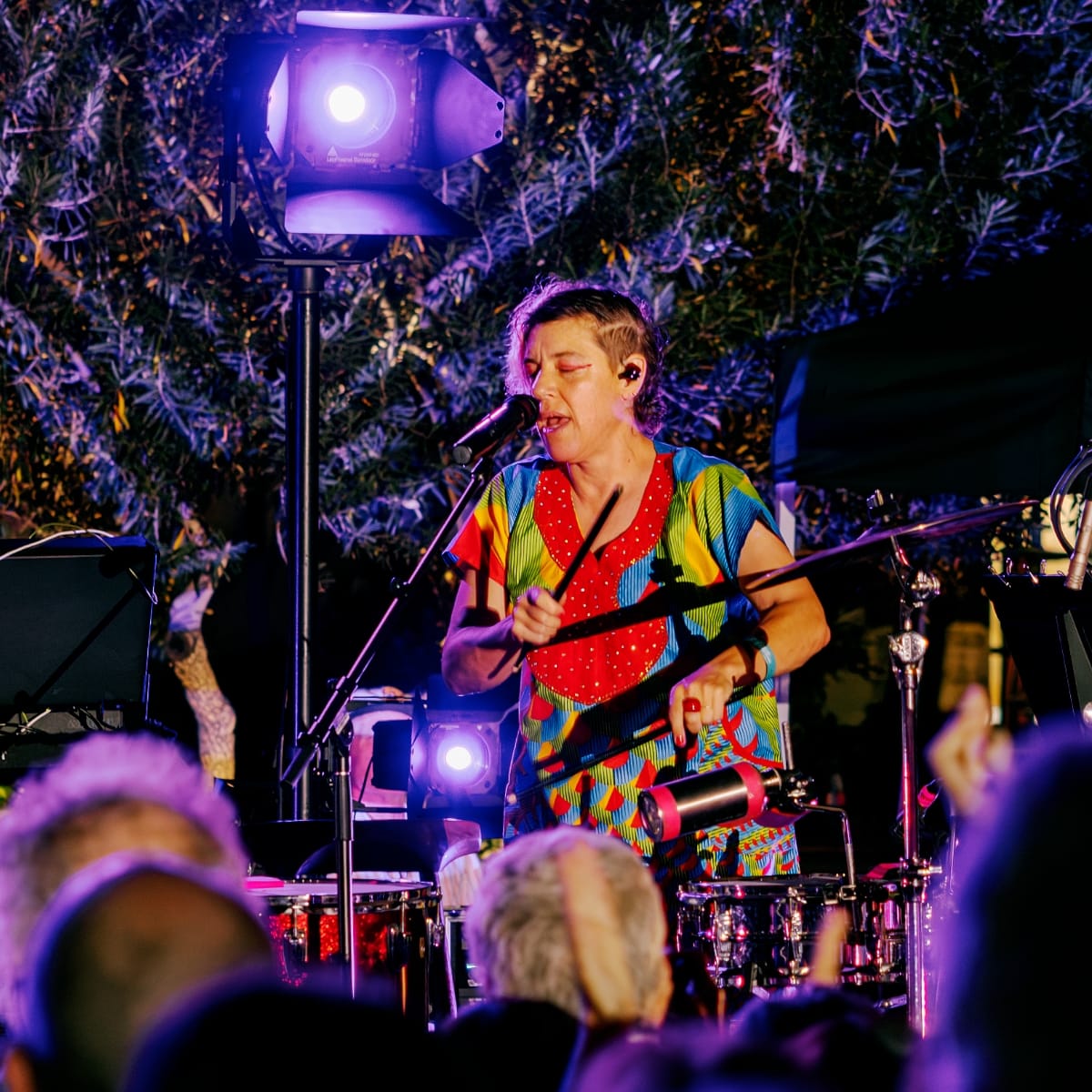
Performing at Yoko Only, clockwise from left: Yuka Honda, Nels Cline and James McNew, Merrill Garbus of Tune-Yards, and Patrick Shiroishi. Photos by Salvador Ceja Garcia.
Meredith: You said in the book Mirror Sound that you aim to tell stories with sounds, which is a concept that I love. What stories were you trying to amplify with these Yoko-related projects?
Yuka: There are many stories; it's hard to say. I Am Yoko is more of a celebration of life, which involves all aspects of it. It's not very black-and-white. It's organic; it's gritty; it's dirty sometimes. It's beautiful in that way; blood and tears and sweat are all there, but I also think that the job of art is to inspire, so I'm not just telling about things that have happened. I'm also trying to express where I want to be heading by going through this experience.
Meredith: On a related note, what is your process when it comes to curation?
Yuka: Curation is not something I've done in my life. This was the first time. I worked with The Broad's team, who were very kind. We met on Zoom every week and discussed ideas. We started from having zero ideas to "how about this, how about this?" Then we decided on an idea and tried to execute it as well as we could. I really enjoyed it. It was scary sometimes because of administrative stuff, which I don't love doing—I'm a creator in everything I do—but I felt really responsible, and I had to grow up.
Meredith: That's so real. And there's also this element of care at work in curation. How does care enter into your process more broadly?
Yuka: Care comes in when you can be relaxed with your project. By relaxed, I don't mean slacking or being lazy. The reality is that a lot can go wrong, and many miscommunications and mishaps happen. We didn't have a lot of problems with this show, but it happens with every show.
It's kind of like a martial art. Bruce Lee talks about staying calm so that you don't get affected by what's happening. You care about what's happening, but you don't let it affect your feelings. You have to be a problem solver, be calm, and make sure that nobody's hurt. If people are being hurt, you want to take care of them; if somebody's not stepping up to the plate, you want to nudge them, but you want to do everything nicely and also firmly, and you have to judge that balance with a calm mind, not an upset mind.
Meredith: It's self-regulation, so that you can help others as a part of your care practice when you're putting together events like this. How are these events in conversation with your own values and goals as a musician?
Yuka: These events have been really fulfilling for me. In terms of values, what has really been great about working on these projects is that these are for Yoko. That makes it very easy, because I can ask people to give me 100% for Yoko—it's very easy to say. If this was just for me, it would be a little bit harder to say, "Give me 100%–for me." That's hard to say—even though I should say it, and I wonder what is so hard about it. But when we think of it as being for Yoko, we musicians feel more generous about dedicating ourselves to this project, and many people really gave 150%.
Meredith: I want to compliment you here because it really felt like every single artist who performed at Yoko Only was perfectly matched to the songs they performed.
Yuka: Yeah, that was fun work for me to assign music to artists, because I'm more of a music producer than a curator. I can tell what songs would work with whom. Yoko has such a wide repertoire, so it was fun to have riot grrrls doing riot grrrl things, Rufus Wainwright doing a super ballad, Emi doing these pretty, innocent songs. Yeah, I felt really excited and happy about this presentation as a producer.
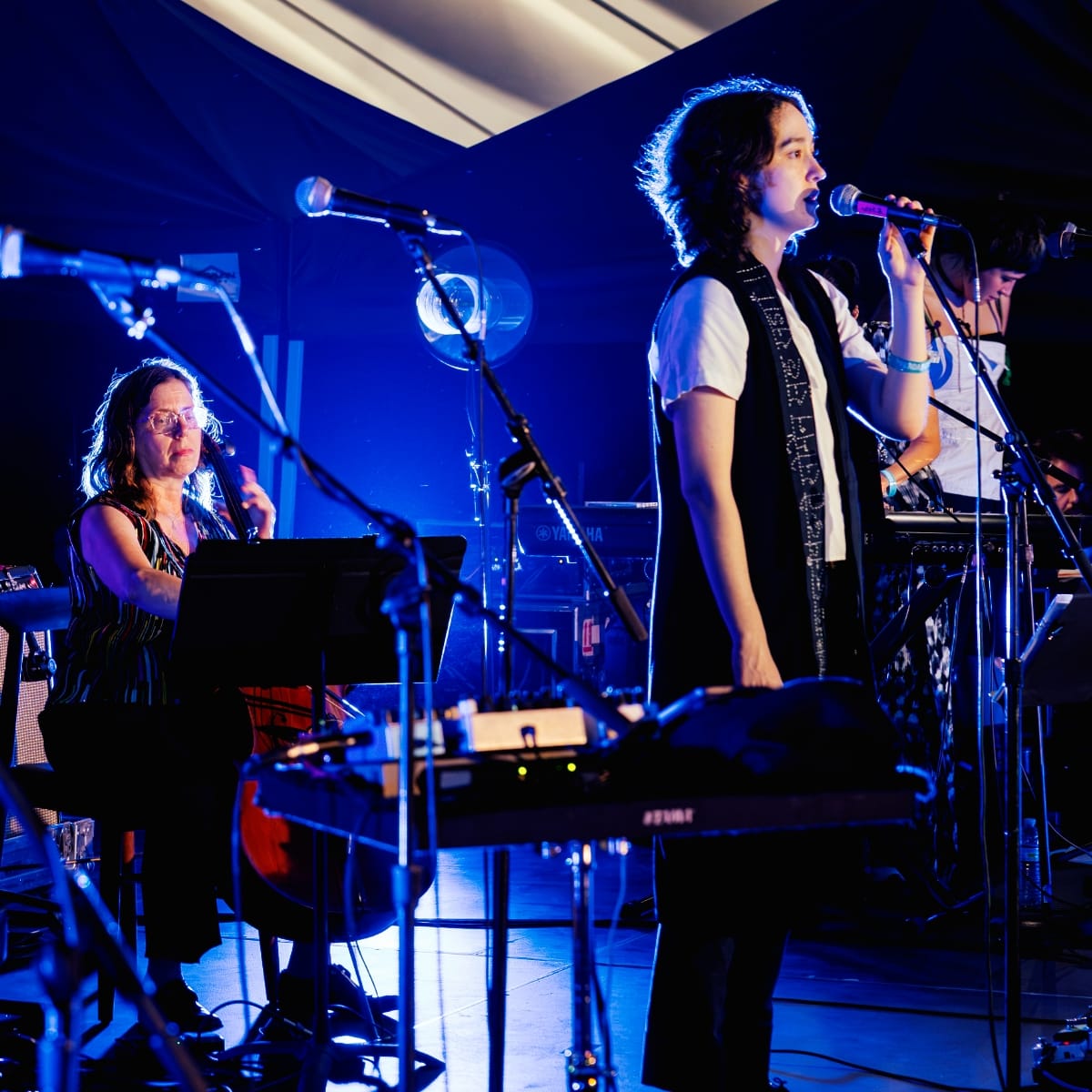
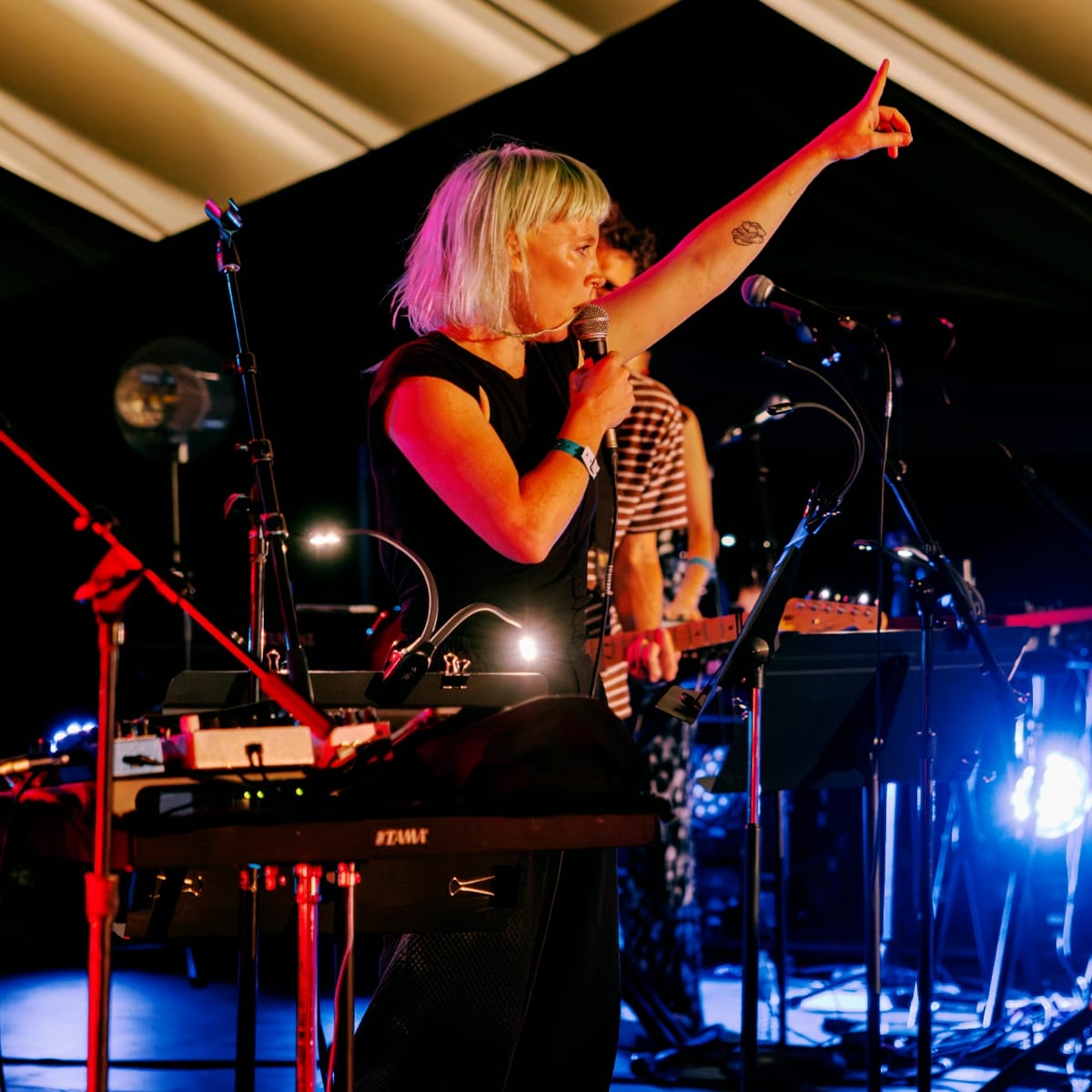
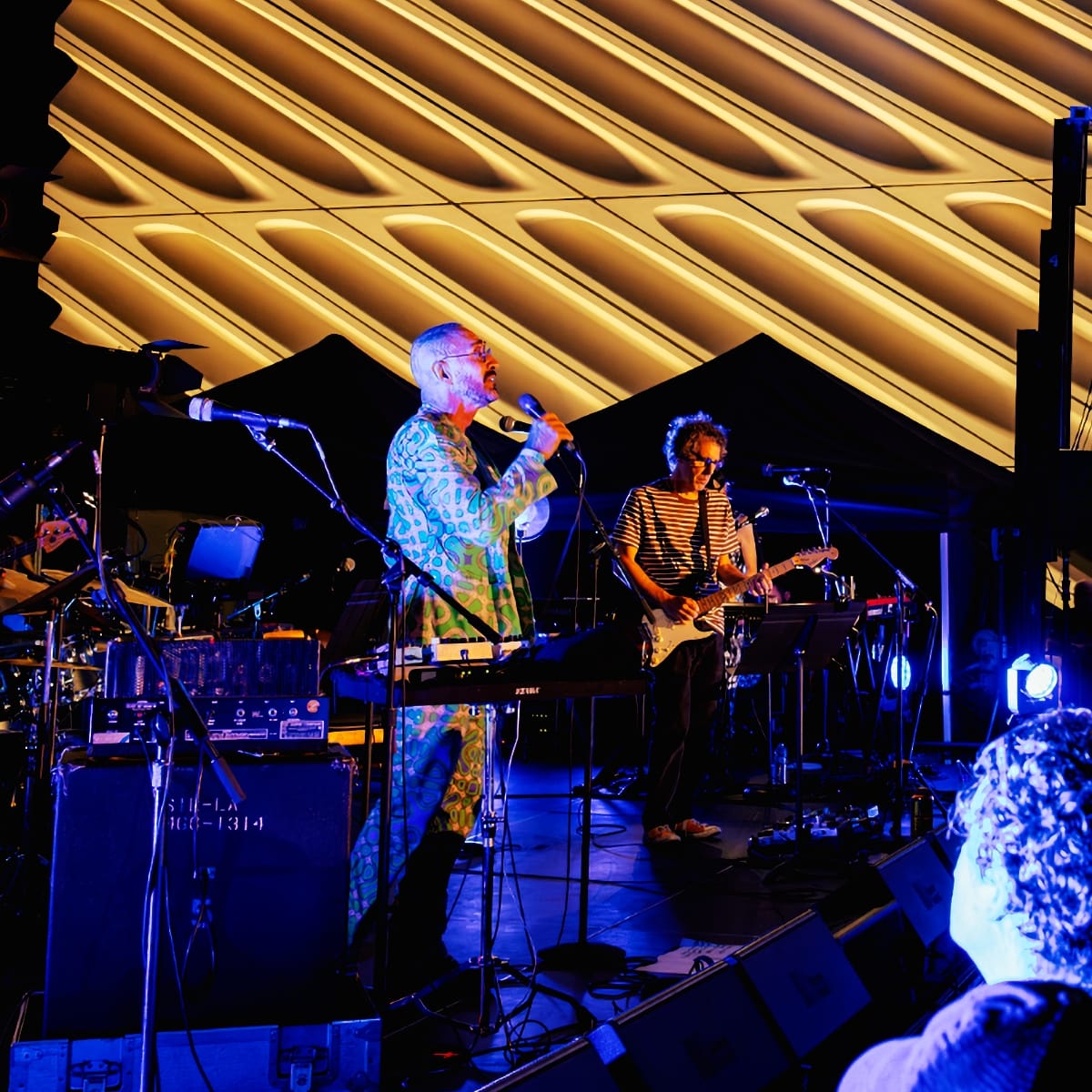
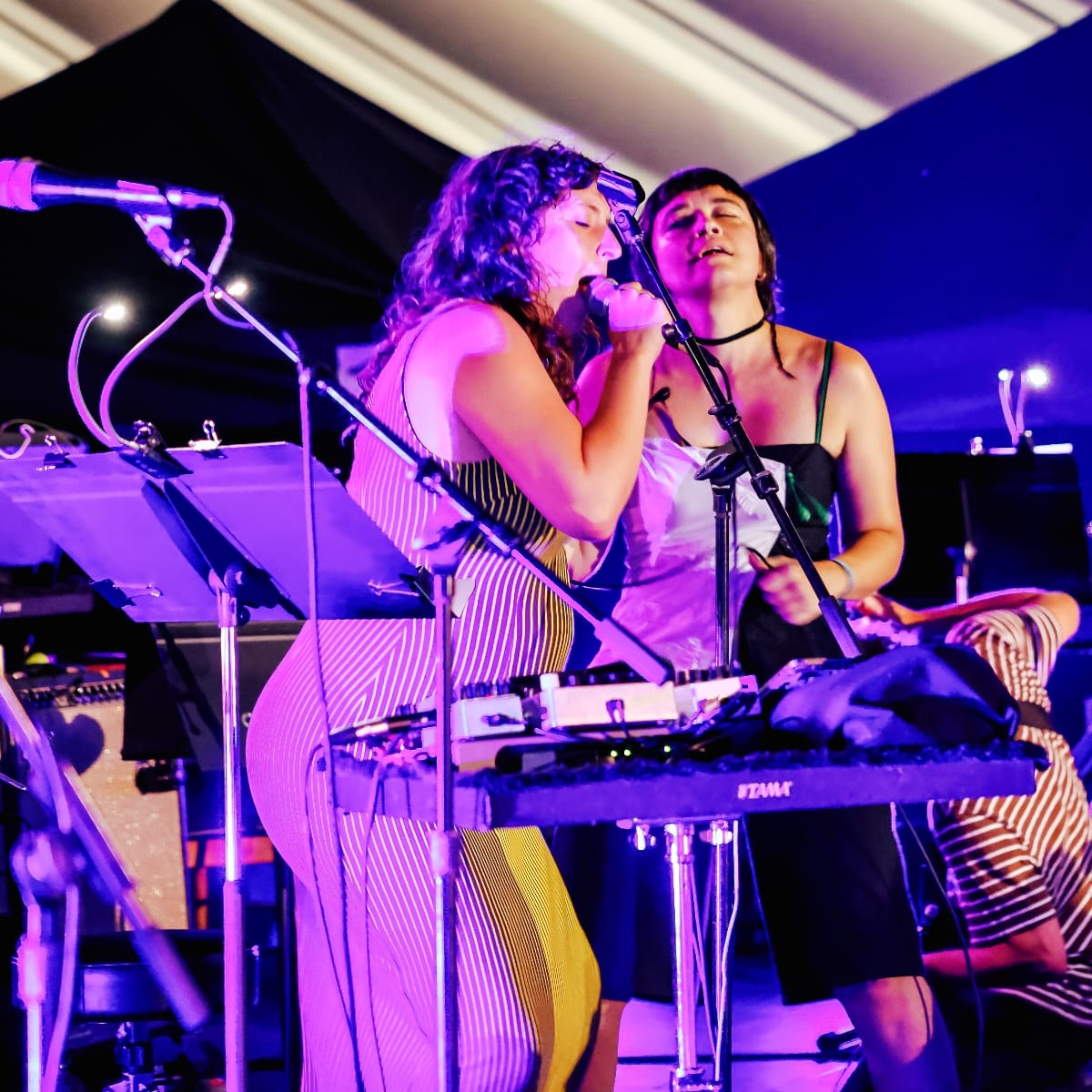
Performing at Yoko Only, clockwise from left: Maggie Parkins and Emi Helfrich, Amelia Meath of Sylvan Esso, Sima Cunningham and Macie Stewart of Finom, and Theo Bleckmann and Ira Kaplan. Photos by Salvador Ceja Garcia
Meredith: In your interview in Tape Op magazine, you talk about Yoko, about seeing her in a park when you first moved to New York and waving as she was helping an elderly person.
Yuka: Yeah, she was helping a woman to walk, without a bodyguard or anyone. It was incredible.
Meredith: And then you became connected as collaborators after that, which is so cool.
Yuka: Yeah, it's incredible. I'm so lucky.
Meredith: And then you became close over time, like "found family" at this point.
Yuka: Yeah, it's nice, because it's not just with Yoko, but also Yoko's grandchildren, like Emi Helfrich. I've known them since they were born. We have pictures of me holding Emi when she was a baby, and now she's grown into this incredible singer, and I feel such joy working with her. She has a brother also, who's a very talented artist I love working with.
I always love mentioning Yoko and Laurie Anderson, because I think their stance about what's happening in the world is something I can relate to. They both have a strong idea of what's good and what they want, but they don't believe in battling people out. They believe in the battle. They're activists, and to a certain degree you always have to fight, but in movies, fighting often means eliminating your enemy and destroying them. That's really not how the world works, you know. Let's say half of the world doesn't share the values. What is our goal? Do we eliminate half of the world? Is that going to make you happy? I don't really think so.
Those two women are asking a question beyond the fight. It's more nuanced and therefore harder to express and to be understood. It's easier to say, "Fight! Let's get them! Kill them all! Defeat them!" But we live in a more complex world, and it's not as easy as just getting rid of an enemy to solve something. For that reason, I think of Yoko and Laurie Anderson all the time and their works. They're some of my biggest influences.
Stay on top of The Tonearm.
Subscribe for exclusive interviews, cultural tip-offs, and community fun.
And your support keeps our site free of advertising and paywalls.
Meredith: Yoko's work is fresh in my mind, having seen the exhibit and the performance, and there's an element of unification to it, a way of uniting people through imagination and shared joy. Is that what you're speaking about, or does it go even beyond that?
Yuka: I'm a science-oriented person; I work with machines, and I have an engineering kind of mind, so I believe in science, but also I believe in love. And love is not something that you can quantify. Love is not something you can prove scientifically, but it's an important force in our lives. Technically speaking, getting rid of the people you don't like can maybe get you someplace. But then there's love, and that makes things really complex, and Yoko talks about that a lot. She also talks about how silly we are to take ourselves so seriously. I really like her sense of humor—like the butt film, Bottoms. I really love that. It's funny.
Meredith: It is. She has a great way of getting to the heart of those contradictions, those things that are all true at the same time. People can say awful things, but they all have stupid butts.
Yuka: Yeah, exactly. She has suggested all politicians should argue with their pants down. It's funny, and she has a really good point. I love how intelligent she is.
Meredith: What a mentor to have gotten to have in your life, right? Not just someone whose work you can admire, but someone that you have personally gotten to know and experience your life with.
Yuka: Yes, I feel so fortunate.
Meredith: Another thing I noticed about Yoko Only is that you had Emi up there with you, and the women from Finom, who I’m sure adore you, and see you as a mentor. What has that been like to shift from mentee into that mentor role yourself?
Yuka: I don't see myself as a mentor. I have a lot of experience, so I can share things. I can say, "If you take this road, there are going to be potholes, but you can decide to take that road." I'm still a student of life. I'm still learning. Actually, Yoko has that attitude as well. She has always said, "I'm still learning. I'm your student. Let's learn together." I think that feeling is never going to change until I'm petrified, and I don't want to be petrified. I want to be learning until the last minute.
Meredith: So it's more of an intergenerational friendship and kinship as collaborators, and less of a hierarchical thing.
Yuka: Yeah, I don't really feel hierarchies. Finom are really brilliant artists. They have a lot to teach me. They can do incredible things. I love working with them. And Emi, too. Emi can do a lot of things I can't. I'm just older, and I appreciate that they give me a certain level of respect, because my back hurts, but other than that, I feel like we're just friends learning things together.
Meredith: That's the spirit that came through watching that show. Friends learning things together.
Yuka: I'm happy to hear that.
Meredith: Yeah, because, in those performances, I know there was limited rehearsal time for most of the artists involved, and the house band (you, Nels, and Yo La Tengo) really held it together, but the people involved were all so skilled and talented as improvisers, and I think everyone was bringing that element to their performance, too.
Yuka: It was such an incredible evening. I was happy for Yoko, but also happy to be playing and performing with these incredible people. Yo La Tengo are legendary people. I had James McNew's bass really loud in my monitor, and he sounded incredible. We had Georgia Hubley rocking; she's so cool. And Ira Kaplan has one of the most beautiful guitar tones—I'm obsessed with really good guitar tones—so whenever he hits a string, it sounds so good! Can I be this happy? Then, watching all these singers do their own renditions of songs was so exciting.
Meredith: Can I ask what makes now the right time for this retrospective?
Yuka: I'm not sure. I think the world definitely came around to Yoko. I'm making this theater piece, I Am Yoko, and studying her history so much. She struggled to be appreciated as an artist around 1960, but then she became pretty successful around 1966–67. She was very well known. She did Cut Piece; she was invited by Indica Gallery, and she was performing with Ornette Coleman. When she met John Lennon, I think she had no idea that falling in love with this person was going to destroy her career. People came and basically stepped all over what she had done, judged her so severely, and spoke about it really loudly. I feel very intensely about that.
I don't really know why we're doing this now, but I remember feeling like the world was turning around after 2000, maybe in the last 20 years. She got the writing credit for "Imagine," then all these exhibitions. When you go to The Broad now that her exhibit is there, it's packed. People want to see her work, because we are finally understanding her message.
Before, it was much harder to understand, because her message is very nuanced. If you listen to Approximately Infinite Universe, she's not saying, "I'm treated so badly by a man, and fuck you." She's saying, "I'm treated so badly, but I understand why you're going there. I understand the social pressure that men have." This kind of thing didn't fly before. It was not black-and-white enough. It was considered not being committed enough to the fight. There was this feeling that if you want to be a fighter, you have to have no mercy, no empathy, no sympathy, no understanding. You just have to attack, attack, attack.
Her kind of thinking is very Asiatic. "You're hurting me, but I also love you, and I understand what's hurting you" is a very Buddhist-influenced idea, and I think now we understand it as a real experience that we too feel. It's not just a foreign idea that this artist has. We also understand this, so the time has come for the world to catch up with her.
Check out more like this:
 Miguel Angel Bustamante
 Lawrence Peryer


Comments