


A piano can become many things—a proxy for a human body, a symbol of affluence, a collection of dwindling materials in the present ecological crisis between wood and ivory. Held within modern visual culture, there have been glimpses of the instrument in disintegration. Thirty years ago, Tori Amos coolly stood in front of a burning piano promoting Boys for Pele, and half a decade ago Taylor Swift clung to a moss-covered grand about to be swept into a flood for folklore.
There is the work of Annea Lockwood, which pushed us—what are we listening to? What are we seeing? What happens when the expectation of performance becomes something entirely different? The piano is on fire, the piano is drowning—the piano is left in a forest clearing to interpret and approach as needed, to document in time.
Piano Decompositions, a compelling document chronicling decaying and destroyed instruments, gives the reader a striking framework to view the collective crisis of being a citizen of the world, with Lockwood's artistic imprint providing much of the lens.
Ecological maladies, war, displacement, and even the human condition of heartbreak and frustration with systemic violence become sonically tangible in the microcosm of these works. In Lockwood's 2006 paper "How to Prepare a Piano", Lockwood gives us a canon for the piano in peril (if it is—):
”Immolation came next. It was 1968 and we were burning American flags, political effigies, the status quo, so when the choreographer, Richard Alston and I started planning Heat, a dance work in which the performance space would be heated to the maximum tolerable temperature, and I was casting around for something sonorous to burn and record, it was no leap at all to decide on a piano."
And later:
”I had not expected that it would be so beautiful."
My curiosity came about in the way that happenstance and being a bit of an outlier in the sound world occur. My friend invited me to visit a piano tucked away in the woods at a local college campus. To my surprise, the piano was a Lockwood "Piano Garden" commissioned two miles from my home. Standing with my umbrella, I noticed a placard asking that the installation not be approached. Someone had placed opaque tape over the words "Please do not enter."
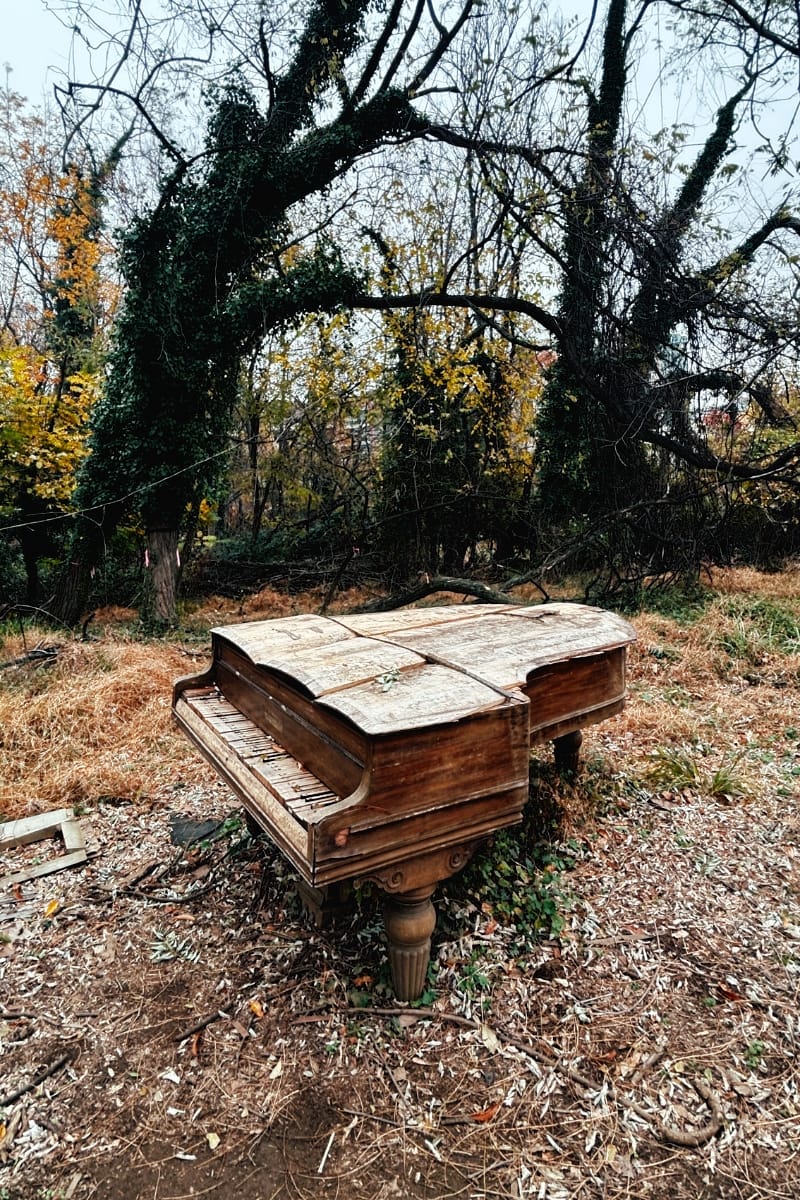
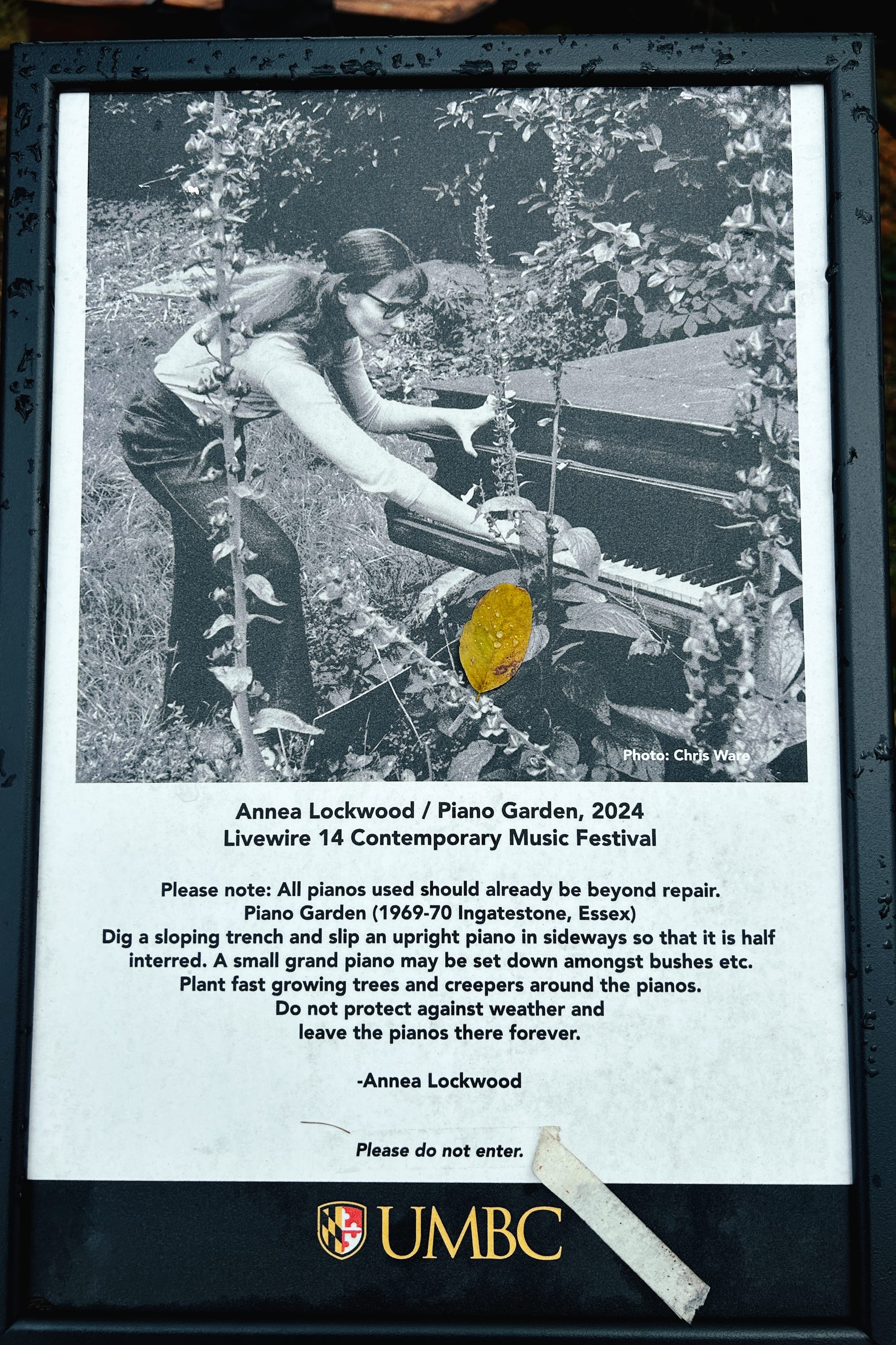
The piano became an observational point for my immediate environment. The experience morphed into an almost diary-like routine, as I began making visits in various weather to document the changes of the instrument left in the garden. Deep snow, humidity, fallen foliage.
Through my personal curiosity, I encountered Piano Decompositions co-authors Heidi Hart and Beate Schirrmacher , who were kind enough to sit down with me. In their research, Hart takes to task music in political and environmental contexts, and Schirrmacher provides a media studies framework. Notably, the team was working through their own personal perceptions of experiencing these works.
I first conversed with Hart in early winter, and of course, I want to know—where has your childhood piano gone?
Carolyn Zaldivar Snow: So, did you grow up in a household with a piano?
Heidi Hart: Yes, absolutely. My mother is a singing teacher, and my father plays the French horn and improvises on the piano, so I was surrounded by music.
Carolyn: And where do you think the piano that was in your childhood home is now?
Heidi: My mother actually moved her piano across the country. She just moved from out west Utah to North Carolina to live close to us. So her piano is there, the one that I practiced on as a young woman, but we had an old Wurlitzer upright when I was very young, and I have no idea where it is now. That's a very good question. It could be in a heap somewhere.
Carolyn: Do you have a primary instrument of practice?
Heidi: I do! I have a baby grand piano in our home, and an indoor harp that is protected and tuned regularly. I do have actual instruments inside that don't decay and don't have insects living in them, as far as I know.
Carolyn: You've written a book with every reference to deconstructed and decomposing instruments. How do we become Heidi and take an interest in this?
Heidi: That is a big question. I grew up with lots of music around me. I was very shy and did not naturally take to performance. I did a lot of performing because of my mother and the world I grew up in. I always had this push-pull between that exposure and wanting quieter, more curious explorations with sound. I had a very rich private world and wrote a lot, and all of those things. I think one of my first experiences with sound in the natural world that wasn't dependent on actual musical instruments was how I loved touching stones together and listening to the sounds they made. The intimacy of the naturalness of that was really comforting to me and exciting at the same time.
I majored in German as an undergraduate because I loved German music—I had lived in Germany with my family for a while. I was absorbing a lot of the country’s unfortunate history and its beautiful music. I ended up doing a dissertation on resistance music during the Nazi era, which was very heavy. But it also taught me a lot about Brechtian aesthetics. I worked in the former East Berlin quite a bit and learned a lot about distancing techniques and critical approaches to sound.
Carolyn: For a moment, let's expand on Brechtian aesthetics and your studies in East Berlin. Give us a primer.
Heidi: So this emerged in the early 20th century as a way to avoid becoming hypnotized by propaganda or by music, which can have that effect. Bertolt Brecht was a playwright and a poet who worked to create a sense of estrangement on the stage. Instead of getting sucked into the drama, you would see a placard suspended over the stage telling you what was going to happen next so that you wouldn't get all caught up in suspense, but you'd know in advance what's happening in the next scene. He was a Marxist, so his plays had a lot to do with inequality, with political injustice. He would try to get people in the audience to be active participants in this experience of watching this terrible stuff happen, and not want to do that themselves. That was the goal.
In music, here’s how this distancing technique would work, especially in the work of Hanns Eisler, who is the subject of my dissertation. You would maybe play with the narcotic aspects of beautiful classical music, 19th-century harmonies, things like this, but then interrupt them in some way by changing the rhythm or having a pause or by creating some distance. So I found that really interesting, that you're taking these elements of older musical forms, but interrupting them, destroying them, you could say in an extreme sense. Sort of messing up the beauty of 19th-century German music partly as a protest against the way music was appropriated in the Nazi era for propaganda purposes.
Carolyn: Let's pretend I want to disrupt the intended physicality of a classical machine like a piano, or I want to disrupt sheet music. I am thinking about Fluxus and a very central figure in your book, Annea Lockwood. What's going on in history in this stretch of time?
Heidi: In the United States or in the world in the 1960s and 1970s, we start seeing Fluxus. We also start to see the emergence of Annea Lockwood's works, who is also the daughter of an RAF pilot. Fluxus was a movement that emerged out of these structures of modernism, the sort of rebellion—let's have these happenings outside. Let's be spontaneous with art in a new way.
Music became a really interesting source of practice because you could have a score that wasn't just notes on a page. Maybe it would be a piece of sheet music with some doodles on it. Or other art forms appearing on that musical page. In the case of Annea Lockwood, a score could be instructions, lists of things to do with an instrument, put it in a pond, let it sit there for however many years. Watch it decay, play it occasionally, those sorts of instructions could be called a score—it really took apart the notion of what a score is. The enactment of these scores became very interesting—people did actually put pianos in ponds or Annea Lockwood's famous piano burning—actually burning the piano and maybe improvising on it a little until it gets too hot to the touch.
The significance of Lockwood's father being in the RAF is that they would have these piano burnings as a sort of rite of passage. So she probably grew up hearing about this at some point, and definitely had curiosity about how the instrument would sound. Her curiosity was really open; it wasn't about "oh, I want to make an environmental statement or a political statement," it was curiosity with an implicit critique of the classical tradition of music. I became fascinated with this partly as a follow-up to my work with Eisler.

Carolyn: You often mention in your book that people are dismayed when an instrument is intentionally destroyed. Why is it shocking to watch this happen? Or why would it be comfortable to someone else?
Heidi: Part of the dismay depends on your cultural situation. One thing we talk about in the book is how there's a big difference between an authoritarian regime taking instruments and burning them, for example, in Iran and Afghanistan. That's a completely different thing, although some have argued there's a performative aspect to that as well.
Carolyn: Let's talk about the harp in your backyard. I would assume this is maybe two years in. Could we argue that it's probably detuned at this state?
Heidi: That happened very quickly.
Carolyn: And maybe I am leading here to get to another point—but what would detuned mean to you and me? Or is it detuned?
Heidi: It's a process, because initially, when the harp went outside, it still had a diatonic scale that was recognizable. I had tuned it before putting it out, so I had a baseline. It stayed in tune for a few days; the top strings stayed a little better in tune, then the lower strings, which got a little more damp. It's quite humid here, so they went out of tune more quickly, or as Lockwood has pointed out, detuning can actually be a kind of retuning. There was no predictability to that process; it was a little random.
For the first six months or so, I could still make semi-tonal sounds with certain strings. I'd sit out there and listen to birds singing and kind of imitate patterns and things like this, especially at the top of the harp where the strings were more in tune. Sometimes there are spider webs in there, or autumn leaves will land between the strings, and you can make buzzing sounds with those. It's an experimental instrument, and I notice sometimes when I go inside and play my in-tune harp—mostly in tune, they're always difficult to keep in tune, even inside, but I find I am more free with my improvisation, and I really thank the garden harp—or as I call it, the "harp transplant" after Annea Lockwood—for that increased freedom.
Carolyn: What is the responsibility we have if we're returning this thing we built from the environment back to the environment? And because it's made of wood and other materials we’ve historically taken from the planet to build a highly controllable, classical machine to assert our economic dominance in our living rooms. Now we're sending it back outside.
Heidi: There's the metaphor of the transplant, and Annea Lockwood was thinking of heart transplants, so it's quite a leap in that way. The instrument becomes like a body or an organ transplanted in a new environment that's actually its old environment, because, as you mentioned, the wood comes from trees. In the case of a piano, you have the steel inner harp, the part that holds everything together without extreme tension. And so you have the metal extracted from the earth, and you have the copper wires in the piano. A harp might have gut strings that were literally extracted from animals. In a sense, you can say it's returning to its source; it's becoming composted. It's also transformed in how we hear sound and how those perceptions change. A large part of the book focuses on analyzing how those perceptions change through a return to the source material.
Carolyn: In your book, you have the line that many people were exchanging pianos for TV sets in their living rooms. Where has the piano gone?
Heidi: It's an important framing, and I think it's a hard problem because, as the epigraph to our book says—it's a little excerpt from a poem by Joan Larkin, who was a teacher of mine at Sarah Lawrence, and she describes having to let go of this heirloom piano. Eventually, a guy comes and takes it away. Many pianos are ending up in landfills right now. Sometimes people will reclaim them—this happened in Australia. Because of the colonialist effort to civilize people in Australia, they sent out thousands of pianos in the late 19th century. This resulted in a lot of abandoned pianos in the outback. There's a guy named Ross Bolleter, who's gone around and salvaged some of these; there's a piano sanctuary in Australia. Some of them are still feral outdoor pianos, but they have a provisional home.
Carolyn: What was the acronym for his institute in Australia?
Heidi: W-A-R-P-S. World Association of Ruined Piano Studies.
Carolyn: Speaking of ruined pianos, you had a couple of examples of things that just happened by accident. Many of these pianos in landfills are kind of intentional, but you've addressed natural disasters and war, and how some of these instruments end up outside.
Heidi: I don't know that we have so many examples from wartime. We have examples of destroyed pianos under different political regimes that don't want people to express themselves with certain forms of music. In wartime, instruments often get sentimentalized. In movies about World War II and the Holocaust, for example, the violin that somehow survived and made it through the war is fetishized almost. These instruments are carried on through terrible circumstances. A lot of them are beaten up and battered. You can see some images from Ukraine of people playing instruments outside in obviously terrible conditions. It's not so much about making a statement as just about hanging onto something—a life that is gone now for so many people.
Carolyn: You also talk about how an instrument can also represent a body, when we think of wartime protest or immolation. Or things we see in popular visual culture.
Heidi: I think a lot of pop artists are inspired not just by the guitar-smashing of the ‘60s and ‘70s or by guitar burning, but also by this idea of the instrument as a body. There are a couple of scholars who've written about instrument destruction and have a term called "honorary person theory," that one reason it might be disturbing to see an instrument destroyed is that we think it's almost human in a way. I think of the Lady Gaga burning piano experience, which was really spectacle, but it also had a strange intimacy about it—the human body, the burning piano, the connection between the two. Taylor Swift's imagery of the fairytale piano, almost like this overgrown creature. We have a mythology that comes up, especially with these women artists; for example, in Boys for Pele, the Tori Amos album, there are images from the promotional material she had. She's talking about Pele, the volcanic goddess. I think for women artists, it might be a more mythological and embodied connection than just, “Look at me smashing this instrument.”
Carolyn: What would you say was the first cultural seed that took you down this path? I know we discussed your German studies, or even in childhood clinking rocks together, but is there a specific work where you went, “Oh, I can use the instruments that I grew up with differently"?
Heidi: It was Lockwood's work, actually. This happened for me during COVID when we were all trapped inside for a while, and the Issue Project Room had a video watch party of Piano Burning, Piano Garden, and Piano Drowning. It was a very long, sit-down, meditative experience to watch all three films in a row. I was so grateful for that because I had never actually focused on Lockwood's work before. That was the spark for me, being forced by COVID to find this surprisingly illuminating experience of seeing and hearing what's happening to these instruments. I ended up applying for a fellowship in Sweden with this topic. I started talking with my colleague, Beate Schirrmacher, who wrote the book with me. Her specialty has been music and violence. So for her, this was fascinating to move from violence portrayed through music to violence performed on instruments in a very literal way.
Beate Schirrmacher and I chat over video between Linnaeus University in Sweden and my home in Baltimore.
Carolyn Zaldivar Snow: Tell me a little bit about how you met Heidi, how you both became collaborators, and how you decided to piece this book together.
Beate Schirrmacher: Heidi and I met at conferences that centered on word and music studies. We are both literary scholars trained in German literature and wrote our PhDs on the relations between music and literature. Lately, I've been researching how classical music in film and literature is often used in scenes of conflict and violence—like in Apocalypse Now or A Clockwork Orange—and what it means. So when Heidi had this idea and wanted me on board, at first I said no; I did not see the connection immediately, as my research up to then had not dealt with visual art or ecological questions. Yet the more I looked into it, the more I realized that the collision between values and perception, between musical sounds and the noises of destruction, and the ambivalence that arises from it play an important role in piano decompositions as well. What does it mean when we destroy or use musical instruments in a disruptive way? What do these instruments mediate? Finding answers to these questions, for me, also changed the way I listen and engage with musical sounds, and also non-musical sounds, which has been very interesting.
Carolyn: I just want to walk back to the last thing you said. So, listening to music, and then you had a second qualifier in your last sentence about music: engaging with non-musical sound.
Beate: We mentioned this a bit in the coda. When I had the opportunity to attend on-site performances of decomposing pianos, I got excited but also slightly nervous, because this was a kind of reality check for our close readings. What if they revealed that we had been overanalyzing these films? We are humanist scholars; we find things everywhere. Still, when I was on site, both my own experience and what I heard from others engaging with these decomposing instruments revealed that doing so expands your experience of musical sounds. You stop listening to the music alone but engage with the instrument and its surroundings in a curious, exploratory way. Personally, I noticed this in particular when I attended a performance based around a drowned piano. I had expected something different and was a bit skeptical at first. Still, the performance gradually changed my perception of my surroundings, though I did not expect it to. I ended up experiencing another aesthetic experience of sound, and that was much more holistic.
Carolyn: And the submerged piano you visited? Is it one of Annea's installations?
Beate: No, it wasn't. It was by two Danish artists who had just left a piano in a damp space and then invited artists to create their own artworks in response to this decayed piano, so the piano wasn't played, and I was kind of disappointed. But then the artworks that engaged with it were also negotiating between sound and noise, and it was fascinating.
Carolyn: Sometimes people feel anger at the destruction of an expensive instrument. I live within bicycling distance of one of Lockwood's installations. We have a piano garden, a few miles from my house. I think I'm trying to address the general disgust people feel when something is not used the way it is thought to be used.
Beate: I think this is kind of an immediate reaction, but it is part of this process, how these artworks communicate by destabilizing clear-cut distinctions. If you take the destruction of the instrument as the “message”, it stops too early. When you ask, “How do I respond to this and why?” it gets interesting, as it draws attention to how we react strongly when we encounter ambivalence. Let me also say this: every time we presented a project, we had to really be quite careful not to be misunderstood. The decomposing pianos we studied are not about destroying functioning musical instruments; it is different from what is done in countries like Afghanistan. This is also different from what is done on stage with Jimi Hendrix. Here, the parameters are important—are you destroying an instrument that still works, are politicians or soldiers taking away instruments from musicians, and is it about the power relations? Or is it an artist who is engaged using a defunct instrument to create something new? What we try to address in the book is that the strong initial reaction is only the starting point in a process of discoveries, and how our love and values for music are harnessed to draw our attention to how we engage with our surroundings, the environment, towards an aesthetic listening relationship to whatever surrounds us.
Some of my friends came with me to the burning piano, and I was a bit self-conscious when I described our project because they are both musicians. They sounded quite skeptical at first, and I felt that it was a bit decadent. Throughout the process, they became intrigued and engaged by what the burning piano revealed about the instrument itself and what it is about. It starts with these strong reactions and then shifts the longer you engage with it. It highlighted very much how music also depends on control. What do these instruments ask if we let go of control? If you engage with these artworks over time, you begin to notice shifts in yourself and to think and experience things differently.
Carolyn: I once took a poetry workshop, and the first rule of the class was not to approach work with judgment but with curiosity.
Beate: Of course, I noticed from listening to what other people observed around me that they were constantly shifting between aesthetic and musical experience, seeing distractions, and shifting from seeing a piano to seeing materials. The strong reactions to musical instruments being mistreated—they are a point of departure for a process that draws your attention towards the backside of how we usually perceive things, both music and destruction. Of course, we want to protect the piano. Of course, it is valued. Of course, we love music; you cannot treat an instrument like that—that is disrespectful. It is a shock. But then why is this more of a shock than seeing photographs of the burning Amazon? Why does this hurt me more than burning trees?
Check out more like this:
 khagan aslanov
 Lawrence Peryer


Comments