


The first time I heard guitarist Ayman Fanous was a good ten years ago now. I went to see another guitarist, Elliott Sharp, play some of his usual dense, formidable, electrifying improvisations at some small venue; it might have been ISSUE Project Room in the old silo building that was later torn down for apartment building development along the Gowanus Canal in Brooklyn. For part of the set, Sharp played duos with another guitarist, Ayman Fanous, who unexpectedly—in this context—was playing a nylon-string classical guitar. The other unexpected thing about him was the incredible speed of his thinking. Not his hands, which had to be good to share a stage with Sharp, but his mind, which had him not just pace-for-pace with Sharp but anticipating the next nanosecond/micro-event. In this tiny room, with each modest individual note, there was the sensation of hearing virtual particles bubbling up in space, of hearing the universe expand micrometer by micrometer.
That has made Fanous a compelling partner for other musicians, like Joe Morris and Jason Kao Hwang, and a player that a fan of improvisation should seek out. His discography so far has been modest, but does include Negoum, a spectacular, dazzling set of duets with cellist Frances-Marie Uitti, released on Mode in 2020. This all changed substantially in the spring, when Infrequent Seams released Brooklyn Stories 1–5, a 5-CD set of collaborations between Fanous and partners like William Parker and Tatsuya Nakatani, Joe McPhee, Ned Rothenberg and the late Susan Alcorn, Mark Feldman and Tomas Ulrich, and more. It’s a tremendous document of contemporary improvisation and a testament to a musical thinker who might be better known for his day job, Chair of the Department of Psychiatry at the University of Arizona College of Medicine–Phoenix. This MD and musician spoke from his office about thinking and playing, working through classical music and harmolodics, and the influence of the late, great guitarist Bern Nix.
The transcript has been edited for length, flow, and clarity.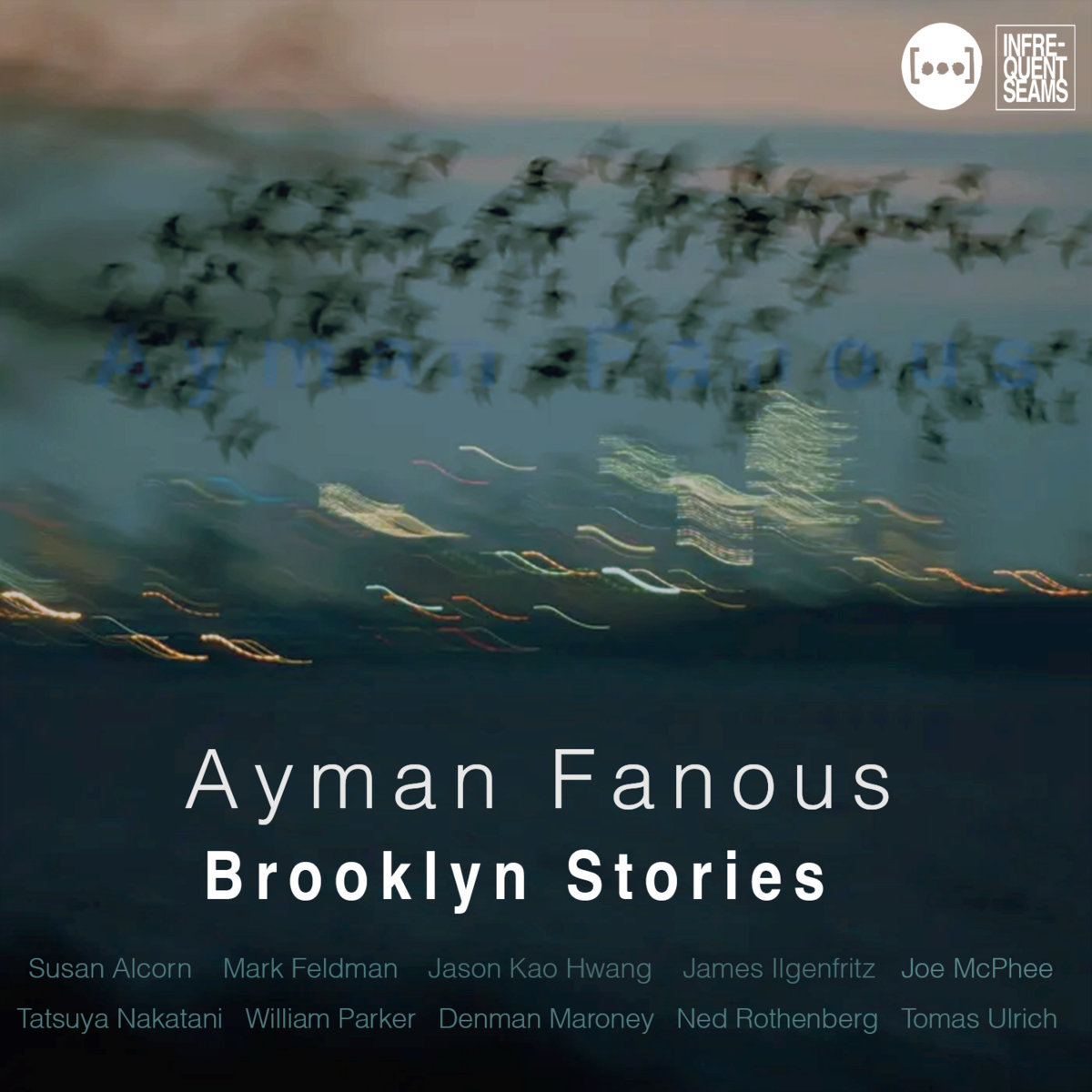
George Grella: When I’ve seen you play and listen to your recordings, you are an incredibly quick-thinking musician in improvisational terms. It’s more than just keeping up with an ensemble; it is this ongoing interaction with other players, and the kind of response time that you have and the sensitivity is really remarkable. That strikes me as starting with a way of thinking and approaching music, rather than just technique. So how do you think about improvisation, and how do you prepare yourself for playing like that?
Ayman Fanous: That’s a great question, and it’s something that you can’t think about too much, so to be honest with you, I haven’t thought about it too much, so I’m kind of having to improvise right now, at this very moment!
First of all, I have to say that I have been very fortunate to have a very strong relationship with Bern Nix, former guitarist from Ornette Coleman’s Prime Time, somebody who obviously had a career in his own right that was quite amazing. He probably didn’t get all the credit that he deserved. But from a purely musical standpoint, someone who was at an extremely high level of improvisation, as you’re describing it; quick thinking. And I think that I had training, without really knowing it at the time, in doing exactly what you’re describing with Bern.
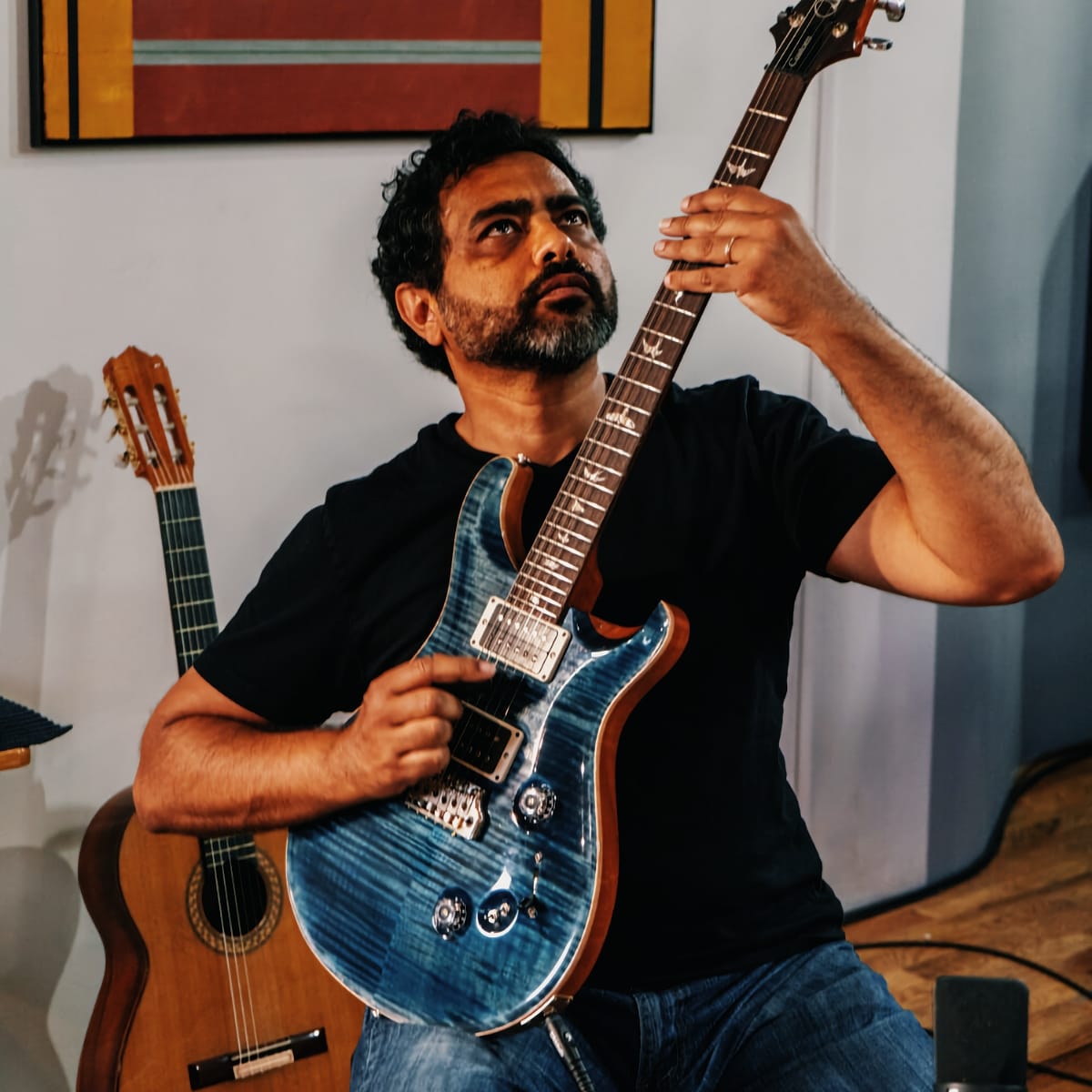
In a nutshell, how I met Bern: I met him at the Knitting Factory. I had heard his recording with his trio [Alarms and Excursions, New World Records, 1993], and I was blown away that there’s this clean-tone guitarist who’s playing harmolodics. I hadn’t known about him before, so I met him and asked if he’d like to play, and to my astonishment, he agreed! “Come on over to my house, bring your guitar.” I literally had never released anything in my life, and this is the great Bern Nix. Interestingly, we have the same birthday: September 21. I don’t know if that means anything, but we began this relationship, not even doing gigs, just playing together. I go over to his house, and we would sit and play for sometimes hours on end—without saying a word, just two acoustic guitars. And so I think I drank from the source of the harmolodic approach, and the way I filtered that approach was through my own technique and my own instrument at the time, which was the nylon-string acoustic guitar, the classical guitar.
We have a recording that’s never been released, but it started out as just him and me sitting together for hours on end, and I sort of learned by working with Bern in that vein. A lot of it comes down to: what can we create at this moment that is a beautiful picture? And I’m using the word picture in a totally metaphorical sense, not in any kind of visual sense. Can we create something right now, the two of us? What can we do together that essentially sounds good?
There’s a phrase that Frances, my dear friend and collaborator, has used; it’s like, “the ear is king.” It’s really all about what you’re hearing and whether it sounds good or not. You know, theory, at the end of the day, means nothing if it doesn’t sound good. Ellington himself said there are two kinds of music, good and bad, right? So it really comes down to, in this very second, what can I do based on what I’m hearing right now that will create a beautiful picture, and I mean that in a very open sense. It could be sort of ugly. But can it be expressive? Can it say something? Can it be compelling? Can it grab the listener? Can it move them? I mean, you’re not thinking of this, of course; I want to move the listener. I really want to move myself; can I create something that moves me and makes me feel something?
I’ve read Joe Morris’s book on improvisation [Perpetual Frontier: The Properties of Free Music]. He breaks it down in a clear technical way; there are ways of responding. You can let what the other person is doing be foreground, and you can create background. You could create counterpoint. You could create counterpoint that is more in unison or the total opposite. There’s what they call the cat-and-mouse approach. It really comes down to co-composing something.
I’ve spent a lot of time improvising on my own and developing a vocabulary of things, whether it’s chords or approaches to chords. They technically would not be considered progressions or anything like that; let’s call them devices. We all have this palette of devices available to us; it could be a strum, it could be a single-note line, it could be an arpeggio, it could be tapping the body of the guitar. Again, it really comes down to: what can I select from my palette that would go along with what’s being done right now? And that sort of suggests, in some cases, that you’re following, but with improvisers at high levels, people love to follow and to lead. It’s both. Both approaches are very enjoyable in their own ways. And sometimes nobody’s leading, and sometimes nobody’s following. You sort of mix it up, and you can’t map it out. It always comes down to what makes sense at this very second. Once you start mapping it out, then you sort of lose that flow; that’s my experience, anyway.
George: When you’re playing with other people, how much listening do you do to yourself, and how much is critical evaluation of what you yourself are contributing? Are you doing in your mind while you’re playing?
Ayman: I would say, I listen to myself equally as to other people, because you’re trying to listen to the whole, and you’re trying to again . . . what can I create at this very moment? You have to look at the entirety of the creation. And so I have to listen to what I’m doing, especially the phrasing. The phrasing is really important when you’re improvising with someone, in my opinion. One of the things that I say sometimes—I know this might sound a little glib—but sometimes it’s not so much the notes; it’s how you play them, or where you place them, exactly. So you have to be listening to yourself. Am I achieving the most effective or impactful juxtaposition with the other musicians? Whatever that juxtaposition is, whether it’s a chord that I’m playing as a harmonic, a background to a melody that someone’s playing, or in counterpoint.
George: That moment before you start to play, whether it’s solo or you’re playing with other musicians, what is your state of mind? I think about Keith Jarrett; his improvisations can sound as if he’s playing a pre-formed song, but he’s famous for saying, “I think about nothing when I sit down, and I just start playing,” while Cecil Taylor does have material he prepared and reused. The mental preparation is different for everyone, but the results can often sound the opposite of what one might expect from the way they play. So what is your state of mind when you are at that instant before you’re about to make a sound? I think about one of my improvisation teachers, the composer Meyer Kupferman, who had two rules for group improvisations: the first is to listen to everyone, and the second is to make sure you’re the last person to start playing. And so everyone is silent and waiting for something to happen. Sometimes you are the first person to start, which isn’t so much breaking the rules as it is getting you to listen and get your mind out of the way.
Ayman: When you’re putting together a group of people, there’s, to some degree, an expectation that you might start, although that may not be the case. And I oftentimes love it when other people start. I never map something out. And as I was saying earlier, once you map things out, you will lose the point of the exercise of improvisation, which is to go somewhere to discover something, to go somewhere that you don’t know, that you can’t know. And if you know where you’re going to go, it’s not improvisation. It’s a different type of composition, which can be fantastic, but it’s not improvisation. And so what I usually do is, I don’t so much have structure in mind; I’ll just plant a seed, and I’ll take it from there. Often it’s a very simple seed, like a few harmonic notes, and then I see what someone else comes up with and play off it. So I’ll toss them the ball, they’ll toss it back, and then we’ll just start going into the flow, in earnest.
George: The way I think about it, when you’re playing the nylon-string classical guitar, there’s a kind of quickness built into the instrument, because there’s no sustain. And if you want to produce a kind of structured sound in time, you’ve got to keep at things. Is that right? Is that something that you feel comes naturally out of the instrument, the way you work, and the way you’ve decided to tackle that instrument and improvise with it?
Ayman: That’s actually a great question, because as I’ve discovered more and more, what can be done with the guitar, it becomes less like that. For example, as I was saying, you start out with some harmonics. I’ll just let those harmonics ring out. And let our ears marinate in it for a bit. And then the other thing that I’ve been doing, I’m a very chordal player, even though I can’t tell you what chords I’m playing.
George: They’re not like a major amount of chords, but you are playing bunches of chords together, bunches of notes together.
Ayman: Yeah, I’m definitely a lover of harmony, but I can’t tell you what those chords are. I certainly can’t analyze them in real time. But with the electric guitar in more recent years, which is something that I’ve been playing more and more, I will play some swells with the volume pedal, so just let those chords ring out for a while, so it becomes less about giving in to the quickness of the guitar, the natural quickness of it, as I think you’re describing, and see what else can be done with it. It can be a very harp-like instrument.
As I’ve also gotten older, I’ve gotten to appreciate Andrés Segovia and his contributions more and more. You’ll hear him talk about how you can make the guitar sound like a brass instrument. You can make it sound like a cello. Of course, that’s metaphorical, but more like brass is more percussive, more piano, and so you can play very slow cello-like passages as well with the guitar. And I’ve listened to Segovia do that as well, talking about phrasing. I mean, that’s a guy whose phrasing is just unbelievable. It’s something that I wish I had discovered way earlier in life.
George: But you’re essentially self-taught on the instrument. Is that right? When you were teaching yourself to play, were there any guitarists you were listening to, saying, I want to sound like that, or I want to do that thing?
Ayman: Lots. I mean, it’s an endless list of people. Paco de Lucía was one of them, certainly Paco Peña, a lot of flamenco guitarists, a lot of classical guitarists, even though I don’t play the classical repertoire. I’ve listened to the vast majority of the classical repertoire, so to speak.
George: It’s very interesting to hear you mention those names and then also talk about all the time you spent playing with Bern Nix. It’s interesting, those two channels of hardcore repertoire, classical guitar, and Bern Nix and harmolodics. It sort of illuminates for me this uniqueness of your sound.
Ayman: This is an area that has not been covered very much: the harmolodic philosophy of playing a nylon-string classical guitar. To me, it just happened naturally, partly because of my ADHD—I was jumping back and forth, you know, I love everything. I started out playing Hendrix, my initial idol. And then I discovered the great fusion players: John McLaughlin, Al Di Meola, Pat Metheny. And through another channel of my interests, the Arabic sound. Once I heard those Phrygian scales of flamenco, I was like, okay, that definitely resonates with me.
So I did a deep dive into flamenco, and that was beautiful, but I had so many other interests; I started listening to Kronos Quartet in college. So then I started a whole set of interests in contemporary classical music, which is how I ended up working with Frances-Marie Uitti. And then through Pat Metheny, I heard Song X for the first time, and when I heard that, it was like, okay, this is something I’ve really gotta do, all of those things at the same time. Collecting all these things into this cauldron, and out of it came harmolodic classical guitar, so to speak.
George: That brings me to my last question, and I’m glad you mentioned Song X. I know it’s hard to explain, but what is harmolodics to you?
Ayman: As Bern used to say, the only person who really knows what harmolodics is is Ornette. If I were to take my own sort of stab at it . . . there’s actually multiple ways you can describe it, and it’s basically a democratization of harmony and melody, where, again, it doesn’t really matter so much what note you play. It’s how you play it. Can you create a cadence? Can you create a human statement using a set of notes in the context of other people doing the same things, where you’re communicating with each other, and you can play whatever note you want? You could play whatever chord you want. You could play whatever rhythm you want, as long as it’s in communication with the other musicians. It’s a democratization of the elements of music and the people you’re playing with, where one person isn’t telling everyone else what to do. The idea of harmolodics: harmony and melody become equal partners. That’s about as good as I can do. But you know, it’s kind of like with other things; you know when you know.
Check out more like this:
 Lawrence Peryer
 George Grella


Comments