


To be a pioneer, you have to move forward and be willing to experiment, whatever the challenges. It's this spirit that has enabled Robert Margouleff to forge his uniquely creative career over the past seven decades. Discovering the Moog synthesizer in its early days, Margouleff found himself entering a new and exciting world of sounds. After partnering up with musician and engineer Malcolm Cecil, the pair began composing and creating music on their multitimbral polyphonic analog synthesizer, TONTO.
Through their Tonto's Expanding Head Band recordings, they began collecting fans, chief among them Stevie Wonder, who soon found his way to Cecil and Margouleff's studio, where the trio formed a creatively and commercially fruitful partnership that turned out some of Wonder's most beloved records, including 1972's Talking Book and 1973's Innervisions albums. This success and interest in sonic experimentation led Margouleff to team up with DEVO to produce their landmark Freedom of Choice album.
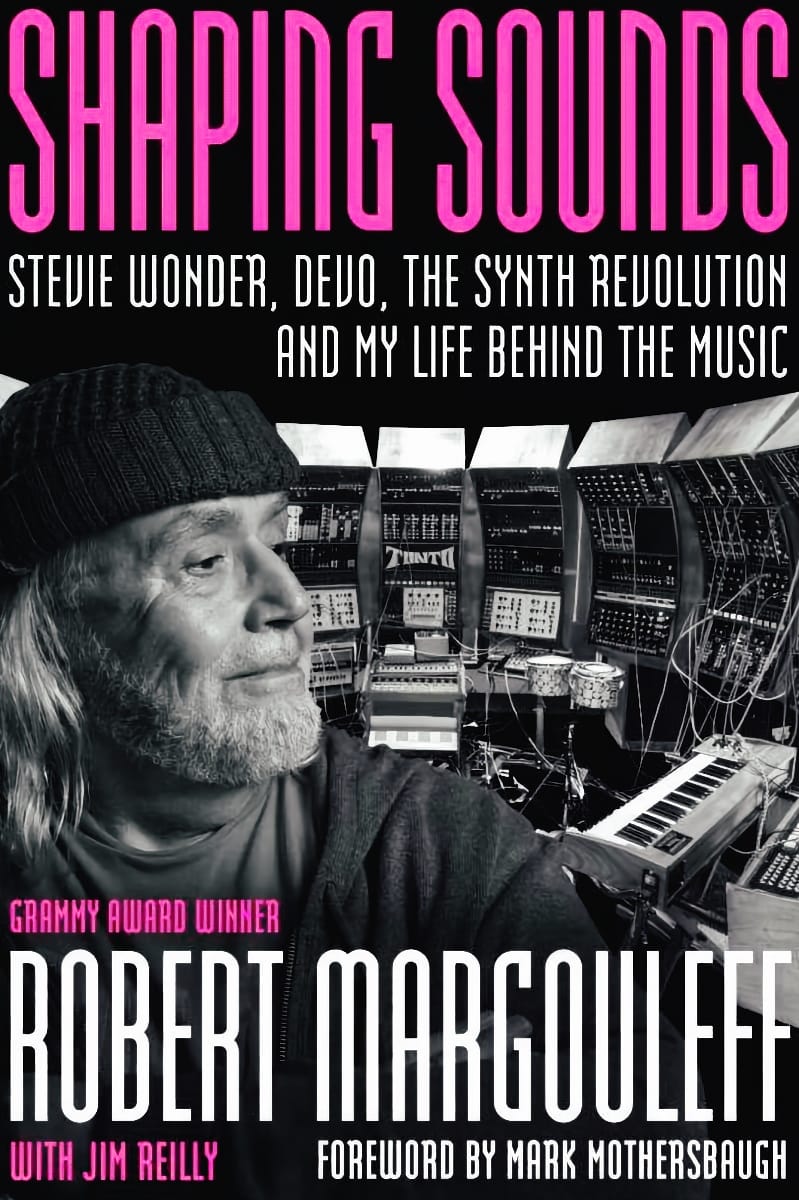
His interest in technology has continued to the present day, as he moves into the world of surround sound mixing, still taking time out to pen his recently published memoirs, Shaping Sounds. The book, released last month on Jawbone Press and featuring a foreword by Mark Mothersbaugh, finds Margouleff delving into his memory banks to share stories from throughout his creative career. He also charts his childhood and formative years, giving readers a glimpse of how he found his way from filmmaking into electronic music and on to music production. Our conversation, edited for length and clarity, hones in on some of the stories and personalities that appear in this fascinating memoir.
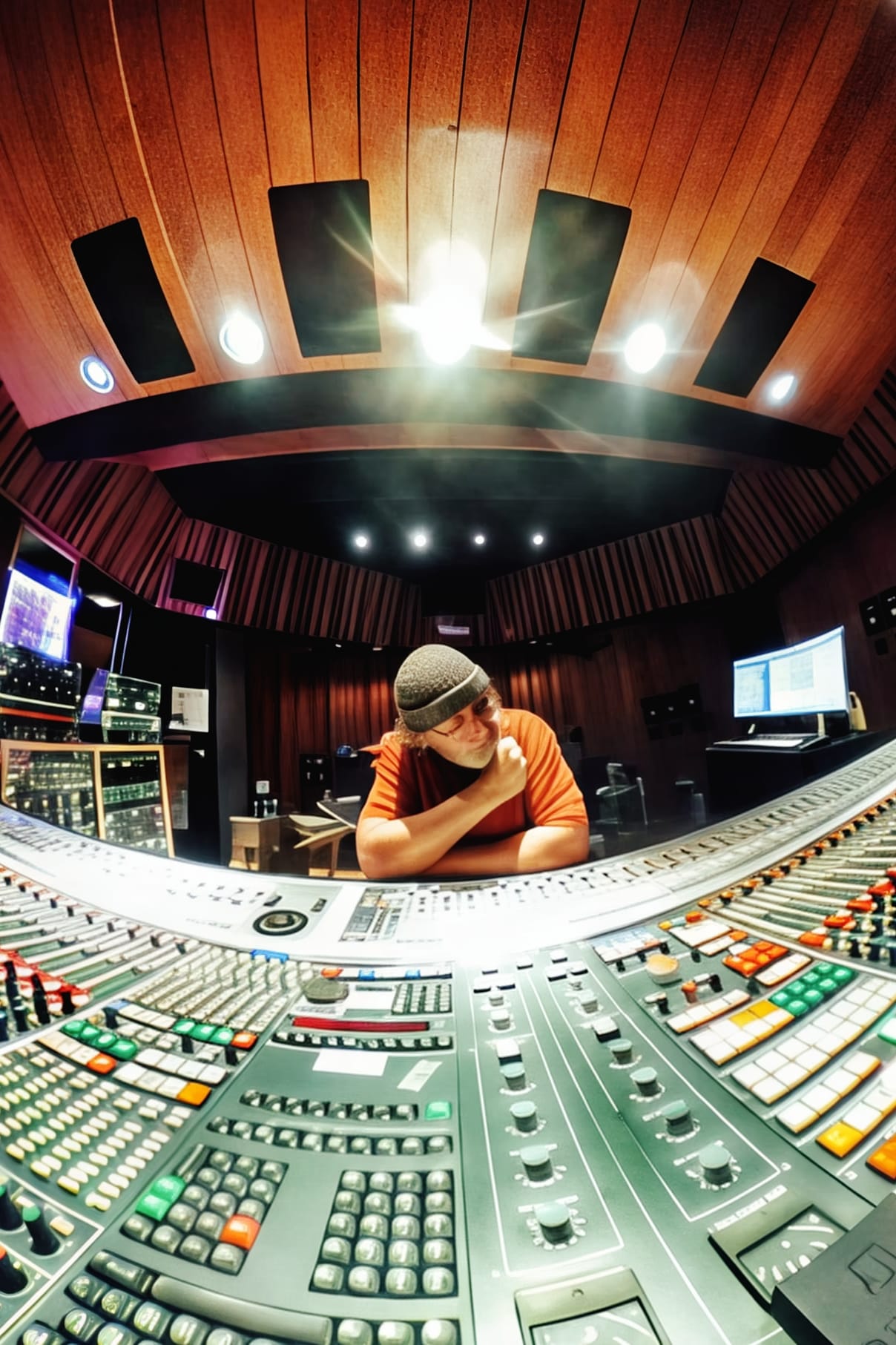
Chaim O'Brien-Blumenthal: In your new memoir, you speak about your earliest musical influences not being pop or rock, but rather classical, which I find interesting.
Robert Margouleff: My earliest musical memories are of playing with my toys underneath our Steinway piano, while my sister was practicing every afternoon; she was six years older than I, and was training for Juilliard. My love of piano and classical music certainly came from her, but I also believe in epigenetics, little films running in your genome from your past. And in my past, the little movies are all about musicians. I still listen to a lot of classical music, particularly piano music, to this day. As a youth, I went to music school, sang with the Boston Symphony at Tanglewood, and sang in a chorus with the New York Philharmonic. I also studied opera, but I realized after a year or two, I wasn't going to be the next Enrico Caruso.
Chaim: But eventually you started hearing popular music.
Robert: Yeah, after I left the Army and moved to Manhattan's East Village, I started soaking up all the rhythm and blues sounds I heard. As it turned out, my apartment was a block up from the Fillmore East and the other clubs, which greatly influenced me. All the new sounds.
Chaim: How did you find yourself in the Army?
Robert: As a young man, I was adrift. I knew I was skating close to being drafted and going to Vietnam, and that if I enlisted, the Army would offer me the chance to go to school and be trained in a military specialty of my choice. I chose Combat Photography because I was interested in photography growing up. They trained me well, and I wound up learning to make documentaries, thanks to Uncle Sam.
Chaim: After your discharge, you found yourself in New York City at a fascinating time for the arts in the sixties.
Robert: I soon found myself part of Andy Warhol's Factory scene; after getting out of the Army, I started a film company, and began directing a film, starring Edie Sedgwick. She had just left Warhol's camp, and this was to be her debut feature film, Ciao! Manhattan. I wanted it to be the first above-ground underground film. It was an adventure making it.
Chaim: From the details you go into in your memoir, that's a massive understatement! With the cast of characters involved, it sounds like the experience was anything but ordinary.
Robert: Absolutely. The project took six years to happen; by that time, Edie had moved out to California, drying out after yet another binge of drugs and alcohol. Still, she was a wonderful person when I knew her.
Chaim: In the process of making the film, you have a pivotal encounter with a new form of music.
Robert: It was around 1968. I was at a club called Cerebrum in New York, and they had a Moog synthesizer, a sequencer, and a couple of damaged modules in the DJ booth, which they used to make blooping and bleeping sounds in between the records they spun. Hearing the synthesizer for the first time, I felt I had found my voice as an artist. I realized I could use this new technology to compose the score for Ciao! Manhattan. It would have been one of the first fully scored electronic soundtracks.
I ran headlong, arms spread wide, and did a big swan dive into the world of electronica, and never looked back.
Chaim: Around this time, you became involved in producing a rock group, Lothar and the Hand People. I'd love to know how you connected with them.
Robert: Well, I bought my first synthesizer from Bob Moog. He had a guy named Walter Sear, his salesman, who sold them to studios. Like many instrument companies that endorsed artists, Moog sponsored a band: Lothar and the Hand People. Tom Flye, the drummer, was working with Walter as his junior salesman; I got to know both of them well.
One day, Tom showed up with Lothar; that was what they called the band's theremin. I turned my little insert stage up on 47th Street from a film studio into a recording studio with a four-track and some primitive equipment, and I recorded that record [1968's Presenting… Lothar and the Hand People, on Capitol Records.]
Chaim: How did working with Lothar and the Hand People lead to your next musical endeavor?
Robert: After that record came out, a lot of people started sniffing around, and I became more involved with the synthesizer and less involved in making movies. Lothar was actually the second band I'd worked with; the first was a group called Buckwheat, whose album I produced for Super K Records. Musically, it was much more traditional rock 'n' roll.
Chaim: Whereas your creative interests were far from traditional.
Robert: I found myself moving the synthesizer into Broadway Recorders studio, which was on 54th St, in the same building as the Ed Sullivan Theatre.
Chaim: That building was a hotbed of musical talent in the sixties; the Tokens had their Bright Tunes offices there, and that studio was a few floors up.
Robert: That's wild. There was a lot of creative stuff happening at that time. Pat Jacques ran Broadway Recorders; I started working there, but before long, I moved to Mediasound Studios on West 57th St.
Chaim: That's where you first met Malcolm Cecil.
Robert: He was the chief engineer at the studio. He was an Englishman with quite a resume, playing jazz at Ronnie Scott's in London with the likes of Herbie Mann and rock stars like Rod Stewart and Jeff Beck. Malcolm was also a radar technician and a big electronics guy. My first introduction was seeing this guy with a huge shock of hair wearing a bib, overalls, and a tool belt with a leather strap around his waist in the control room of Mediasound, working the console. He looked like a skinny Q-tip! We hit it off immediately.
I asked Malcolm to teach me to be a fastidious recording engineer, and he agreed, so long as I taught him how to play the Moog. We made a deal right there, and that was the beginning of Tonto's Expanding Head Band.
Stay on top of The Tonearm.
Subscribe for exclusive interviews, cultural tip-offs, and community fun.
And your support keeps our site free of advertising and paywalls.
Chaim: The two of you set to work recording [1971's] Zero Time album. How did you get the deal with Embryo Records?
Robert: When I first played the track "Aurora" for Malcolm, it was twenty-six-and-a-half minutes long and went in a lot of different places. Malcolm saw that it needed judicious editing. And with that, it wound up seven minutes long, edited, with more musical parts added.
One night, when we were in the studio playing around with our stuff, Herbie Mann walked in. He and Malcolm knew each other from the jazz world, and he asked what he was doing in the studio with this electronic music. He'd known Malcolm as a bass player previously, and kind of looked down his nose at electronics. Malcolm told him, "Don't knock it until you hear it," dragged the synthesizer out, and played "Aurora" for Herbie. Herbie offered us a deal on his Embryo label, and the rest is history.
We decided to misbehave in the studio as much as possible when making that album, not maliciously, but by going outside the norms of 8-bar phrases, tone rows, and stuff. We would tune the keyboard so it would have notes inside the notes. We were playing in the cracks in some of those tracks. Trying to experiment as much as possible, taking chances to walk on new ground and do things that we felt. I came from a classical background, Malcolm from the jazz world, and somehow the two of us just connected. And the result was that record.
Chaim: Zero Time became an underground favorite, particularly in Europe, and attracted some serious fans at the time, chief among them a creatively minded Motown star seeking independence.
Robert: Stevie Wonder heard the album and really liked it. He was listening to Tonto and to Wendy Carlos, all these new electronic sounds at the time, which were influencing him. It was Memorial Day weekend of 1972 when he first visited us at Mediasound.
Chaim: How did you and Malcolm hit it off with Stevie?
Robert: We connected immediately, and for the next three years, it was just Malcolm, Stevie, and me. We were totally focused on him. We went on Stevie time. He took over our lives—in a good way. We were constantly in the studio working with him.
We became his merry henchmen and officially his associate producers. But I think those four albums we did with him speak for themselves. They're absolutely different than anything else he did before or after. Even though we parted ways creatively, I still care tremendously about Stevie.
Chaim: What did Motown think about you and Malcolm working so closely with Stevie?
Robert: When Stevie walked into Mediasound for the first time, he was two weeks out of his Motown contract, which he'd signed when he was underage. For the first album or two, we basically stayed away from Motown and any dealings with them. Prior to our working with him, Stevie had grown up in the Motown environment, recording albums the way they did it and learning from their school on how to perform. Berry Gordy knew how to get his music out to a white audience, which was very important.
But Stevie was not into the formula. He and Marvin Gaye were living outside of that. For the first year, until we finished Music of My Mind, we were working with just Stevie; the label left us alone. But his heart was always at Motown. He loved the people there, and his lawyer got him a spectacular new deal with them, and so once that happened, we started seeing label people around more and more.
Chaim: What was it like working in the studio with Stevie Wonder?
Robert: Stevie got the idea of the synthesizer in a second. With all his songs in his head, it wasn't difficult for him to understand what to play once he learned what the synthesizer was about.
The classic story is when he first entered Studio B, and we were making some sounds; Stevie put his hands all over the synth, we guided him around, and taught him what it was about. He started trying to play chords on it, and said to Malcolm, "There's something wrong with the synthesizer. I'm playing chords, but I'm only getting one note." Malcolm, in his insight, said to Stevie, "The synthesizer is like a saxophone or a trumpet, it only plays one note, but you can bend the notes and make it expressive." Once Stevie got that, there was no holding him back.
Stevie has the passion and the energy in his music; it came naturally to him. The three of us were a magical combination; we worked very hard with him during that time. It makes me emotional even now, thinking about it.

Chaim: Beyond music, you forged a deeper connection with Stevie.
Robert: I was ten years older, so I had grown up hyper-sensitive to civil and human rights and what was happening in America. Malcolm had grown up in the jazz world. When Stevie started delving into social topics in his songs, like "Living for the City," we immediately connected with what he was trying to express. Stevie has made human rights a focal point of his entire life and career.
Chaim: The success you and Malcolm were having with Stevie brought interest from other artists curious about Tonto, and you two moved out to California by the middle of the decade.
Robert: We started working with artists that Stevie was collaborating with, producing Syreeta and Minnie Riperton. This led us to produce other funk and soul artists, such as the Isley Brothers and Stairsteps. Malcolm and I were extremely productive. All we did was work.
Chaim: How did you and Malcolm wind up diverging professionally?
Robert: Our interests went sideways a bit. Malcolm wanted to focus on Tonto and live performance. I discovered that I wasn't interested in performing in front of audiences; I'd much rather be in the studio. Performing terrified me. I like being the man behind the curtain. There was no anger when we parted, and we remained friends until he died. He went off to work with Gil Scott-Heron, and I went off to work with DEVO.
Chaim: That's a perfect segue, because I would love to know how you came to co-produce DEVO's Freedom of Choice album.
Robert: Times had changed, and I was employed by the Record Plant as the sonic maître d', chief consulting engineer. Make artists feel comfortable. My role was to organize their rapidly expanding technical department. But I had total free access to the studios as well, using as much downtime as I had for whatever projects I wanted.
One night, I saw DEVO perform at the Starwood, and I really liked them. They reminded me of Lothar and the Hand People, in a way. Very off the wall, very different. And, strangely enough, we had the same accountant. They heard about me and came to the studio one day, while on a break from filming Neil Young's movie Human Highway. They arrived off the set in these nuclear waste workers' uniforms, with tubes up their noses, hard hats on, and boots on. When people in the studio saw them, they went fucking bonkers. All these people were supposed to be nonchalant about any big stars, but DEVO blew them off the map.
Chaim: How did you connect with the group?
Robert: Quite well. Jerry Casale and Mark Mothersbaugh were fans of my work with Stevie; they'd paid attention to records and sounds they liked. And what they liked was funk and soul music. Records with good bottom end. After the studio tour, I went over to their rehearsal space and worked with them on their sound, giving some ideas.
Chaim: Freedom of Choice is really a new-wave funk-pop album.
Robert: Absolutely. It's an R&B record with synthesizers.
Chaim: Different producers who have worked with DEVO have found that the group had a clear vision of what they wanted to do in the studio, with little room for altering that vision. What was your experience in working with them? Were they open to suggestions?
Robert: Their previous two albums were all songs they had written in Ohio. By the third album, they were writing new material in Los Angeles. And strategically enough, Motown's offices were located right across the street from DEVO's rehearsal studio. I wonder if that place was throwing off vibes or something. They were influenced by R&B and said one reason they brought me on board was my musical background. I paid strict attention to the bottom end of DEVO's records to get a good rhythm-and-blues feel.
There are a lot of producers whose sound takes over an album. I didn't want people to say, "Oh, it's a Margouleff album." I wanted people to hear it and say, "Oh, it's a DEVO album." I worked very hard to make sure they maintained their identity. And you can hear that on Freedom of Choice.
Chaim: Speaking of the rhythm, one of the secret weapons of DEVO was their powerhouse drummer, Alan Myers. What were your memories of working with him?
Robert: Alan was a very accomplished player. One of the things that made that album so unique and beautiful was the lack of click tracks. Just like Stevie, no click tracks. Alan knew when to push it and when to pull it back. He was rock solid in his discipline as a player, and he made sure the band had feel. And that's what really made that album happen, the solid rhythm tracks. Once the band started using drum machines on their subsequent albums, it stripped the soul out of their sound. I feel music became more militant when click tracks entered.
Chaim: DEVO was in a precipitous position at the time with Warner Bros., and were in danger of being dropped if the album you were producing didn't become a smash.
Robert: Right. And DEVO knew that. There was a lot on the line. The first single WB put out was "Girl U Want," which everyone thought would be the hit. That didn't happen, so they released "Whip It" as a single, and it took off. I always thought "Whip It" would be the one that became huge. Is it about progressive political attitude or is it about masturbation? I used to get a lot of leering comments at the time; people had all sorts of interpretations of what it meant to them. But that duplicity is what made the record popular.
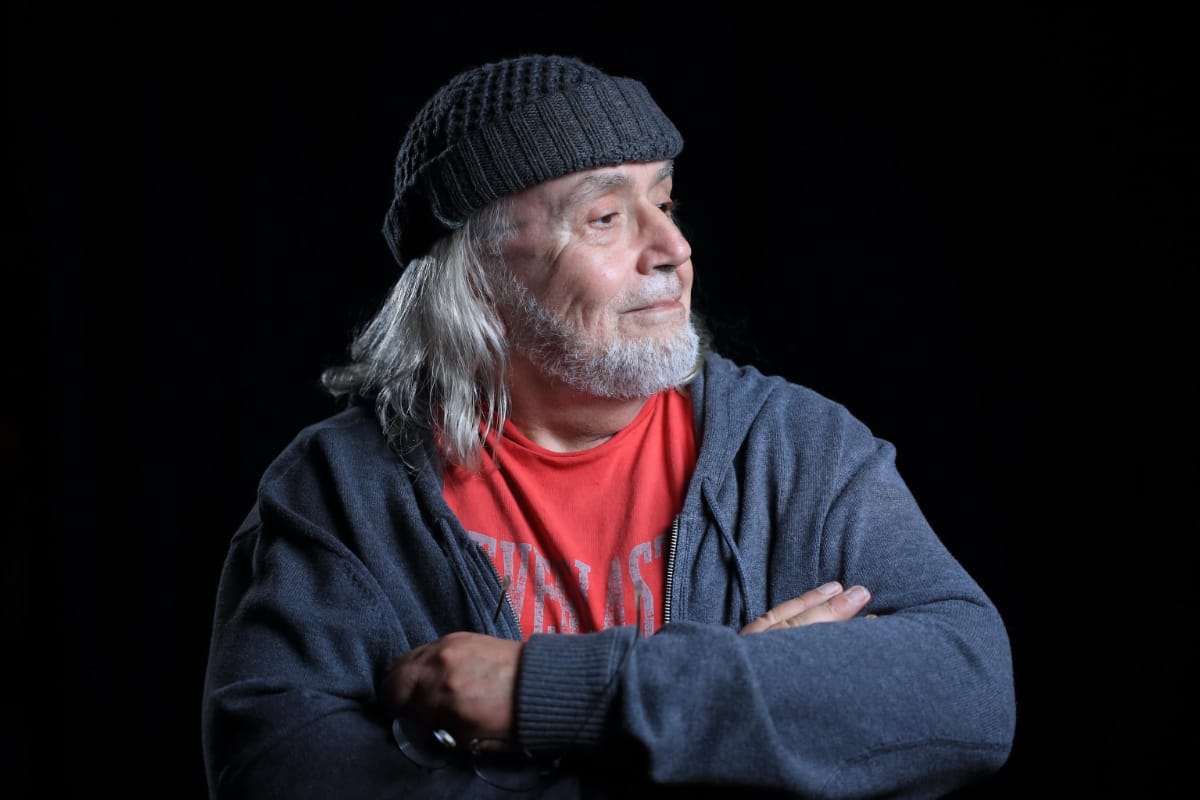
Chaim: After the success of the Freedom of Choice album, they chose not to continue collaborating with you on their follow-up album. Was this a shock?
Robert: DEVO really wanted to produce their own album, in their heart of hearts. Even though we'd had tremendous success, that was what they wanted. I don't blame them for it. It's not important to do the same thing again and again. What I did for them, that's enough. The results speak for themselves.
Chaim: Was there ever talk of your producing DEVO again in the studio in the ensuing years?
Robert: Later on, when Mark Mothersbaugh was established as a composer for movies, I did a few film mixes for him at my studio. We've stayed very close, and he generously wrote the foreword to my memoir.
Chaim: After working with DEVO, you find yourself continuing to move in the new wave field by producing Oingo Boingo's Good for Your Soul album.
Robert: Honestly, I don't remember a lot about producing that album. It was their last for A&M, and there was political stuff going on at the label. I recorded it in a different studio, which was nice, but it didn't have the same feel as the Record Plant. Working with DEVO felt more personal; I think the human rights element played a big part in that as well. Jerry and Mark were at Kent State, and DEVO came out of that political world. But Boingo didn't have that level of awareness in their lyrics that DEVO had.
Chaim: What made you decide to write your memoirs?
Robert: COVID came, and I couldn't go to the studio to work. I could only stay at home. And one day, I woke up and said to myself, I've had a very rich life, and maybe God is telling me it's time to write my story. And that's exactly what I did. Sat down and wrote the book. My manager really egged me on and put my nose to the grindstone, and for that I'm very thankful. I have to say, I didn't do it alone. I had a lot of help from friends who helped me track down all the photos and do research. It was a team approach.
Chaim: What strikes you about the old days of the music business from where things are at today?
Robert: Looking back, I'm glad I was a part of it. It wasn't as big a business as it is now. People got together, there was a lot of openness, and it was a beautiful time. But I also think there are great things happening in new music, ideas, and thinking. Artists can sit down at a computer and create incredible visual content and music. There are new tools we could only have dreamed of back in the day. I do believe technology drives art. We have new technology that creates new art. Don't fear technology, embrace it and make art with it.
Check out more like this:
 Bill Kopp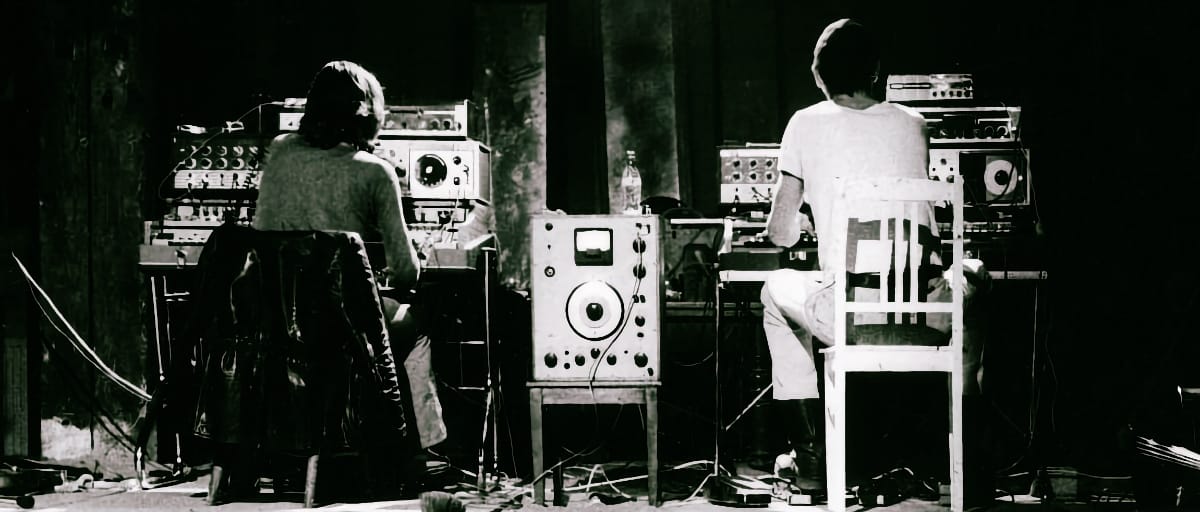
 Chaim O’Brien-Blumenthal


Comments