


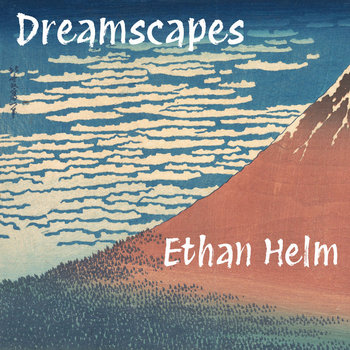
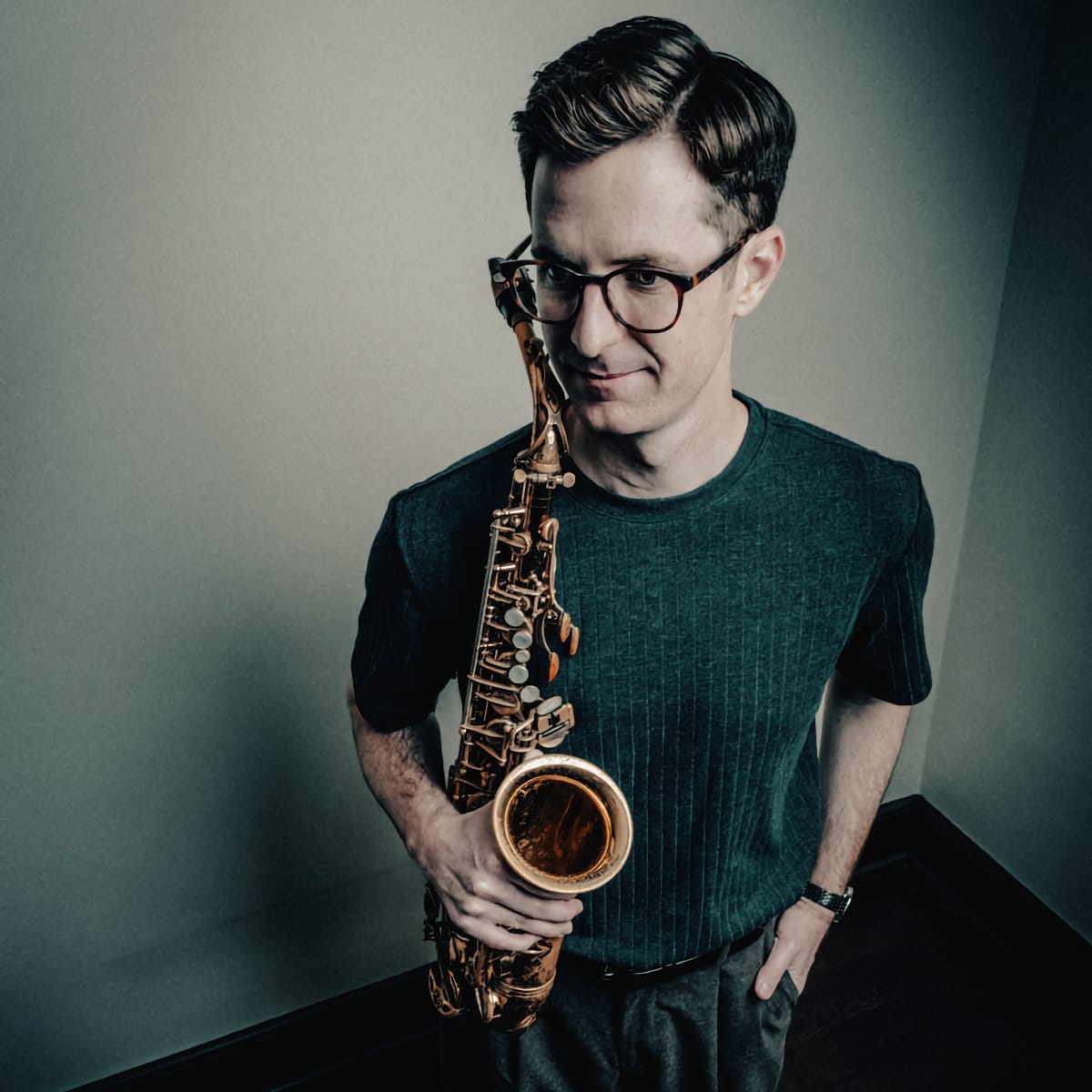
Late last year, New York City-based saxophonist and composer Ethan Helm released Dreamscapes, a solo album that uses a Boss RC-1 Loop Station pedal to weave a multi-layered sonic tapestry from a single alto saxophone. Inspired by the natural features of Japan, where Helm and his wife took their honeymoon a few years ago, Ethan describes the album as "music about earth," or an exploration of the way the world can "shift, flow, disappear, change color, diverge into many paths, and seem to repeat itself."
To express this idea, Dreamscapes charts a distinctive improvisatory course across its eight tracks. Although the album is predominantly contemplative, the music is often restless, transforming its textures and melodies, ramifying, exactly as Helm intended. And, his saxophone is not exactly alone on the album: the looping pedal is always there, moving between the music's foreground and background depending on the given track. Almost the entirety of "Pastoral," for instance, presents long, lyrical melodies that wind around each other, at times suggesting a saxophone chorale. Helm's RC-1 obviously enables this polyphony, but he hides its influence through the naturalism of the performance. On the other hand, "The Lotus Peak" features impossibly long drones topped with rippling, swirling textures built out of fast gestures that the looper repeats with shortened samples, producing a sound reminiscent of granular synthesis. These contrasting elements form the backdrop for an additional layer of meandering melodies that seem drawn from a different musical world because they are not heavily processed.
The thoughtfully crafted sonic spaces Helm builds and explores in Dreamscapes reflect the geography that inspired him, as well as the unique performance circumstances the album demanded. Helm honed his practice as an improviser in more traditional jazz contexts, playing alongside and in response to other people. Dreamscapes showcases a new virtuosity for Helm in which he shines as a solo saxophonist, displays newfound deftness with his looping pedal, and showcases a determined and adaptable artistic vision that conceives a wide range of offerings from a very limited set of musical tools. The album's production style is strikingly intimate—listening to it is like having Helm in your living room for a private concert. And, while Helm favors an alluringly warm and gentle tone across much of Dreamscapes, there are a few places—like on the track "Three Visions"—when he lets it rip just like he might during a solo at Birdland.
I have followed Ethan's work for almost a decade after we both participated in Pulitzer Prize-winning composer Gabriela Lena Frank's Creative Academy of Music back in 2017. In the intervening years, he has released albums with his long-running postmodern jazz quintet Cowboys & Frenchmen as well as Wet Electric, earned a PhD from the Jazz Studies Department at NYU, and has become a fixture in the New York scene, appearing regularly with The Gil Evans Project, Miho Hazama's m_unit, and Brad Shepik's Balkan Peppers. In this context, Dreamscapes obviously stands out as a distinctively individual endeavor in Helm's musical activity. I caught up with him earlier this year to uncover more details about how Dreamscapes came together and how this new album has changed his musical practice.
Garrett Schumann: So, my first question is, when, how, and why did a looping pedal find its way into your practice as a saxophonist and composer?
Ethan Helm: So, I distinctly remember during COVID—surprise, surprise— I was thinking about new ways of making music, and not making music that was missing something because we were in a pandemic and could not make music together. I wanted to somehow offer a complete musical experience just using my saxophone. So that was the impetus for it, and I think I got the pedal then, messed around with it a little bit, and set it aside.
I have a little experience with electronic music, but not a ton. I feel like I know just enough to see the abyss that I do not want to dive into. I really eased into it, thinking, "let me just buy this one looper pedal" and see if I can treat it as a compositional tool more than a traditional pedalboard—like, the way it would traditionally function on a pedalboard—and squeeze all of the compositional juice I can out of it just with my saxophone and these loops. It stuck with me as a way of creating. Even once we left the pandemic, I thought this would be a great kind of complement to my other ways of making music with small jazz groups, with large ensembles as a composer, etc.
Garrett: What did it feel like, or maybe what does it feel like, for you to perform alongside digital iterations of your own playing compared to the other types of performance that you do, like with jazz bands or other people?
Ethan: I actually haven't thought about that, and what I immediately realize is that it's terrifying because there's a level of trust there that I don't get when I'm depending on myself, or when I'm depending on a piece of technology. There's a level of trust I can guarantee when I'm playing with other humans, I think, because of that human connection. If I fall, they're gonna catch me, and vice versa, especially in a small group jazz setting. But, I think playing with the pedal, just myself and this looping pedal, requires a new set of problem-solving skills, and a new sense of self-confidence that I can solve the problems I create for myself, because no one else is going to do it.
Garrett: Have you played these pieces live?
Ethan: Yes. I've done a couple of shows in Brooklyn, and then I played at this really cool series in Philadelphia called Event Horizon Concert Series, at a venue called the Rotunda. That was really fun, it's kind of like an ambient music community event. I've done it a couple of times live. I have to modify the pieces that I put into the set. Usually, the stuff that's really rhythmically complex is too hard to get together for a live performance, only because there are so many variables with the sound system and the reverb in the space. Some of the rhythms on the album are really hard to nail in a big, boomy space, so I usually opt for more open structures and more improvisation.
Garrett: Can you talk about where the idea for the album came about, and what the production process was like?
Ethan: Initially, these pieces started as their own approaches to the looping idea, different concepts of what a loop could be. There's one track, "The Bewitched Mill," with really long loops over a minute long. I treat it as a counterpoint, almost like an invention or something, where I play an entire first line, then try to give it a meandering quality so it doesn't sound repetitive when I come back to add a second and third line. So, the idea behind "The Bewitched Mill" was these long ideas, kind of pushing the loop to as long as it could be.
And then, conversely, on the opposite side, with "The Lotus Peak," I was trying to do loops that were as short as the pedal could possibly go. I'm creating these little layers with arpeggios and very short loops, and everything amplifies and layers on top of itself to create these harmonic clouds. So that's the inside-baseball approach behind it, but the conceptual thrust of the album really began to crystallize when I went on a trip to Japan with my wife for our honeymoon. I had never been there before, and I was floored by our visit to Mount Fuji, this singular geological structure that extends the entire horizon to the point where you can't look anywhere and not see Mount Fuji. It's a mind-boggling, disorienting experience. And then also the idea of this mountain, which I don't know if you've seen it in person, but often it's completely covered in clouds. So, you can make a big trip to go see this mountain, and not get to see it. There's something beautiful to me about that, about how it's not there to be looked at. It's its own thing, and sometimes it reveals itself, and sometimes it doesn't. And in front of that mountain, you feel the power balance of who you are as a human versus the entirety of the Earth.
Garrett: That's what you mean when you describe it as 'music of Earth.'
Ethan: Yes, all the different ways of experiencing the world where it doesn't conform to our expectations. Something as elemental as dirt, or a field, or a group of trees, can actually subvert your expectations and your experience, and those are some beautiful moments in life.
Garrett: So there's one very clear musical continuity that I heard between "Flock" and "On the Threshold of Liberty," which share a harmonic progression. Are there other musical threads that stretch across the album?
Ethan: Nothing to that extent. And I'm glad you caught that. I had two ideas for the direction of that piece, and I liked both, so I found a way to get both of them in there. Sometimes I like to think of the album as these singular meditative experiences one after the other, so the music really follows that idea. "The Lotus Peak" is Mount Fuji, "Flock" is, and kind of self-descriptive, either a flock of birds or a flock of sheep. "On the Threshold of Liberty" is also based on a painting. "Pastoral," I was thinking a lot about [Stanley Kubrick's] Barry Lyndon. If you've seen that film, just gorgeous cinematography, and these landscapes of verdant green, just like the most concentrated greens and reds you can imagine on a movie screen. So that's some of the imagery there. Musically, no, I think each track is fairly distinct, and maybe characterized by my relationship to the looping pedal in each of them. Like I mentioned before: long versus short, harmonic versus melodic.
Garrett: Well, to that end, there's quite a range in how present the looping pedal is. Obviously, it's there doing the loops, but you, at different times, engage other production elements, other effects that it can do. How did you think about that aspect as moving beyond just the looping into the sound design expressivity that you could get out of it?
Ethan: Some of that was just through live experimentation. There's kind of a blessing to having an RC-1, a simplified looping pedal that's not supposed to do too many things. I noticed that if I add a bunch of layers, erase a bunch of them, and then go back to the first pedal layer, all of a sudden, there are a bunch of aural artifacts in that layer. I'm not sure what's going on in the tech, but it was definitely something to exploit. All of a sudden, there's this weird little bump in my first layer that I definitely did not put in there. Discovering all these things in performance, something like smashing a saxophone and a pedal together, things that weren't necessarily designed to go together, creates all these fun little nooks and crannies to exploit. Likewise, realizing how easily the microphone can pick up key clicks or breath sounds coming through the saxophone, and just how those timbral or percussive elements can add a lot to normal notes and rhythms.
The album itself stays pretty true to how the pieces sound live. The mixing and mastering engineer, Sam Minaie, who's a fantastic artist I've worked with before, really understands my saxophone sound and my aesthetic. I gave him full license to do whatever he wanted with the pieces. Having said that, he didn't end up doing a ton, but added some really nice, subtle reverb touches, some echoes, some fade-outs. Towards the ends of pieces, or at a section break, he might kind of change the overall color. And so, I was definitely relying on his production sensibility to add his touch. I think the things he added really make the album more special.
Garrett: What do you have coming up?
Ethan: I am currently developing new pieces for future performances of Dreamscapes and have a few upcoming appearances this summer, all in NYC. On June 13, I will be at Symphony Space for the BMI Jazz Composers Showcase, and on June 29, I will play with trumpeter Michael Sarian and his band, The Big Chabones, at Culture Lab.
Check out more like this:
 Bill Cooper
 Garrett Schumann


Comments