


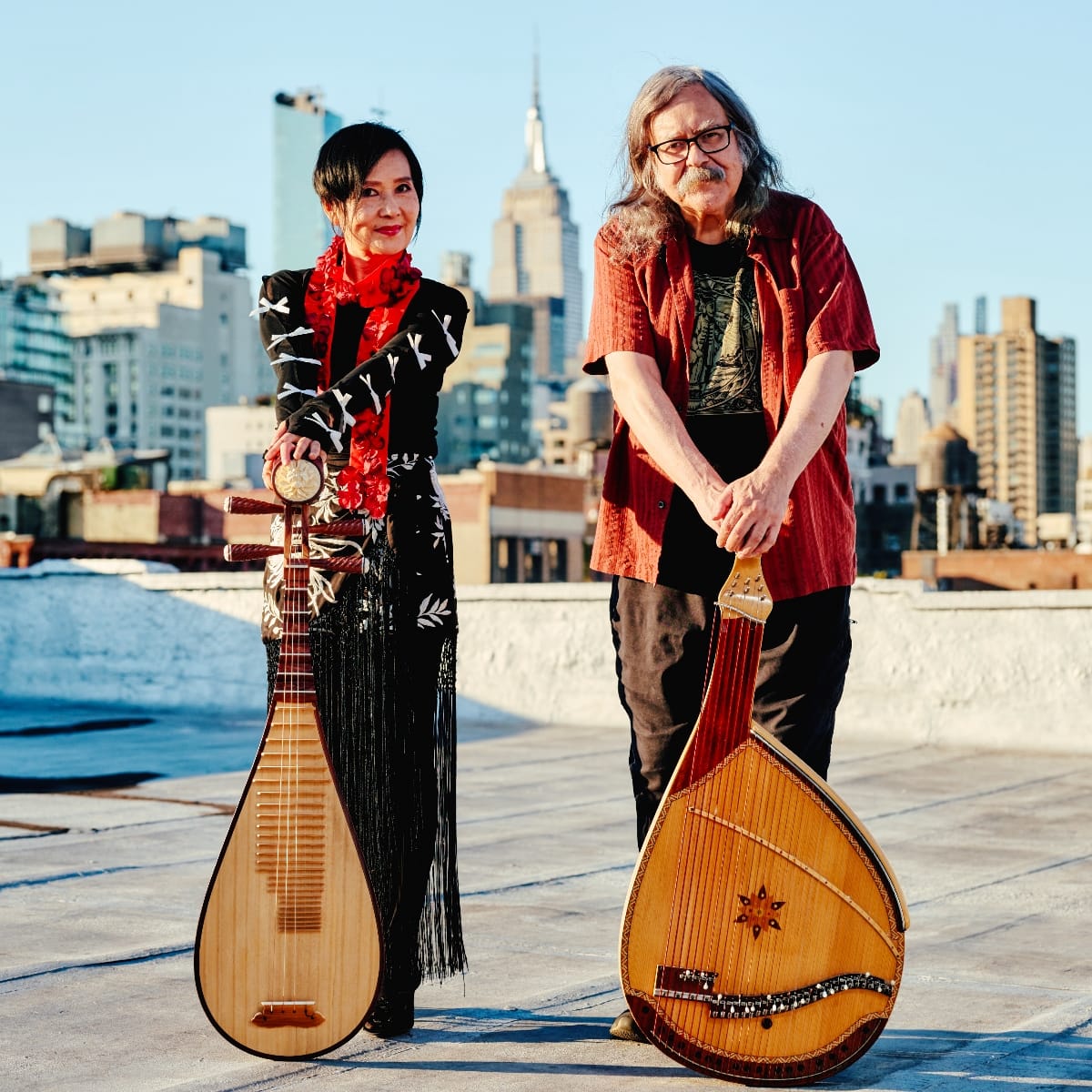
Bridging East and West in a novel way, Min Xiao-Fen, one of the world's foremost exponents of the Chinese pipa, has collaborated with celebrated Ukrainian bandura master Julian Kytasty. The product of the duo's creative partnership is Boundless, a new album that highlights the nexus in which tradition, improvisation, and cross-cultural communication come together. Set for release April 17, Boundless will premiere with a special concert as Min Xiao-Fen and Julian Kytasty appear together at Lincoln Center.
Min Xiao-Fen's musical journey has long been marked by unexpected endeavors. Yet in retrospect, all her myriad musical excursions can be seen as part of her lifelong quest to explore and celebrate the interrelatedness that exists among seemingly disparate musical traditions. After more than a decade with the Nanjing National Music Orchestra, Min emigrated to the U.S. Her solo debut, 2017's Mao, Monk and Me, found the thread that connects Thelonious Monk's idiosyncratic style with the folk musical traditions of her native China. Subsequent releases found Min collaborating—in both composed and improvisational settings—with guitarist Derek Bailey, violinist/violist Leroy Jenkins, and others. She has also worked and/or recorded with Björk, John Zorn, and Jane Ira Bloom.
In 2021, Min applied her creativity to a work of great historical import. The 1934 film Shénnǚ (The Goddess) is an exemplar of China's cinematic golden age. Nearly 90 years later, Min composed a score for the film, releasing it on CD as part of the album White Lotus. With virtuoso guitarist Rez Abassi, she mounted numerous performances of the work, including dates at the Smithsonian; the two played Min's original music while The Goddess was projected on a screen above. Scores for two more silent films—Romance of the Fruit Peddler from 1922, and 1927's Romance of the Western Chamber—would follow.
Min Xiao-Fen's latest release continues her fascinating musical odyssey. I spoke with her about Boundless, and how it fits into her larger body of work.
Bill Kopp: How is Julian Kytasty's instrument—the bandura—related to one of your instruments, the pipa?
Min Xiao-Fen: When I lived in New York, I had a lot of experience working with musicians who played plucked instruments. For example, like the 12-string African kora and the guembri from Moroccan gnawa—it's a plucked instrument with three strings like the Japanese shamisen—and African banjo, and also Arabic oud. And there are so many others! Julian plays a plucked instrument, too: the bandura. The pipa and bandura have a lot of similarities—the instrument body is a pear shape—but they're very different. The bandura can play a lot of chords. Both instruments are from the lute family.
Bill: How is Boundless different from the recordings that you've made in the past?
Min: I did two soundtrack albums: White Lotus with a guitarist, Rez Abassi, and Metta with drummer and master musician River Guerguerian. And I wanted to make a new album with different instruments like the bandura. Pipa and bandura have a bright, resonant sound, and they’re always very expressive and dedicated to the melodies. And both have long cultural histories of telling stories and expressing emotion through the music.
Bill: To your knowledge, have the two instruments ever appeared on a recording together before?
Min: I think Julian has worked with another ensemble that included pipa, but not [in the context of] a duo.
Bill: How did this collaboration with Julian Kytasty come about?
Min: I lived in New York for 25 years, and I never met Julian. But I heard his name. In 2021, I had already moved to Asheville, and I was invited by him and a Ukrainian group called Yara Arts Group to perform a solo show at their winter festival at the Ukrainian Museum in New York City. At the end of the show, I invited Julian to jam with me as a tribute to Derek Bailey. That show was a highlight of the moment and a really beautiful memory. So we stayed in touch with each other. I was applying for several grants [to cover the cost of bringing him to] play in Asheville after this collaboration. But the grant applications failed.
But the funny thing is that Julian visited Pilot Mountain in North Carolina; he had some people there who handmade the bandura for him! And this is why he's often coming to North Carolina, just two or three hours away from Asheville.
So he contacted me last May and said, "Min, I'm in North Carolina." And I said, "Come to Asheville! Can you bring your instrument?" He said yes. So he drove here; it took him a little more than three hours, because he got lost a little bit. Then we had such a great time jamming together, and we went to a restaurant. We immediately connected and decided, "Let's make a record together."
Bill: How did the songs come together?
Min: [After that visit,] Julian came back to Pilot Mountain again [several times]. So sometimes I drove to Pilot Mountain, and sometimes he came here. Then we exchanged ideas. I created three duet pieces: "Xi Xi, Cuo Cuo (Wash & Rub)," "Soluna," and "Under One Sky." Then he also came up with three beautiful pieces based on Ukrainian folk tunes. We also had a couple of rehearsals before recording in New York at the end of August 2025.
Bill: Did you find that playing along with the bandura meant that you changed the way that you approached your instrument?
Min: Yes, definitely. Like I mentioned before, because the bandura has such a rich and resonant sound, it makes me think more about space, texture, and how the instruments blend together. As you know, I played three instruments on the album: pipa, ruan, and sanxian. And I wanted to push the instruments in a new direction; this is why I focused more on rhythm and interaction.
Bill: How did you learn of the story about the Chinese immigrants that inspired "Xi Xi, Cuo Cuo (Wash & Rub)"?
Min: I watched the movie Sinners. And there's a big part about Chinese Americans in the Mississippi Delta. They had lived there for over a century, and their laundries and grocery stores served both the Black and white communities. In the film, you can see the Chinese owner run across the street, going to the Black community, then going to the white communities. And I also watched a documentary called The Untold Story of America's Southern Chinese about the people who still lived in the deep South. Many of them are, of course, older people, and they speak with a thick Southern accent.
That's how I found out [about this story]; really fascinating. So when I wrote this piece, I wanted some kind of interpretation. In Chinese, "Xi" means to wash, and "cuo" means rub. And I wanted to bring out the positive energy.
Bill: What inspired some of the other songs?
Min: Every song is very unique, very special. [For example,] we came up with one piece, a complete improvisation that I gave the name "Alterknit." Alterknit is actually a place, part of the Knitting Factory in New York. My music really started from there; after I first moved to New York in 1996, I played my first solo show at Alterknit. That's where I met John Zorn, and he introduced me to Derek Bailey. So it's such an inspired and spirited place for me. And I feel that "Alterknit" is a thread connecting that time in my life with my collaboration with Julian.
Bill: Your connection to Ukraine goes back many years. What can you tell me about your performance in Kyiv in the '80s?
Min: That was such a beautiful experience and memory, too. It was almost 40 years ago: July 1988. Ukraine was still part of the Soviet Union. I went there with the Nanjing Chinese Traditional Orchestra as part of a Chinese cultural exchange. We spent three days in Ukraine and performed at a kind of army auditorium. And then we visited a museum and went to the Kyiv Monastery. We also visited Odesa, Ukraine's second-largest city, and we attended the opera. It was great.
And now, almost 40 years later, I am working with one of the greatest bandura players, Julian Kytasty. And all the memories and beautiful experiences come back. And I really hope Ukraine will be peaceful soon.
Bill: Tell me about the upcoming performance at Lincoln Center.
Min: I'm very excited about it. Lincoln Center has been so supportive. [This will be] my second time invited by Lincoln Center to present my own project. Three years ago, they invited me to perform my White Lotus film soundtrack with Rez Abassi. And for this album, Julian and I are going to have the release and the first performance on April 17. After that, we will perform at Solar Myth in Philadelphia, presented by Ars Nova Workshop, on April 19.
Bill: What emotional reaction would you like listeners to have when they experience the music on this album?
Min: I hope listeners can keep an open mind and feel a connection when they hear the music, and use their own imagination to experience joy and happiness.
Check out more like this:
 Lawrence Peryer
 Bill Kopp


Comments