


The picture slowly comes into view: a gently phasing sustained note, laden with overtones and harmonics; then percussive, jangly strings shaped into a basic four-four beat; all coalescing into an instrumental rock riff that becomes something close to a song without words. There's a mix of familiar style and attitudes with mesmerizing, almost obsessive, repetition, and something seems both strange and luminous about the chords and where some of the notes fit into them.
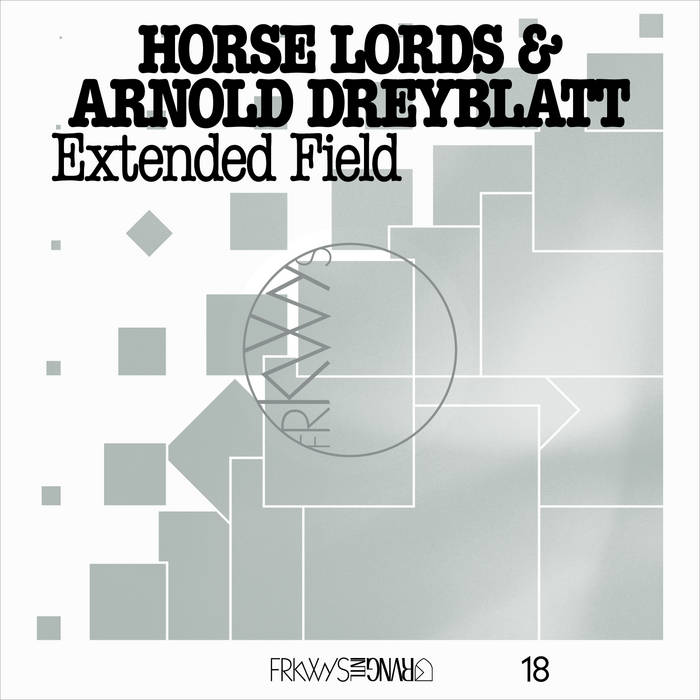
If you don't check out the album cover—and depending on what you've heard in your life up to this point—you'd say this is a Horse Lords album you don't remember listening to, or else composer Arnold Dreyblatt has radically reconfigured his Orchestra of Excited Strings. And you'd be right, of course, because Extended Field is a collaborative Horse Lords/Dreyblatt album, a meeting of two parallel tracks of music in that still-being-formed liminal space that mixes the experimental and avant-garde across rock, minimalism, conceptualism, and some very, very old and enduring ideas.
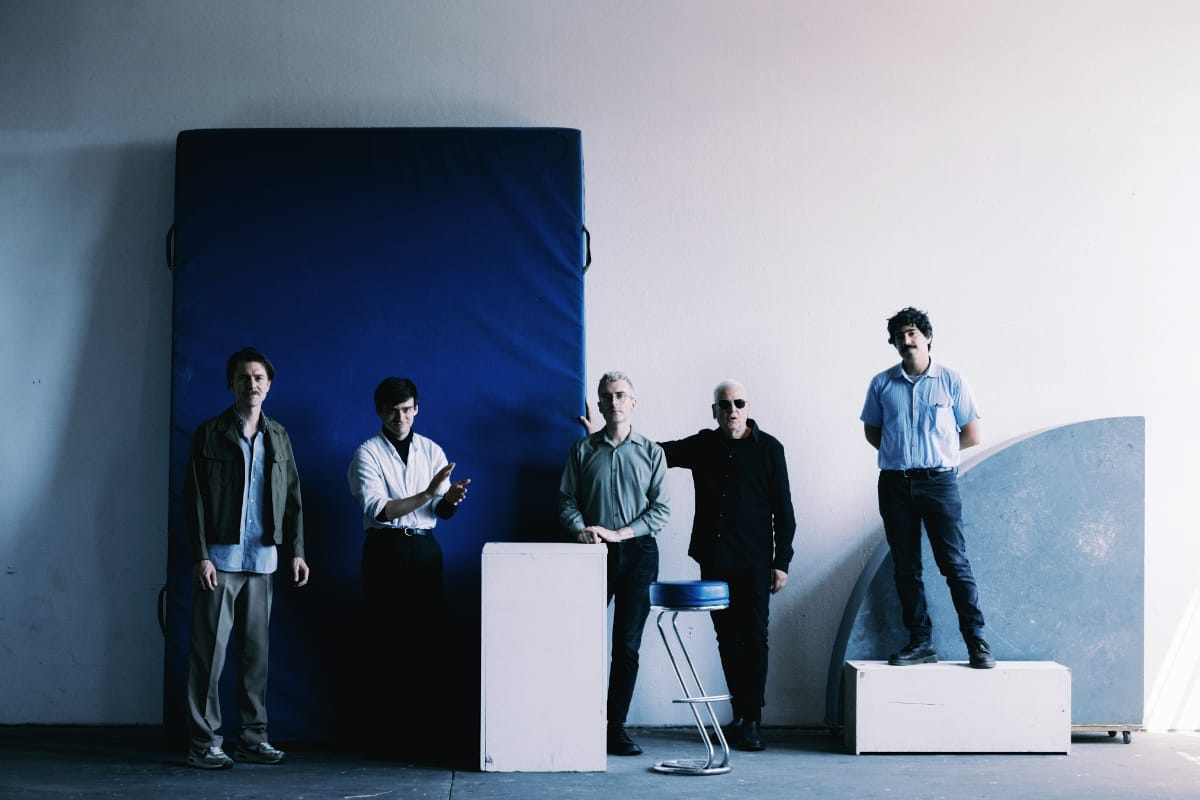
What brought the two together was mutual interest in each other's music and the specific figure of German musician Werner Durand. In separate video conversations, both Dreyblatt and Owen Gardner, guitarist in Horse Lords (with saxophonist Andrew Bernstein, bassist Max Eilbacher, and, for this album, drummer Andrea Belfi), noted this. "Durand mentioned them to me," says Dreyblatt, as "a minimalist rock band with just intonation . . . this driving rhythmic aspect. So, of course, I felt some relation to my own interests." Dreyblatt listened to the band, and as he wrote in the record's notes, replied, "'Sounds great! A little like my music. I've never heard of them!'"
He sent Horse Lords a message through their Bandcamp page; the reply was, "Hello! Thanks for the note, we're big fans of your music!"
They first discussed collaborating in the fall of 2021, and started what was the slow process of fitting together both schedules and ideas about music. One of the things that seems to immediately cement them as sympathetic musical partners, tuning, took some work to synthesize. Gardner says, "I think the first thing I heard from him was Nodal Excitations," originally released in 1982 on India Navigation Records, "maybe ten years ago or so. It was after Horse Lords had gotten started. I guess I was just struck how it felt very similar . . . the extent to which we came to the same conclusions about what we were doing, the shared vocabulary of just intonation . . . in a driving, highly rhythmically articulated way."
This demands the usual sidebar exploration of something that seems ubiquitous and constant, tuning, but is and has been anything but in history. Probably 100% of the music most people regularly hear (and maybe only a small fraction less of music people drawn to the avant-garde and experimental hear) is tuned in major and minor keys and scales of equal temperament. That has been the dominant tuning system in the West since the technology of the modern piano made it desirable to use a system that has an equal frequency distance between each defined pitch. Before equal temperament, there were myriad tuning systems, many having to do with the idiosyncrasies of various keyboard instruments. The most ancient is probably just intonation, which goes back to the Hellenistic Greeks. Rather than the distance between pitches marked by frequency measurements (the units are cents, and in equal temperament, the distance between each half-step is 100 cents), just intonation uses ratios between pitches. For example, 2:1 is the octave; if you take a vibrating string and shorten it by half, it will vibrate at twice the rate, one octave above the original rate. Key intervals like the perfect fourth and fifth can be tuned to the ratios 4:3 and 3:2, and just intonation is organized around the idea of those key "perfect" (or unchanging) ratios.
That is a highly generalized description, as there is more than one way to tune in just intonation, but the key feature is just intonation's "naturalness." It is built off a fundamental pitch, and the natural overtones above it are produced when that note starts vibrating. These upper partials, depending on the source, can pass beyond the range of human perception, but always rise in a specific order from the preceding partial: octave, fifth, fourth, third, etc. All these are in ratios—just intonation—and as the series rises, it moves further from equal-tempered tuning. While it may sound strange in the context of nearly all music in the West, a cappella vocal groups naturally sing in just intonation, and string ensembles will gradually move there if they play for extended periods without retuning.
This album is an example of the richness, complexity, and variety in just intonation (It's in RVNG Intl.'s "FRKWYS" series, which the label has established as "an intergenerational collaboration of adventurous musicians drawn to the sonically radiant world of just intonation."). Horse Lords and Dreyblatt both use the tuning, but in widely different ways. Dreyblatt works with the upper end of the overtone series: "My scale, what I work with, up to the 11th harmonic, and everything under. I kind of know the combinations by now," he explains. That and his repetitive, mantra-like style are key components of an artist who worries at a single spot on the canvas until it expands to universal dimensions.
Gardner plays a refretted and retuned guitar in just intonation, and Bernstein plays an instrument that is relatively easy, with a practiced embouchure, to play in the tuning. In the context of the world of just intonation, Horse Lords are probably closer to the lower end of the overtone series, and more expansive, while Dreyblatt is determinedly sticking with and wrangling the upper registers, a floor and ceiling of what on the album builds into linked, ecstatic inner and outer worlds. If Dreyblatt brings a mantra, Horse Lords bring the dervishes.
In the context of the last 200 years of Western music, just intonation can seem radical, but again it's both ancient and natural, and the appeal, as Gardner points out, doesn't have to be intellectual or theoretical, but purely about the pleasure of the senses. "I don't know if practical is exactly the word," says Gardner. "It's just a sort of sound that's very appealing. It's a lot of things at once, not only a sound, but also it suggests a method. And I think that the numbers being so abstract, they can be sort of mapped onto any parameter. So that's very useful, very practical.
"It gets you out of a rut—or maybe gets you into a new rut—at least as far as dealing with traditional musical materials. It's a sound that we're very deeply drawn to; it leads you in directions that you just wouldn't go otherwise." Getting there for the two parties "wasn't easy," Dreyblatt admits. "Actually, I thought it was going to be much easier." He points out the advantages that the current generation has, "the kids," he calls them, over what he faced in the 1970s, and that La Monte Young and Lou Harrison tackled 60–70 years ago. Dreyblatt, like Harrison, had to build his own instruments (something perhaps more natural for someone like him who began not as a musician but a visual artist), while for "the kids, it's part of their toolkit, that comes from having laptops and software, being able to hear" and play around with multiple tuning systems.
"Earlier," he points out, "it was very difficult. You either had to retune an instrument, or it was kind of a compromise so you could hear it. That information is now disseminated everywhere. So you find these young people composing in some form of just intonation. What was an interesting learning experience for me," in making Extended Field, was that, "I kind of explained the system that I use, which is a closed system. Once you get into just intonation, the numbers are endless. There are some very clear points on the continuum, like a perfect fifth, but then there's a lot of other possibilities. Because of the way I develop my work, my work with instruments, I reduce my palette to basically only overtones, which are transposed into a system."
That made sense to Dreyblatt, coming out of the model of Young and a transcendental musical and spiritual experience built on "rooting out all the possibilities" of specific intervals, moving them around. "And then I find out, like when I presented to them, that for them, any note could be played with any note. It was kind of just numbers. And that's not what it is for me. For me, there's always a fundamental tone which could be anything." Anything, yes, but once established, it remains fundamental.
Horse Lords, on the other hand, "were quite mathematical," says the composer. "I mean, they're great musicians, and they also use much more complex rhythmic structures than me, which is great, so I like to say we met each other somewhere in the middle." From that middle, the music can be followed through multiple directions in time, including backward. Though everyone has a pedigree that flows either directly or indirectly from La Monte Young, the music is a more complex mesh of ideas.
Gardner says, "I think the collaboration seems natural, because of what we share in terms of where we're coming from and where we go with it. So we didn't really have to try for that . . . to get this sort of sonic sympathy, because I feel like it was already there to begin with." Extended Field, in fact, is a stellar example of how musicians incorporate ideas from previous generations and peers as part of the raw material for their own work. The sound and shape of the music, the ramp up from the introductory "Advance" to the more driving title track that resolves into a new mood, opens up a larger window into this experimental rock/avant-garde compositional play space. The album can be heard as the exploratory ideas of Glenn Branca and Rhys Chatham incorporated into the style of 21st-century rock bands; it's a sound that would fit with Robert Longo's Men in the Cities series. And both Horse Lords and Dreyblatt are each in a clear post–Terry Riley world that seesaws between repetition as a structural tool and a shamanistic one, the processing of time or the process of building a drone.
Gardner acknowledges that. "I think we were responding to a lot of the same inputs. We were very interested in early minimalism and the Downtown milieu. He was part of it. It feels a little weird that I, or any of us, heard his music so late, because we were very interested in this era, in the scene. I don't know, some people fall through the cracks, I guess."

Gardner talks about fitting the band together with Dreyblatt's tightly controlled pool of materials. "Andrew and Max and I," he says, "had a few meetups where we were just dealing with his set of materials, very strict, yes, compared to us. In some ways, we also have pretty strict limitations on what we use. But his are much stricter and much more enclosed in a way we found exciting and helpful. We were figuring out practical things, like the nuances of a system, how we work; we wanted to learn how he works, see how the instruments could be fit into this. So there were a few precompositional meetings like that. There were short, practical, precompositional kind of meetings."
"Andrew and Owen proposed structures for navigating my tonal systems," explains Dreyblatt. The band and Dreyblatt sketched out ideas, showed them to each other, played around with them, decided what fit and what didn't. They used a matrix to help make decisions, working with an algorithm that Eilbacher programmed in the open-source SuperCollider computer music language. "We came up with a lot of material, a huge excess of material," Gardner says, only some of which made it onto the record.
The result is seamless and organic. The music doesn't just play; it seems to grow into the spaces of time, like roots into the earth. Time is in the beat, and the beat is time, and it repeats like minimalism, but the drone is there too, rising off the fundamental in a lattice of overtones, of ratios. A drone here isn't flat but a sinuous, malleable thing, like the penultimate track "Suspension." This four-track album ends with "Impulse Array," a quasi-sonata-like finale that returns everything to a feeling of home, a journey completed, personal memories and transformations carried back to the starting point.
Sit with this in a different way. A composer is working with an ensemble, fitting together their ideas about tuning and harmony and rhythms, in sympathy, over four sections. There is an introduction, a track that explodes into activity, a slow and still section, then a fourth one that wraps things together and brings everything to an end. Sonic sympathy makes a new symphony.
Check out more like this:
 George Grella
 Meredith Hobbs Coons


Comments