


Robert Aiki Aubrey Lowe's career trajectory has been as unpredictable as a butterfly's flight. He burst onto the underground music scene in 1997 with the pugnacious, artful post-punks 90 Day Men, playing trumpet, singing, and bass. Unshackling himself from rock strictures, Lowe launched his solo project Lichens with 2005's The Psychic Nature of Being via the Kranky and Holy Mountain labels. Shortly thereafter, he joined the popular, sophisticated rock band TV on the Radio, a side hustle that surely helped fund more inaccessible Lichens releases such as Omns and the Cloudland Canyon collab Exterminating Angel. In 2008, Lowe began singing and playing bass with Chicago noise-rock disruptors Singer. In 2009, he began a nine-year stint with Om, during which he added soulful vocal enhancements, guitar, and percussion with the San Francisco philosophical-metal mystics. Lowe entered the soundtracking world in 2012 with Kevin Barker's Last Kind Words, but 2021 marked a significant leap in his film-scoring profile when he soundtracked Nia DaCosta's supernatural-horror film Candyman.
Lowe's plentiful solo releases and collaborations over the last twenty-one years present a daunting time commitment, but patient listeners will be rewarded with cosmic, spiritual music detached from traditional religions—and that often sounds timeless and placeless. Minimalist drones, outsider folk peregrinations, trompe l'oeil vocal improv, subtle dub excursions, and Terry Riley–esque melodic grandeur comprise much of his work as Lichens and under his own name. Some of Lowe's most under-the-radar releases are his most interesting. Two examples are the wonky, beat-oriented IDM of 2020's Mind Kontrol and the 2015 Ariel Kalma teaming, We Know Each Other Somehow, a nocturnal, mellow jazz session in a Fourth World music context.
Lowe's film scoring has been just as rewarding. His chthonic soundtrack for Candyman makes Philip Glass's original one seem innocuous. As I wrote about Lowe's Candyman in The Stranger, "Lowe wrings maximal fright and suspense through minimal means, with demonic manipulations of his own voice haunting the score like ectoplasm." Grasshopper Republic (2023) teems with intricate rhythmic activity, weird tonalities, and unsettling moods, and is perhaps his most sonically varied soundtrack. Similarly, Telemarketers (2023) possesses anomalies such as "Dunkin WiFi," which recalls Brian Eno ca. The Drop, the quasi-gamelan banger "GBS Variation," and the wonky, Herbert-like house of "The Magic Chair." The eerie, remorseless ambient of Power (2024) is another highlight.
On Lowe's newest album, Manifestations in the Shadow of an Uncertain Land (released by Randall Dunn's Kou label; Dunn recorded, mixed, and co-produced, as well), it's hard to determine where the human voice ends and the instruments begin. Lowe creates an intense feeling of dread and damnation; there's not so much a sense of motion as there is a frightening stasis. Inexplicable and horrible things appear to be happening. A mood of peril prevails, not unlike in some of Biota's inscrutable releases. In the chasms of space found in "On the Nature of Human Memory," Lowe's chants and synth disruptions seemingly exist in a dank dungeon. For "At Punishment Park," pulse-pounding drums thump low in the mix amid a soundscape strewn with ominous drones, oddly placed wooden thwacks, and what sounds like shredded violin shards converted into gong shimmer. A panoply of bizarrely tuned percussion caroms around the stereo field, increasing the tension and grip of paranoia. Manifestations is Lowe's most fraught, intense solo album to date.
In the interview below, we discuss that recording, plus Lowe's approach to film soundtracks, his creative process and gear preferences, Alejandro Jodorowsky and The Holy Mountain, and his involvement with Om, among other things.
The transcript has been edited for length, flow, and clarity.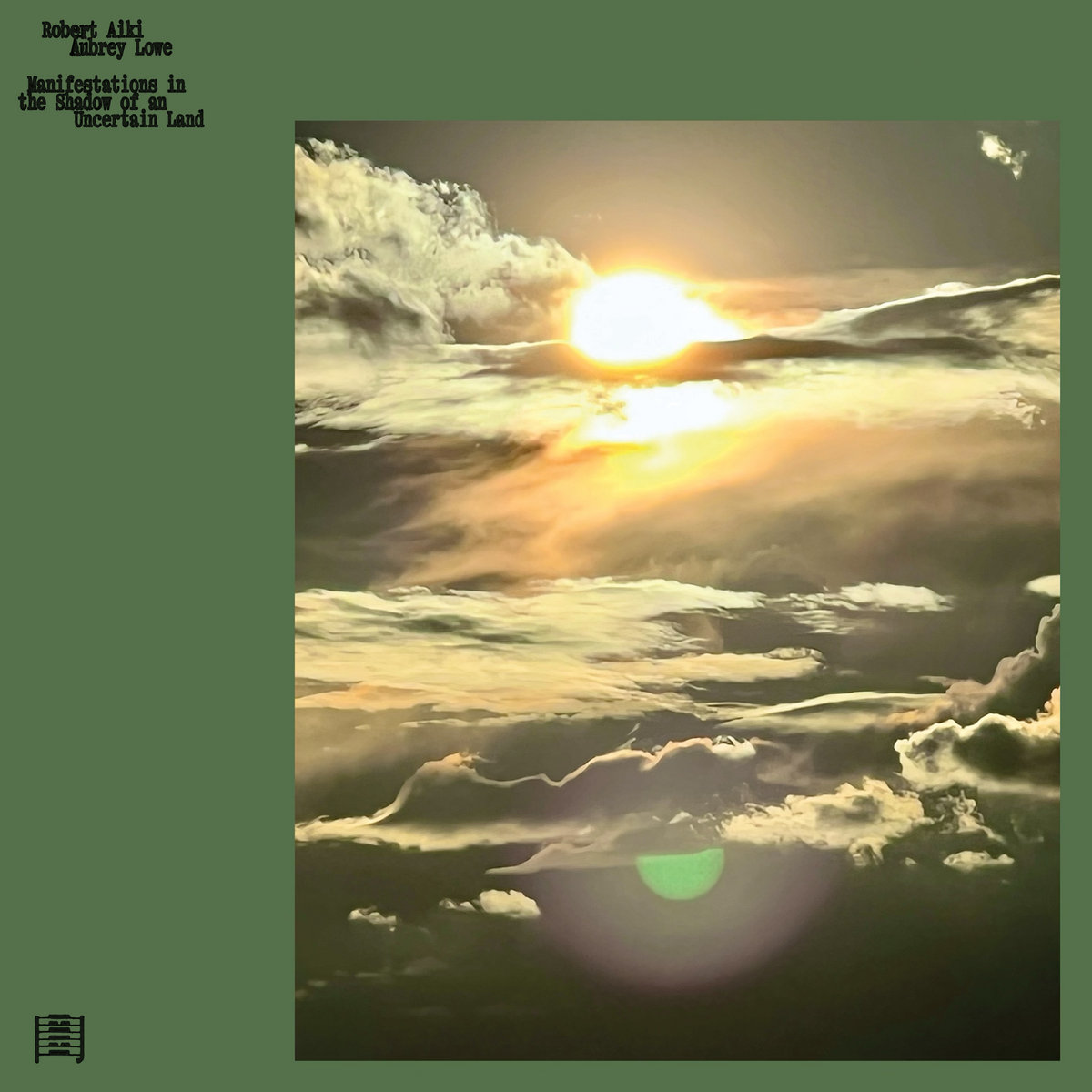
Dave Segal: The press release for the new album lists Parmegiani, Morricone, Penderecki, and Ligeti as influences. What is it about those composers' music that inspires you?
Robert Aiki Aubrey Lowe: The thing that I love about all of those composers is that they make very human music. There's this idea of perfection or remaining within a tradition. As human beings, we shift and move in different ways. I find it not very interesting to exist within traditional musical scales. The Western scale is not very interesting to me. I respect it, absolutely. But for me, it's about playing in between the notes. That's where I find the things that are most exciting and where I find the most ecstatic music. You can have these bursts of spontaneity where you can really lean into the concept of the ecstatic.
Dave: Manifestations in the Shadow of an Uncertain Land is a bleak sonic document of our current dystopian reality. Was it your intention to capture this horrible moment in history and reflect on how it rhymes with Kafka's In the Penal Colony and Peter Watkins's Punishment Park?
Robert: No. It was not initially my intention, but as I started to work on the record, I realized pretty quickly that the fatigue I've been feeling over the last few years, just being a human that lives in this world, it was important for me to get it out, and it's not out of my system by any stretch of the imagination. But it was important for me, with where I am, who I am, to look at how those things had been internalized and turn them back out in that form, which is this multiphonic landscape of horror. But also to try to find the dynamism within that space to have these bursts of, maybe not particularly joy, but hope . . . if that makes any sense?
As I was putting together the album, as I was going over the recordings and arranging the compositions, and doing the mix, I realized that these were the things that were important for me to land on and to try to do so in a way that was pointed, but not to make anything that was necessarily a discrete comment. The commentary is there, but these things don't have to be overt. It's this idea of things revealing themselves to you over time that is how I got there.
Dave: On the new album and in other parts of your catalog, it's hard to discern what sounds are coming from your voice and what's derived from your instruments. Is your goal to create this disorientation? Is it a challenge for you to take your voice to places that maybe only machines have reached? Is that part of your praxis?
Robert: It absolutely is. I love illusion and trying to trick the ear. We have such a wide range of timbres and frequencies at our disposal. Certain things can get into these nooks and crannies, and I like to play with acoustic, electronic elements, and body and vocal elements in these spaces to see what I can concoct, to really play with the ear. This idea of psychoacoustics, inner ear music, is all really exciting to me. And I love being able to take an element and manipulate it so you perceive it as one thing. These doors of perception that we have at our disposal—why not play around with them?
Dave: Has working with Randall Dunn—who called you "one of the masters of anybody doing modular-synth music" in an interview I did with him in 2021—changed how you create music?
Robert: I don't know if it's necessarily changed the way that I make music. When Randall and I work together, we find ourselves in a really interesting space. The amount of times we've worked together is really nice, because we developed our own vocabulary and way of moving. Like collaborating with anyone else, it's this idea of almost creating this exquisite corpse, where you have multiple bodies moving in space that end up finding themselves as one unit moving together.
I love the way that Randall thinks about sound. I love his enthusiasm for how he creates and how he hears things. I think we hear things differently, and that's something I really love. And once again, it's the idea of being able to create something that you may not have considered.
Dave: Let's backtrack a bit. When you were playing bass and singing in 90 Day Men, did you have any idea that your musical career would go in the direction it has?
Robert: No. I wouldn't say it was the farthest in my mind of possibilities, but it's not something I was actively thinking about, or thinking, "This is where my path would lead me." In general, I traverse this landscape day by day. And film has always been something that was interesting to me. So thinking about composition in that world just sort of made its way into my view. New composition and thinking about ideas of concert music and expanded composition were also really interesting to me early on. I don't want to put too much stock in it when it comes to career paths, because I don't really think I have a career. I'm just a person who makes things.
As a multi-disciplinary artist, the interest I have in many different things and many different ways of making things and addressing form and breaking formalism, I guess, in that regard, sure. But ultimately, the path is the path. You open yourself up to these possibilities, and you see what's available. Things reveal themselves to you over time. One thing that I will say is, I'm a relatively patient person. It's not a sprint; it's very much a long-distance walk for me. I find my way at a very slow pace.
Dave: Do you find that you use a different muscle group when composing for film than you did when recording as Lichens or as you do under your own name when working on non-film music—or is it all part of the same process?
Robert: Everything is under the umbrella of my practice and within that. I do try my best to exercise different parts of my brain that may have atrophied over time. I try to address things in slightly different ways and find ways to challenge myself, because that's ultimately most interesting to me. The intentionality is always there, but the tools I use to actualize those intentionalities will differ. It's always important for me to produce the work in a way that I can take risks in certain moments to try to find different pathways. It all becomes part of a larger vernacular. In one way, it's finding that I can trust myself intuitively to do these things.
Stay on top of The Tonearm.
Subscribe for exclusive interviews, cultural tip-offs, and community fun.
And your support keeps our site free of advertising and paywalls.
Dave: What factors draw you into working on a soundtrack? It seems like most of your scores accompany films dealing with social justice issues. Is that a prerequisite? I also note a pervasive darkness inhabiting your soundtracks.
Robert: I think it's just where I've sort of landed. My personal politics drive me in that way. Film music is something that I came to because I had a great love of it since I was a child. It also stands in for, or takes the place of, playing with an ensemble or a group. You find different ways to collaborate in these spaces. When I'm making an album or a piece of art that is solely mine, I'm sort of working within a vacuum. What I say goes. But I really like the idea of being in community with people, collaborating, and seeing these projects actualized.
Also, my love of the nonsensical and the absurd can factor into those spaces. Historically, you can see a lot of politically driven art movements that deal in the absurd, because the life that we live is pretty ridiculous in a lot of ways. The seriousness you can find in the political landscape is one thing, but so is the humor or banality you can find inside those same landscapes; it's all wrapped into one thing.
Dave: A lot of people who know your work may think of Telemarketers as a project you wouldn't take on. What drew you into that film?
Robert: I was approached by the Telemarketers team when they were in the process of getting the edit together for the first episode. In particular, the picture editor on that film, Chris Passig, who's a friend of mine and whose work I really respect, and I really enjoy his sensibility. He and I had never worked together on a project. But he had been using a lot of my work as temp music as he was cutting the scenes together. And when they reached out and told me about the project, I thought it was interesting. Then I saw some of the footage and experienced some of the characters within that landscape, and I thought it was a really exciting project. To this day, I think it's a pretty wild ride. It was a really fun series to do and also a good exercise for me to step outside the enclave I had created with some of the other film scores I had done.
Dave: I've been listening to your music and writing about it since 2005's Psychic Nature of Being. It seems like that album may have been influenced by Alejandro Jodorowsky's The Holy Mountain?
Robert: I would say that Jodorowsky in general was an influence on that record. It was during this psychedelic period I was having. I was really interested in a lot of mid-century film, music, and art. From the ground up, those recordings were improvisations. I had been exploring the voice as an instrument for a while at that point, and it was really my first foray into solo performance and recording. It was really interesting to see what I could do with my own voice with these sorts of crude accompaniments, as well as using a steel-string guitar and some percussive elements. It was really rough, which I was excited about. There seemed to be a tactility. And that's something I've maintained throughout the years in the way I make things. I like things that are unpolished. I like a bit of texture and noise. It makes the music a little more real.
The ideas that Jodorowsky had in that film, which also came from a political place, his work in avant-garde theater at the time, were all really interesting to me. It was very visceral and very disruptive in a lot of ways, and I really appreciated that. That's something that's carried through. Maybe there's been a bit of refinement in my output, but I think that tactility, that physicality, still remains. That's something that I never want to lose.
Also, in thinking about this new record and these new compositions and the relationship that I have to cinema and the excitement that I find in the work of someone like Chris Marker or Peter Watkins, I think that it maintains that visceral, tangible nature, but coming at it from slightly different slants.
Dave: You worked with Om, and I thought that went extremely well. Are there plans to return to that, or is it just a chapter that's done?
Robert: That whole thing came out of the friendship that Al Cisneros and I had and the mutual respect we had for each other's work. Truth be told, the reason that The Psychic Nature of Being came out as an LP on Holy Mountain—because I had signed to Kranky, and they weren't doing vinyl releases at that moment—and I was talking to Joel [Leoschke] about it and said I'd really like it to come out on vinyl. Would you mind if I approached another label just to do the vinyl version? He was fine with that. That first Om record had come out on Holy Mountain, and I was so taken with that record that I reached out to John Whitson. That's how that happened.
It's funny, because my first solo record, Om's first record, Six Organs of Admittance's first record, all came out through JW. That's why, when he passed, it was important for us to do that tribute. So Al, Ben [Chasny], and I were talking and trading recordings back and forth to put that recording together "Song for JW" by Holy Mountain Orchestra.
Dave: With regard to gear, are you strictly an analog guy?
Robert: Oh no. Any sort of elitism or concepts of purity don't make a lot of sense to me. All instruments are tools. If you find a tool that helps you to your end goal or at least helps you along the way, everything is welcome.
Dave: What are your go-to pieces in your studio?
Robert: I've been really into spectral sound sources lately, spectral oscillators. So I've been using a lot of oscillators where I can focus on the odd and even partials of a waveform. I'm always using low-pass gates. It's a combination of a filter and an amplifier, and they have a slower response time than a transistor-based amplifier. So you get these really nice, soft responses that actually sound like a membrane being struck. I like creating a lot of percussive sounds using those because it actually sounds like a three-dimensional object being activated.
I really like random voltages. I use a lot of random voltages in the work I do. When I use a modular synthesizer, I tend not to use sequencers and instead use random voltages, and I can then scale the amount of voltage to rein in the frequencies they're hitting. It's more manageable for me. But I like having random articulations, frequencies, or pitches that you can play with.
I like granular synthesis, being able to capture a sound and then zoom in on a very particular part of that sound and then time-stretch it, do a bunch of manipulation to it. I tend to use granular samplers when I'm working on film scores, because I'll do field recordings on location while the film is being shot, and use granular synthesizers like I would an old tape machine, by running the field recording through the granular sampler and cutting up different elements inside of the recording, to create something new.
Dave: What projects are you currently working on or are on the horizon?
Robert: I've just finished a film called A City in the Forest, which is a documentary about Cop City in Atlanta. The film turned out really great. [Nolan Huber and Lev Omelchenko are] young filmmakers; this is their first feature. They captured the footage using not only digital cameras (Blackmagic Cinema Cameras), but also 16mm film, so the cross-pollination of formats is really nice. It makes for a really interesting texture throughout the film. I just got back from watching the DCP [Digital Cinema Package] of the film that's being submitted to the Sheffield DocFest. (It premiered June 11 there.) A film that I worked on a couple of years ago called Grasshopper Republic, which is a documentary about grasshopper trapping in Uganda, was picked up by the Criterion Channel and is streaming there. Also, if you go to grasshopperrepublic.com, there's a link to Kinema, where you can stream the film.
Check out more like this:
 Carolyn Zaldivar Snow
 Dave Segal


Comments