


Ahoy, newsletter reader of the highest caliber! I am your recurring Sunday pal, Michael, and I bring you the weekly Talk Of The Tonearm newsletter. This one is particularly filled to the brim, which is an amazement as you'll soon discover, so let's drop the small chat and get right to the heart of the matter. Enjoy!
Surface Noise
 Sam Bradley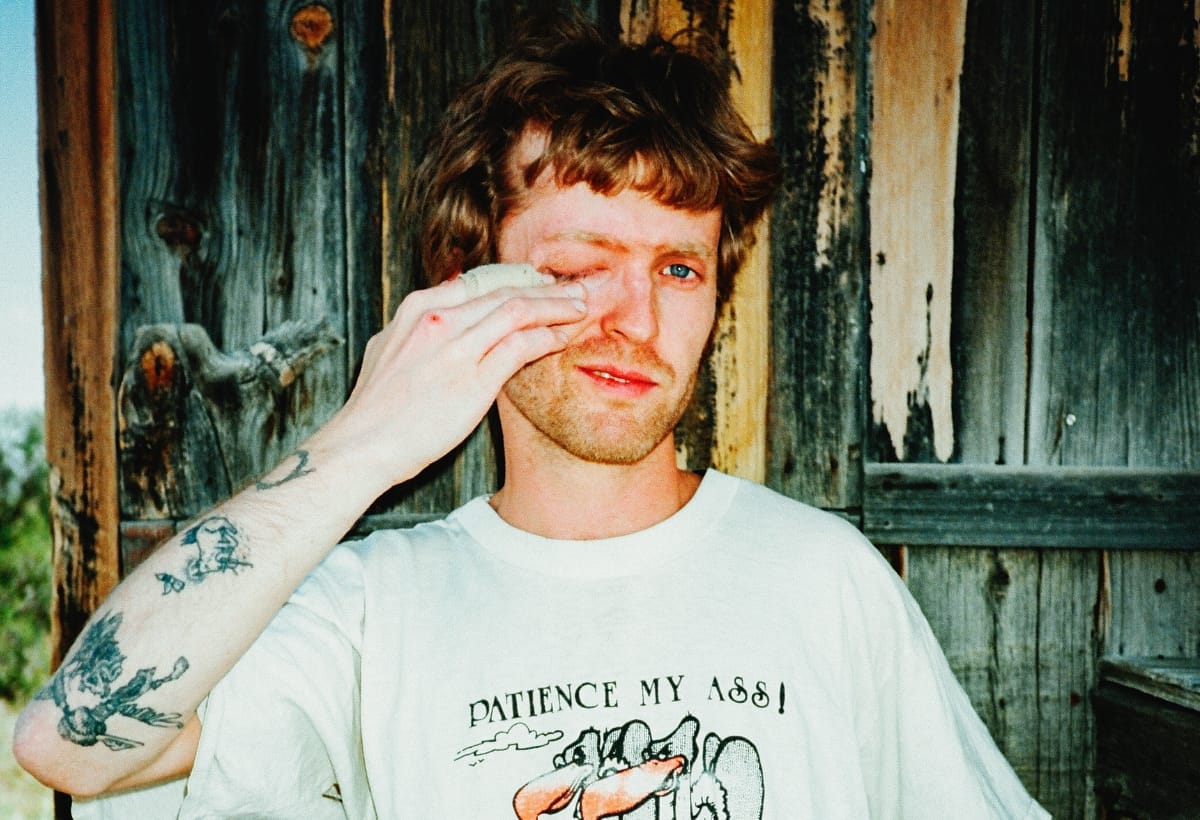
Greg Freeman's choice to title his second album Burnover reaches back to early 1800s Western New York, where "apocalyptic theology and weird utopian communities" changed the region into America's strangest spiritual testing ground. The area became known as the Burned-Over District, so named because it had been so thoroughly evangelized that there was no religious fuel left to burn. Freeman insists he "wasn't trying to get overly historical with the name," yet his music participates in a tradition stretching back two centuries. Women claimed divine authority through sound and song in these communities, and sacred landscapes shaped American musical consciousness.
The Lebanon Shaker settlement, just south of Freeman's Vermont home, established communities where Mother Ann Lee's female followers developed "gift songs." The Shakers claimed to channel these spontaneous compositions from the spirit world and performed improvised transmissions during worship. These were often wordless vocalizations that arose at specific locations they designated as "feast grounds." They also charted their settlements around places where they heard celestial music, treating hills and groves as instruments capable of amplifying divine communication. The Fox sisters of Hydesville pioneered their own form of acoustic mysticism, converting spirit communication into music consisting of strange knocks and mysterious sounds. Their séances were participatory concerts, requiring audiences to decode meaning from rhythm and timbre rather than melody.
Freeman's insight that "any Robert Johnson song is just a list of places" connects him to the Shaker tradition of embedding sacred locations within musical texts, while his emphasis on grounding songs "in stories and the material world" reflects the same principle that guided uostate spiritual seekers of the 19th century. Freeman's garage rock anthems might be tapping into the same restless energy that once drove thousands to utopian communities, suggesting that the Burned-Over District's capacity for musical inspiration still burns brightly.
Playback: Reflecting Humanity Through César Dávila-Irizarry's Chaotic Soundscapes → Growing up in Puerto Rico, César Dávila-Irizarry learned to perceive "silence" as layered soundscapes full of crickets, coquis, occasional gunshots, and domestic sounds. His description of Puerto Rican silence being "really fucking loud" while suburban Chicago presents a disturbing vacuum might rhyme with how the Burned-Over District's settlers transformed supposedly empty landscape into spiritually resonant terrain.
 Lawrence Peryer
Rez Abbasi sits in meditation each morning, working toward deep stillness. Yet even in these moments of mental quiet, something audible persists. "I always noticed that sound is the last thing that goes," he explains, describing how his consciousness can release thought, emotion, and physical sensation, but never quite escapes the domain of hearing. This observation, which inspired the title of his latest album, Sound Remains, says something about how our brains prioritize the senses. Unlike vision, which we can close our eyes to block, hearing works as a 24/7 early warning system designed to detect approaching threats. Thus, sound becomes the "last sense standing" in Abbasi's meditative states—we're hardwired to keep listening even as everything else shuts down.
Abbasi's method for improvisation—learning to "stop thinking about your own playing and really just listen"—describes a neural state that researchers now recognize as optimal for creative flow. Our inner narrator quiets during deep listening, allowing other neural networks to take over and make interesting connections. It's as if auditory focus expands our awareness while visual focus narrows attention. Abbasi goes even further, discussing the concept of becoming “environmentally absorbed” rather than “self-absorbed” during performance and engaging a distinctly interactive listening mode.
Abbasi's daily meditation practice is training for this improvisational state of mind. Likewise, his choice of acoustic instruments creates optimal conditions for both performer and listener as the natural harmonics hit us in ways that synthetic sounds can't. Listening, our most ancient sense, may be our best creative tool —a novel consideration in a world increasingly dominated by a firehose of visual stimuli.
Playback: Claire Cope's 'Every Journey' and the Women Who Dared to Explore → Composer Claire Cope describes how improvisation "liberates" her from the intellectual constraints of composing on a computer, allowing her to be more creative than through purely cognitive means. Cope and Abbasi both aim to bypass the analytical mind in their work, suggesting that a listening-centered process opens compositional possibilities that are much different from those arrived at intellectually.
 Lawrence Peryer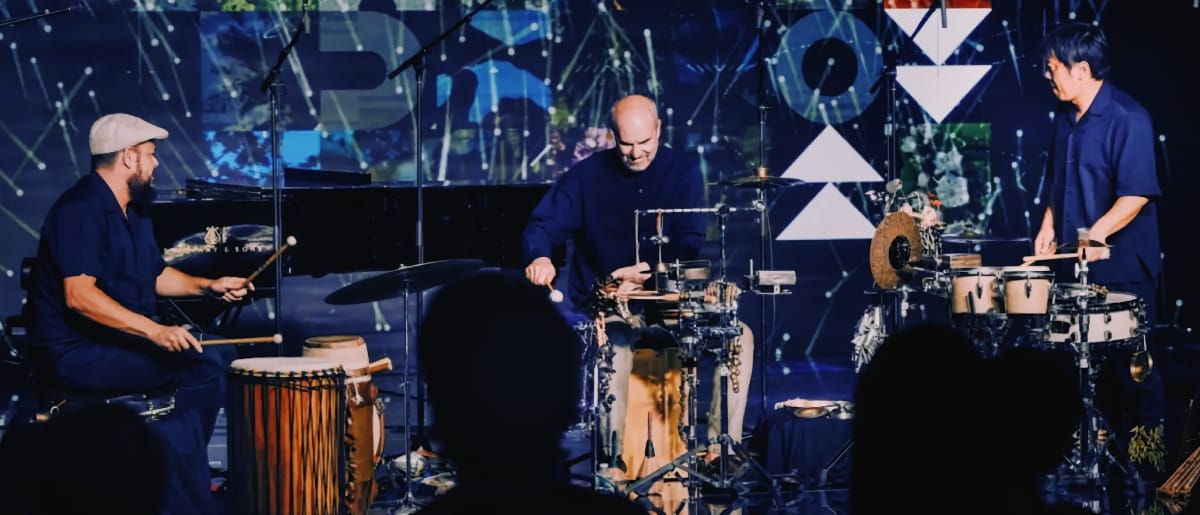
Each Cardume performance creates what anarchist theorist Hakim Bey might recognize as a Temporary Autonomous Zone. These brief pockets of freedom allow conventional rules to dissolve and new potentials to develop. Rogerio Boccato's trio occupies sonic territory rather than physical space, establishing a leaderless musical republic that exists only for the duration of their set. The parallels to open-source software are fun to think about: just as programmers contribute to a shared codebase, each musician offers sounds and gestures without claiming ownership over the resulting composition. Boccato's description of "letting go of our own ideas when it makes sense" expresses the core principle of this creation, where shared intention eclipses any individual contribution.
This mindset challenges the attention economy's principle of scarcity. Most musical contexts operate on attention as a limited resource. Soloists compete for the spotlight, while rhythm sections support singular voices; Cardume practices what amounts to attention-gifting. The trio's ‘intense listening’ creates an abundance loop where gifting focus to others generates rewards for everyone. Nobody hoards sonic space or saves their best ideas. Boccato's emphasis on trust and mutual respect converts individual expression into collaborative creation, spawning what he calls "an act of resistance" against an ego-driven musical culture.
Of course, there are political implications. In a culture where platforms extract value from every interaction, Cardume's analog method preserves what tech theorist Zeynep Tufekci calls "enactment." This translates to the ability to create meaning through direct, unmediated human coordination. Cardume's music becomes a small-scale rehearsal for post-capitalist cooperation, reminding us that collective action can flourish without markets, overseers, or algorithmic coordination.
Playback: Buzzing with Zen — Steve Holtje's Improvisational Honeymoon → Steve Holtje describes the Bushwick/Ridgewood noise scene as uniquely open and without the usual combative dynamics. He says it's the most loving scene he's witnessed, where "nobody's being competitive or saying 'that's not how you're supposed to play that instrument,'" sounds a lot like the trust and mutual respect that Cardume practices.
 Lawrence Peryer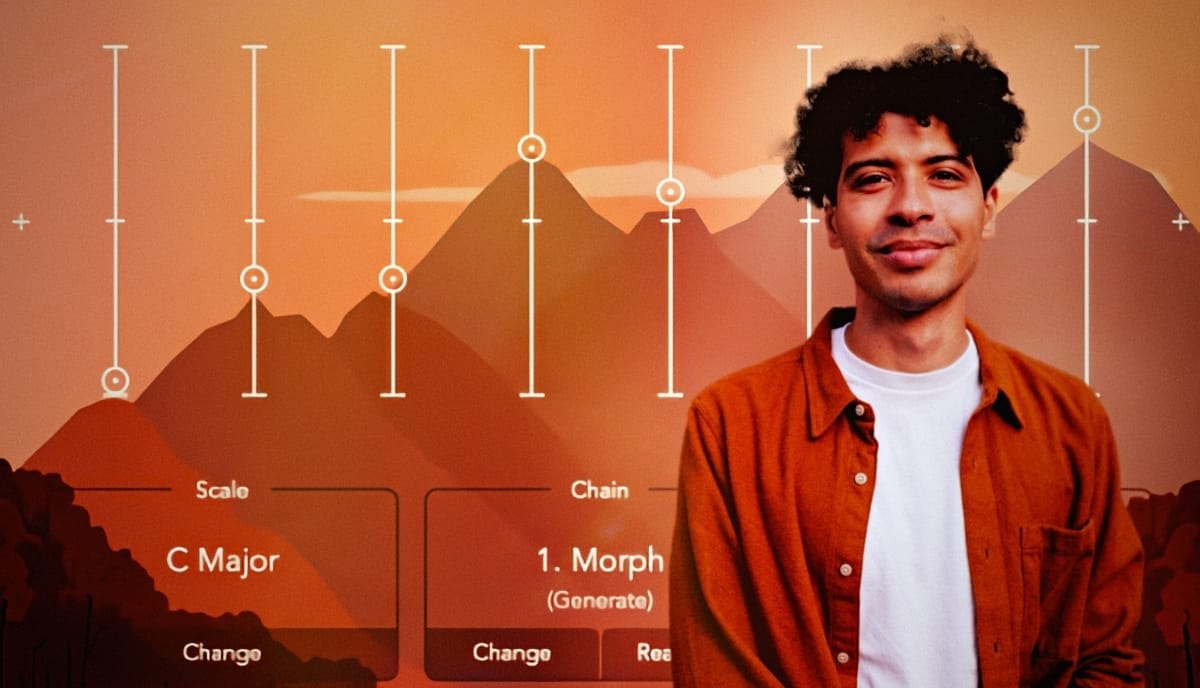
Philadelphia-based developer Aqeel Aadam has built his company, Aqeel Aadam Sound, around what he calls "democratizing ideas"—taking the inspirational workflows of thousand-dollar Eurorack systems and condensing them into affordable software. He also admits that he "typically doesn't encourage people to explore" modular synthesis itself. So then, how do you maintain the underground spirit of electronic music culture while making its tools accessible to everyone?
The modular synthesis community is shaped by its barriers. These are economic ones, certainly, but more importantly, through complexity. Understanding control voltage, patch programming, and the esoteric functions of modules requires commitment. Knowledge becomes cultural capital, and there are clear insider and outsider dynamics. Aadam's plugins, alongside other developers' virtual modular synths, threaten this exclusivity, and Aadam's latest offering, Waymaker, especially aims to bring modular sequencing concepts to anyone with a DAW. The hardcore modular community's response to software like this has been mixed. Some embrace software tools as gateways; others view them as commodifying their craft while missing the point. Many synthesists treat the physical act of patching cables as a philosophy.
There's no doubt that Aadam is aware of this back-and-forth. His methodology focuses on "recreating workflows" rather than replicating modules, positioning his plugins as teaching tools that encourage creative thought. But who gets to be the teacher and what exactly is being taught? Almost as a response, Aadam describes his daily practice of recording something every morning while avoiding his own plugins. This helps him stay connected to the hardware world that inspires his work. So, perhaps Aadam is also wrestling with this balance. He understands that inspiration can't be packaged even as he makes the tools for unwrapping it.
Playback: Disappearing Act — Tal Yahalom's Generous Guitar Moves → Tal Yahalom talks about his goal of challenging "the image of the guitar slinger," moving away from the traditional hierarchy that places individual virtuosity at the center. Like Aadam, he's working to expand access to musical expression while confronting the tension between maintaining authenticity and broadening participation.
The Hit Parade
I’m passing the baton over to LP for a couple of recommendations this week, which will give you a break from my usual noodly ambient-adjacent suggestions. Here’s what he’s got for you today:
- New York Times Popcast: Earl Sweatshirt Interview → I have found a new dream podcast guest (sorry, Zorn, you’ll have to wait in line now). The recent New York Times Popcast interview with rapper Earl Sweatshirt is a discussion where intellectual depth meets emotional honesty without a trace of pretense. I have not always enjoyed Joe Coscarelli and Jon Caramanica’s interviews in the past; both are better as commentators and critics, but despite themselves, they created space for Earl to reflect on his growth from teenage internet sensation to 31-year-old father. The result feels like listening to the inner monologue of someone working through fundamental questions about art and identity. Earl, talking about the title of his new record, Live, Laugh, Love, sheds light on his relationship with irony and sincerity. He explains that the 16-year-old in him still scoffs at basic sentiments and sentimentality, while fatherhood has made him genuinely understand the value of both. I admire Earl’s ability, even desire, to hold contradictory truths without needing to resolve them. He seems delighted to be sitting in that nexus point. If every pop star could be this funny, insightful, vulnerable, and self-aware, our pop culture would be all the richer for it. We might even go back to having heroes. (Ed. Note: Also be sure to check out Harmony Holiday’s poetic essay on Mr. Sweatshirt in her latest newsletter.)
- Led Zeppelin – Live EP → There’s a new Led Zeppelin album coming. (Alright, only kinda not really.) Live EP is a four-song, well, live EP, featuring concert takes of songs from Physical Graffiti. Side A features two tracks from the band’s 1975 Earls Court shows, while Side B has two tracks from their final UK shows, at the 1979 Knebworth Festival. I have had Zeppelin on the brain due to a combination of watching the Becoming Led Zeppelin documentary earlier this year, as well as listening to a recent interview with the director of said film on Rick Rubin’s podcast. (Ed. note: Not to mention the latest mind-boggling episode of A History of Rock Music in 500 Songs.) Plus, it’s summer, and I am not immune to driving around with the windows down, blaring the Mighty Zep. Only one of the four tracks is available as of today, “Kashmir,” from Knebworth. The performance is great, but the mastering is a little tinny; it could use more John Paul Jones and Bonham. I ordered the vinyl. It arrives September 12. That’s a warning for my neighbors.
- … and now back to me for the Short Bits: Saxophonist Rico Jones is the guest on this week's Spotlight On podcast, and he has a lot of insightful things to say about the meeting of spirituality with improvisational jazz. • Mark Richardson on the 40-year anniversary of Brian Eno's Thursday Afternoon. • A pair of chill-out mixes, one from Joe Muggs and the other from Nightmares on Wax. • A pretty comprehensive history of CBS Records' 'The Nice Price' album tier. • Hopefully coming soon to your town: In Sheep’s Clothing’s 2025 Guide to Audiophile Listening Spaces. • An extensive article in DJ Mag looking at the future of music festivals through the lens of climate change. • Here's one of the best covers of a Velvet Underground song I've heard.
A Shout from the 'Sky
Deep Cuts
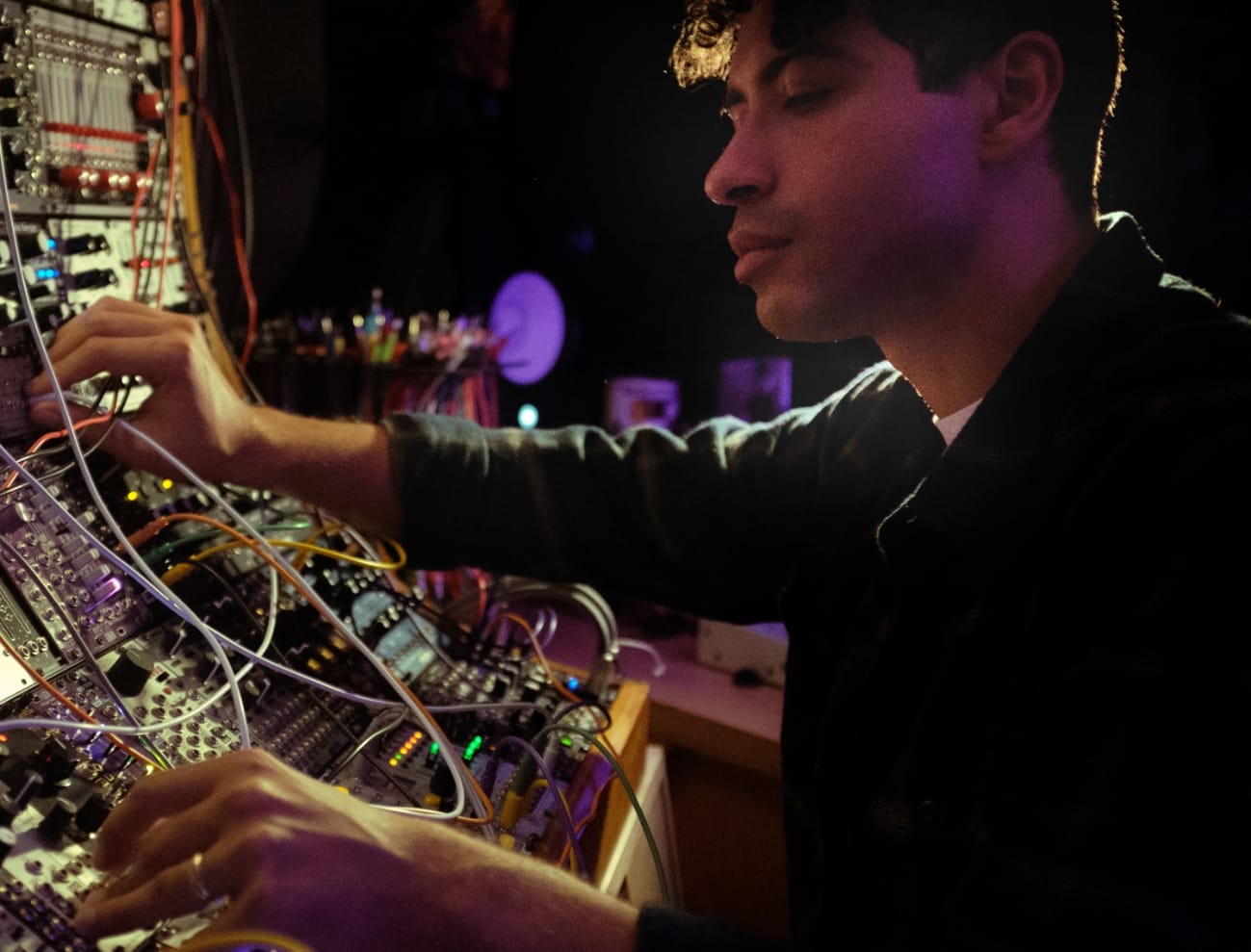
This week, I asked Aqeel Aadam (profiled above) my favorite question: What’s something you love that more people should know about? He gave me a puzzling answer (ha-cha-cha-cha):
One of the things I love most outside of work are puzzle games! As often as I can, I get stuck into games like The Talos Principle, Chants of Sennaar, A Monster's Expedition, The Witness... As someone fortunate enough to enjoy what I do for work, it's easy to let work consume my thoughts constantly. Early on, when I started Aqeel Aadam Sound, I adopted a philosophy of ‘forced relaxation’—I make sure to take the time to dangle a different carrot in front of the horse, and give my brain some different problems to chew on. I think it's really important to make sure that you're always considering other perspectives and having new experiences, and wrestling with puzzles is one of the ways that I love doing that.
Run-Out Groove
Whew! This one was quite an accomplishment. I'm having issues with my eyes this weekend (those who know me will recognize a familiar refrain), and I wasn't sure how long I'd last. But through all the squinting, eye drops, and vision breaks, I made it all the way. Now I am lying on a couch and chilling the frack out, eyes closed, content with my newsletter triumph.
Here's a quick shout-out to Ross, our first paid supporter here at The Tonearm. As you may recall, last week we soft-launched our supporter program. You can pop over to the front page of our site and scroll down a tad for some incomplete details. More to come, etc., etc. We love you and would love your support.
Something else we love is when this newsletter gets shared. So please forward it to a friend who's never heard of the Burned-Over District before (which would have included me until Sam handed in his Greg Freeman interview). You can also post the 'View in browser' link found at the top on social media, which is also a kind of Burned-Over District, if you catch my drift. And—as always, I'd love to hear from you, and I'll surely respond, even if that requires more squinting. Just reply to this email or contact us here.
That's all for today! Protect those peepers. Don't speed in school zones. Give an animal friend a hug (and a person friend, too, while you're at it). I'll see you here next week! 🚀
Connect with The Tonearm:


Comments