
I first heard about Beth Ann Hooper's idea to keep poetry alive for the next generation by blending it with film from my spouse. As we sat at the dining room table, I kept redirecting the conversation back to the award-winning poet, filmmaker, and producer. Questions poured out of me, and they wouldn't stop.
Soon afterward, my spouse connected us. With a few emails back and forth, the more I learned and the more fascinated I was. Hooper described her project in two parts. The first was a poetry collection titled Haunting the Dead. The second part, Poetry in Motion Picture, "is a short festival/arthouse film that takes the same three poems with two brief intermissions, [the first] between the first and second [poems] and [then another intermission between the] second and third poems." She added that this "gives the film five parts, which is a symphony structure. A composer is creating original music for this, and we are going to hit the festival circuit with it."
The idea of setting poetry to film, while also interspersing symphonic structure, excited me. As someone who fell in love with poetry only after hearing it at a poetry slam competition almost seventeen years ago, I understood that the art form needed to be modernized. Beth was trying to take it further by merging artistic media to create something new.
A week before the interview, I was sent a PDF preview of the 108-page poetry collection Haunting the Dead. From the musicality in her language to the raw topics she covered, I found a writer capable of pushing boundaries on the page. But there was more—a few of the poems had QR codes ("Haight Ashbury," "Aşk," and "Kismet") that led to YouTube videos. I watched, hearing Hooper read her poetry aloud against various abstract imagery, from cats eating trash to waves crashing against the beach to an illuminated moon peeking into view through clouds. The more of Hooper's work that I experienced, the more I wanted to discover.
Since we are both local, we met at The Bookery, a local indie bookstore and coffee shop. It would be only a few months before Hooper held her release party there on July 25. After a brief, inaudible exchange with two Bookery clerks that Hooper seemed to be well-acquainted with, Hooper appeared, shifting her bag to the ground near her seat. Sitting down at the table, Hooper explained that her project was coming together, and she had something to show me. She opened her laptop and pulled up a preview of Poetry in Motion Picture. Though a few small parts still needed to be added, I saw an exciting project in its final stages.
The three poems I had seen earlier now had symphonic New Age music, giving the work a completed feel. As each poem washed over me during the seven or so minutes, I experienced all of Hooper's poetry coming to life, leaping out from the confines of the white pages I had read only a week prior.
From there, we began to talk. I started by asking Hooper to walk me through her career both as a poet and an independent filmmaker. Specifically, I wanted to know how both careers were connected. Hooper began by saying she "wrote poetry all her life," and then recounted an anecdote about how her ex-boyfriend stole a poem from her, entered a contest, and won.
But her desire to write poetry wasn't just something that came to her. In her words, she "was born into it." During her PhD program, she only planned on "questioning T.S. Eliot and Ezra Pound and basically arguing that modernism started with Poe." However, her life path changed drastically when she told her PhD supervisor that William Carlos Williams had delivered her dad. Hooper explained that he "promptly sat me down, went completely pale, and told me I needed to look into my DNA three times." This is because, in addition to being a doctor, Hooper explained that Williams was "a womanizer. Because he was also a doctor, he slept with all his patients," and "delivered all his love babies."
After this, Hooper's investigations shifted, and she began uncovering what she called her "family secret." Her father "tried to push her toward journalism because he had been a sports writer before becoming a lobbyist . . . anything to do with poetry or literature was completely silenced." Now, she knew why.
Several months later, with her dad’s blessing, Beth’s uncle gave her a copy of William Carlos Williams's autobiography. Inside was an inscription written to Doris Hooper, Beth's grandmother, dated April 1, 1952, (because as Hooper explains, "doctors date everything") that read "For Doris Hooper, for old time's sake—W. Carlos Williams." Hooper expressed that this date was "18 years to the day my father was conceived." There was also the poem "Nantucket," which was written around that time. Hooper stated that "if you read the poem, it obviously has a lot of Freudian symbolism. In fact, the last line is 'the immaculate white bed.'"
These findings were revelatory for academia and became the building blocks for Hooper's first novel, 2024's The Roots That Clutch. She won several awards for both the book and the cover and created an accompanying short film, all while allowing her to tell her story through a fictional lens. After living for years overseas in the Netherlands, she's made her way back to New England because she has "400 years of family history that has been kept secret" from her.
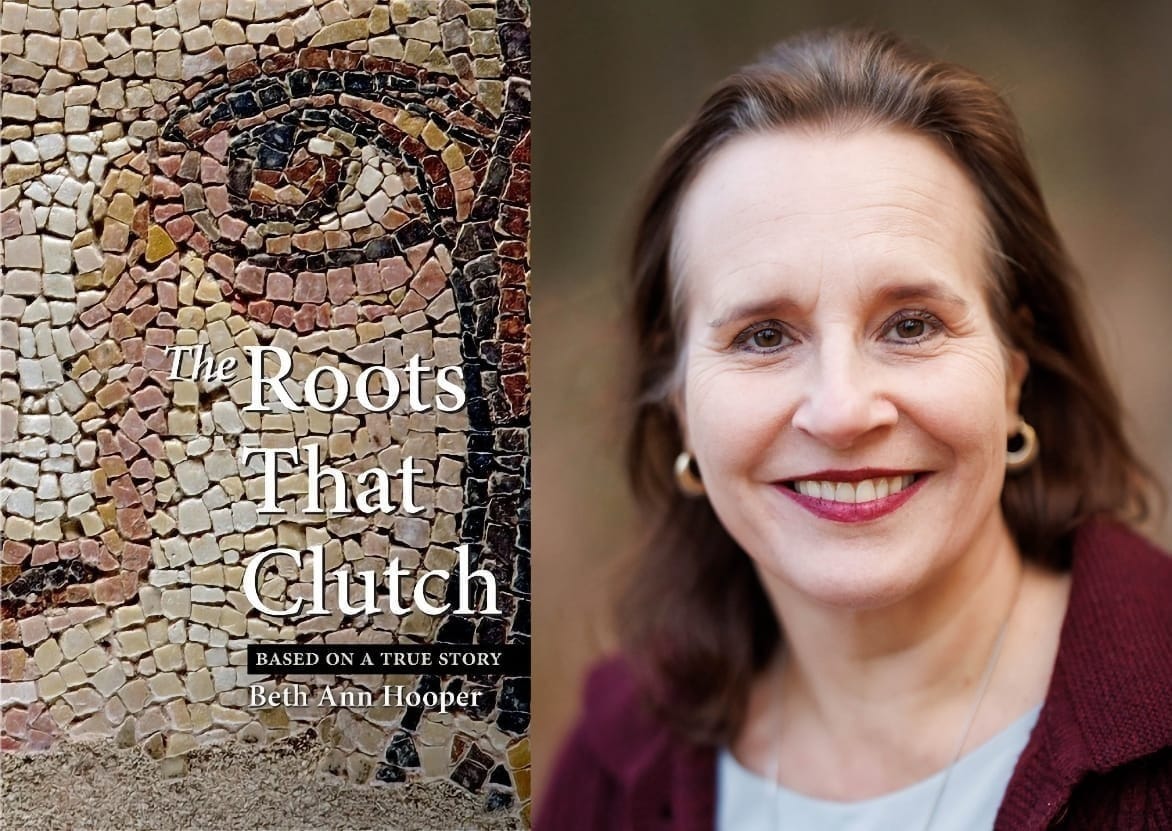
In her last ten years in the Netherlands, Hooper was a freelancer, working on various projects while writing her novel. Because of her line of work, she was able to collaborate with various creative people, such as Kjeld, her graphic designer, who would eventually help her with the celebrated cover of Roots That Clutch. Over time, she "developed a crew" from various projects, including adding English subtitles, producing, and writing, that she could use for future endeavors. Throughout her artistic collaborations, Hooper has said that the most important way to maintain these connections is to give "complete creative license that you have total trust in their ability to make you better." And of course, she added, "pay them on time too."
Hooper was regularly producing projects at this point, and by 2022, she took a leap when she found out about a "Dutch documentary [In the Interest of the Child] going around in the Netherlands." The film, described in copy as "battered mother fighting against child protective services," had "a huge audience overseas because of the subject matter," Hooper says. As such, she reached out to the director and asked why the film didn't have an international version. The director said that there was no funding, but Hooper persisted, saying that she'd "finance and do it." Though she would later earn an associate producer credit, Hooper saw herself as "an investor."
In three weeks, thanks to Hooper knowing who to hire, the subtitles were finished. Later, the documentary was nominated for awards at DOCUTAH, including best foreign film and best feature, which Hooper describes as "just amazing for a foreign film in the United States." However, by spring, she began posting promotional videos for her own novel, The Roots That Clutch. The Swedish International Film Festival asked if she would enter them in the festival. Because each video submission required a fee, Hooper combined all the clips into one film.
Despite Hooper riding high on these moments, tragedy was not far behind. Six months before DOCUTAH, her mother had passed away, and two weeks after she returned, Hooper found out her partner was terminally ill, eventually dying in 2023. Her father also passed three weeks before that. After "three key people" in Hooper's life passed within 54 weeks of each other, along with several deaths during COVID, Hooper realized that "Art is life's pushback on death." This sentence is part of her introduction to Haunting the Dead. She further elaborated in the interview that, as humans, "art is one of our coping mechanisms. One of the good things we can use social media for is to spread art," especially when it makes art more accessible and affordable to others.
This, of course, ties in with her idea of transforming a few poems from her collection into a film. She had the inspiration when she saw Werner Herzog speak in September 2023 at the Eye Filmmuseum in Amsterdam. Several film students were in attendance, so at one point, when Herzog was asked on stage what the students needed to do to create a great film, Herzog replied, "You've got to evoke the same emotion as poetry in film." From there, a lightbulb went off in Hooper's head, one that would later come to fruition in the second part of her project, Poetry in Motion Picture.
But before that would come Haunting the Dead. Even though Hooper had her debut as a novelist, she wanted to move even further back to her "roots." Stating that "writing a novel when you're a poet is like taking a shit with your ass in the air," she explains that it's hard to know what to do with all that space. That's where Haunting the Dead comes in, the first part of her new project.
Keep The Tonearm free.
We publish without advertising or paywalls.
Reader support makes that possible.
One of the things we talked at length about was craft in various ways. Haunting the Dead, though a written work, is rife with musicality. Though this is a common theme within poetry, Hooper's collection inhabits it in several ways. Hooper attributes it to being able to "speak a number of languages." In addition to Dutch being her second language, she spent time in France and Belgium, where she developed her French. Also, Arabic was another language she heard often, not just because her partner was Turkish, but because she said she met several refugees due to US foreign policy.
All of this made Hooper think about "the rhythms of these different languages." Going on, she describes how to her "English is very staccato," and "the farther south and farther east you go, you get more crescendos."
Another aspect of her musicality comes from T.S. Eliot, whom she says she is "very critical of." She admits he "was an extremely musical poet," implying that some inspiration comes from him. She believes she found this link because she grew up in Kentucky, which allowed her to see a connection between Stephen Foster, an American composer who wrote "My Old Kentucky Home," and T.S. Eliot.
Our conversation became particularly deep when we discussed cosmic references within Hooper's work. Hooper explains that it's all about cycles, mentioning that Earth is always spinning. Although people want to be able to move on with grief, instead, "you just learn to live with it." She somewhat equates it with an act of "submission to something larger than we are." She admits, though, that there's a cognitive bias here, stating that "submission's a tough word in the Western world, because it's the opposite of freedom." Though Hooper argues we aren't "going to win against death," she is "going to fight it as long as I can with creativity or with art." Again, the phrasing she uses here connects back to the one in Haunting the Dead's introduction: "Art is Life's pushback on death."
We shifted here to talk about Poetry in Motion Picture. Though I had read in Hooper's emails that the videos were interpretations, I wasn't aware of the extent to which Hooper wasn't involved in creating them. This is a similar mindset she has toward much of the work she hires people for. Although she expressed that you need "a level of trust that you can't just whip out of a hat," the results can be astounding. With the video interpretations, she gave her video editor, Andries, "complete creative license."
Although it has worked well for the most part, Hooper said, "sometimes we hit a wall, and we do have to collaborate." Describing one of her poems, "Kismet," as originally "a disaster," she brainstormed with Andries on an instant messaging app to arrive at a solution. In general, though, Hooper found that giving other artists creative control and license allows them to create better work. This is because it makes them more passionate about what they're creating. Giving an example with her graphic designer, she stated, "Most graphic designers will give you three options. And he sends me nine." Hooper posited that maybe this is where film direction is going, where you "can work with an international crew" on an instant messaging app.
I asked if Hooper had any advice for artists. She advised them to "get out of their own paradigm. Go beyond the material. Don't just stick to the page—work with filmmakers, visual artists, composers." She further stated that if you "do let go" of the "boundary of the page," you can "discover remarkable things." Further elaborating on her own work, she expressed that a lot of Poetry in Motion Picture came about because of the collaboration: "What Andries and I discovered is that you have a typographical canvas on screen, just as Kjeld and I have one on the page—but you also have to deal with the limitations on that screen." However, despite these "fundamental constraints," the form can be "expressed in a different dimension," which allows another point of view. It felt like the perfect point to end on when talking with the multi-hyphenate filmmaker, author, poet, and producer. After we said our goodbyes and finished my last sip of coffee from the café, I smiled, glad to be part of a further collaboration to help share Hooper's story.
Check out more like this:
 Lawrence Peryer
 Lawrence Peryer


Comments