


As a teenager in San Francisco, David Katz first heard reggae on the local station, KTIM, though it was an encounter with a Jamaican soundsystem that finally blew his mind. "I just remember walking into the room, and the bass hit me like a thunderbolt," he says of that night in 1982. He moved to London later in the decade and was retained there as Lee "Scratch" Perry's ghost writer, "that's two words, ghost writer, but that's kind of another story."
He has written about Jamaican music ever since. People Funny Boy, his biography of Perry, appeared in 2000, and Solid Foundation, an oral history of reggae built on formal interviews with more than 250 of the music's prime movers over fifteen years, followed three years later. A study of Jimmy Cliff came in 2011. Alongside the books, Katz has coordinated and annotated more than a hundred retrospective collections of Jamaican music and produced documentaries for Afropop Worldwide, the BBC, Arte, and Channel 4. His writing and photographs have appeared in The Guardian, Mojo, The Wire, and Wax Poetics.
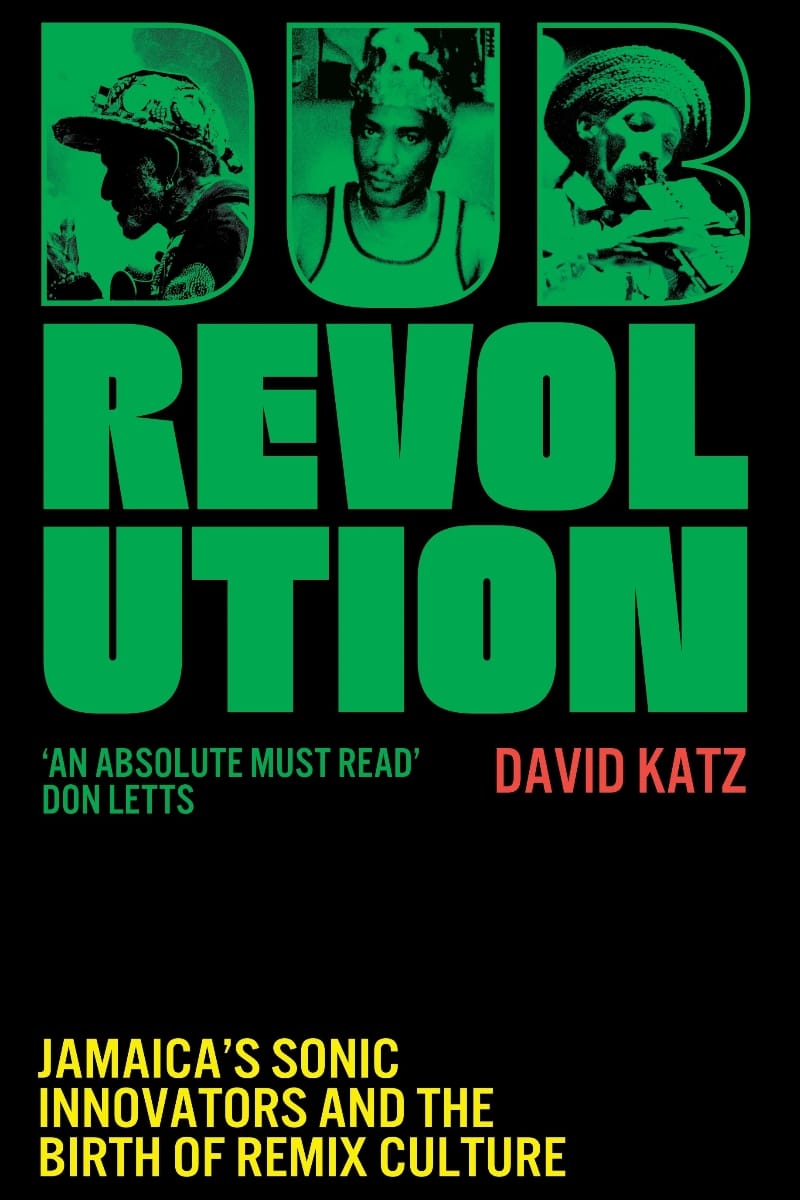
Since 2004, Katz has run Dub Me Always, a monthly reggae vinyl night at the Ritzy in Brixton that makes room for veteran soundsystem selectors. He's also co-hosted the annual Reggae University at Rototom Sunsplash since 2007, where he has put questions to Bunny Wailer, Chris Blackwell, and the Skatalites. Dub Revolution, published by White Rabbit Books, draws on forty years of that work and took five years to write. Most of it comes from firsthand testimony from the people who first made dub, and it follows the music from Kingston to New York, London, Europe, Japan, and Brazil.
Lawrence Peryer recently hosted David Katz on The Tonearm Podcast. They discussed where soundsystem culture began, the engineers who built dub at King Tubby's and Channel One, and the particular environment in Jamaica that spawned the music.
You can listen to the full conversation in the audio player below. The transcript has been edited for length, clarity, and flow.
Lawrence Peryer: I want to ask you a little bit about King Tubby, Scratch, Prince Jammy, and Scientist. They're grouped as sort of the originators, right? I'm curious about the similarities, the differences, and the contrast between them. And I wonder, could you talk me through a little bit about those personalities and the music they make? Because by the time we get to Scientist, I think of it as much more modern, although dub is always this sort of quasi-futuristic thing. But Scientist feels so different than King Tubby in my mind.
David Katz: I completely agree. In the book Dub Revolution, I do my best to trace this evolution, and it's complicated. You have to look at the broader picture. And I would also encourage your listeners, anyone reading the book, before they start the book: everything they think they know about dub, just put it to one side.
That's what I had to do when I was researching the book. And this book draws on about forty years of research, and it took me about five years to put together. I really did have to set everything aside, or even throw it out the window. And in the book, I do have to trace it back, because dub is so tied up with soundsystem culture. I had to wind it right back to explore and try to illuminate more clearly what soundsystem culture actually is. How did it come about in Jamaica, and why?
And the thing with researching the evolution of Jamaican popular music is that—and this is happening to me time and time again—things always happen earlier than you think.
I always considered soundsystems to be a post-war phenomenon, the years following World War II, and then when I was researching this book, I actually discovered that as early as 1939 you could go to Stanley Motta's Appliance Store in downtown Kingston, or the Montego Bay branch, and you could purchase or hire something that was already termed a soundsystem, and it had an RCA amplifier and two speakers.
And then it turns out that actually even before that you had what's known as a radiophone—in the UK they called it a radiogram—and you also had these radiophone parties happening. Initially, they were held at exclusive members' clubs like the Bournemouth Club and a few other members-only clubs in Kingston. They were a way to attend an orchestra dance without actually having an orchestra present.
Then came developments in 1947. Everything changed when Hedley Jones, who'd already built a solid-body electric guitar himself, made an amplifier much better suited to reproducing prerecorded music. Most of the soundsystems to that point were using PA systems, and the PA systems were really designed just to amplify the human voice. Because he'd been in the RAF in World War II and learned radar and sonar technology, he found a circuit design for an amplifier by D. T. N. Williamson. That circuit design really transformed amplifier building in the years following World War II. Hedley used that blueprint and built his own amplifier, and then flopped Tom the Great Sebastian—or in those days he wasn't the Great Sebastian yet. It was just called Tom's soundsystem. Tom was preparing for a dance across the street from Hedley's shop. Hedley started blasting these Pérez Prado records on this new amplifier he'd built, and it totally flopped Tom's dance. So Tom went and bought an amplifier from Hedley, and then all the other soundsystem owners did as well.
Lawrence Peryer: That's the first soundsystem clash right there.
David Katz: Pretty much. It was unofficial, but yeah. I think the first official one was 1951 at the Pioneer Club in Jones Town. Then you had this thing that happened in the early fifties: from 1950, Count Machuki started to do these wisecracks, a kind of jive talk slang that came from Dan Burley's Original Handbook of Harlem Jive, which he bought on Orange Street at Beverley's. He started doing this kind of rhyming pattern in between records.
And then Clement Dodd at Studio One, he said everything changed when he bought a two-track Ampex in 1964, because before that the recordings he was making were all monaural, monophonic; everybody crowded around one microphone. And I remember—I think it may have been Niney the Observer, or one of the musicians—had told me that in those days you had to really be good, because if you flubbed a note, everyone would have to stop and they'd have to wind the tape back to the start.

So Coxsone understood. Now that you have two tracks, he said, I decided to record the musicians first on one track. And then once the vocal was isolated in one track, it was really easy to drop out that vocal. And he said the first one he tried it with was the song "Rudy," also known as "Jailhouse," by the Wailers, Bob Marley and the Wailers. Then he removed the vocals, had Roy Richards play harmonica on it, and released it as "Green Collie." And that was a success for Coxsone. Lee "Scratch" Perry also put it on the first version the Wailers recorded at Studio One. They removed the vocal, and Scratch did this rude alternate on it, "Rub and Squeeze," but it didn't really take off at the time.
This is what became known as version. It was a couple of years down the line, '68 coming into '69. Suddenly every 45 released in Jamaica had an instrumental counterpart on the B side, and then the toasters on the soundsystem started to use these raw rhythms to do their rhymes. Then U Roy changed everything, because he came with a fluid toasting style where you would toast all the way through the rhythm.
All the other toasters that had started to record, like Count Machuki and Sir Lord Comic, would just do these little interjections. Same with King Stitt. So U Roy changed the game, and he did that while he was a resident on King Tubby's Hi-Fi. So this brings us to King Tubby now. King Tubby, you have to picture this: he was a self-taught electronics specialist. He went to Kingston Tech and studied electronics there.
Tubby had this little shack at the back of the family home in Waterhouse. The other thing with Tubby is that he wasn't from Waterhouse; he was from Central Kingston. So moving to Waterhouse meant crossing one of those boundary lines, because Kingston is a very divided place, and especially in those days, neighborhoods had strict allegiance to one of the two main political parties. So Tubby went from a JLP area to a PNP area, but he was right on the border of the PNP area and the next JLP area. So that part of Waterhouse was affiliated with the PNP, and then Tower Hill was affiliated with the JLP. These distinctions are an important part of the story.
But Tubby had his soundsystem, which initially was a small affair, just known as a Hi-Fi. Then he built it up, partly because he had U Roy on the sound. It boosted U Roy's career, and it boosted Tubby's soundsystem. At the same time, Tubby was servicing the machines at studios like Treasure Isle, so he had access to exclusive mixes and exclusive material that he could use on his own soundsystem.
A little further down the line, he built his own mixing desk that he used to mix his own dub plates, first for his soundsystem, and then other soundsystems came to him. Apparently, once a week was designated specifically for dub cutting for soundsystems.
So Tubby was this kind of reclusive, enigmatic figure, and one of the reasons why it was so hard to get convincing information about Tubby is that he gave very few interviews in his lifetime, and in a few of those interviews he's just paraphrased, or there's only a verbatim quote of about ten words. If you go online, you can listen to an audio interview conducted by Tero Kaski. It's brief, but you'll hear Tubby's firsthand account.
It gets very confusing with King Tubby and his studio because he wasn't the only one who engineered there, and the chronology has been difficult to substantiate. Roy Cousins, who started out in the Royals as a singer and then became a producer, lived around the corner from Tubby. He said that for the first two years of King Tubby's studio, Tubby mixed there alone. So that's what Roy Cousins said, whether or not that's correct. Hard to say. Then we know that there were other engineers working there, like Pat Kelly, who was a singer of kind of soft, sentimental ballads for most of his career, but he also mixed some very hard dubs at King Tubby's studio. You also had Philip Smart, who started to go there through his association with Augustus Pablo.
It's notoriously difficult to say who mixed what at that time. There are very few specific credits. Some retrospective credits credit Tubby when they're not genuine. But I can say for sure that when you listen to the early dubs Tubby made, the first thing he used was reverb.
So those earliest dubs—and I talk about it in the book Dub Revolution—you can trace those back. Reverb is the first thing that Tubby used. Then Tubby started using a homemade tape delay, where you go between two tape machines to create a delay, or, Scientist said later, you feed the playback head into the record head and do it through the mixing desk. That made a very distinctive delay sound at Tubby's, because it was fixed; you couldn't alter the pitch. Scientist explains in the book that you could only do it at seven and a half inches per second or fifteen inches per second, and nobody did it at fifteen because the tape would run out too quickly.
And then there was the signature effect. You know you're listening to King Tubby's studio because the mixing desk that he got, this MCI, one of the early JH-series mixing desks, had this built-in high-pass filter. So it had these ten notch switches, where it would be a particular frequency that you could then manipulate the filter. Bunny Lee used to call it the Squawky because it made this squawking sound. And Tubby was just a master of that device. The journalist and producer Chris Lane explains in his book that he would go to one frequency notch and tweak it for a while, and then maybe move up to another notch and then tweak that for a while.
So the thing with King Tubby's studio is that probably more dub was mixed there than anywhere else. In the seventies, it was the place to head to for dub.
Prince Jammy came back down to Jamaica in 1976 and took over from Tubby at Tubby's request, because Tubby was too busy with his transformer business. And Scientist explained that Tubby got tired of mixing because there was so much smoking going on in the studio. And he didn't want his clothes to smell, because Tubby didn't smoke.
Lawrence Peryer: Wow.
David Katz: And you would go in there and it would be this fog of ganja smoke. So yeah, that was apparently another reason he stopped mixing. So Jammy had his own style. It was very different to Tubby's. Maybe Jammy incorporated more treble elements.
Philip Smart explained some of the different devices. He said he used the test tone as a kind of a repeat. You have a test tone to test the frequencies, and they started using it as a percussive instrument. So Philip Smart was explaining they all had to have something that made their dubs distinctive. So he said, mine was the test tone. I put it on "The Clock" by John Holt. Then he said Scientist would do the spring reverb splash: sploing! And so it's like everybody had their device.
And then, like you were saying, when Scientist comes on board, he revolutionizes things again. And I liked what Roy Cousins says in the book. He said most other engineers would mix a dub and then you'd say, okay, run it off to the quarter inch. But he said Scientist wouldn't leave it alone. He'd mix the dub, and then you'd tell him, okay, run it off to the quarter inch, and he's still mixing it as he's running it off to the quarter inch, and he's manipulating it another time. So that was the thing that Scientist had, that more experimental edge. He wanted to push things to the limits, or maybe beyond the limits.

Lawrence Peryer: So you talk about the historical context of the music. I'm interested in the broader context that you put everything in, in terms of colonialism, post-colonialism, gang culture, all the fallout of independence, good and bad. On the one hand, we're talking about a technical mixing desk technique, if we want to be super reductive, but it's so rooted in this other swirling mass of social issues. And I wonder, could you tell me why those things are so connected?
David Katz: Jamaica has such a turbulent history that goes way back, as far as we can record. The British took the island partly through piracy—that is how they gained control of Jamaica—and then the Brits turned it into a sugar factory. In that process, it's this extremely dehumanizing process of chattel slavery.
Everything that happens in Jamaica after that is tied up in that whole colonial project and that dehumanization, and also all the kind of colorism and shadeism that you have, and the post-colonial mindset where the elites are looking to Britain and Europe as the model, or later to the United States. And these are all problematic ways of nationhood, and a lot of that does come into the music.
We were talking before about King Tubby's studio, where it was positioned on the boundary of these two politically aligned neighborhoods. A little farther down the line, it was a real war zone. It became a sanctuary and a safe space, but at a cost to the people working there. And that's also true with Channel One Studio, where tremendous dub was also created. Scientist, after leaving King Tubby's studio, went to Channel One.
Scientist also explains in the book that he probably stayed at Channel One longer than he should have, because the neighborhood became unsafe and untenable. King Tubby was also in the process of building a proper state-of-the-art recording studio at the same premises in Waterhouse when he was murdered.
And there's testimony from people like Fatman, the soundsystem proprietor, a Jamaican who lived in the UK. Ken Gordon was his real name. He talked about being in the studio one night, and you heard all these gunshots, and he said, I ducked down under the mixing desk, and me and Pat Kelly's eyes made four. So it's like that.
And then Peter Chemist, who was a protégé of Scientist—Chemist's story is quite fascinating—he grew up around the corner from Channel One, and he said, oh, the first time I went into the studio it was because my mother was the cleaner there. He was just there as a barefoot boy, and then he observed everything that was going on. And then one day he tried to mix when Soljie Hamilton had drifted off. And the song he mixed was a number one hit, and he said, oh, and then the producer bought me my first pair of shoes.
Chemist said Channel One became a kind of sanctuary because it had all these grills and locks, so it was barricaded, and you couldn't force your way in. He said sometimes it was safer to be at the studio than to be at home, because he said every day we would look at a body and people who we knew were being killed. It would be easy to listen to this music for years and have no idea what was happening when it was made.
On the other hand, if you listen to the dub versions of "Don't Want to Be a Rude Boy" by Johnny Clarke, or some of those other songs, they've been stripped of the vocals, but the music holds all the tension. That was another part of the dub practice. Dub reveals that the musicians deliver the same message as the lyricists. They're doing it through the music. I invite the listeners to listen to some of their favorite songs in dub form and see if they can follow what I'm positing there.
I also think, in the introduction, there's a quote from Isis Semaj-Hall, who's a Jamaican academic known as the Dub Doctor. She describes dub as a kind of process of memory where the vocals are stripped away, but you still hear the lyrics in your head. It's also tied up with identity, memory, and transformation. So, in its own way, dub is also fighting back against colonialism and these post-colonial hangovers. So that's part of dub's purpose as well, in a symbolic sense.
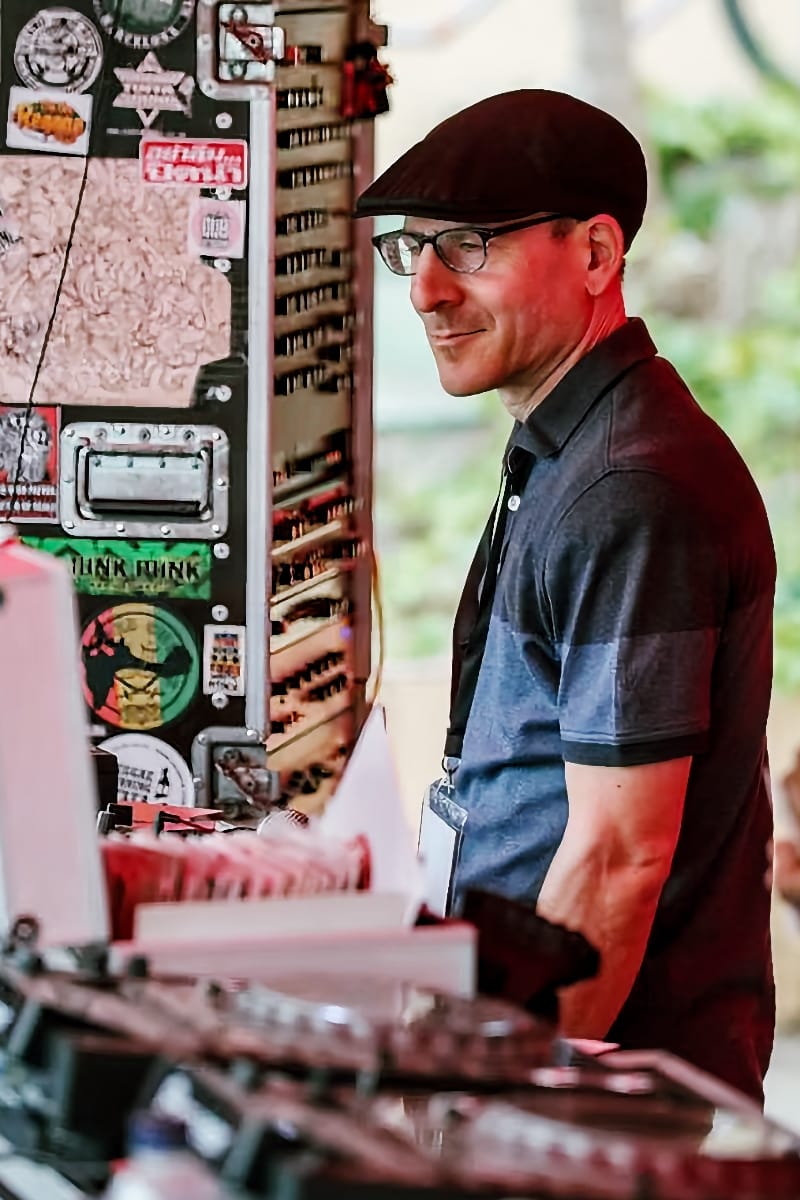
Dub Revolution / David Katz on Green Light Soundsystem, photo by Etienne Bordet.
Lawrence Peryer: It's always so fascinating to me about Jamaican music and dub in particular that there's this recursive nature, because the music sort of steals from itself. It's such a deeply self-referential music. It all gets lost, mixed, and put into the stew. And a book like this inevitably balances being expansive with—there just has to be some figures or scenes that you can't get to the bottom of, I would imagine. And I'm curious if there's someone or something that eluded you that you wish you could have gotten there with.
David Katz: So obviously I was never fortunate enough to interview King Tubby. He died before this project began, so that's something missing, I guess. And then the other problem, in that sense, for this book, was that it had a word limit. It would be easy for me to expand on any of the chapters in this book and do a ten-volume set or whatever. But obviously one of the things that dub teaches us is that what's left out is as important as what's left in. So I didn't want it to be exhaustive and exhausting, even if I'm trying to tell as much of the tale as I can.
The book also leaves Jamaica, because, of course, dub traveled first with the diaspora. I got to interview many important figures here in the UK, many times: Adrian Sherwood, Dennis Bovell, Mad Professor. One that declined to be interviewed, which is, yeah, a little bit of a shame on my end, is Mark Lusardi, who played an important role, somewhat overlooked. I'm not sure why he opted out, but fair enough. It would've been nice to have some testimony from him.
Then the book leaves the UK and moves into what happened in Europe. It also covers parts of Japan and Brazil, and a little bit of Mexico. If I had more space, it would've been nice to trace dub in Africa a little better. I'm aware there is a dub scene in Chengdu, China, but I haven't been there, and I don't know anyone there.
Lawrence Peryer: I think this book is very important in terms of building on the foundation and expanding from what Michael E. Veal started with Dub: Soundscapes and Shattered Songs in Jamaican Reggae. I really appreciate the book as someone who loves the music.
David Katz: Thank you. Also, obviously we can't talk about this book without mentioning Lee "Scratch" Perry. Scratch had his own distinctive niche in dub, and that came after he opened his Black Ark studio. A lot of people get confused and think Scratch was mixing dub before that, but that wasn't the case.
What Scratch achieved at the Black Ark with very limited equipment—just the Teac four-track, a Mu-Tron Bi-Phase, and a Roland Space Echo—is absolutely astounding. It's interesting that Chris Blackwell gave him an eight-track, and Scratch really didn't like using it. He preferred the four-track and just bounced his tracks between a four-track and a two-track.
Check out more like this:
 Michael Donaldson
 Lawrence Peryer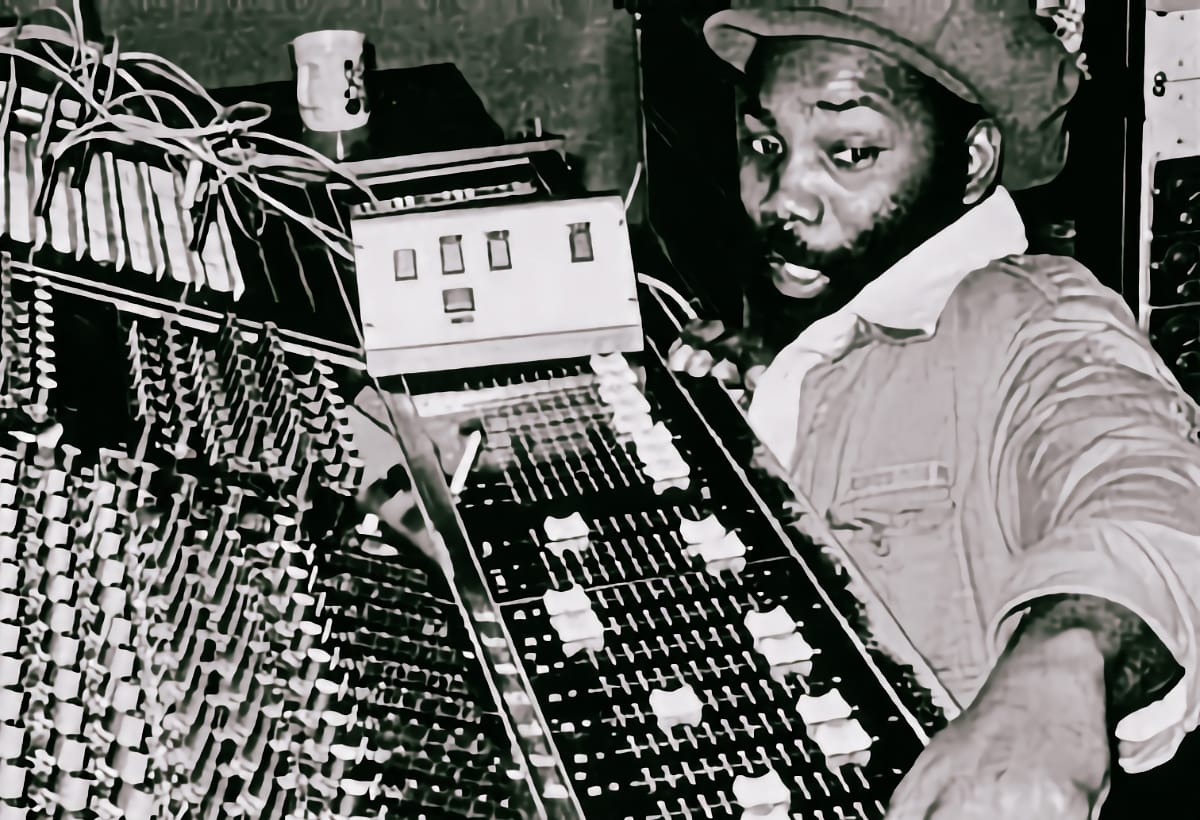


Comments