


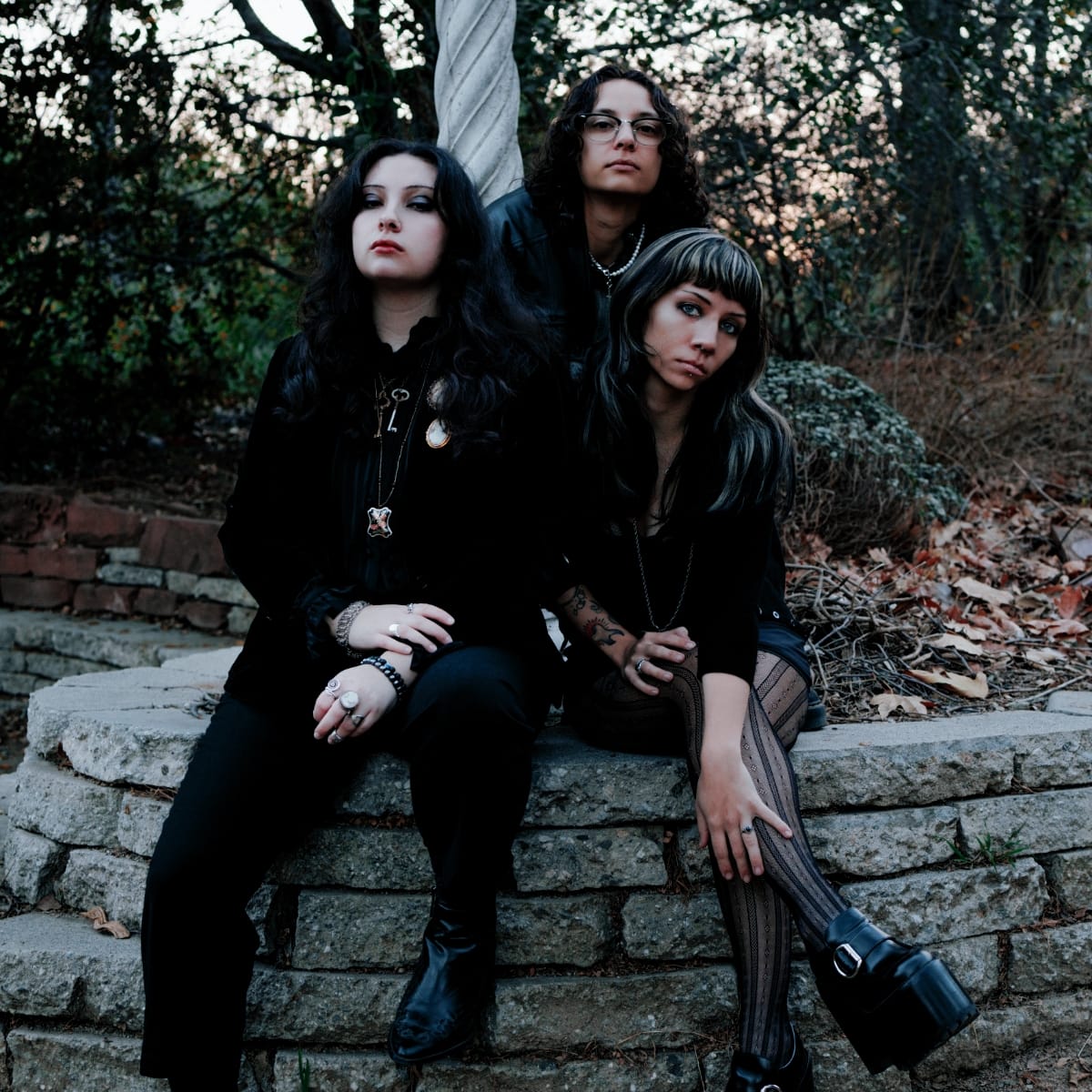
The American doom metal trio Faetooth released their second album, Labyrinthine, last September on The Flenser. The work marks a new, powerful chapter for the Los Angeles-based band that features Ari May (guitar, vocals), Jenna Garcia (bass, vocals), and Rah Kanan (drums). 2025 saw Faetooth's profile explode as they became a staple at European festivals and crisscrossed the United States on multiple tours. Formed in 2019, the COVID-19 pandemic delayed the group's live debut for three years, and they played about thirty shows up and down the West Coast between 2022 and 2024. But Faetooth took the stage almost sixty times last year, and will return to Europe later this month to headline a tour with German psychedelic 'blackgaze' quartet Coltaine.
Labyrinthine follows Faetooth's acclaimed 2022 debut Remnants of the Vessel, which earned recognition from Spin Magazine as co-best metal album of the year alongside Close, the eclectic third release from Italian retro-doom outfit Messa. Written in 2019, its release, much like Faetooth's first live shows, was obstructed by the uncertainties of COVID-19. Remnants also includes Ashla Chavez-Razzano (guitar, vocals), who helped found the band but departed in 2022. This first offering activated an enthusiastic audience Faetooth cultivated through social media at a time when live performances were impossible and established the band's signature heavy and alluring sound, which they described at the time as 'fairy doom.'
I caught up with all three members of Faetooth over video chat in early November, and they explained that last year's performances represented a watershed in their relationship to their first release. "All the touring [in 2025] felt like a chance for us to tour Remnants," explained Garcia, "because there wasn't really any touring on that album." Their recent shows have also expanded and strengthened the band's connection to their fan base, which May described as "just a very dynamic group of people." May continued, "The youth will come, which sounds funny to say. Teens will come, and they'll bring their parents, and then their parents will be like, 'I actually brought my teen,' but they wanted to come themselves. And it'll be like some jock dude or, like, a frat guy who likes heavy music." Kanan recalled, "I remember in Berlin, this American couple was like, 'We just were looking for alternative things to do, and this popped up.'"
Labyrinthine's arrival capped both a year defined by international attention and opportunity as well as a years-long writing process that began in 2022, well before this newfound success emerged. "We finished the album last year around this time," explained Kanan, continuing, "and this year, like, starting in March is when the touring ramped up." As Garcia described, "It took quite a bit to write the album; that window of time is really foggy for me." May elaborated, "It took a while just because we were starting to tour around then," they continued, "we wanted to make sure we were playing enough live shows because we felt it was really important to do that at the time. So we set aside a distinct amount of time from summer into fall of last year to really hash out the album."
To my ears, Labyrinthine presents more intensity, abstraction, and complexity than Remnants of the Vessel. The first album distinguishes itself with skillful performances, impressive songwriting, and a confident embrace of the heavy and slow aesthetics that define the doom metal subgenre. This aspect is most obvious in Faetooth's hallmark blend of screaming and clean singing. But, to me, the moment on Remnants that defines what it has to say about Faetooth's artistic perspective comes at the end of the track "La Sorcière." Here, after three minutes of ethereal verses, chilling chorus screams, and heavy distortion, the song turns to a new, sludgy instrumental riff that gradually and virtuosically slows down as it repeats over and over, grinding to a halt (Kanan and May told me before our interview began that they take this material to greater extremes when they play "La Sorcière" live).
Notably, Remnants of the Vessel is more formalistic in its composition than Labyrinthine. The whole album expresses a longitudinal structure denoted by three symbolically interconnected instrumental tracks: "(i) naissance," "(ii) limbo," and "(iii) moribund." Many songs also feature fairly straightforward vocal melodies and conventional structures that draw on a pop sensibility without throwing the album's dark and heavy elements out of balance. The ways in which Labyrinthine departs from its predecessor feel and sound natural to a band that has evolved in the time between its first two releases. Garcia recalled, "We didn't intentionally strive to make a huge musical departure or anything, we really just wanted to write more songs." May added, "We're still growing, you know what I mean? When we recorded Remnants, I was 21 or 22. Doing Labyrinthine, we were a lot more familiar with the recording process, our ability to write in general, and how to explain the sound we want better. We're just doing stuff differently."
To an extent, the new release simply heightens Faetooth's existing idiosyncrasies. At its heaviest, Labyrinthine sounds darker and more menacing; its song forms take what we hear on Remnants and push much farther away from convention. The album's lyrics are more naturalistic and draw less on symbols from mythology, the occult, and other archetypes. And the vocal writing and production is more expressionistic. Garcia is responsible for almost all the screaming, while May occasionally joins in when they aren't performing the clean vocals. These two timbres are intertwined throughout Labyrinthine, often with the help of effects processing, to produce a total vocal presentation that feels as intentional as it does dynamic and spacious.
But for me, as a listener, the most captivating and exciting transformation of Faetooth's sound in Labyrinthine comes in the arena of rhythm and meter. The music on Remnants is, more or less, totally conventional in this respect: only one track, "Discarnate," features changes in meter that come close to what is commonplace on Labyrinthine. Six of the new album's ten tracks play with beat groupings, beat subdivision, and/or other related elements; four feature irregular meters (recurring beat patterns that cannot be divided into equal groups), which is totally new to Faetooth's catalog. These features are far from unprecedented in heavy metal overall, but their appearance on Labyrinthine marks a significant expansion to the band's songwriting. These are compositional choices that could be described as 'math rock,' that bands might deploy to convey their technical abilities or intellectual aggression. What is most impressive about Labyrinthine is the prowess Faetooth displays by engaging these sophisticated materials without compromising the album's gentleness and ethereality.
Garcia explained this aspect of Labyrinthine as an unplanned-for result of the band's creative process. "It's funny, I think sometimes it's just how Ari and I write our riffs, the feel is never intentional," she illustrated, continuing, "we know how to intentionally write in a certain meter, but something big that comes up for me was when Ari was writing the song 'October' we were like, 'What fucking timing is this song in?'" In certain respects, the meter in the track "October" is the most complex on Labyrinthine, as the verses mix a variety of grouping patterns and then the choruses restructure the song's metrical arrangement altogether (music theorists might call this phenomenon a 'metric modulation'). As Garcia put it, "Rah was, like, counting it out and we were like, 'What do you mean it's in seven, and now it's in 6?'" Kanan later chimed in, "Yeah, 'October' is definitely a weird one, but it's fun."
In this way, "October" epitomizes the skillful mix of new and familiar ideas that sets Labyrinthine's place on Faetooth's creative path. The song's composition is unquestionably intricate, but it is a warmly enveloping ballad. The chorus melody comes closest to the pop-adjacent style that appears more consistently on Remnants of the Vessel, but its unique play with meter is true to Labyrinthine's distinctive style. And these elements emerged easily from Faetooth's highly collaborative songwriting practice. As Garcia concluded about the meter in "October" and across Labyrinthine, "It was, like, a good challenge for us. It makes something interesting, and people are picking up on that."
Labyrinthine pulled Faetooth into yet another unprecedented creative direction with the production of a cinematic music video for the single "Hole," released last July. Director Joe Mischo has known Faetooth's music since Remnants of the Vessel. Kanan described, "[Joe's] been to a couple shows and really liked us." As Mischo shared over email, he chose "Hole" as the subject for the video because "[it] is an incredibly evocative and dynamic piece of music. My general rule of thumb is, if it's a good song, you better be able to make a good music video for it." Once he recruited Director of Photography Nick Williams and dancer/choreographer Stephanie Kim, who stars in the video, to join the creative team, Mischo contacted the band to initiate the collaboration. "They actually reached out to us, which was quite a surprise because they're obviously very talented," recalled May, continuing, "it was just such a vice versa, like, they said, 'We're so excited to do this,' and we said, 'No, we're so excited to do this.'"
Both Mischo and Faetooth described the process of working out the video's narrative and symbolic language as highly collaborative. "The treatment was entirely written, crafted by Joe, and from his perspective it is a play on the three fates from Macbeth," Garcia noted, adding, "the three fates can signify the three processes of life, you know, birth, life, and death, which I think is interesting." May recalled, "We sent them a mood board and things that were inspiring us." Mischo elaborated further, "I wrote an initial narrative that included a female character, the death of an infant, and her journey to resurrect the child." Kim portrays the grieving mother, while May, Garcia, and Kanan are shown in cloaks that suggest supernatural powers. Mischo explained that he conceived the band's styling as a representation of "the eternal cycle of the Triple Goddess—maiden, mother, crone," and that the video's language is "elemental—flesh and soil, breath and shadow—told through long takes and stark, mythic compositions."
Kim's profound solo choreography emerged from Faetooth's reference materials, her consultations with Mischo and Williams, her experience listening to "Hole," and her personal perspective. "Within the lyrics (I felt) and my personal experience (I knew), the raw and richness of heart break," she wrote to me in an email, continuing, "the darkness which consumes and the breath which rebirths one's soul through pain and ritual." To me, the resulting performance is as astonishing as it is visceral. Among a range of physically intense gestures, Kim imitates the violent throes of labor and, in an extraordinary choice for a heavy metal music video, places the childbearing human body on center stage. As Kim described the philosophy behind her choreography, "There is a madness to the feminine divine. One that at times feels out of control and greater than one's self. A rage against all who try to dictate our thoughts, experiences, and body form. The madness isn't planted within. It is a reaction to an attempt to contain our power. A collective feminine pain body."
The "Hole" music video, by combining Mischo's narrative vision and Kim's physical performance with a song Faetooth had already written and recorded, adds a new layer of meaning to the music. I view the video's symbolism as resonant with the tradition of feminist thinking in heavy metal. So I contacted Dr. Jasmine Hazel Shadrack, a British scholar and seasoned metal musician, for an additional perspective. In 2023, Shadrack wrote about the relationship between witchcraft and restorative feminism in the volume Black Metal Rainbows, which highlights queer and gender-diverse perspectives on the black metal subgenre. After sharing my own interpretation of the video's witch-like imagery, Shadrack observed, "It's a parallax view. We're looking at the same thing but through a different perspective." She continued, "Whether it's the fates, or the Norns, or the three witches from Macbeth, we are looking at a similar principle, which is wise and cunning women or nonbinary people, keepers of knowledge, which goes against the general thread in heavy metal." It testifies to the strength of Faetooth's creative voice, the vibrancy and depth of their ideas, that their music could inspire new meanings in their audience and collaborators that go beyond the band's expressions. "I love the music video," observed May, "I think it's just its own thing."
Certainly, Faetooth's lineup stands out in the male-dominated world of heavy metal, but the trio is not interested in labels, even the iconic 'fairy doom' descriptor they donned during the promotional period for Remnants of the Vessel. "I know we labeled ourselves as 'fairy doom,' but it's mostly just our name, 'Fae' to 'fairy' and 'tooth' to 'doom,'" explained May, adding, "It's a nice definition for us, but I don't think everything we make has been about that." Labyrinthine shows that Faetooth's creativity continues to expand into exciting new directions, even when the band's songwriting is grounded in the personal. "Jenna and I delved really deep," May shared, "it was a very cathartic experience of just, like, letting go, going inside that mental labyrinth and getting lost in ourselves, and in our problems, putting it out there, and hopefully people can relate."
Check out more like this:
 Michael Centrone
 Lawrence Peryer


Comments