


Azar Lawrence joined Elvin Jones's band in 1972, when Dave Liebman left the group for Miles Davis. He had years of gigging in Los Angeles behind him but no records of his own. He moved to New York with the band and soon began working with McCoy Tyner, recording Enlightenment, Sama Layuca, and Atlantis with him in 1973 and 1974, and appearing on Miles Davis's Dark Magus. Tyner also introduced Lawrence to the producer Orrin Keepnews, who signed him to Prestige for three albums as a leader: Bridge into the New Age (1974), Summer Solstice (1975), and People Moving (1976). In the decades that followed, he recorded across a much wider field, contributing to Marvin Gaye's Here, My Dear, co-writing on Earth, Wind & Fire's Powerlight, and working with Freddie Hubbard, Roberta Flack, Phyllis Hyman, and Busta Rhymes.
He returned to jazz as a leader with 2007's Legacy & Music of John Coltrane and has recorded steadily since, most recently New Sky in 2022. He plays with the Cookers, David Weiss's band with Billy Hart, Cecil McBee, George Cables, and Eddie Henderson, and since 2024 he has taught in the Global Jazz Studies program at the UCLA Herb Alpert School of Music. Turn the Music Up arrives September 25 on Trazar Records, credited to the Azar Lawrence Experience, the band he tours with. The seven tracks were recorded at Earthstar Creation Center in Venice and mastered by Bernie Grundman. Two come from the Brazilian guitarist and composer Amaury Tristão; one is Tyner's "Atlantis"; one is Pharoah Sanders and Leon Thomas's "The Creator Has a Master Plan," and three are Lawrence's own.
Lawrence Peryer recently hosted Azar Lawrence on The Tonearm Podcast, and the two spoke about the making of the new record, the players and traditions he came up through in Los Angeles and New York, practice as a lifelong discipline, and the friendships running underneath fifty years of this music.
You can listen to the entire conversation in the embedded audio player below. The transcript has been edited for length, clarity, and flow.
Lawrence Peryer: First of all, it's been a joy spending time with Turn the Music Up and having an excuse to go back into the catalog. I'm really curious about the decision to revisit some of your own songbook on the new record. The version of "Summer Solstice" is such a scorcher. I put them back-to-back, which I'm sure isn't the most original idea.
What I came away with was hearing 50 years of musical development. The two versions of the same song seem to reflect not only where you're at and where you were at, but everything in between—a little bit more hard-driving, a little bit more of the funk, and certainly the rock influence. What was going on there for you?
Azar Lawrence: This album is supposed to answer some of the questions we would get when we would sell CDs at a performance. The first question usually asked is, "Are these the songs that we heard tonight? Is this the music that we heard tonight?" I wanted to answer that question.
So this is a compilation of material that we play. I have another set of material, too, that we've added to the New Sky album. This is pretty much the meat of what would be some of the regular material on this record, just like a live album. We tried to make it as forthcoming as we could in terms of the solos, to give people a taste of that.
My approach to music is that, whatever I'm playing, I feel that the rhythm starts from an Afro-rhythmic place, even the Brazilian kind of thing. So I want to be authentic. Whatever type of music we play and incorporate into our show is authentic. When you hear a Brazilian rhythmic thing, you get to feel that that's the thing. The sambas are the sambas. They're not half sambas, they're not almost a samba—they're an actual samba. That's one of the thoughts we explore musically, and then, of course, the jazz repertoire, wherever that's being heard.
We didn't really swing on any of these. When you do hear a swing, it's the swing that has been experimented with and explored with the great Elvin Jones. That's where I come out of. I lived with Elvin for two and a half years before I was with McCoy for five years, but then I went back with Elvin after a short period with Miles. I learned a lot from Miles in the short time. Musically, we're trying to explore the authenticity of each genre we exhibit.
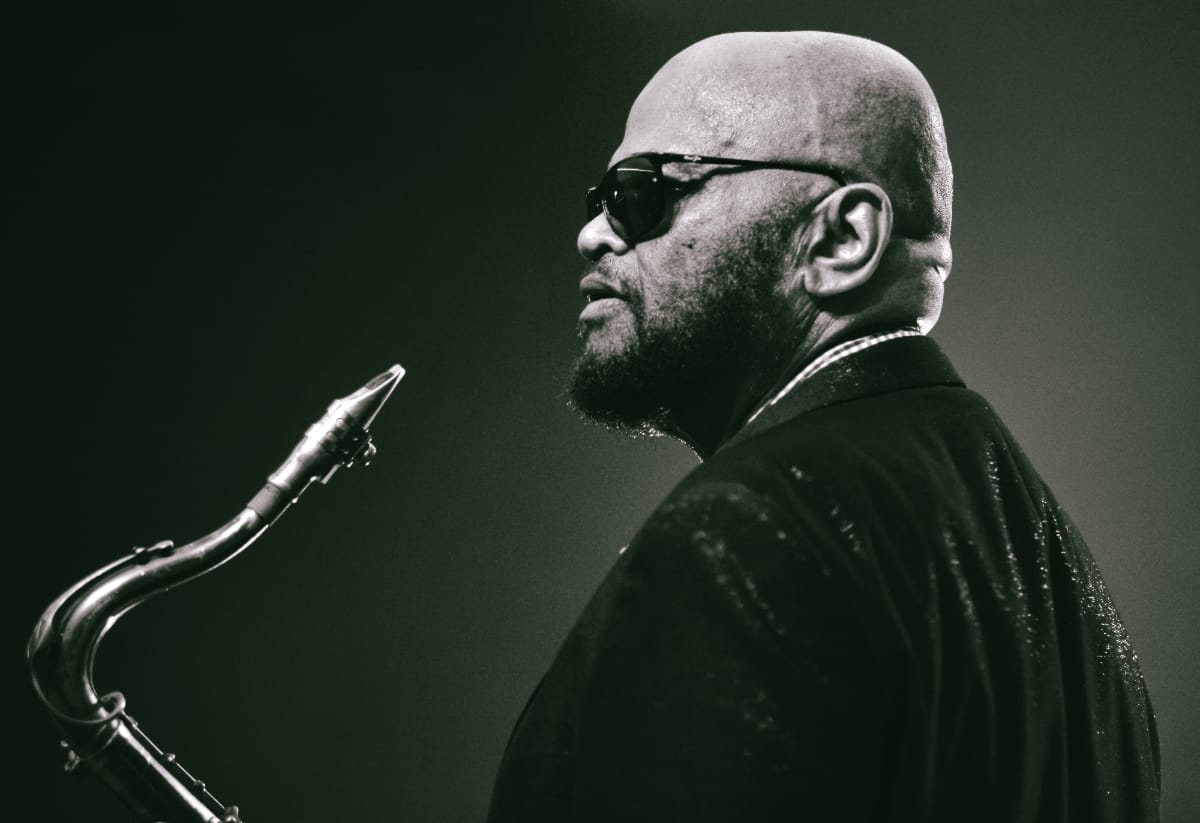
LP: You've been in so many different contexts and so many different roles. What I'm most interested in is how you show up as a bandleader versus how you show up when you're walking into somebody else's thing.
Azar: Well, that's interesting you said that. George Cables and I have worked together—in fact, before any of my so-called career started bearing fruit, there was a group with Woody Shaw, George Cables, Larry Gales (who was the bass player from Monk), Candy Finch (the drummer who had been five years with Dizzy Gillespie), and myself. We used to play after hours at L.B. West on 54th Street.
At the same time, I was working with the Watts 103rd Street Band and with Eric Burdon from the Animals, who had started the group War, and we did a recording. I don't know if you know a little bit about Los Angeles, but where the Guitar Center is located on Sunset used to be Far Out Productions, and that's where Eric Burdon, the producers, and the management of Far Out Productions existed.
When I went to play there with Eric, I was surprised because it was a giant warehouse with a huge truck inside. Actually, that was the truck that was used to record Woodstock. And Eric owned it, of course. That's what we used.
Eddie Henderson—I'd stayed at his beautiful A-frame house in the Oakland Hills, and he came down and stayed at my parents' house on a couple of occasions. So it's family.
LP: There are a few things you've touched on that sort of dance around the theme of the lineage. You're talking about playing with Woody Shaw—these people and your interactions with them. That's the lineage of this music, going back the better part of half a century or more now. And going back to Monk, even longer. How do you think about lineage without getting caught up or self-conscious about it?
Azar: I don't observe it or think about it, because I am it. You know what I'm saying? I don't think of it objectively, because I am this. It has emerged from within my being.
I've realized, accepted, and participated in my own unfoldment in terms of it. It starts back with my mother, who was a fabulous pianist herself and a sixth-grade teacher, coming from Oklahoma. Her teacher told her that if she wanted to pursue a career as a professional pianist, he would fail her, so she was able to express a lot of that through me.
When I first joined McCoy Tyner, there was a bigger impact than when I was with Elvin, for some reason. When we played at the Vanguard, there was a line out the door. All these guys, great guys, waiting in line for the gig, to see somebody from the country. That's what they called me—that was my nickname for a minute. Los Angeles is a country town compared to this big city.
So they were trying to say, "Who is this guy that they brought from the country and skipped over all of us?" The beautiful part is, he said, "Well, somebody's got to be your family out here. I guess I'll take you on." And that's how Billy Hart and I have been friends for 50 years or more.
LP: I'm a McCoy guy—McCoy's important to me as an artist. Something that's intrigued me about him is that he never went electric in that era, when everybody else was experimenting with either electric instruments or electronics as a form of innovation. What's the why behind that, to the extent you know?
Azar: One time they didn't have a piano for him. All they had was an electric piano. So you can imagine the condition of that piano after we finished. (laughter)
LP: Well, what was left of it, with that left hand!
Azar: Yeah, the left hand, on more than one occasion. But one comes to mind in Germany. We were playing a ballad during the time that the Atlantis album had come out, and he and I were doing "My One and Only Love" as a duet. While he was playing his solo, he did one little run—boom. And when he hit that little note, three strings busted that barely missed me. His tone, his touch—three bass strings popped, and I just got out of the way.
I think he was doing enough. He was exploring the full value of the acoustic piano, which had not been quite taken to that level. Before we go to electronics, let's see who has explored the core value of the acoustic instrument. And I think McCoy Tyner's name would have to be there, in terms of this particular genre—progressive jazz, or whatever one would like to call it. The music we're playing is also what we like to refer to as Black classical music. From that particular standpoint, I think he explored it to its heights before one would explore going to electronics.
He played with Ike and Tina Turner for a moment. He was a funkateer—he could get busy. And I had worked with the Watts 103rd Street Band and, for a short time, with Ike and Tina in the Revue. I own up to my funkiness. (laughter)
LP: You don't strike me as somebody that hides from the funk.
Azar: No, that's right. That's a good saying there.
LP: Growing up as a surfer kid, that's pretty far from the spiritual jazz scene. How does a kid hanging out in Southern California, into sun and fun, become the player you became?
Azar: Well, interesting enough, my mother used to practice every day when she would put me down for a nap. I remember hearing Beethoven, Bach, and all that kind of stuff when I was going to sleep. In fact, a few years ago, a friend I grew up with reminded me. She said, "Yeah, your mother used to say, 'No, he can't come out and play until he's practiced. He hasn't practiced.'" I had to practice. Then, of course, it got me, and I feel funny if I don't practice.
LP: To this day, you still practice?
Azar: Oh, absolutely. You can tell somebody that does. Albert Dailey, the great Albert Dailey, graced me with his presence. We became friends. He was always telling me, "You can tell the difference between those that study and those who have not studied." You can tell the difference, certainly between somebody who practices and somebody who doesn't. For me, I'm just an old-school guy. The traditional approach, for instance, is long tone scales, chords, tonguing—all the different approaches to cover the capabilities of an individual expressing themselves through music, and of course through saxophone.
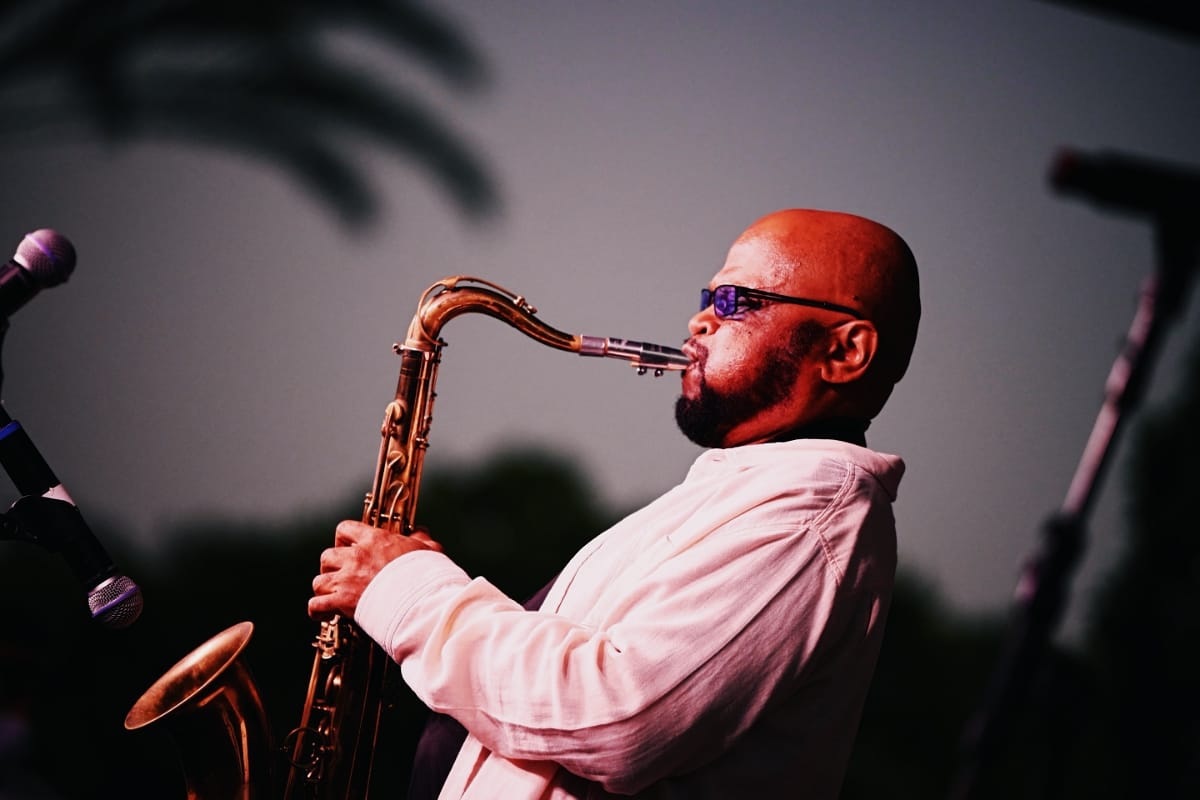
LP: What is it about the saxophone for you? What was it about it when you first got it in your hands, and what's kept you engaged with it for a lifetime?
Azar: I was a singer, also. I used to sing with my mother when I was in her class. We would do those performances at the school. I would sing, and she would play piano. But as I got older, my voice dropped. I was also playing violin, and not only was I tired of hearing "Oh, he's a sissy"—you know how little kids taunt you—but my voice had changed, and my hearing had changed. So I was considering whether to go to viola. I knew I didn't want to go to cello, because I already had to carry around a saxophone. Now I'm going to carry this big old thing? No, I didn't want to do that.
We moved up into Baldwin Hills before President Kennedy was assassinated. Baldwin Hills was, and still is, pretty elite. Ray Charles lived there. Nancy Wilson. My father's friend used to come by, lay out by our pool, and bring his flute, and that was nice. But one day he came by and had brought an alto saxophone, and when he played that, I was like, "Oh, wait a minute, Danny. That's it! That's what I'm looking for. That's the sound!" He said, "Well, let's go get one." Later on, I found out that for the money we paid for that horn, we could have flown to New York and had a week's hotel stay paid for. We paid top dollar. So anyway, that's how I got the first instrument.
LP: I'm curious about the friendship you developed with Pharoah Sanders, and of course how you've come to include "The Creator Has a Master Plan" on this new record. My impression, just from reading about your relationship with Pharoah, is that it seems like something different from a musician merely revering another musician.
Azar: Interesting enough, I had connected via Horace Tapscott, the Pan-Afrikan People's Arkestra, and through them I met the Straughter brothers, Ray and Ernest Straughter. Also, I met a guy named Reggie Golson, Benny Golson's son, and all of these individuals were connected to Pharoah Sanders.
Pharoah used to come when he played at the Lighthouse. This is way back—I was still playing alto saxophone. We shared a spiritual understanding, some of the more spiritual concepts, even dietary, vegetarianism, all these types of things, trying to prepare oneself to be receptive to the voice within you, your own spirituality, your own inner self.
I used to attend a spiritual community. We called it the Sun because the numerical value of the address numbers worked out to be the number of the Sun. We were studying together at the Aquarian Spiritual Center, under the direction of Dr. Alfred Ligon—so all that tied into the connection with Pharoah. We had a long relationship due to the spiritual connection: like-mindedness, one mind, the God mind, all those types of concepts.
Then, of course, I got connected to Elvin Jones via Reggie Golson, who became my best friend. Next thing you know, I'm on the road with Elvin, and I'm starting to bump into Pharoah. We would go see him at Concerts by the Sea or at the Lighthouse any time he was in town and talk. He was fond of us, the Straughter brothers, myself. Pharoah and I became even closer over the years.
During the pandemic, I would go by and bring him some food. I'd call: "Hey man, do you want something over there?" "Well, I would like some Thai food today." I just so happened to know nice Thai places. I'd go pick up some food.
I would hear about him giving certain people mouthpieces. He had tons of them, but he knew each one and what each one could accomplish. One day he said, "Man, wait a minute. I've got something for you." He went upstairs, came back down, and he had a gift bag with a ribbon on it and everything. And humbly he gave me this mouthpiece. I was like, "Oh, thank you."
LP: Do you use it?
Azar: Well, not all the time. For a long time, I wasn't able to manipulate it the way I'd like to, because I've played for as long as I have. It's not as easy as we think as you get older.
So Pharoah—in fact, I was with him the night before he passed away.
LP: Oh, wow.
Azar: I brought him some food, and I guess somebody else had, too. They were trying to get him to walk. I didn't feel good about the fact that he'd gone to Europe for that concert, in his condition. I thought that was a little rough. They were walking him back and forth, walking him back and forth. They thought they were doing the best thing they could for him. He gave me a handshake and looked me in the eyes, and it was like he was saying goodbye. And that night, or early the next morning, he took flight.
LP: Tell me about "The Creator Has a Master Plan." It plays as a tribute, not simply a cover. It seems beyond maybe even an interpretation. Hearing you talk about the spiritual relationship and the interest you shared in personal development with him gives me a new reading of the recording.
Azar: I think, as you said, it was not so much a cover. It boils down to a medium for expressing the love I had for Pharoah and our friendship. And just to be able to think that you can do that—to have permission within your own self, that you think you qualify to do it. But not only that—I thought it was something that needed to be paid tribute to, the principle of a great man. And I studied with him. Every question I asked, I was like, "Well, what was Trane playing?" And he was like, "Okay, we were doing this, that, we were playing this, that." He was exposing some good things.
LP: You had this sort of direct transmission through people like McCoy and Elvin and Pharoah. You got about as close to the source [John Coltrane] as you could get.
Azar: Yeah, I must admit that I did. I never heard it live. The closest I got was when I was with McCoy. We were at the Top of the Gate, and Elvin was at the Vanguard, and McCoy said, "Hey man, it's Elvin's birthday. Let's run over to the Vanguard on a break." I said, "Okay." We walked down the steps, and he went straight to the piano through the crowd, to the left side of the Vanguard. And I noticed that Jimmy Garrison, who I didn't know at that time yet, was at the bar, and somebody else was sitting in on bass, and this guy named Jazzbo was playing saxophone.
Elvin was playing. Next thing you know, McCoy took his right hand and placed it on the piano, and the guy took his right hand off. And the next thing you know, McCoy was sitting down at the piano. Well, Jimmy sees that and goes up to the bandstand to get his bass back, and the guy was trying to hold on to it. Jimmy said, "Give me that bass."
So next thing you know, the trio was playing, and they were playing "Softly, as in a Morning Sunrise." To this day, I've never heard anything like that.
LP: Oh my God.
Azar: Oh boy. Next thing you know, you were in the Amazon forest. All these visuals started popping just from hearing the music. Oh man. Later on, I wrote a song on one of my albums, "Lost Tribes of Lemuria," that expressed some of those visual things.
My brother passed away in February. I was on the phone with his wife, because I was out of town. I had told him that when my mother passed away, I had an experience. I saw what I believe was the angel of death. He came in, and the music that he brought with him through the window—his vibe was so high, it was music. He looked at me, and his mouth opened, and I didn't hear anything. Then he went on through the wall into my mother's room, and when I went in there he was going through the wall toward the street.
So my brother kept saying, "Turn the music up, turn the music up." And his wife was like, "I'm telling him there's no music." And he kept saying, "Turn the music up." And he passed away.
LP: So it wasn't meant for you at that point? You weren't meant to hear it.
Azar: I couldn't hear it. I didn't hear what he said at the time, but days later I did.
So that's how Turn the Music Up came about, and also some of the artwork. My brother became an artist—he did the Bridge into the New Age album cover, and he did the Summer Solstice album cover, and some of the sketches from Turn the Music Up he had done. And so we used some of those in there too.
LP: I'm curious about your role as an educator. I wonder if there's one thing in particular that you strive to tell students, something you want to impart that nobody could have told you when you were younger.
Azar: Yeah, there's so much I'm trying to pass on that I didn't know, that I wasn't ready to receive. I'm really just scratching the surface. My basic connection to the music I try to pass on is that I learned to be ready. When we were on the road with Elvin, I always had to practice, be ready. If you aren't saying something, that's when they go get popcorn. You know what I'm saying? Better have something to say.
Check out more like this:
 Bill Kopp
 Lawrence Peryer


Comments