


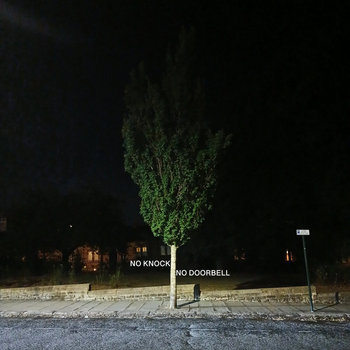
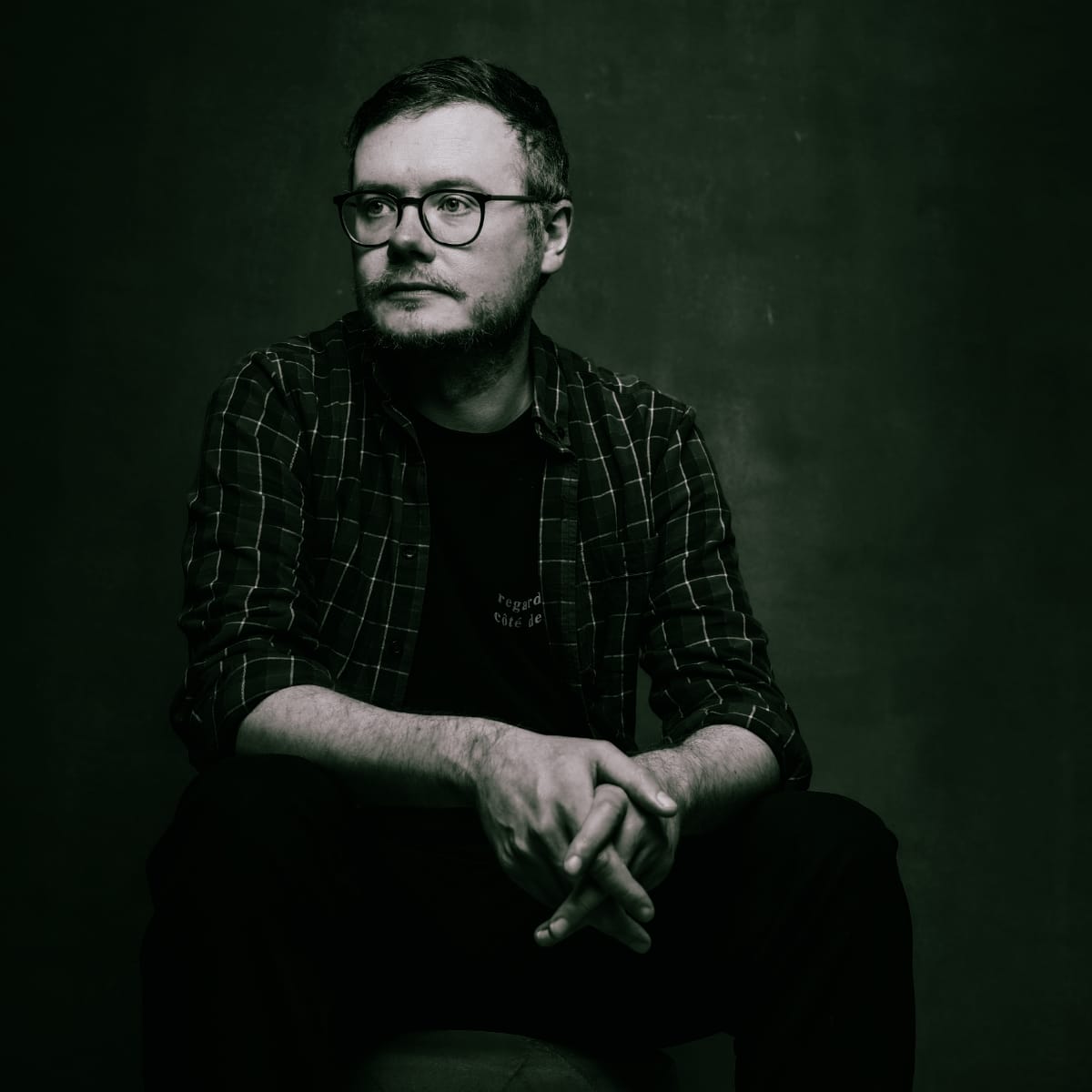
No Knock, No Doorbell is worriedaboutsatan's 20th release, one in a long line of musical output from prolific musician Gavin Miller. Along with his partner Sophie Green, Miller has built a Lynchian-like electronic womb of delayed guitars and intricate textures. The album takes us on a slightly different exploration of Miller’s own expansion of worriedaboutsatan’s sound, entwining jazz drumming with shoegaze-influenced guitar textures, and audible altercations of electronic elements.
Miller's two decades of experience have taken him on some noteworthy adventures. He has toured globally and played festivals such as Dunk, Bluedot, and ArcTanGent, as well as a remarkable church gig with Ólafur Arnalds. Miller's music has also been used in Adam Curtis’s BBC documentaries, and he has lent his talents to music supervision for some of them. Pitchfork described worriedaboutsatan as "Burial for English lit majors," while many other outlets have also taken note of Miller’s post-rock broth of digital delay and affable rhythmic wanderings.
I was curious to sit down with Miller to learn more about the process of this Yorkshire-based artist and how he views his growth, both musically and personally, thus far. No Knock, No Doorbell drew me into foggy worlds, both urban and sometimes reminiscent of the Yorkshire moors (having once lived in the same region as Miller, myself). One could almost imagine this languid collection of tracks being some sort of score to a mixture of these worlds.
Kallie Marie: For someone who just encountered you and your work, what would you want to communicate about this recent album?
Gavin Miller: I think the whole point of worriedaboutsatan is to communicate stuff without being super literal about it. So all the records follow a similar path, where it's all very melancholic.
I obviously don't work with lyrics, don't work with like a voice or anything like that, so it’s more about, “What sort of feeling do I want to get out there with what I do?” So this [new album] is just another extension of that.
It's weird, actually, because somebody asked me about keeping tracks and not releasing them. I always think that's a bad idea because they’re like little mini-diary entries. It's whatever I’m feeling or dealing with at the time. It's nice to get them down, make something, put it out, and have that as a record for that sort of period in life, that sort of time. Then you move on.
When I listen back to satan records from five or ten years ago, I always think, “What was I trying here? What was I even on about? This is awful.” And it'll happen again in five years' time. I'll probably look back at this record and think it sounds rubbish, but it's what I was feeling or trying to experiment with at the time. It's cool to have those little markers. In this massive discography, I can go back and say, “Oh, I remember that time. This happened. That happened. It was COVID,” or something, or “This was when I moved house.”
Kallie: Do you feel like your process has changed recently, and if so, what new approaches are most evident or influential in your latest release?
Gavin: It has changed over the last couple of years because Sophie [Green], my girlfriend, and I used to work for a company she set up. So we were quite lucky in that we had a lot of time and our schedules could be quite malleable. If I needed to go on tour, I could just be like, “Oh, I'm off. See you later,” for a couple of days or something. Or I could just spend a week in the studio, and it wouldn't matter too much because we could find a way around it, and it would be fine.
We both got new jobs, and they're nine-to-five—a lot more structured, a lot more rigid. Now it's, “Okay, I have to find a way to work around like the job.” This sounds stupid because everyone's got a job, everyone's doing the nine-to-five grind, but, for me, it was so long without that. It shunts everything in your life around it.
So now it's weekends and evenings. Evenings, especially up north here, are cold and miserable. You just want to be in bed with a cup of tea. You don't really want to turn on all your gear and do this mad synth stuff. So it's finding those little snatches of time, basically to think, “I’ve got to do it now, because if I don't, it's going to be like another three weeks.”
The last couple of things that I put out have been me working on stuff around this more rigidly structured job. Obviously, it has its high points—you get a lot more money, you get a lot more stability, and that kind of thing, so that's fine. But rearranging my whole schedule around it has been different, and it's been quite cool in a way because it gives me boundaries. So it is good and bad; I suppose it is a kick up the ass, so I can sit down and actually focus on it properly. Yeah, that was the big change.
I upgraded a few bits and bobs of gear, so that brought out a new sound as well. Working with new sounds is always good, just experimenting a little bit more. So yeah, it's just like little changes, but the job's just this huge crater that landed in the middle of the process.
Kallie: What has been your biggest area of growth recently? Personally or musically, and how has that impacted your work?
Gavin: I used to rush stuff quite a lot. Again, the job helps this, but I used to plow through stuff and not take the time to give it what it may have deserved. There are tracks I just ran through and finished and thought, “Yeah, that'll do.” Now, even without the job stuff, I’m thinking more in terms of, “That's cool and everything, but can I spend more time on this? What do I need to do to elevate it a bit higher? Do I need to add something, or take it away, or do I want to put this in another time signature?” Stuff like that—just to sit with things more, and not be so eager to get them out.
I guess over the last couple of years, I've been fairly prolific just because I had the time and the tools to do stuff. Whereas now I've been forced to think about things and not be so impatient. You can keep making stuff and pick the best, which is what this album was. I was making a big bank of things and then picking stuff that fit together rather than just smashing through. It's been a bit more, “This stuff sounds nice, and there are a few bits over here, so pick the best and if it flows, make that work,” rather than being impatient. It's been nice to do that.
Kallie: Yeah, being intentional with it. I also noticed the production on this album is beautifully evocative and warm. Tell us about how you achieved some of this aesthetic and the tools you used.
Gavin: There's nothing too outlandish. I'm a big lover of delay and reverb because I come from a post-rock background. Those can make things sound really nice and melancholic. But you can also overuse them, and it can start to sound boring. God knows I've listened to so many boring post-rock albums where it's all the same sort of, “Here's a big crescendo.”
With the satan stuff, it's always like a push and pull between the melancholic post-rock side and the electronic side. Which, again, can feel a bit overused. You can fall into the trap of thinking, “I’ll just put a delay on it. That'll do, and I'll loop that for 10 minutes, bounce it, and it'll be fine.” But it's nice to use elements from both sides and squidge them together to see what happens. I know that sometimes I'll sit down when I’m jamming or have an idea, I’ll stop and think, “Nah, I've done this before,” or “This sounds boring. This sounds like every post-rock band. I need to try something different.”
So every time, I try something different. For this album, I was experimenting with live drums, different textures, and time signatures. I've not really gone outside my wheelhouse in a while, so I thought, “Let's just try it. It might sound awful, or it might sound great. You never know.” So it was putting all these things together and trying to make it exciting without sounding either too weird or boring. Basically, I'm trying to find that sweet spot between those two poles. Hopefully it worked.
For example, the Moog Prodigy goes out of tune all the time whenever I record it. I’ll sit down with what I've recorded and think, “I’ll play some bass over it,” and it clashes really badly. So then I’ll try to make it work with that, and I’ll detune my guitar just to make it fit. Stuff like that can give you happy accidents or drive you absolutely insane. It's always one or the other, basically.
Kallie: Many of the titles on this album suggest an arc of some sort, or a story. Is there a narrative to this body of work?
Gavin: Not really. There are a few Twin Peaks references on there. When I was putting it together, David Lynch died, and I rewatched the entire Twin Peaks all in a massive row. So, I had that on the brain a lot, that kind of aesthetic. That sort of thing often feeds into worriedaboutsatan because I'm just a big, nerdy fanboy.
I'm useless at titles. It is all “Ambient Jam One” or “Jazz Two,” and they'll just sit on my laptop, and I'll never remember which is which. I’ll spend a good half an hour loading up all these sessions, and I'll be like, “For God’s sake, ‘Dark Electronic One’ isn't ‘Dark Electronic Five Final’!”
I do feel like sometimes, especially in electronic music, people take themselves too seriously with their titles. To get away from that, it's nice to do a few tongue-in-cheek references or a little pun. I've got a folder on my computer where I keep my stupid thoughts from the shower or a phrase that'll pop into my head. Some of them are absolutely diabolical—there's no way I can use some of the ones I put in there. Now and again, there'll be a nice little nugget, and I'll think, “That one's really good. Yeah, I'll take that one.” There's no narrative, but they all have to fit. There are very serious sorts of titles as well; it's a balance between those two. So it's very strange because you don't have lyrics, but you don't know what to call something whilst you're making it. What it sounds like is the thing, right? That’s more important than what you're going to call it at the end.
Kallie: That makes sense. I have that problem, too. Sometimes I just name things by the time I write them.
Gavin: Oh no, that's horrible as well!
Kallie: Yeah, because I've got files that are just like, “3 PM” or “7 PM.” Tell me about the people involved in this record. Is it just you? How does this affect your workflow?
Gavin: Yes, it's just me. There are some samples on there, like a jazz drum sample pack I got because the guy was a phenomenal drummer. It’s quite nice because it's got nice hi-hats you can work with, or little brush snares. They fit nicely with electronic stuff because you can add an 808 or a little snare pattern, and these things sit behind it and just give an extra sort of humanity, I suppose. It doesn't sound as cold.
So it's basically that sample pack and me, and then my girlfriend Sophie did some violin towards the end of the record. That's about it, which sounds terrifying when you say it like that, but it's nice to sit down and think, “If the band is just me, I can do whatever I want, and make it what I want.' You shape it in your image. Then, obviously, the trade-off is that there's no one to tell you when you've gone too fast. I could sit and make some mad prog rock album, and there's no one to say, “Actually, that sounds a bit crap. You might want to rein that in, mate. No one's ready for your seven-hour operetta.” You've gotta think to yourself, “This is cool, but I gotta watch it. I've gotta watch myself.' Otherwise, I'll be here all day making all sorts of mad stuff.
Kallie: And do you master it yourself, as well?
Gavin: Yes. I used to use somebody, but they dropped off the map. So I learned how to do it myself and understood what I was listening out for. Just the basics: don't make it clip, but you've got to make it sound quite bright. It’s helped the mixing as well. Now, I'm quite methodical in the mix. I'm like, “I’ve got to bring this down, and I've got to use this EQ here because otherwise it's going to sound dreadful when I come to master it.”
Some of the early stuff, especially some of the solo stuff I was doing, I came to remaster all of that, and I was looking at the WAV files. I was like, “Jesus Christ. What on Earth was I thinking?” They were horrible. The mixes were dreadful. It was all over the place, with these huge things in the middle of these tiny little waveforms, these huge peaks. So I'd have to go back, remix it, and make it sound better. But it's nice to do that as well, and take a sort of ownership of everything.
Kallie: Is there any piece of equipment you found yourself going back to over and over again while making this record?
Gavin: Mainly guitar. I hadn’t used it a great deal in a couple of previous things I was doing. Being an old post-rock head, I can't just keep the guitar locked away for too long. I think it separates me from a lot of other electronic stuff that's kicking around, and sort of vice versa with the guitar stuff. It could be a bit of a double-edged sword because the guitar guys don't like the electronics, or the electronics guys don't like the guitar.
I got an amazing new pedal from this company in France. It’s like a three-in-one pedal: delay, reverb, and distortion, but they all work in tandem with each other, so they all feed into each other. That was nice to play around with, and it just gives the guitar a whole new level, as opposed to just a bit of reverb I was using before. I found myself going back to it all the time and coming up with nice textures or little riffs.
Kallie: Was that a Collision Devices pedal? Is it the Black Hole Symmetry?
Gavin: It is, yeah! It's right here, actually. I can never remember what it’s called.
Kallie: It's a great pedal.
Gavin: It's so good. I like their other gear as well. When I got it, I was just sitting there for hours, tinkering with all this stuff. It was absolutely brilliant. It's on the record quite a bit—just me messing around with it.
Kallie: Very cool. It's high on my wish list. What are you most looking forward to about this album being out?
Gavin: It's nice just to get it out. It feels like it's been done for a while, and it’s nice to send things out into the world so people can enjoy them, pick them up, or talk to you about them. It's nice to see people's reactions as well as my own. Oh, it's there! It's done. You can press play. It's great. Here's a CD, here's a tape, do whatever you want. It becomes just a part of the catalog, then, and you’re not laser-focused on it all the time, so it's a bit of a relief to get it out. It also has a sort of finality, where you put something out, and it comes full circle because it kicks you up the ass to think, “Okay, that's done. What else you got? Let's get on the next one, shall we?”
Check out more like this:
 Gerry Hectic
 Michael Donaldson


Comments