


For those of a certain age, Family Affair was TV programming for young and old. Watch the kaleidoscopic visuals set to a most jaunty theme song.
Now, doesn't that make you feel a whole lot better? I'm just asking. Set in Manhattan between 1966 and 1971, the show explored family dynamics in an Upper East Side period-appointed apartment run by the butler, Mr. French, who unfailingly tended to a wealthy bachelor who had recently been charged with raising his deceased brother's three children. Quirky. The show's exterior shots denote only the sweetness of the Big Apple. It was magical.
Enter now Lost Noises Office, an Orlando musical trio evoking mythologized eras, persons, and locales with music parceled from active imaginations, revolutionary ideas, library, and chamber music. An office whose interiors are nowadays infrequently heard on the sweet little hi-fi.
Addressing Orlando's music history would be (surprisingly for some readers) of a breadth and depth beyond this URL. Spartan precedents relating to Lost Noises Office follow. In the 1990s, Orlando was an international rave hub. Boy bands sprouted from sidewalk cracks. Impulse!/Blue Note jazz legend Sam Rivers settled in. Anthemic rock bands broke. Obliterati, a seven-piece manic motion machine, found themselves touring with the newly-polished Silver Apples. Obliterati signed to Simeon Coxe's Whirlybird label, performing on and off into the 2000s. Unequally parts No Wave, mutant disco, and free jazz, Obliterati's keyboardist Holly Tavel and violinist Sarah Morrison kept the melodies intact.
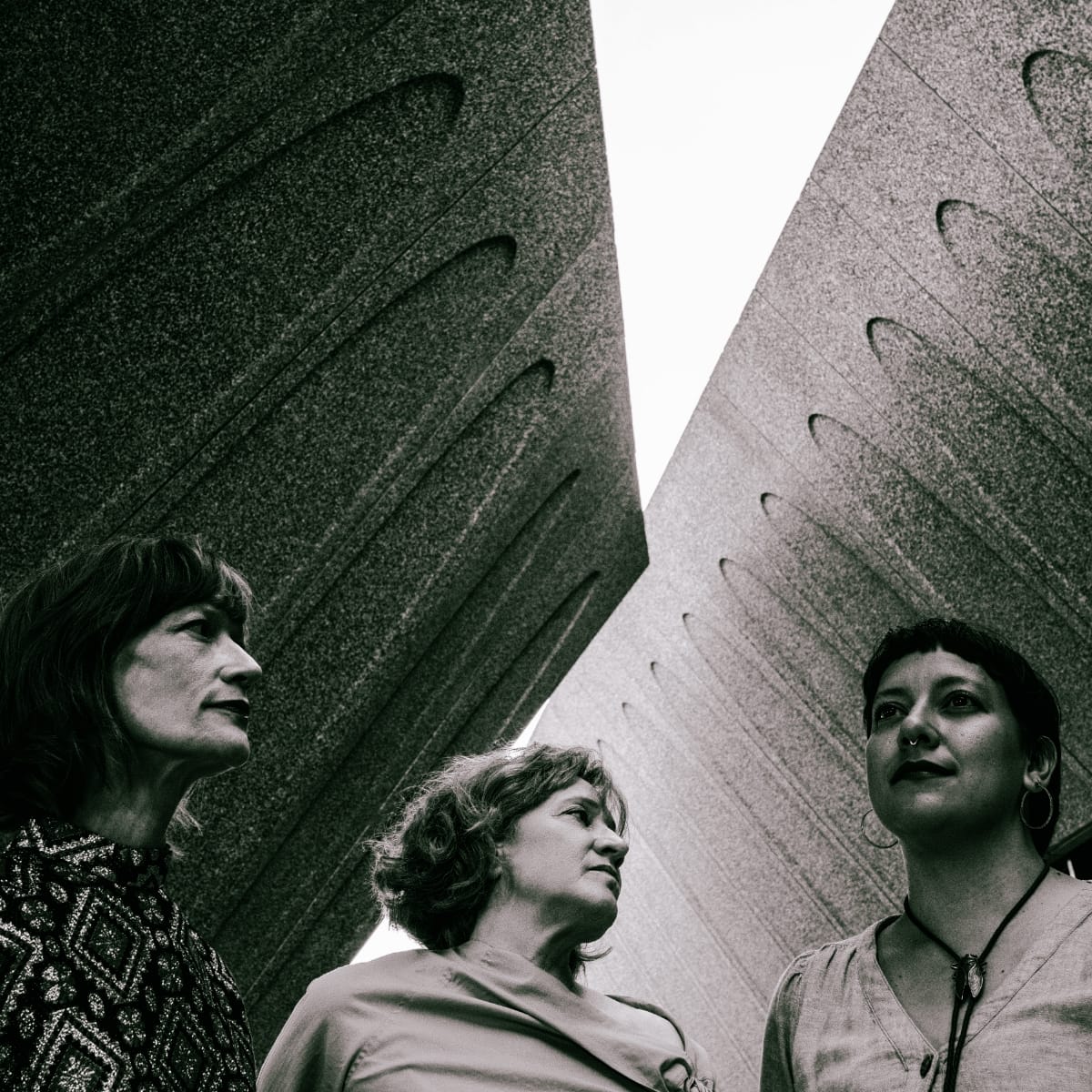
Today, Tavel and Morrison, alongside Beatriz Ortiz-Belt, comprise Lost Noises Office. LNO. These women are assured, witty, aware, and content to make music on their terms while optimistic listeners' lights turn on. In both live shows and studio, the latter as evidenced by their latest album, cloud, castle, lake, the music can be bionic. Via video chats and emails, I learned more.

Steven Garnett: Holly, you're the founder of Lost Noises Office. What's the spark?
Holly Tavel: I think there's an impulse in music where I want to create a world, where I want to create a story that the music is telling. One thing that I've talked about before is my intense love of library music. And what's so great about library music to me is that it's creating, it's doing something different than a pop song. A pop song does not necessarily create an idea of a scene or something, whereas with a score or a soundtrack, even if you have never seen the movie and you don't necessarily know what the soundtrack is accompanying, there can be, in many cases, an obvious scene that's being created. If you hear seventies funk, immediately you're going to think of Shaft, or you're going to think of a car chase or something. Or if you hear certain types of spooky electronic music, it recalls Suspiria. So library music creates these visual ideas of places. It's creating a different kind of space and mood that a pop song isn’t necessarily going to create.
Garnett: You don't direct the listener to a specific thing, but you direct the listener to find something. That’s a way I've taken it. For example, listening to Lost Noises Office in my car, another car rolls up to the stoplight, thumping bass and disrupting the dreamscapes I've conjured in my head. When the light turns green, the film resumes.
LNO seems to resist the ugliness of the 21st century, and to me that's via sonic and lyrical explorations of other times and places—the future, even—which evoke universal beauty, truths, humor, giddiness, opening an unexpected gift, early childhood memories, fears, but especially freedom from. Their press kit language includes the potent if wink-wink self-description of being an "experimental paleo-futuristic cabaret band."
This is a partial instrumentation list: omnichord, viola, violin, oboe, English horn, autoharp, and keyboards. Some song titles: "Forest School," "Mad Professor," "Swim Meet," and "Mauve Incident."
Tavel, the least formally trained LNO musician, earned her MFA in creative writing from Brown University. She's a published author, editor, and educator. She's LNO's primary vocalist and lone lyricist. She proclaimed no manifesto, imposed not even passing sentiments about the day's news. But consider these lyrics from "Monuments":
Out on the edge of town they're building monuments
To their future incarnations
Trying to suss out the last of the architecture and avoid complications
But the days are blue and gray
The horizon floats away
We would like to tell them that they're glorifying the wrong things
And that we're having serious misgivings about our new gods.
A quasi-fanfare opens the song. The warmth of the sun as Tavel's enunciations float alongside hot air balloons whose passengers wipe mist from the lens of their binoculars. What's the sound at 10,000 feet?
And then there's "Mad Scientist" with its concerned neighbor/narrator asking,
Where's he hidden the shrinking ray?
'Cause everything is getting smaller and smaller,
smaller and smaller each day
And the air is filled with glowing particles
And time is running out
And the air is buzzing with quantum particles
Where does this scientist work?
Garnett: How has the Orlando of the 1990s changed for bands like Lost Noises Office?
Holly: First of all, keep in mind that my experience has been bracketed. I didn't do music for twenty years. And when I was in New York, before I moved back here, I tried to find people to play with, and it just didn't work out for whatever reason. Sometimes it's hard because people are already in bands. I would say that, in general, the Orlando of the nineties was probably an easier place to play for bands doing experimental weirdo shit. More venues felt really ideal for that. And maybe it was partially our age. But I do think that nineties Orlando was just a different scene from 2020s Orlando. We had a lot of cuckoo banana stuff happening here. Now I definitely want to expand beyond Orlando. I don't want to just be local weirdos, Lost Noises Office.
Garnett: And your likely audiences?
Holly: I would just say that you'll probably dig us if you like certain types of avant-garde music. There are a bunch of British bands [inhabiting a realm we occupy] like Broadcast. They're more about soundscapes, but they are still pop, and they're influenced by a British seventies aesthetic. Have you heard of the band Warrington-Runcorn New Town Development Plan?
Garnett: No. But that's fabulous.
Holly: Yeah, and the name of the album is Public Works and Utilities, and it's almost like what they're drawing from is similar to what we are, which is not pop or rock music. Instead, they're drawing from the short film that they had to watch in 1970s Britain. It's a little bit like synth music. Maybe there's a little bit of Delia Derbyshire in there. Maybe there's a little bit of Wendy Carlos. Maybe there's a little bit of ambient . . . maybe. There's a mashup of different things, but none of it really comes from the pop or rock traditions.
"No, she doesn't like to define things," Beatriz Ortiz-Belt said of working out Holly's compositions during rehearsals. Bea, classically trained on both English horn and oboe, sharpens the focus.
Beatriz Ortiz-Belt: There are so many influences that I think Holly has gathered over the years. The song-based tunes we have are Holly’s songs, which we are interpreting and adding to. We do have an improvisational element to Lost Noises Office. We’ve been improvising film scores for old black-and-white films, and that's been really fun. We always have new ideas and improvise over them, and that kind of helps develop the song that Holly is writing. Nothing that we do has ever been written down. So it's Sarah and I kind of figuring it out, Holly describing it, and then there is that improv in there, which makes it flow very nicely from one thing to the next.
That's the part that's taken the theory knowledge and the stuff that I've taught in the classroom . . . actually applying it to myself. Because usually in classical music, everything is composed and written out exactly. If you want something to happen, you have a reference in your sheet music. But with Lost Noises Office, it's more of just internalizing what's happening. It’s a lot more long-term memory and processing than I've ever had to do in any other ensemble.
Holly's evolved the finalized chord structure, form, and lyrics. She'll throw out a band from the late seventies, early eighties, or something, and it just sounds so modern. Where was this band? I've never heard this before. You can hear bits of those in what she's doing, but in a way that still sounds new and modern.
The "quarks" [instrumental interludes] are really funny, and there's very much a Sarah addition to it and her taste of obscure old kids' records. She's got quite the collection of these things, and it's a plethora of children's instruments that she just brings to every rehearsal. She's like, “I found this new thing at the antique shop, and it's a noisemaker from the 1930s, and I think this will be perfect.” It'll be perfect. That's very much what rehearsals feel like, just bringing new things.
I mentioned my fondness for Andy Mackay's playing with Roxy Music, how the band reshaped song conventions, and how his reeds playing pointed backward while Eno's electronics pointed forward. Lost Noises Office similarly redirects my understanding.
Beatriz: I think the English horn works perfectly in this ensemble, especially for the range that we have in tone. We eventually want to add a lower element, maybe a cello or a bass of some kind. But because the oboe and the violin have such similar timbres, when we had percussion, it made more sense for us to both go back and forth. But because it's just the three of us, I think the English horn, which is a little bit lower and more mellow in tone, works really well fitting with the violin. We can play at the same time and support each other in different ways. Whereas the oboe might conflict with that.
Ortiz-Belt is well-versed in symphonic and improvised music, performing in the contemporary quintet Answers and the classical duo Belt & Ramirez with her husband/guitarist Chris Belt. Her complete CV is extensive, but she is also the mother of two, and music-making requires family time management. What's it like to have that time?
Beatriz: Lost Noises Office usually rehearses on Sunday evenings, so I just take the time. It's one of those things—when I do it, I'm very happy in the moment where I'm like, “Okay, I'm going to have to stop, and I'm going to have to practice, and I'm going to have to go to this rehearsal.” Once I'm creating, once the thing is happening, I don't want to be doing anything else. It's what I want to be doing. And then when you're getting into it, and you're just improvising and just going, you don't know how long you've been doing it. Your mind clears, and you're listening to everyone, responding, and creating. It's really fun!
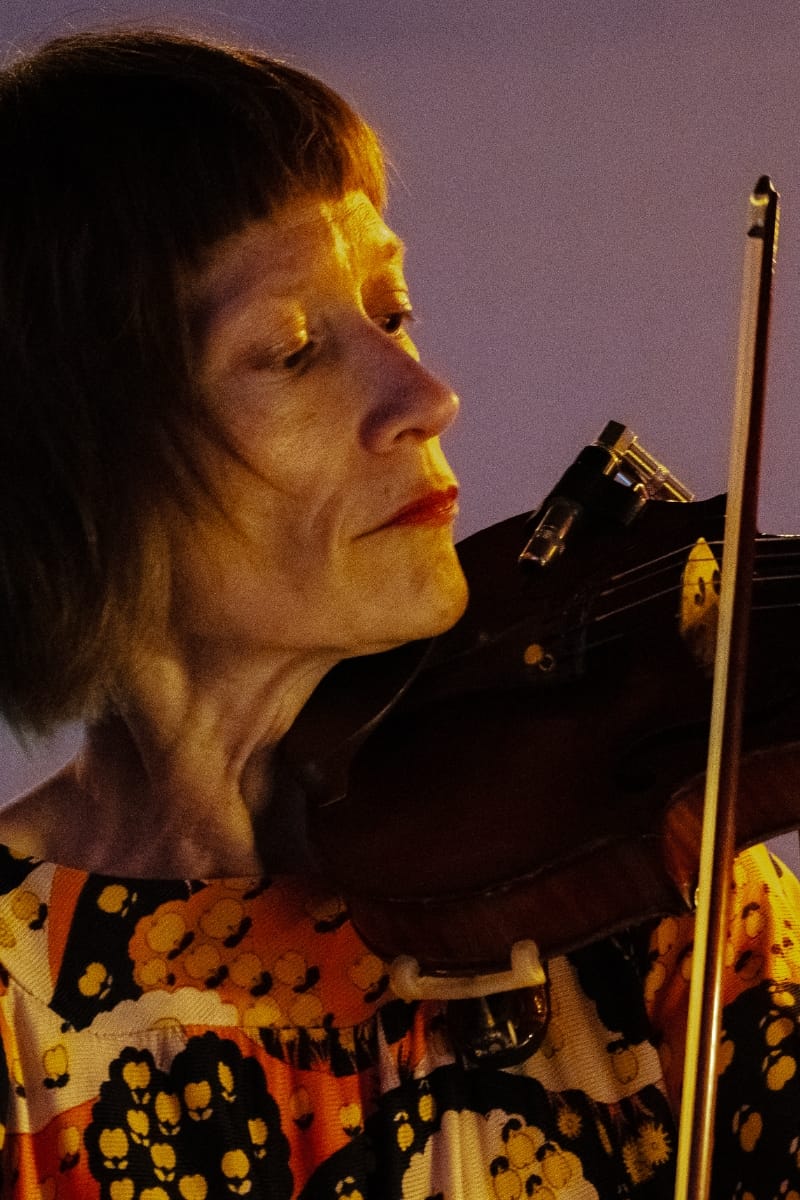
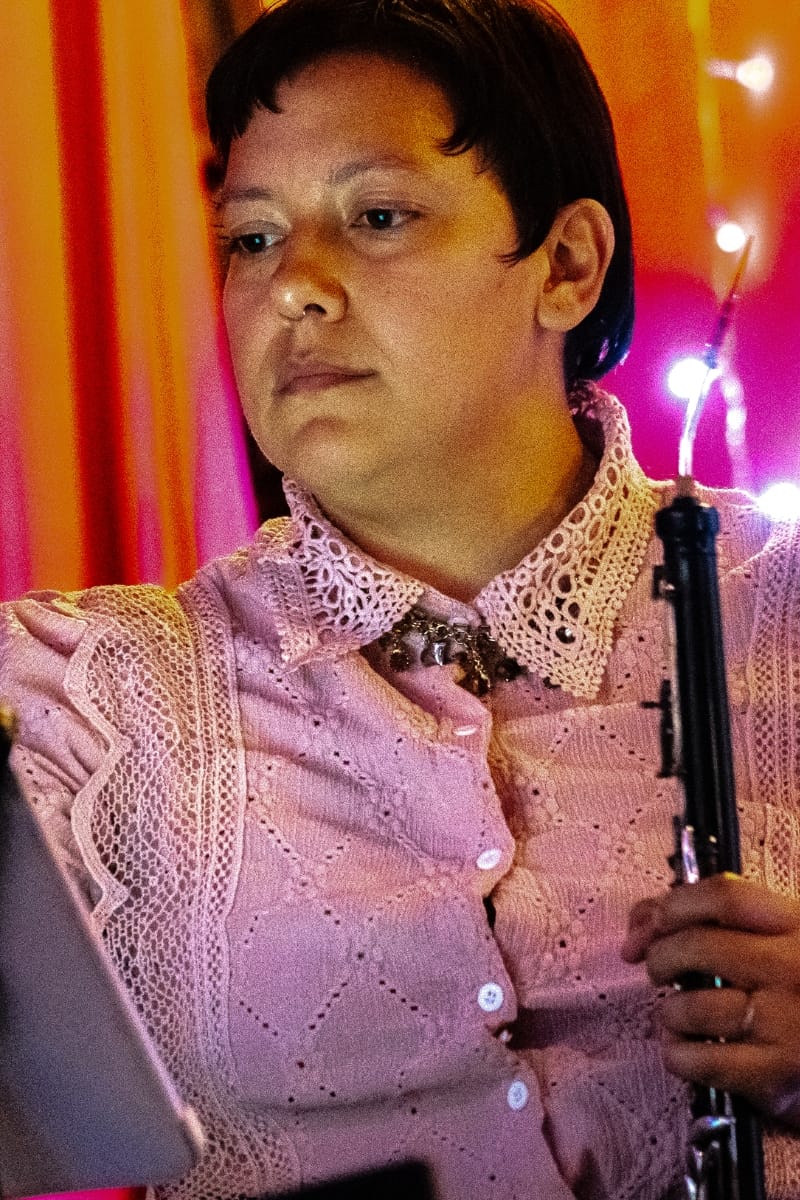
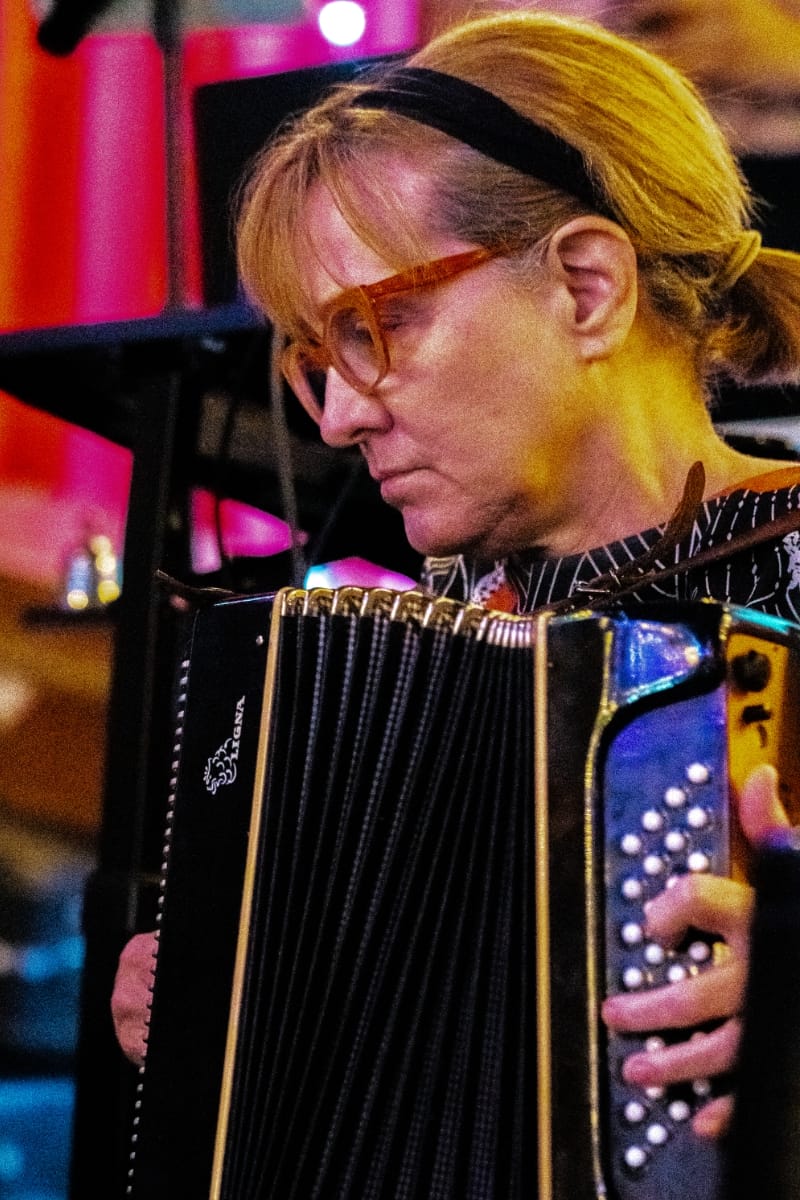
Sarah Morrison, Beatriz Ortiz-Belt, and Holly Tavel performing as Lost Noises Office. Photos by Jim Leatherman
Sarah Morrison, also a mother, has other musical pursuits, including her own The Captured Bird ("children's music of rare and brilliant plumage" for grown-ups) and work-in-progress Lost Tangelo, which she described as "experimental soundscape Floridiana." She's a violinist with the Lakeland Symphony Orchestra when not conducting the Prelude division of the Florida Symphony Youth Orchestra.
Like Beatriz, Sarah has a fondness for the surprises when Lost Noises Office meets.
Sarah Morrison: We have enjoyed improvising live soundtracks to old archival film clips and video montages a couple of times as a band, and I love how, at those times, everything is so unpredictable and immediate as we listen and respond to one another with ‘big ears’ and within new parameters. Even if we had made a plan beforehand, we always veer off course, wander, and explore, juxtaposing beautiful and adventurous sounds without knowing where we will be taken.
Garnett: Please tell me more about the "quarks.”
Sarah: I think of each of these instrumental interludes as a little vignette, or a fragment of a hazy larger story, or a glimpse of some character with an intriguing backstory. These interludes take turns highlighting different musicians for an instant (accidentally, not intentionally). "Mauve Incident" is Holly's solo creation, while "Charm Quark" and "Bottom Quark" are experiments with a kalimba plugged into a looper, made by my son Sebastian in the living room. The pure play of layering raw sounds of toy instruments led to "Strange Quark." They all come together to create this whimsical and curiously shifting soundscape.
Garnett: Often, I listen to music in search of cosmic truths, to understand a higher power and its relationship to me via the musician's creation. What do you think, how does that factor for you? Who's a musical inspiration?
Sarah: Medieval nun Hildegard von Bingen, who was just across-the-board amazing: a composer, a scientist, a direct-line advisor to the Pope. Listening to her music, you hear these ethereal melody lines. She had her first vision at around thirteen, and essentially—at a time when women couldn't do anything—the Pope was listening to her. She was a botanist, a scientist, all of it. I've been thinking about her lately, what she was doing, and the context of it. I love listening to her music, though I'm not sure it's so directly connected to Lost Noises Office. It's been in a more personal vein, just that idea of there being no limits.
I had this music education professor in school, Cliff Mattson, who taught behavioral modification. His tagline was: "Everything connects to everything. Everything's connected." And as I get older, it's like, “Of course.” I see connections everywhere. This music we're making—that's one of the pleasurable things about it, one of the nourishing things: everything does seem to connect to everything else. Holly's idea makes me think of some image, and then Bea connects to that. We may all have a different inner story going on, but I'll add something to something I've already improvised or created because it makes sense—there's a story there.
Garnett: You and Bea play classical instruments, but the Lost Noises Office sound isn't boxed in. Perceptions are subject to change.
Sarah: I love getting outside of the beautiful melodic ideas and making noise, scraping a little, trying to find different sounds, and doing it without relying on effects. A string instrument can do everything you need without plugging in. I've watched people play the violin and do experimental stuff through an effects box, but in my opinion, you don't need to do any of that. You can do it acoustically or manually, where you place the bow, or whether you use the wood of the bow. You can make all kinds of crunchy sounds without resorting to any electronic effects. If you use the tools you have and you're willing to mess around and push the limits of what's listenable or beautiful, there's so much you can do with a string instrument.
Bea does that with her oboe, too. On "Forest School," in the free section in the middle, and also live, she'll go way outside the bounds of what you think an oboe could do. It's mostly her technique. She uses effects, but it's mostly what she does physically with her own playing. She knows how to push that instrument to these limits where you're thinking, “I’m not sure what that is, but it's still beautiful. I'm still drawn to listening to it.” It has that integrity. I love hearing her do that.
Holly does the same with her patches, with how she treats a keyboard and her libraries of music box sounds. She'll go back and forth unexpectedly—and just at the right time—between noise, really effective noise, and these kinds of innocent melodies.
I have come to terms with the fact that I am compelled (without much say in the matter) to collect and curate precious things, or things that feel precious to me (I feel Holly and Bea share my affinity for this). I love the process of stumbling upon images, sounds, and ephemera and collecting or recording them meaningfully and intently. This nourishes the creative process for me, so I feel the process of discovering beautiful things in unexpected places is exhilarating, however it comes about.
Check out more like this:
 Lawrence Peryer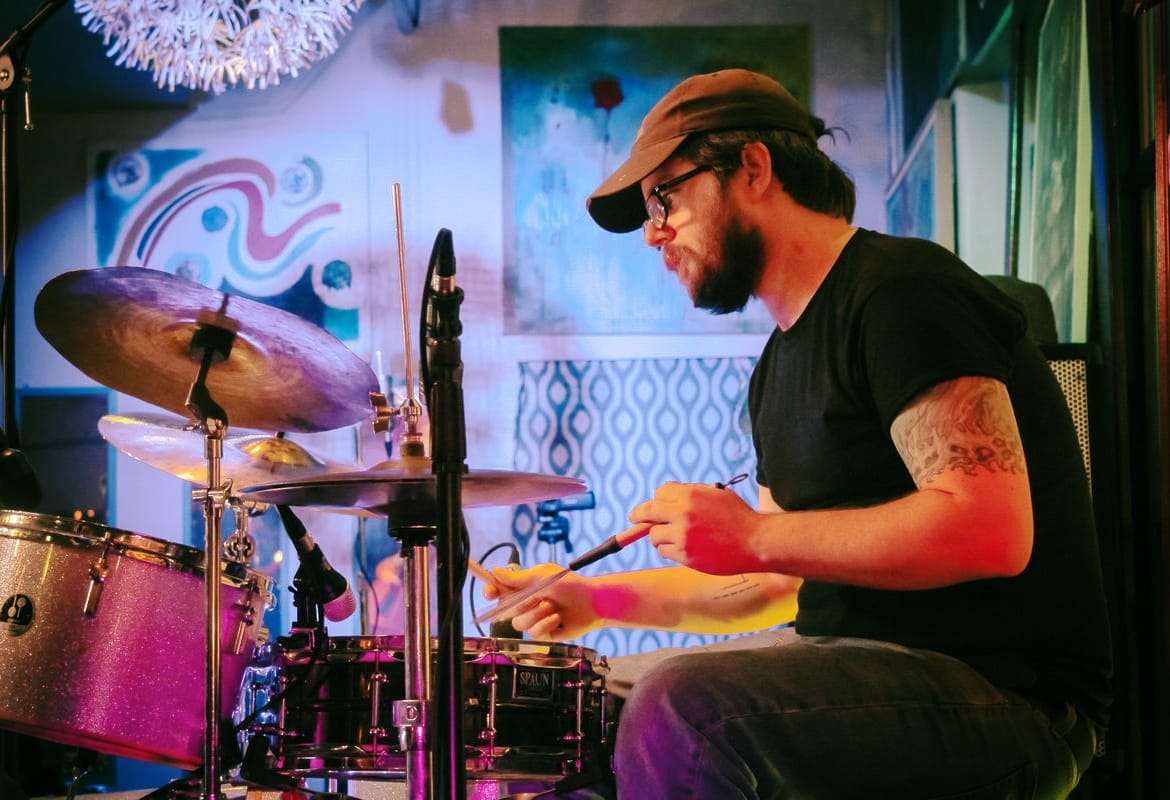
 Steven Garnett


Comments