


Ahoy, dear reader! Yesterday afternoon, I took my mom to see Love & Mercy at the beloved local art house theater. She enjoyed it enough to go online afterward to research Brian Wilson's life and struggles. So, it turns out movie-inspired research runs in the family. On the downside, I ate way too much popcorn and took a long, unplanned nap upon returning home. You're probably used to this newsletter's lateness (I sincerely shoot—and miss—for early morning), but this is the first time my excuse is 'too much popcorn.' But, hi! This is the Talk Of The Tonearm newsletter, a weekly missive where I explore our site's recent artist profiles from unpredictable angles. I mean, I didn't predict any of these. There are also some fine recommendations rounding things out, and I'm glad you've joined us. Here we go:
Surface Noise
 Lawrence Peryer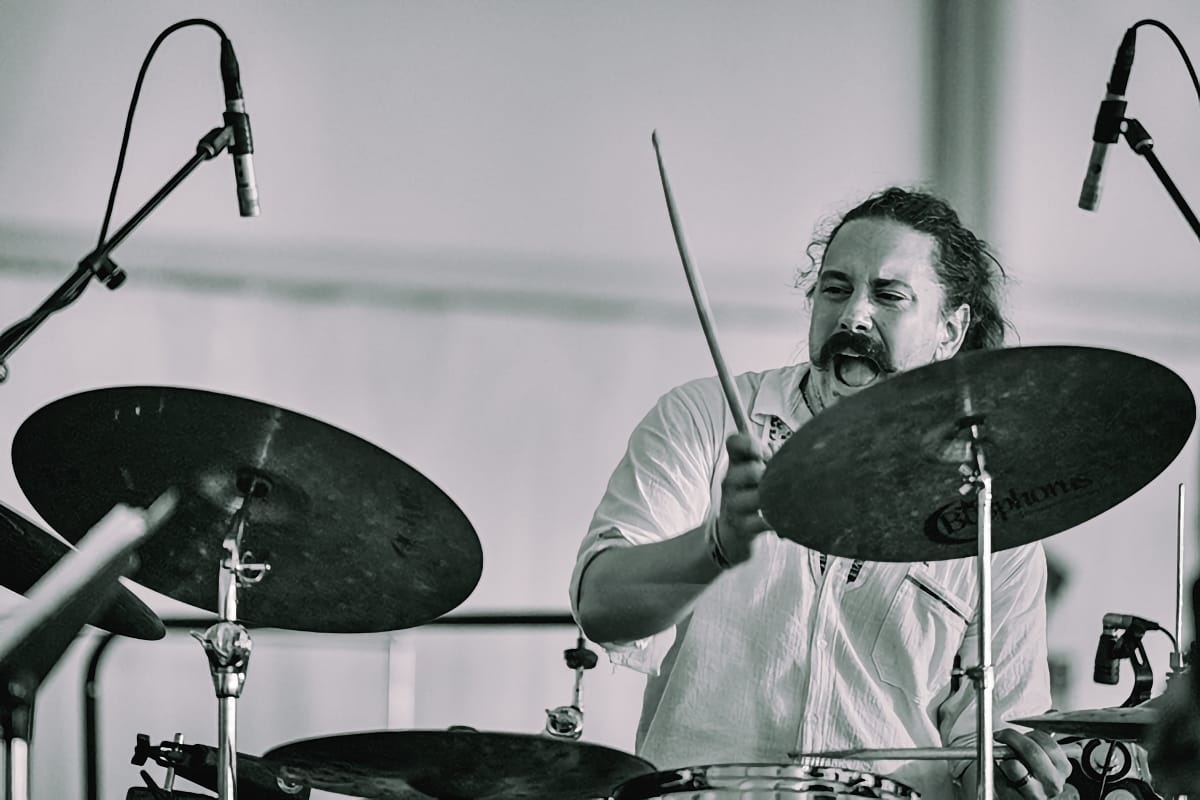
How do you score ecological collapse? Gustavo Cortiñas tackles this question on his remarkable new album, The Crisis Knows No Borders. One album song example, discussed in our interview, is the use of counterpoint to illustrate ecological disaster on the track "Oil and Water Don't Mix." So, it's not a stretch to say that today's composers interpret the environment differently than their vintage peers. Vivaldi's Four Seasons promised predictable cycles, and Beethoven's Pastoral Symphony invited listeners into an idealized countryside where humans and nature lived peacefully. However, Cortiñas recognizes that the old pastoral vocabulary has become inadequate. There's no evidence of Romantic nature worship in his "Meditation on the End of Times" because the nature being meditated upon is disappearing.
Artists across genres are producing what might be called "haunted pastoralism"—music that expresses an alienated relationship with a transformed natural world. Animal Collective's Merriweather Post Pavilion uses electronics to make organic sounds feel natural and artificial, creating something akin to what critic Simon Reynolds might call "eco-psychedelia." Similarly, Grouper's Liz Harris makes ambient sounds that imitate field recordings from places that may not exist. This connects to Cortiñas's use of traditional Aztec instruments in his music, such as imitating the sound of swelling storm fronts by shaking Aztec dancer seeds. Cortiñas also had a meaningful collaboration with Xavier Quijas Yxayotl, helping the drummer and composer musically comment on indigenous traditions that embed humans within natural cycles.
The most significant shift in environmental program music involves moving from emotional sympathy with nature toward making abstract systems audible. Cortiñas's "The Basic Economic Farsity" evokes the economic structures that drive environmental destruction while it melodicizes wind and water. His choice of players and instrumentation, based more on how they work together rather than practical concerns, parallels the collective political action necessary for environmental solutions. Whether he planned it or not, Cortiñas ended up modeling alternatives to the individualistic thinking that created a crisis.
Playback: The Going Gets Weird — Locrian Revisits 'The Crystal World' → Locrian's album The Crystal World draws from J.G. Ballard's novel about ecological catastrophe, specifically a jungle consumed by crystalline forces that transform all matter into "shimmering stillness." Terence Hannum describes the musically expressed themes of the album as “suspended time, entropy, and the sublime beauty of ruin,” which mirrors Cortiñas’s compositional challenge of reflecting on environmental destruction.
 Michael Donaldson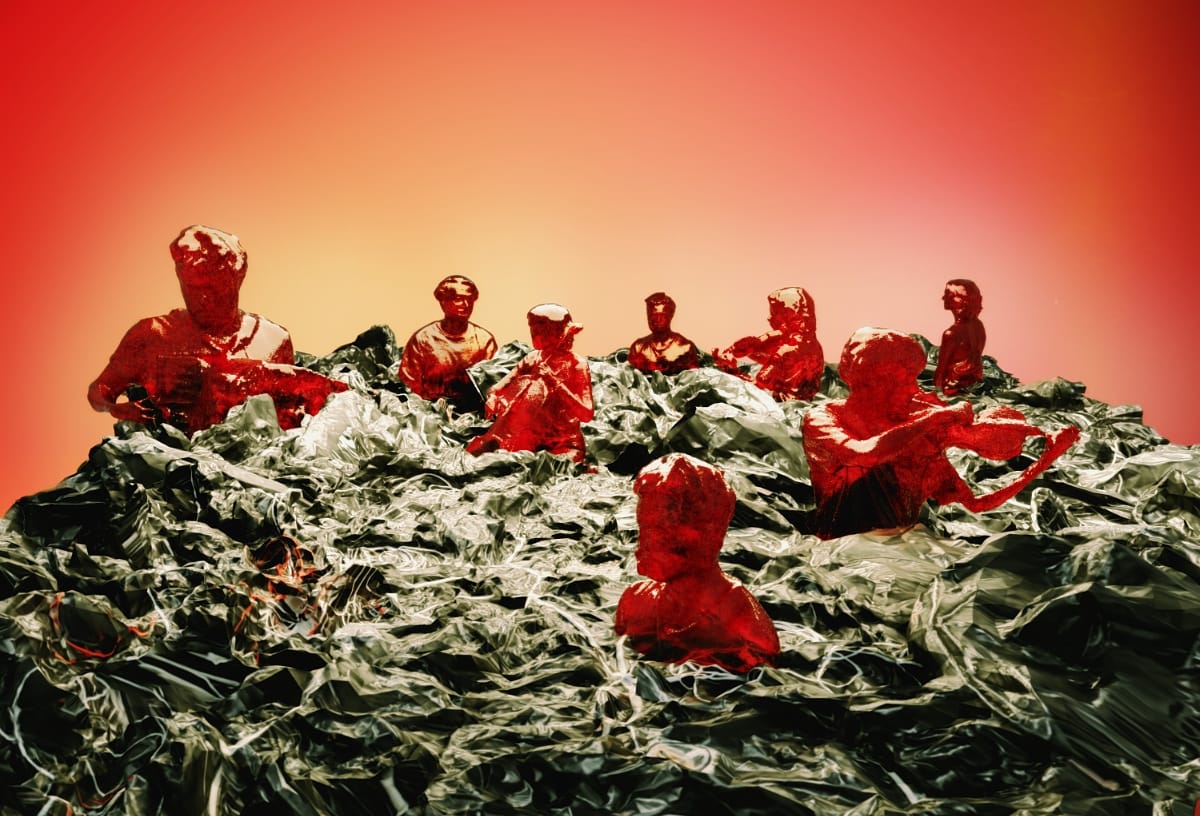
Speaking of romanticization, I'm amused by those who fondly recall that brief window between AI's glitch-aesthetic infancy and its current technical polish. Composer Jamie Hamilton refers to this gap as the "intermediate slop period." On his album Versionland, Hamilton chose to work with early neural networks that would often get stuck repeating words and single sentences. Hamilton discovered that, counterintuitively, the more broken the technology, the more creative the collaboration became. This is evidence of one of our pet axioms here at The Tonearm: creativity often thrives not in the absence of constraints, but because of them. The friction between human intention and technological resistance creates a generative space where no one, not even an 'intelligent' machine, is in control.
I’m jumping at the chance to mention the parallel to Dadaist poetry here. Hamilton's description of his neural network training process—feeding a 1990s Yahoo! mailing list about the Hum (a weird phenomenon you can read more about in our interview) into OpenAI's GPT-2, then watching as the generated text "hovers much closer to the boundaries of gibberish"—recalls a silicon-powered version of Tristan Tzara pulling words from a bag. If you’re familiar with similar poetic tomfoolery, you might have seen early AI systems as unintentional practitioners of automatic writing. Hamilton was among those who recognized this dysfunction as a form of collaborative surrealism. The feedback loops he describes—"AI generation → ensemble interpretation → AI training → AI generation"—create what he calls "playing sounds with other sounds." Each iteration drifts further from the original human intention, becoming the aesthetic itself.
Unsurprisingly, Hamilton is disappointed with today's "fairly boring" slop period. I do like to keep in mind that the doomsayers have always preached that technological sophistication is the enemy of creativity. But I can't deny that it's not necessarily a 'plus' that AI tools minimize friction and give users what they want with minimal resistance. This efficiency gets rid of the cock-ups that steered earlier computerized collaborations into unexpected and frequently hilarious territory. Remember, kids: resistance sparks innovation. Hamilton's work with Versionland thrived on this philosophy. The bizarre and otherworldly finished product and its audible processes come from a unique realm that belongs to neither humans nor machines.
Playback: Synths & Echoes — Catching Up with A.M. Boys → A.M. Boys embrace the non-perfect characteristics of their analog synthesizers and tape delays, letting the machines dictate their recordings' creative direction. The duo uses noise to influence their writing sessions, waiting for good sounds to emerge naturally before building chords or melodies around them. Like Hamilton's process, neither human nor machine maintains full control.
 Lawrence Peryer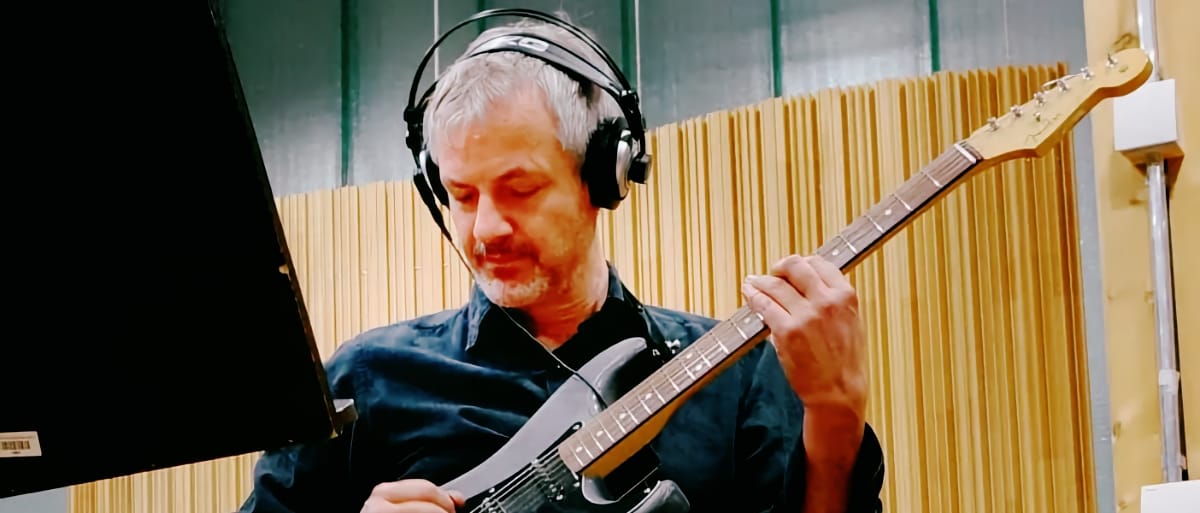
In our interview, Stephan Thelen commented on an idea spawned by working with guitarist David Torn on the recent album, Worlds in Collision: "The basic question was about what happens when a feedback signal is put into a looping machine, so that you basically have two kinds of feedback, an acoustic one from the room and an electronic one from the looping machine." This dual feedback system transformed the recording room into what Thelen calls "an almost unpredictable extension of his instrument." Thelan will surely admit he's not the first one to consider the room as a sonic collaborator; of course, Phil Spector had his Wall of Sound, in turn inspired by the concrete echo chambers at Gold Star Studios. The slap-back echo that defined early rock and roll was also mostly accidental, betraying the natural acoustics of Sun Studios, a converted radiator shop in Memphis. And then Les Paul stumbled into tape delay through a malfunctioning machine, becoming an unlikely temporal traveller whose invention defined dub reggae.
I love Alvin Lucier's 1969 piece "I Am Sitting in a Room," which made the room-as-atmosphere relationship explicit. Lucier recorded himself speaking, then played that recording back into the same room while recording again, repeating the process until his voice disappeared into a blurred-out haze of the room's resonant frequencies. For once, the room was the primary instrument and human voice its 'second fiddle' accompaniment.
Likewise, in Thelen's work, the room responds to Torn's guitar, which in turn feeds back into the loops, which then feed back into the room. I followed this train while thinking about Jamie Hamilton in the preceding section: it's a cybernetic circle, and human intention launches processes that exceed human control. Then things get interesting. So, if you're recording in a problematic room, embrace its shortcomings. Sometimes the problems we look to solve are actually mysteries to collaborate with.
Playback: On 'Oneiris,' Chloe Lula Bridges Two Musical Worlds → Chloe Lula mentions using "feedback loops" in pieces like "Pretence of Permanence," along with heavy reverb and delay effects that blanket 'lead' sounds in temporal distortions and washed-out reverbs. She also discusses how effects and overdubbing create "nostalgia" by playing with "where sounds sit in time."
The Hit Parade
- John Also Bennett left Columbus and its noise collectives to wander the globe for a bit before settling in Athens, Greece. The influence of this locational and cultural change is all over his latest album, Στον Ελαιώνα (translating to "in the olive grove"), which is out on the exceptional Shelter Press imprint. The work documents this geographic shift through nine electroacoustic compositions deliberately constrained by the palette of bass flute and a Yamaha DX7 II synthesizer tuned to just intonation. Bennett's resulting pieces reflect on and collapse temporal distinctions with contemplative grace. The bass flute proves a provocative lead instrument, oddly soothing in its near-familiarity within these solo contexts, while Bennett demonstrates particular mindfulness in how he accompanies it with bell-like synthesized tones—a 'unity of opposites' that would make fellow Grecian Heraclitus proud. The opening title track finds the lull of bass flute accompanied by easy breaths and synthesized tones in the act of finding balance, with brightly ringing notes tipping the mood toward the reassuring. "A Handful of Olives" opens hymnal-like, its harmonium-style drone bedding the flute's Mediterranean melodies that surprisingly recall Nico's Desert Shore. The centerpiece is the nine-minute "First Lament," which layers the flute into interlocking drones and melodic descents with sublime results. Its harmonic textures seem to pulse with the motion of a heartbeat. I should also mention "Seikilos Epitaph," where the oldest surviving complete musical composition is reconsidered through Bennett's digital synthesis. This is music that reaches for meaning, peering at the Athens skyline and Greece's layered history through an ex-pat's musical lens. Somehow, there's little fusion here, just a remarkable document of constraint and instrumentation that mentions the prominence of its surroundings with calmness, curiosity, and beauty.
- Short Bits: Looping synthesizer and clarinet? What will they think of next!?!? That's exactly what Glenn Dickson and Bob Familiar did on their lovely new album All the Light of Our Sphere, and they're on the latest episode of the Spotlight On podcast to talk all about it • "In a cultural moment saturated with information and spectacle, Arvo Pärt offers something almost universally appealing." • "There are Greenlandic rappers, throat singers, and metallers." — Inside Bicep's Arctic Masterpiece • "The blind composer-musician Moondog worked the street [and the] freakish ukulele-strumming, falsetto-voiced Tiny Tim was a favorite at lesbian bars." — The Strange and Wonderful Subcultures of 1960s New York • 99% Invisible tries to explain Neil Young's Pono • New and reissued music you should check out: Art Ensemble Of Chicago's Reese And The Smooth Ones — K. Frimpong & his Cubano Fiestas's The Blue Album — Martin Kuchen's Angles 11 - "Tell them it´s the sound of freedom" •
A Shout from the 'Sky
Deep Cuts
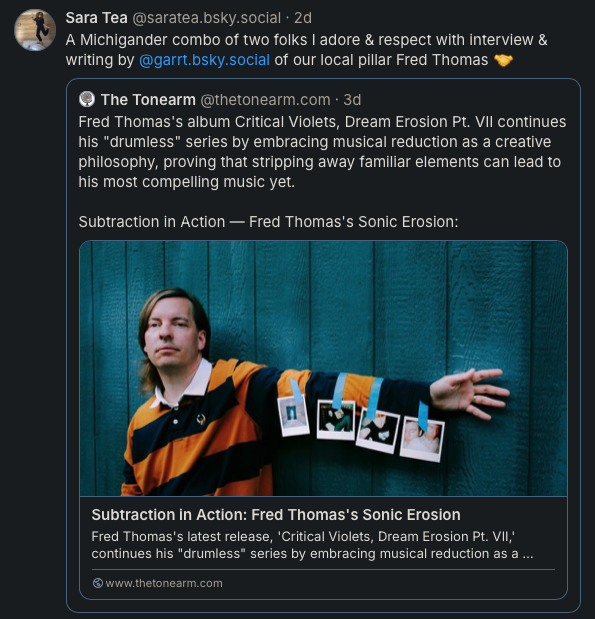
There’s a new interview and profile of Michigan’s Fred Thomas on the site, written with terrific aplomb by our latest writer, Garrett Schumann (more on this next week). I secretly leaped behind Garrett’s back and asked Fred an important question: What’s something you love that more people should know about?
Fred Thomas responds:
In the late '90s, my friends Layla and Helen were in a band called Petty Crime. We weren't friends yet, but they knew some of my friends who played me their sole 7" around the time it came out in 1998. It was a really raw punk sound, not too far removed from Huggy Bear or some of the better riot grrl bands happening in the States. We became friends soon after, and last year, Helen mailed me a cassette of some songs Petty Crime had recorded in a U.K. bedroom in 1999. My job was to transfer the tape and master the songs for a 7", which has just been released on the JABS label.
I love this record because it's so unlike anything else that was happening in punk in 1999, or really anytime. Completely free of self-consciousness, ambition, and ego, the goals here are connection and expression above all else. Listening to it feels so remarkably like being in the sacred inner world of two best friends, people who trust each other enough to explore real feelings together, and who don't give a fuck that they're playing unamplified electric guitars and hitting boxes instead of drums. I love this because it's the real thing.
Run-Out Groove
Thanks for reading to the end! I barely made it here myself, as I'm beginning to enter a mesmerized, dormant state while listening to that Alvin Lucier cut. Before I completely glaze over, I'd like to encourage you to reach out with your comments—we want to hear from you. Just reply to this email or contact us here. And, like a broken record (or this thing I mentioned that I'm listening to), I am once again asking that you forward this email to a cool pal who digs this sort of trip. You can also share the 'View in browser' link at the top on your social media colossus. Whether you do this kind deed or not. You're A1 in my book either way.
Stay vibrant but safe, drink that water, tell your friends you appreciate them, and hold the butter. Thanks for putting up with my silliness. I'll see you again next week. 🚀
Connect with The Tonearm:


Comments