


A couple of months ago, I got caught up with Andrew Hickey's A History of Rock Music in 500 Songs podcast. I listened to every single episode chronologically and learned a ton. Now that I'm 'current,' I have to wait for new episodes to drop like everyone else instead of binging forward in an uninterrupted fashion. But, as I’m missing that cadence and because I'm a maniac, I decided to start listening again from the beginning as I await the newer installments.
It's intertesting listening to these again with the knowledge of what's coming up in the historical timeline. Names mentioned in the earlier episodes now stand out as I know the roles they have yet to play. The importance of events in the first dozen episodes becomes crystal clear with hindsight. And with refreshed attention, I may be actually learning more about the dynamics and intricacies of popular music of the 20th century than the first time around.
Recently, I listened to episode 24, covering the song "Ko Ko Mo" by the duo Gene and Eunice. This is probably a song or an act you're not familiar with. That's somewhat the point of the episode: Gene and Eunice's "Ko Ko Mo" (not to be confused with the dreadful Beach Boys song with a similar name), despite being a big hit, widely covered by the likes of Perry Como at the time, is missing from our collective history. Why is this so? Andrew has a theory:
I think this comes back to something that has been an underlying theme of this podcast from the start—the fact that great art comes from scenes as much as it does from individuals. This is not the same as saying that great artists aren’t individuals, but that the music we remember tends to come out of reinforcing groups of artists, not just collaborating but providing networks for each other, acting as each other’s support acts, promoting each other’s material.
Brian Eno talks about scenius, which is similar but not the same. Andrew's take is possibly even more profound. He's talking about networks of artists helping each other out through friendship and shared goals. Traditionally, these networks started in local scenes and exploded outward—think of how hip-hop rose out of the Bronx or how a group of friends planted the seeds of techno in Detroit. This meme-fication of music was amplified by connections made with like-minded travelers and those connections leaping into the world. Stylistic genres are created like this: locally sourced, globally spread.
I often wonder if reestablishing local scenes is an answer to some of music's modern struggles. An artist now is networking with the world, and tight, supportive, friendship-based relationships have limitations over the internet. There's much more to gain from kindred souls in one's local community, and not just professionally. Friendships sprung from combining forces are great for encouragement and mental health, not to mention opportunities to share gigs, studio spaces, or industry know-how over a pot of coffee. Reputation, renown, and newer friendships expand from there.
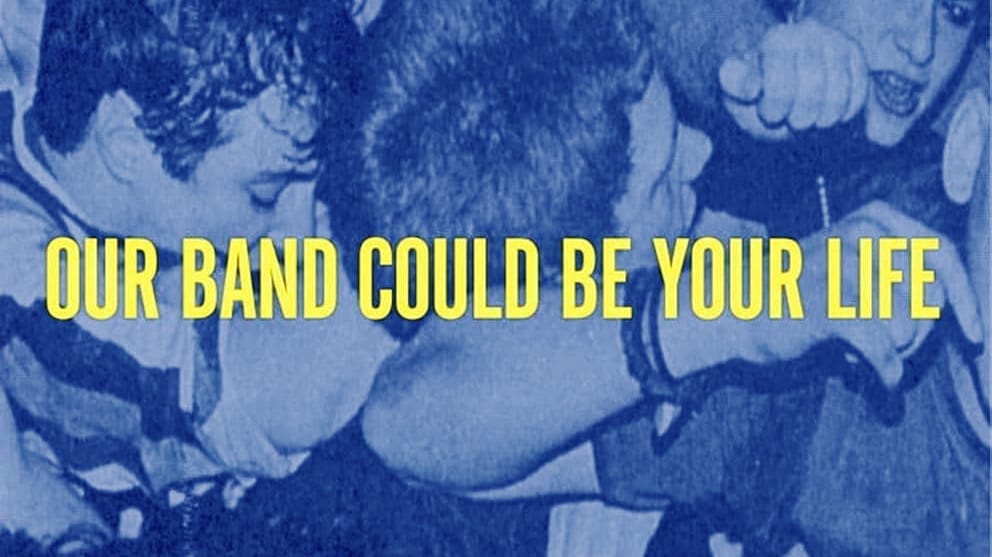
Here's my moment to recommend Michael Azerrad's Our Band Could Be Your Life. I realize, to those who know me, I'm kind of a broken record when it comes to this recommendation. This book shows how local scenes led to national networks of club owners, zines, and college radio DJs, which led to one of the most vibrant and self-supportive independent music scenes of the era. And, of course, the book's territory is pre-internet. With the online tools of the 21st century, scenes like those described in Our Band Could Be Your Life should be easier to develop, but somehow they're not. Why is that?
This Week's Highlights
Cary Baker, author of Down on the Corner: Adventures in Busking and Street Music, is about as passionate about busking and street music as one can be. His Spotlight On appearance gathered evidence for this enthusiasm, and it bounds off the digital page in our article version of the conversation. The online piece is extra-special as it features many links and video embeds, including some footage of legendary blues musicians busking on Chicago's fabled Maxwell Street.
 Lawrence Peryer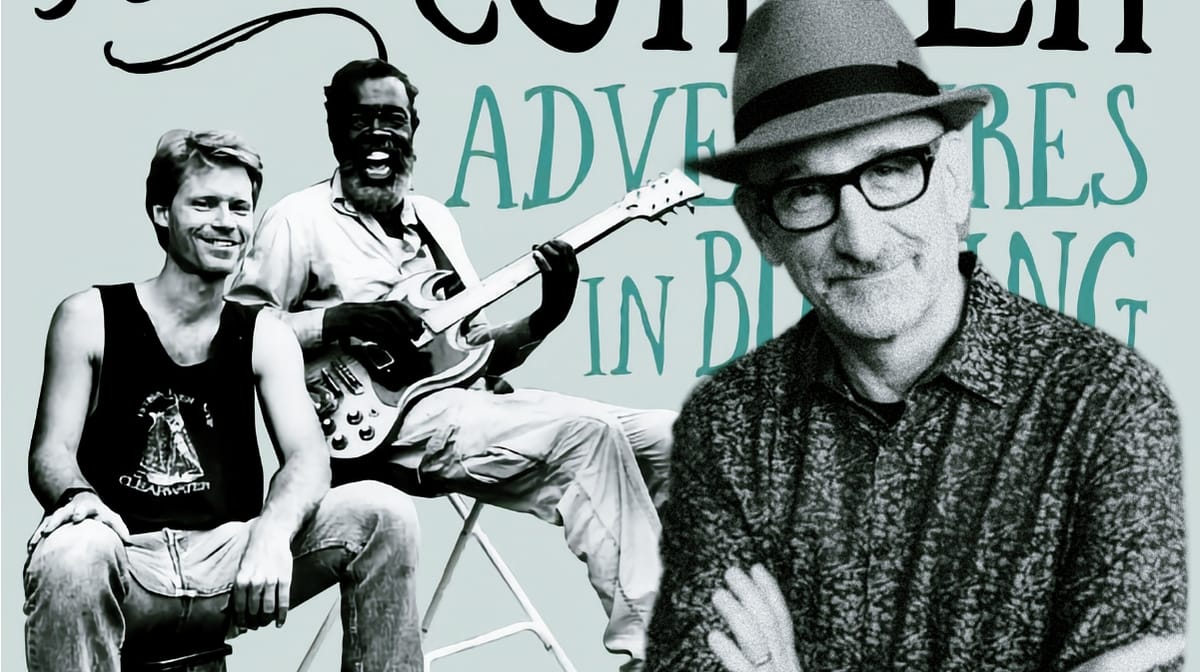
Disclaimer: I've known Pezzner (and have been a fan) for a long time. So when Sara Jayne Crow pitched an interview with Pezzner for her debut piece on The Tonearm, I was glad to give the go-ahead. What I didn't expect was that the article didn't focus on Pezzner, the electronic music producer known for innovative twists on deep house and techno, but instead, the Pezzner who mixes tuba sounds with 808s for a cabaret show. As the article makes clear, it turns out there are quite a few Pezzners, and it’s fascinating how they come together for a new musical approach to Seattle's historic Can Can. Oh, and if you’re into music production, this article goes deep.
 Sara Jayne Crow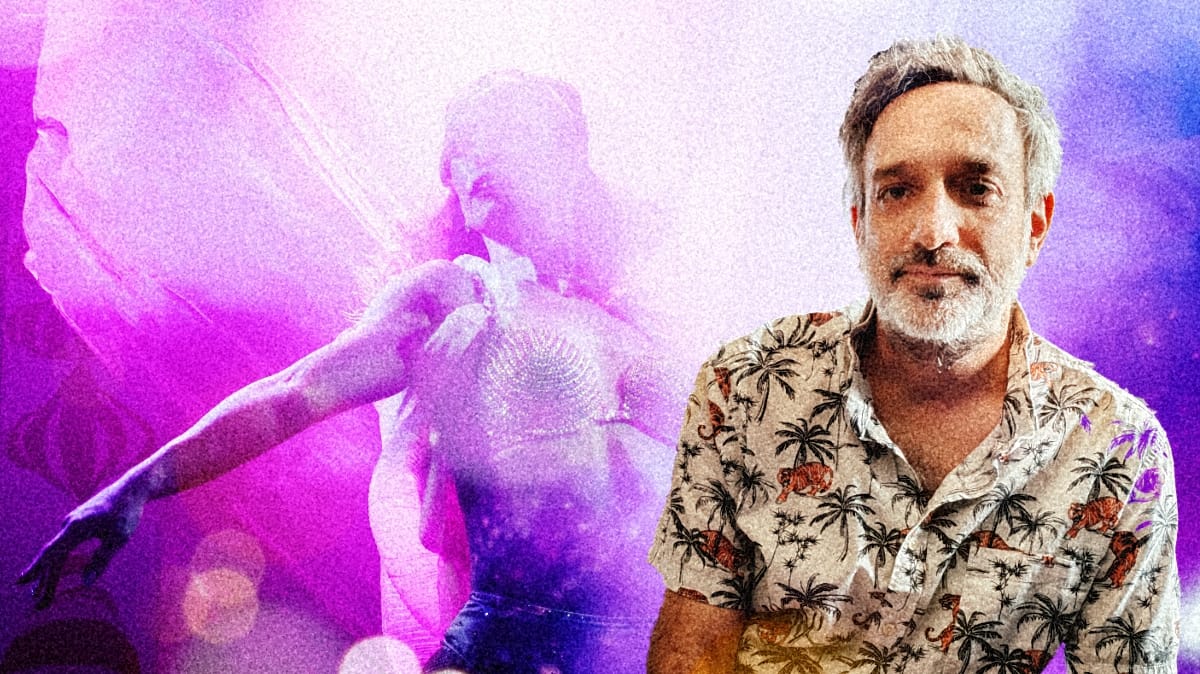
LP continued his series looking back over five years of the Spotlight On podcast, this week focusing on 2023, AKA year four. Some of my own personal favorites are included in this rundown, including spritely conversations with That Petrol Emotion, Lebanese trumpet virtuoso Ibrahim Maalouf, and professor/philosopher(?)/UFO-considerer Diana Pasulka. Lawrence's curiosity drives this podcast, which often brings out at least one 'aha' moment per conversation, and this selection of episodes amply backs that up.
 Lawrence Peryer
Intake Moderation
- The most exciting things happen musically when genres mix and collide. A couple of examples: a feature in Resident Advisor on dub techno, including YouTube embeds of ten tracks that follow the history of this exceptionally moody style. And then Simon Reynolds, in honoring the late Roy Ayers, notes the '90s movement of mixing jazz-funk—itself a fusion!—with jungle rhythms. Says Simon: "Jungle paradoxically enabled me to build up a tolerance for this kind of mellow mystical-tinged sort of warm-glowing softness 'n' slickness - rather than the other way around."
- Author and blogger Robin Sloan revisits the printed zine in earnest, wielding a Risograph and distributing limited editions of brightly colored manifestos. Says Robin: "I am planning ahead, contemplating new (old) systems that might be better suited to the media ecology & economy of the 2020s & beyond. No grand launch here — just the quiet ignition, vroom, of a hopeful machine." His post on the matter also features a love letter to the postal service, a love I also enthusiastically share. So, zines are in the air, and that's really nice. The Jaymo is making zines, too. And I used to make zines—and maybe I will again.
- This week a Mastodon pal turned me on to a Groningen-based band named The Tranquis and their 2013 album Sandcastles. These songs recall the calmer moments of the Velvet Underground's third record, and it helped soothe my anxious soul. There's also friend-of-The-Tonearm danielfuzztone and his latest, Negative Space. With this album, he's close to perfecting the nuanced drone-shoegaze-kosmische sheen he's been shooting for. Also, be sure to check out a sextet of fantastic release recommendations from LP in this week's Needle Drops. Unrelated: I've been completely obsessed with Television's "Venus" for the past few days and I'm not sure why. Did I feel low? Nah.
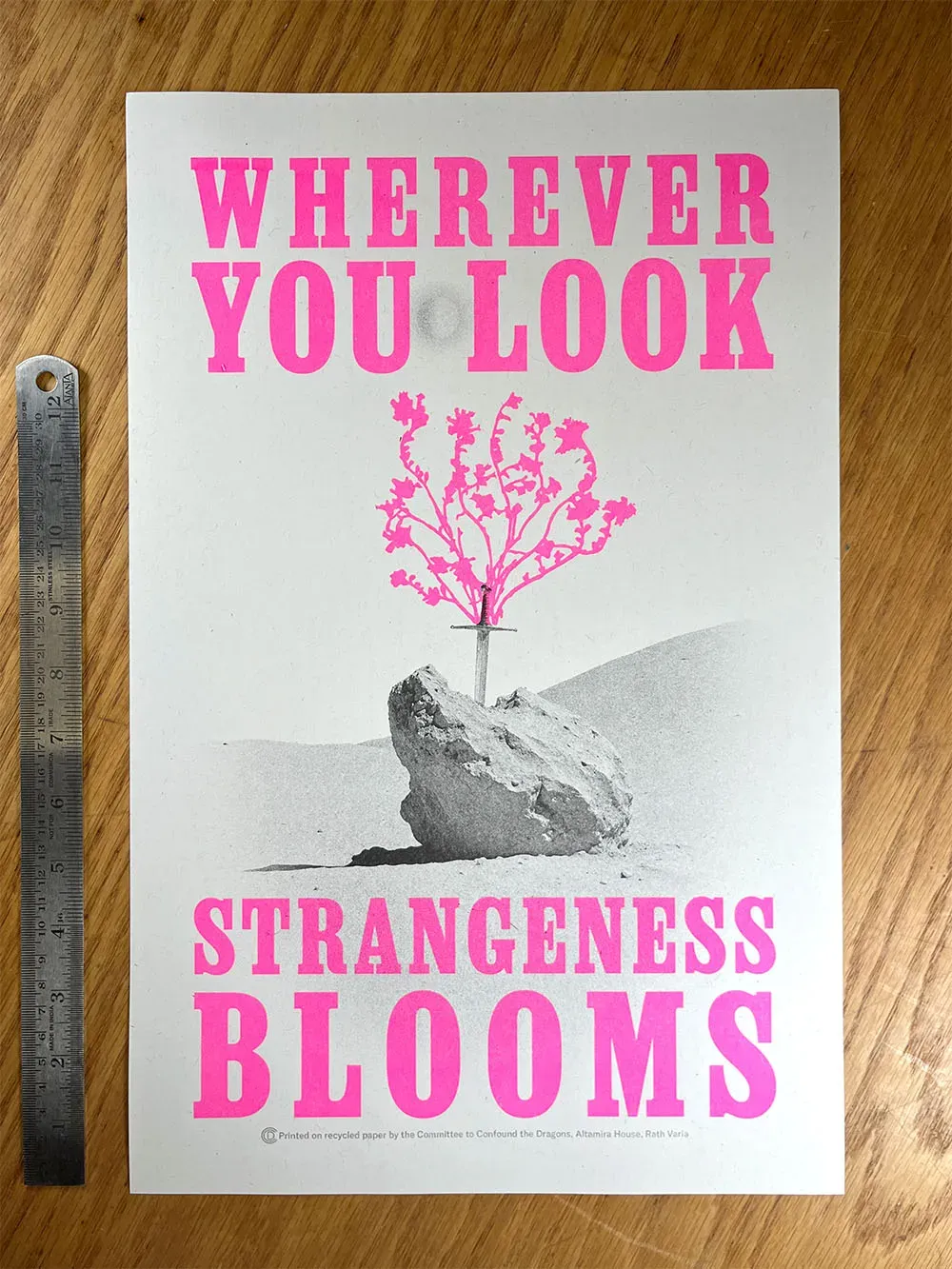
Robin Sloan shows off the enormous potential of the Risograph print.
Something We Love
Danielfuzztone, who I just recommended, answered a few questions for my blog back in 2021. One of those questions was the perennial "Tell us about something you love that more people should know about." I enjoyed his answer, so I'm repurposing it here:
Danielfuzztone: Writer and model-misanthrope Ambrose Bierce. He was a Civil War soldier and journalist who went on to write fictional tales of the Reconstruction-era South, complete with roaming bands of renegade troops, violence, depravity, and plenty of ghosts. While I’ve in no way scratched the surface of his literary library — he mainly published compilations of short stories — his hallucinogenic prose fascinated me from an early age. Like many American students, I first discovered his short An Occurrence at Owl Creek Bridge in middle school (also via the 1962 French film The Owl River). And course, The Devil’s Dictionary has become the bible on satirical humor. I keep it close so I can read random entries when a laugh or dose of cynicism is required.
Not too long but action-packed, right? Thanks for joining us. Please tell us what you think and, you know what?—if you have any recommendations of your own, we'd love to hear them. Just reply to this email.
As always, please tell a friend about us if you have a quick moment. That's probably the best way you can help us out if you like what you see.
Until next time, here's a rocket: 🚀
Connect with The Tonearm:


Comments