


Leilani Patao really knows who they are—that much is evident within the first few minutes of our conversation. There's a confidence with which Patao carries themself interpersonally—an easy humor—but there's also a level of ownership in their approach to songcraft and composition that comes through in the work. The lyrics on their latest daisy, an EP written to honor Patao's dearly departed childhood dog, are confessional, as are the lyrics of many singer-songwriters. But there's an awareness of the many cognitive layers beyond the raw emotions explored (and of the patterns underlying the actions that got them to the point of making certain mistakes over and over again) that feels freshly applied to the medium.
It also takes a songwriter with a keen understanding of themselves and what they stand for to choose to forgo the default streaming model of the modern release schedule, opting for Bandcamp alone as an act of resistance. Though they are hardly alone in making an anti-streaming statement (Deerhoof, Hotline TNT, and others had already made the decision to remove their catalogs from Spotify to Patao's release of daisy), their approach to this act of resistance has been all their own, even down to a personal essay penned by the artist to be sent out with the other elements of their press package.
We spoke virtually following a day full of classes for Patao. Still, they were vivacious and funny throughout our conversation, even showing off the giant-sized pillow commemorating Daisy herself as we discussed their work.
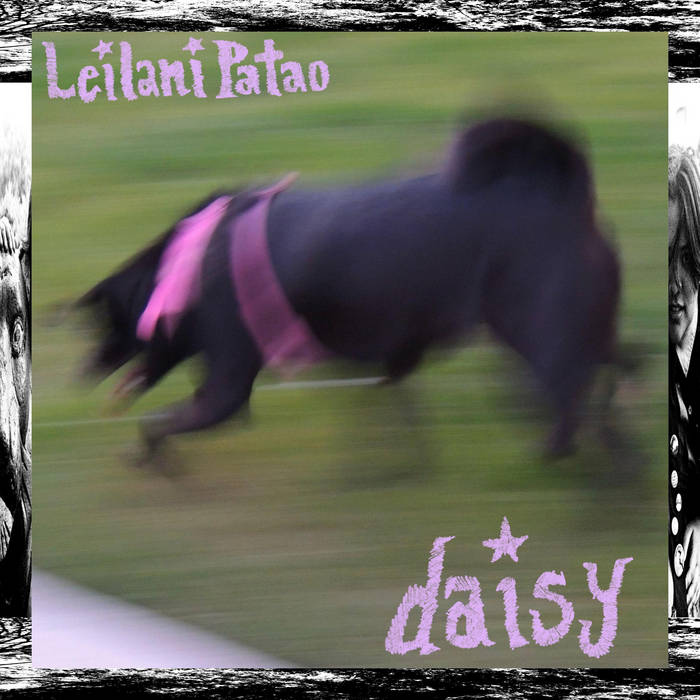
Meredith Hobbs Coons: daisy, your EP, explores a lot of feelings of love and feeling worthy of love. Dogs are famously known for being unconditionally loving.
Leilani Patao: Yeah, funny that you pick up on that. When I first came up with this EP, I had spent two semesters in songwriting courses [at New York University] where you had to write one to two songs a week. And before, I was like, "Okay, I'm going to have an EP," and my dog had just passed. So I wrote a 'good dog' song. I was like, "Okay, cool. There's the premise of the EP: It's all dog songs." And then I spent a year writing a lot of music, and I realized that not all of my dog songs were hits. (laughter) "get em boy" was on there and "branded." Those are the two songs that are still truly dog-related.
I think that before Daisy passed, I was quite a dog-metaphor person. And I think I do see the way that I perceive love in a way—not "perceive," that feels so therapized—I feel like sometimes the way I feel is dog-like. I take to people really quickly. I endure a lot of mistreatment, but I'm also super loyal. I can tell when a home is right and, you know, I bite, I guess? That's the whole truth.
Meredith: I love that. "Songs about checking if something's still bad" comes to mind from what you just shared.
Leilani: Yeah. I'm currently in a relationship that's really happy and healthy, and my whole last album, But What If?, is about her. But this EP isn't about her at all. I wrote a lot of these songs at very different times, and it was interesting to see that I don't listen to myself when it comes to relationships. And this is now a recurring pattern that's showing up in an EP—yay! (laughter) The story behind "Cut" and "BIRD WHISTLE," if I zoomed out, is sort of similar in a way, and in my mind, they're not even about the same person. They were written at very different times about very different situations.
Meredith: There's a lot that comes into this, not just in terms of romantic relationships, but a lot of childhood wounding that you're unpacking here, too.
Leilani: Yeah, "Red Hair Dye" took five-ever to really nail down. That song is about my mom and the feeling of "Will I ever feel like I'm enough as an adult?" It's also about figuring out how to care about home, but to know that that's not always going to be the most comfortable place in the world for me. I suppose that is a theme between all the songs: questioning love and where it comes from, regardless of whether it's romantic love, familial love, or friend love—
Meredith: —or pet love.
Leilani: Yeah. It's funny, I'm leaning on a pillow of Daisy that my parents got me for, like, my 18th birthday.
Meredith: That's sweet of them, actually.
Leilani: I know, right? (laughter) Now, in hindsight, it's like, "Oh my god, now I have Daisy with me always," but she's comically large. Daisy was not this large when she was alive, and now she's memorialized in this massive pillow. It is absolutely hilarious.
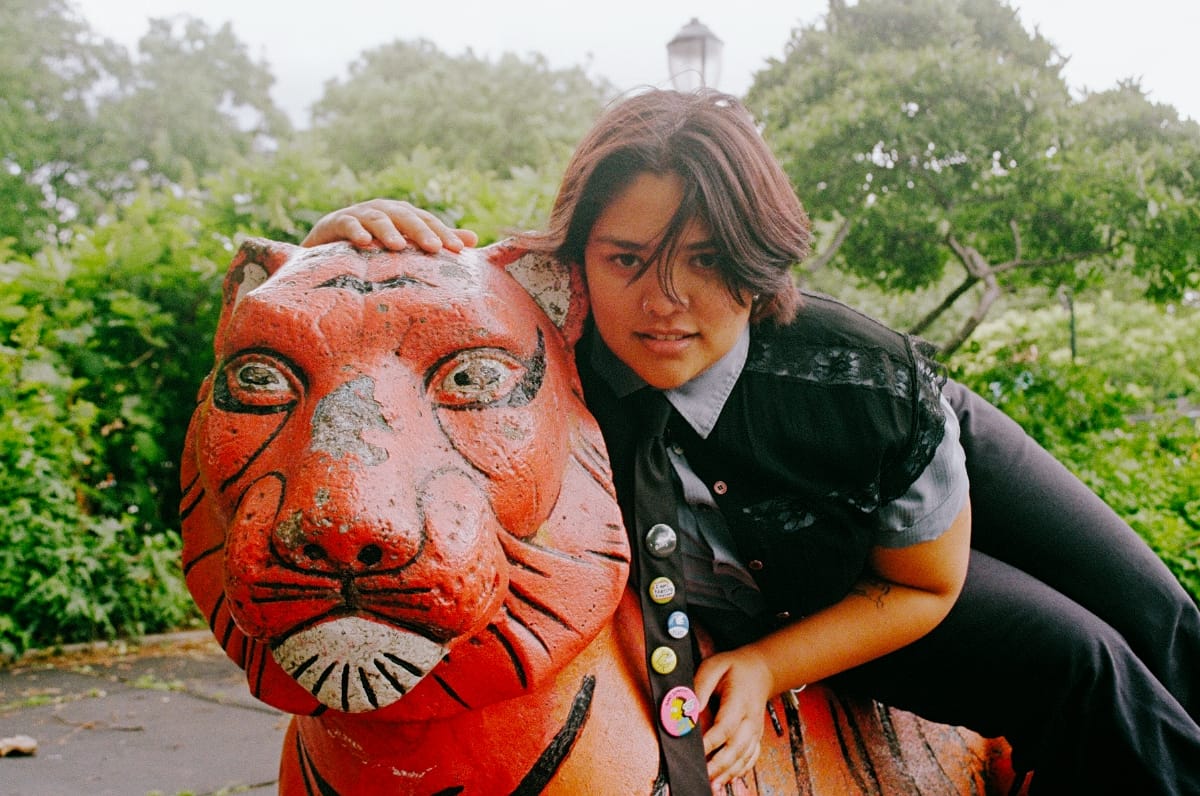
Meredith: You take the helm on a lot of your work—written, produced, mixed, mastered—but you do have some trusted collaborators. I know one of them is Nat Yew, who is your girlfriend, and you were in a band together called Prophet Tree.
Leilani: Yeah, that's her solo project.
Meredith: Nice. And then there's Kiera Williams.
Leilani: Yeah. Kiera is an NYU student with me, a newer friend. I mean, in comparison to Nat. I've known Nat since I was . . . six? We went to kindergarten together.
Meredith: That's very cool. These are just a couple of the people that you find yourself in a musical community with. Do you want to share a bit more about the collective that you find yourself a part of? Maybe about the shared ethos, too?
Leilani: Going to NYU and Clive Davis Institute of Recorded Music, it's easy to feel like the music industry is all like, "You have to network, you have to know people. You need to go to every event. You need to be cold, keep a receipt for everything, and open an LLC in Delaware!" Whatever. I don't know. But I find that my music is personal. I'm a very personal person.
So all the PR pics I've been sending out, along with the stuff on my socials, are by Shannon McMahon. We share a radio show on the NYU college radio station, and she has her own zine, My Little Underground. She's just a wonderful photographer and a really nice person who got the ethos of this album and was super down to take pictures. And then my drummer, Jamie—who, for the record, was my drummer, and Shannon was my photographer, before they dated, but now they're also dating—is the best. We're both at the college radio station, and I met him by pure accident. He was playing drums for someone else, and I was playing bass for someone else. We became friends through that, and he's been my drummer ever since. And he and Nat are really close.
My manager is awesome. We've been best friends for my entire time at college, and they've stuck by me through the last album release. When I came to them with the premise of not releasing daisy on streaming, they were like, "I saw how excited you were about it, and I immediately wanted to say yes," and they've been helping me with absolutely everything.
I will text them about the stupidest thing imaginable, and they will just be there to support me. It's just nice to have another person to bounce ideas off of, especially as someone who is so like, "This is my little thing, and no one else can touch it." I'm such an only child that way. I like steering the ship, but I'm really lucky it has a lot of cool people on board.
Meredith: You touched on getting your music off streaming, and I was curious to hear more about that, about what you're choosing to do with this album.
Leilani: I sat on this music, as I mentioned, for so long, just because I kept thinking over and over and over again about my last album. That was like a two-year project. For my first two years of college, all I could think about was producing this album and finding weird ways to finish it. When I got to releasing it, I'd sat through music business courses at Clive, and all I'd ever done before was just put it on DistroKid and streaming platforms and call it a day. Maybe post on Instagram once or twice.
This was when my manager and I first started working together. They were like, "Okay, we're going to try to talk to this person. We're going to do gigs. We're going to do posting in this way," and this, that, and the other. And I found I couldn't get over the fact that I could put in as much effort as I wanted, and I would probably make no money back. That's not what it should be about. That's not what I care about in the real world. I'm not like, "Money is all I ever care about. The grind never stops," you know. "There must be something I can do."
What really made me choose to take my music off of streaming was, of course, when Deerhoof, Hotline TNT, and King Gizzard and the Lizard Wizard all [took their music off Spotify]. I'm a big Hotline TNT fan. I am a big Deerhoof fan, and King Gizzard's cool. Of course, they're in a completely different league than I am, but seeing that any artist, period, is doing this for the reasons that I was feeling, I was like, "Okay, what now?"
That was around the time I got an iPod. I got rid of my streaming services. I have an iPod, and I buy all my music through Bandcamp or on CDs. My CD collection is getting huge and massive now, and I had had this iPod for maybe like a month or so when I was like, "Okay, there are people online who are doing this. This wasn't even my idea. I didn't even come up with this. I've started to like it. Let me see if taking my music off of streaming will make me feel more fulfilled," and I think it already does. I'm like a Bandcamp warrior. Yesterday was my birthday, and Jamie from Audio Antihero sent me a bunch of Bandcamp stuff they bought me. It feels good to be known in my circles as the person who tells you, "Buy something on Bandcamp; stop streaming things; buy a CD. I don't care if you don't have a CD player—get a CD player." It feels like I can experiment and see if I can really do the things I want to do, in the way I want to. That was just the bottom line in deciding to do it.
Meredith: It's interesting, as a person who cares about love and being loved well, there's risk in making a decision like that, that could put you at odds with people, but it seems to also come from how you want to practice love in terms of the global community and other artists.
Leilani: Yeah, very much. This trajectory makes so much sense to me. "BIRD WHISTLE" is about wanting to be friends with someone that is so awful that you're just like, "How did I ever have feelings for you?" "Cut" is about the stupidest breakup I've ever gone through, and it was just like, "Why did that happen? Why did I have to go that way?" And I'm going through all these ways to decide how I want my voice to be heard in my personal relationships. I want to be the one in charge of my own life. I don't want people to steamroll over me. I want to be the one making my own decisions, and I'm listening to all this music that's like, "Why am I not able to make my own decisions?" And I'm like, "Well, I could start now!" My music career and my personal life are all one and the same. For me, making music is about seeing the world that I'm personally seeing, seeing the world that I'm seeing politically, being around the people I'm around, and feeling like I have to say something. It's all one. I don't think I can compartmentalize it all.
Meredith: Right. And, as you were sharing that, I was thinking that it becomes an act of self-love, honoring your voice.
Leilani: Very much so. My therapist would be very happy with that observation. (laughter) I think in so much of the music world, as well as the theater world that I came from, and the world we live in, self-love is this package of, you know, "Eat nine bananas a day, and drink all this water, and go do pilates, and eat Erewhon." I never even thought that self-love could be like a thing like this, that self-love could be, "I'm gonna release an EP and see if it works in this way." And—hot take!—I'm not going to eat any bananas. I'm just gonna release my EP, drink a glass of water, and call it a day! It is really exciting. I feel good knowing that this is a step for myself.
Check out more like this:
 Steven Garnett
 Meredith Hobbs Coons


Comments