


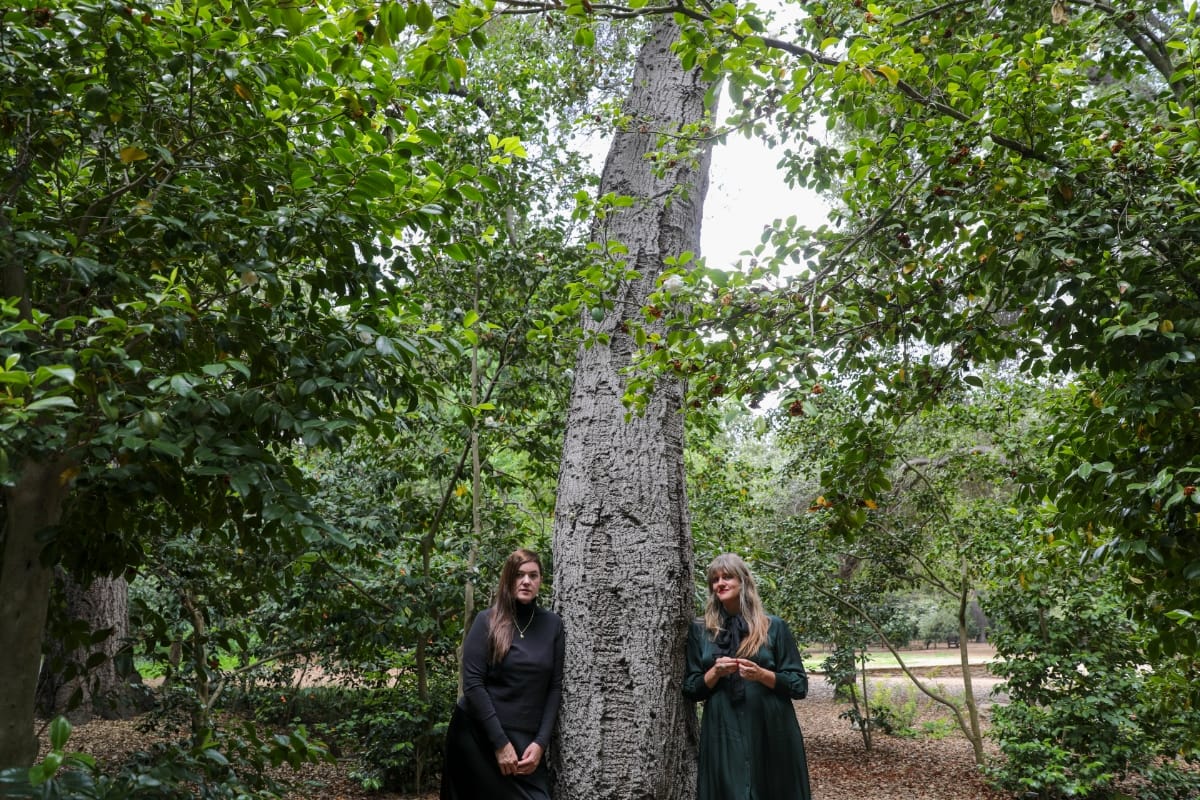
Mary Lattimore learned the harp as a pre-teen in western North Carolina, where her mother was also a harpist. Across five solo albums, including Goodbye, Hotel Arkada in 2023, Lattimore has developed a practice that treats the harp as a vehicle for fleeting impression and emotional memory.
Julianna Barwick grew up in Louisiana singing in church choirs, hearing voices layered in harmony. Barwick's sound is built entirely around her voice, looped and overlaid to resemble the choirs of those formative years.
Lattimore appeared on Barwick's Healing Is a Miracle (2020), which also featured Jónsi and Nosaj Thing. Pitchfork named it Best New Music that year. Then, years of touring together produced a genuine closeness and, among listeners who followed both artists, a persistent expectation. "Through the years, people who like our music would say, 'You guys should make a record together,'" Barwick recalls. "And we were always like, 'We know, we want to.'"
The setting for their collaboration was, even by the standards of artist residencies, unusual. The French label InFiné has partnered with the Philharmonie de Paris since 2017 to give contemporary composers access to playable instruments from the Musée de la Musique's historical collection. Tragic Magic is the third release in that series, after efforts by Arandel (2020) and Seb Martel (2022). InFiné brought Barwick and Lattimore to Paris for nine days of recording in January 2025, shortly after the Los Angeles wildfires had disrupted both artists' lives in the city.
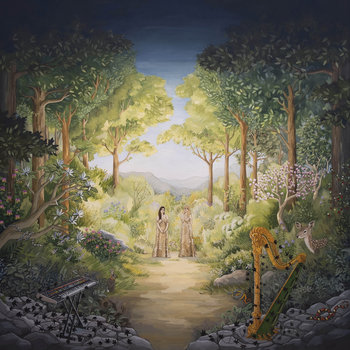
Lattimore selected three harps built between 1728 and 1873, including the Jacob Hochbrücker harp and two Érard models. Barwick chose a Roland Jupiter synthesizer and the Sequential Circuits Prophet-5, introduced in 1978 as the first fully programmable polyphonic synthesizer. Trevor Spencer, known for his work with Fleet Foxes and Beach House, produced and mixed the sessions alongside the duo. Tragic Magic was released on InFiné in January 2026 and received near-unanimous critical acclaim. "People would ask me, 'So how was Paris?'" Barwick recalls. "And I just said, 'It was perfect.' It was perfect."
At this year's Big Ears Festival in Knoxville, Barwick and Lattimore played through nearly all of Tragic Magic inside the First Presbyterian Sanctuary, a space whose vaulted resonance felt continuous with the songs. The setting was not incidental for Barwick, who spent her childhood singing in rooms just like it. Midway through the show, they performed “Rachel's Song,” the Vangelis theme from Blade Runner that the two have been developing. Barwick and Lattimore told the audience the story behind the track's opening rainfall sample before playing it. The accompanying explanation, directly related by the artists who felt it, evoked an emotion in the live setting that the studio version could only suggest. The room was brought to a hush. (Michael’s note: This was one of my festival highlights, hands down.)
Julianna Barwick and Mary Lattimore recently appeared on The Tonearm Podcast. With host Lawrence Peryer, they discussed the emotional circumstances of their time in Paris, the role of place and physical space in their work, how each came to her instrument, and their shared interest in James Turrell's light art.
You can listen to the entire conversation in the audio player below. The transcript has been edited for length, flow, and clarity.
Lawrence Peryer: I wanted to start by asking you about the conditions under which you arrived for the sessions—immediately after the fires in Los Angeles. What did you show up with emotionally and interpersonally? Mary, you look like you're bursting at the seams.
Mary Lattimore: I would say a lot of gratitude for the opportunity to just get out of a city that had been so terrifying in the weeks before. Gratitude for this opportunity, and really glad I could be there with Julianna. A lot of the music we both make comes from our hearts and how we feel, so having the opportunity to process that through music in a gorgeous city was something to be really grateful for. There was also some guilt about leaving a place that had been so traumatized and going off to Paris. Julianna and I talked about that, too. You feel very privileged, and with that comes a recognition that not everybody gets to do this—there's a little guilt in leaving so soon after such a disaster.
Julianna Barwick: We flew to Paris on the 25th, so it was shortly after everything happened here. It was a mixed bag for sure—complete and total elation. Mary and I had probably dreamt of making a duo record for ten years. This was just an unbelievable opportunity for us. But we were making our way to Paris with really heavy hearts.
Mary: A lot of processing. It was heavy. It was a heavy trip.
Lawrence: With all of that in the air for the two of you, I'm curious about place and space and how it affects your work. What was the role of Paris, the role of the rooms you recorded in, and, most special on this album, the role of the instruments?
Mary: The rooms were in the basement of the Philharmonie and the Musée de la Musique. The rooms themselves were unremarkable. One was more like a storage room we started in until the bigger room was available, and it was a rehearsal room with no windows. Given such an ornate setting and the architectural gem that is the Philharmonie, these rooms felt like the place where the work happens behind the scenes. And it was fun to get to know that side. I always like behind the scenes—the secret little twisty hallways and the coffee machine where you go when you go to work there.
The instruments themselves couldn't go very far. The curator had to deliver them down the elevator and handle them delicately, because they had come straight from the museum exhibit. There were little signs in the museum where the instruments had been on display that said, "Sorry, you can't view this harp because it is on loan to Mary, who is making music with Julianna." It was really cool that we were seen as important enough to merit that little card. Once in a lifetime.
Lawrence: Julianna, could you tell me about the instrument selection? Did you stroll through the collection and pick items?
Julianna: We were sent a list of available instruments to choose from. Since I'm a vocalist and the only thing I really know how to play outside of my own voice is keys, I was looking at which keyboards were available. So I chose the Jupiter and the Prophet-5. I did say I would've loved to play the harpsichord, and that didn't end up happening. Once I saw it in person, I understood why—every square millimeter of it was painted in this beautiful pastoral oil painting from who knows what century. I also chose the vocoder because I could do things with my voice through that.
Lawrence: When you think about choosing a synthesizer or a keyboard instrument, you can approach it with some idea of what it's going to sound like or what it's capable of. What's the analog with a multi-century-old harp?
Mary: I chose based on playability. It didn't feel like, "Oh, I'm choosing this harp because it's my favorite." I felt like I was choosing it because it was closest to what I play now—the instrument through which I could best express the music Julianna and I make, but give it the voice of something from the 1800s, a kind of merging of the centuries. Some of the harps that were offered were in a condition that wasn't playable—the string tension was off, the tuning was off, which meant they couldn't be merged with a more modern instrument. I basically picked the harps I felt could be translated into this modern voice, most easily given the time constraints we had.
Lawrence: Correct me if I'm wrong, Mary—you didn't necessarily fall head over heels in love with the harp initially. It took you some time to really connect.
Mary: It's so funny, because in preparing for this interview you asked to have my Wikipedia page included in the prep materials, and I read my Wikipedia for the first time in a really long time, and it said something about me not initially connecting with the instrument, and I was like, "Oh my gosh, I hope my mom doesn't read my Wikipedia." My mom is a harpist.
It's true. Wikipedia is correct. When you're a child, you don't necessarily want to practice all the time. I started playing the harp when I was eleven. I had a strict classical background, and it's very tedious to sit down and play scales. The way you learn the harp in general is one finger at a time. Combined with my mom being a harpist, it just felt normal to me. It wasn't, "Oh, the harp, it's so magical." The harp was my mom's job. But then, when I started to get better at it, and started to play Debussy or some kind of beautiful cadenza, and had it click after studying for six months or so, it got really fun. You start to see the small nuances you can make in classical music—how you can make something sound your own, add your own tone and emotions to pieces that have been played for so long. I think that's when it started to feel like my voice, rather than something I was just studying because of my mom.
Lawrence: I have a similar question for you, Julianna. Your primary instrument is your voice, yet you approach it in a very specific and interesting way. Could you tell me a little bit about that journey of discovery—the looping and layering, how you stumbled across it?
Julianna: Sure. I grew up singing every which way—I just sang all the time. I found reverberant spaces as a child and would sing and make myself cry, just singing in a parking garage or whatever. I always loved to sing. I was always in choirs throughout school, and sang in church with the congregation a cappella in these reverberant spaces. So my brain was constantly being informed by singing and by the effect the space it's in has on its sound.
In high school, I took voice lessons. I was in an opera chorus after high school, had a little Fostex four-track recorder, and ended up with some effects pedals that I would put my voice or an electric guitar through. I was just finding my way, trying to figure out what kind of music I could make that didn't just sound like trying to be somebody else. One of my best friends showed me a DigiTech digital delay pedal meant for guitar. He showed me that if you held the pedal down, it would loop. That just ignited something in my brain. I took it home and just made millions of loops, experimenting. Everything clicked. I could compose in the moment—start a loop not knowing where it would go, and end up sitting back like, "Where did that come from?" It just fit my musical constitution perfectly, and still does.
Lawrence: It seems like there's also an analog to having grown up singing in church with other voices—there's an element of hearing your voice in the context of many voices, and being able to do that on your own is kind of fascinating.
Julianna: Totally. I sang in choirs starting in about third grade, and then my whole life going to church three times a week—hearing rounds, hearing the sopranos, altos, tenors, bass, baritone, all the different parts, the harmonies, even the clapping. I could hear all the layers. So once I figured out how to loop my voice, it was so fun to harmonize with myself—instantly. With looping, you put one layer down, then add to it, harmonize with yourself, add beats, whatever you want. I also have a lot of fun using my voice in different ways and timbres—sometimes making it really soft, other times making it honky or brassy. I just like playing with my voice, kind of like a palette.
Lawrence: I’m curious about the harp you used for the Roger Eno piece, "Temple of the Winds." My understanding is that it was a particularly old and rare instrument. Tell me about that song, that pairing, and what responsibility comes with handling that object.
Mary: It was terrifying, really, to be entrusted with the tuning and playing of that instrument. We knew we wanted to feature it somewhere on the record, but using it every day, handling it, and looping it didn't feel right. This song felt like the proper way to honor it. That harp was unaffected—we just heard the natural sound of that very early pedal harp, the Jacob Hochbrücker harp from 1728. It was extremely delicate. Trevor [Spencer, co-producer and engineer] had to literally hold it on my shoulder so that it wouldn't fall. It was light as a feather. The strings were very close together, the tension very different from my harp.
This piece was written by Roger after we met him in Australia. We had a fun lunch together—we were all playing the same show later that night—and got along really well. Then he went to a park by himself, wrote us this piece, and presented it to us at the concert. He said, "I just wrote you a piece this afternoon—'Temple of the Winds.'" So we'd been saving it for the right moment to record it.
When I came across the Jacob Hochbrücker harp, I thought, okay, this would be the right one to use for this song. The song was tricky—it sounds simple, but it was pretty hard to learn. We wanted to do it in one take, no cutting and pasting or punching in. Just play it through twice. It took a lot of time and practice to get it right, especially using such an unfamiliar instrument.
Lawrence: That's such a beautiful offering—to have someone respond to time spent together by coming back with a composition.
Mary: Roger is a cool person. He's really funny and amazingly talented, and I really feel like it was destiny that we got to meet him that time.
Lawrence: Tell me about "Rachel's Song." There's a lot in your collaborative presentation of it—the field recording of the rain, the themes of the song, how it comes from Blade Runner. There's a lot of weight in that composition.
Mary: The rain sample came from our friend Rachael—total coincidence. Pony is her nickname. We were chatting, and she lives in LA, and she said, "It just started raining—the first time in eight months, the first time since the fires." And we said, "Please go outside and send us a recording. We want to hear it—we want to be able to experience the relief with the rest of our city." So we listened to it, and we were like, "Oh man, maybe we should slow this down a little and include it in the recording."
The recording, in totality, feels like a time capsule—it holds all the memories of that time in our lives and of that experience. We wanted to include that moment, that very important moment, along with all the other things we'd collected during that recording period.
Lawrence: That's such a fascinating impulse—to say, "Please record it. We want to experience it." I don't know if I have a question around that so much as it just strikes me. What's that about?
Julianna: That was all Mary—she asked Rachael to do that. But it just goes to show how, even though we were so enthralled with Paris and our experience at the Philharmonie, our hearts were very much back in LA. To hear that it was raining there was deeply emotional. There were moments when we were just crying on and off throughout the whole recording process, and hearing that it was raining back home was one of them. I put that recording into my sampler, so we've been playing it live. It's wild that this is the actual first rainfall after what happened to our city, and it's on the record, and it's there every time we play it live. It's a really beautiful amalgamation of all those elements.
And with "Rachel's Song,” Mary mentioned a few years ago that she would love to hear me sing it. So we worked it out to play live. We played it a couple of times, just to work the Prophet-5 into it, and Mary's harp just sounded perfect in there. The chimes, everything came together. Even the horrifying vocals at the end—I just kind of pressed every button on my effects pedal, and that's how we arrived there.
Lawrence: There's something else I've been really excited to talk to you both about: James Turrell. I lived in New York for around twenty years, and I was fortunate enough to see his installations there and in LA. I think about those experiences quite often. There's such a natural connection between light art and the kinds of sounds artists like you make.
Mary: I first discovered him around the time of the Guggenheim show. I read the review of that show in The New Yorker, and I loved the way his work was described—the words "luminous" and "ravishing" were ones I remember reading and thinking, "I must see this." I'd never heard of him in my life. I rode the bus up to New York to go see it, and my brain was just blown open.
I feel like I do some Turrell tourism. I went to Japan, to Naoshima to see a couple of his works there, and to Villa Panza in Italy. Julianna appreciates his work just as much as I do. We even had the honor of opening his newest Skyspace at MASS MoCA—we played for the opening, and he was there.
People ask, "Mary, what's your biggest dream show?" And I always say playing in the crater. Playing in the crater—that would be the highlight of a lifetime, if that could ever happen.
Lawrence: Did you go to the crater?
Mary: No. Is the crater open? Can you go to the crater?
Lawrence: I don't know exactly how it works, but I feel like some people get to. I was kind of hoping you were going to say that when you were with him at MASS MoCA, he said, "Why don't we all go back to my place sometime and visit the crater?"
Mary: I know! I didn't even talk to him. It would be scary to talk to him.
Lawrence: Something I find very compelling about his work is the way it reproduces in photographs—it's stunning as a photograph, and then to go see it in person, and it's just . . . I don't know why I'm always so surprised. I guess, because it’s light art, I just expect to be disappointed in person after seeing it so stunningly photographed. But you're instantly in a different universe.
Mary: You feel it—you don't just see it. You feel it.
Julianna: You're a part of it. I remember being a kid and looking out the window at the beautiful sun with the yellow leaves falling, not just wanting to see it, but wanting to get out of the car and be a part of it. With his work, you really are—you're within it, you're in that spongy color, you're experiencing something. It's so different from looking at a painting. You walk upstairs, and you're in a piece. It's something else to be in a space with the art, trying to see where one surface ends and another begins. It's just so fun for the brain and so beautiful to your eyes.
Lawrence: And the crisp lines that demarcate the boundaries of the light and shadow—so stunning.
Mary: How does it even work? It's biology, it's science, it's magic.
Lawrence: Something I very much appreciate about the two of you—you didn't really indulge my attempt to get mystical about the space and the instruments, because that could have been a whole rabbit hole I definitely would have gone down. But if I can drag you back into that for one second: something that strikes me about this work is that because of the instruments, and frankly because of their age—not only the harps, but these classic synthesizers—and the space that houses them, they have narratives, stories, histories. And now you've contributed to their stories. Some of these objects probably hadn't had their stories added to in a while.
Mary: It's beautiful the way you put it. You always feel like this is a living thing, a living, breathing thing. These instruments are meant to be played. I feel like they enjoy being played. Alexandre, the head of our label at InFiné, said, "You're waking up the sleeping princesses." And we named a song after that because it was just so beautiful. It does feel like we're waking up these instruments and bringing them into a new chapter—“Come join us here in the future, come with us.” And we're going to play these instruments live again in April. We have three sets to play at the museum on April 10th, where we’ll have to readjust to these instruments and communicate with them again.
Lawrence: Julianna, you actually put electricity through them, right? Like, they're actually sleeping—and then you wake them up. It's barely metaphorical.
Julianna: Got to have electricity. But the harps are acoustic instruments, too, and I feel like those instruments want to be played. They don't want to just sit on the shelf. I definitely have semi-emotional connections with the instruments I use—they're all machines, but I love following my nose and figuring out what they're going to do.
Check out more like this:
 Lawrence Peryer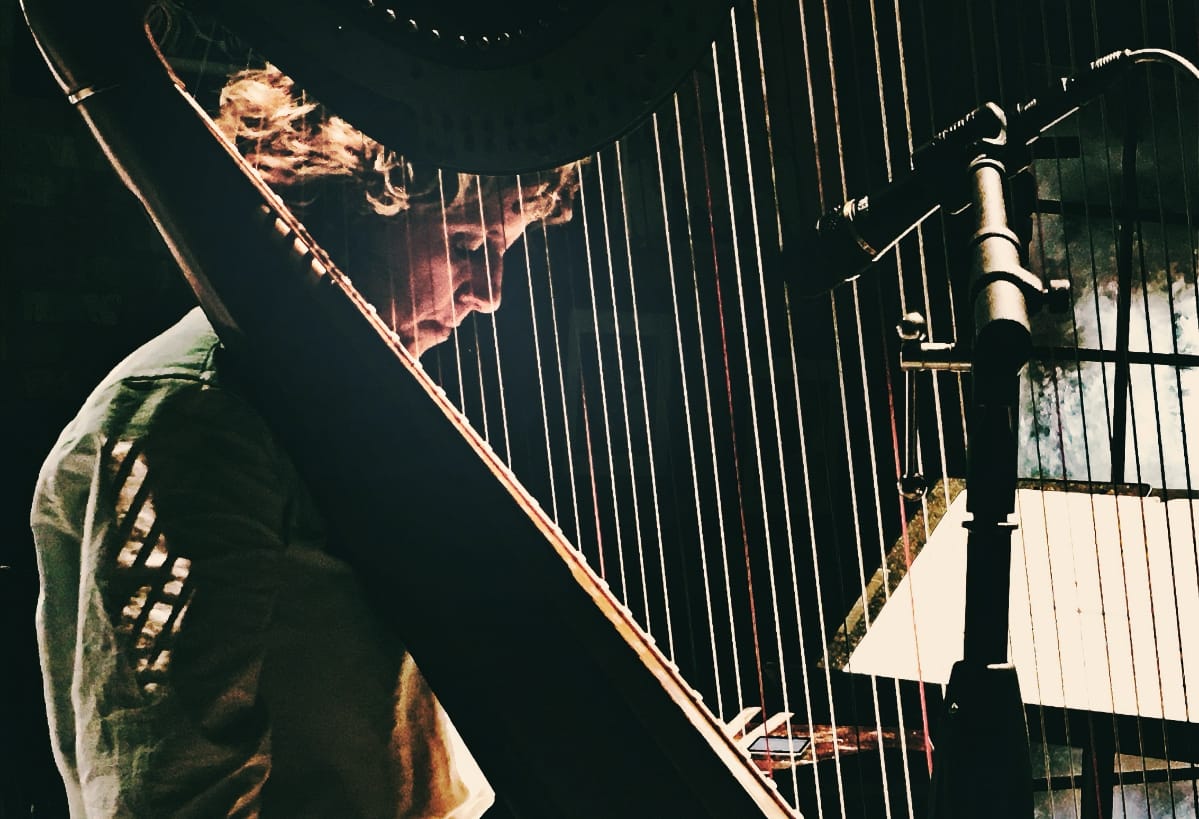
 Carolyn Zaldivar Snow


Comments