


Hello! Michael here. Last week, I offered my manifesto of sorts, detailing how I'm guiding The Tonearm based on a philosophy of generous expertise. This week, Lawrence (aka LP) relates how his experiences in his working life shaped his attitude toward focusing on the not-exactly-profit-bound but extremely rewarding worlds of The Tonearm and the Spotlight On podcast. Here's LP:
I sometimes listen to a podcast called Search Engine, and this week they re-posted an episode from 2024 titled Does anyone actually like their job?
Like many podcasts, particularly theirs, the title does not do justice to the depth of the inquiry. Of the several questions the episode pondered, one that resonated for me was, “What happens when we stop chasing external validation and instead pursue work purely for its inherent value?” See, I have discovered something remarkable through my experiences with Spotlight On and The Tonearm: the less desperately I pursue traditional metrics of success, the more meaningful and often successful my work becomes.
Neither of these ventures operates with a conventional revenue model. This wasn't an accident but a deliberate choice rooted in respect for our audience. Michael and I refuse to degrade the reader or listener experience or compromise our editorial independence for commercial gain. When Spotlight On briefly experimented with ads from an internet ad network, the misalignment with my values became immediately apparent. The ads were inappropriate and out of sync with my beliefs. I was not going to have my voice or that of my guests placed next to ads for some of the things that were getting served up. Ultimately, it was not going to be enough money to matter anyway. I can frame this as high-minded, but it wasn't that difficult of a choice.
The lack of commercial pressure has proven liberating. It allows us to cover otherwise under-covered art, artists, and ideas that mainstream outlets overlook. We have created what I think of as an ecosystem of people interested in creativity, process, and humanism. Rather than chasing metrics that might please advertisers, we focus on editorial quality and honoring our interview subjects with thorough preparation and curiosity.
And there are rewards. Spotlight On helped get me through the pandemic. The regular conversations with creative people cut through the isolation and anxiety in substantial ways. Having production deadlines gave structure to that otherwise amorphous time. About a year into hosting the podcast, I realized I wanted to continue these discussions indefinitely, not for any external feedback but because the conversations themselves had become deeply fulfilling, a means of connection.
This experience has fundamentally altered my perspective on success. I can view the work as a slightly expensive hobby (some guys buy boats or sports cars; I write about experimental music!) or, less glibly, as a way to participate in a global current of creativity. Or neither, or both. Definitions aside, there is no measure by which these projects are not successful.

Many artists and thinkers I admire operate outside the commercial mainstream, always hustling to create their lives in their own ways. I find satisfaction in being part of this global network or community of people who share my values and beliefs that art and culture are fundamental to a free and healthy society. These are my people, and I feel honored to be on this path with them.
As a consultant and advisor, I still work hard on business projects; we all gotta eat. But my relationship with work is different. I now love my work and the people I do it with as much or more than at any other time in my career. My experiences with my creative projects have made me a better professional. At this stage, I seek not balance but integration: a life of intellect, curiosity, creativity, drive for excellence, spirituality, compassion, and love for the people important to me.
Does this sometimes feel, or can it be viewed as, reckless and self-indulgent? Of course. I know I come from a place of privilege, but I believe what I do with that privilege is what is important and how I should be measured.
This is the opposite of desperation: creating not from anxious striving for external validation but from a place of genuine curiosity and purpose. We often produce our most meaningful work when we define success by our standards rather than conventional metrics. The audience and recognition may follow, not because we desperately pursued them, but because authenticity resonates in ways that calculated strategies rarely do.
This Week's Highlights
As I noted on Mastodon, my brief time editing our online journal has already brought me to some unexpected places, but none more so than the opportunity to talk shop with the great Adrian Sherwood. I'm a former (for now?) music producer and have always held Adrian pretty high up in my pantheon of mixing desk heroes—perhaps second only to Mr. Eno. So you can imagine my joy when he agreed to a short but insightful interview about his time working with the late "Style" Scott on the final series of Dub Syndicate albums. The article is one of my major highlights at The Tonearm so far, and there's a bonus statement from Adrian at the bottom of this newsletter. Be sure to click the first link in that article to experience the masterly magic Adrian Sherwood casts in a small studio.
 Michael Donaldson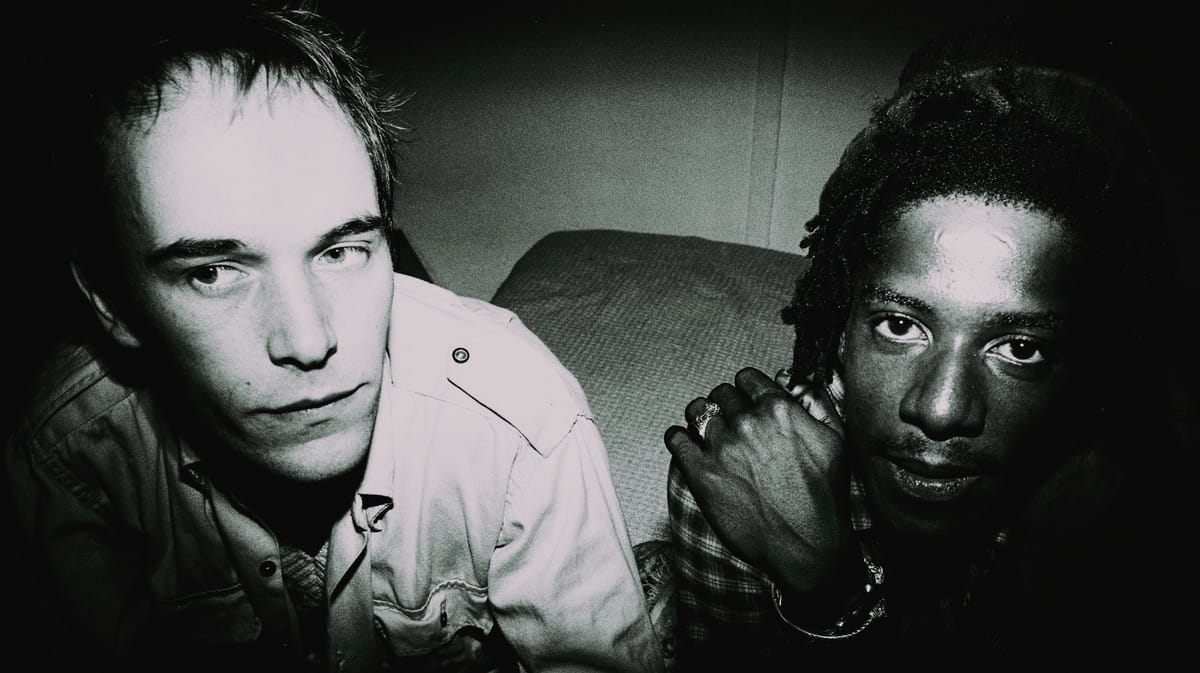
Greg Lisher was (or is) the guitar-slinger in beloved indie-stalwarts Camper Van Beethoven and Monks of Doom. After a pair of more conventional solo albums, Greg took a path into the unexpected and self-challenging by embracing electronic music production. With no experience in this sort of music—though a deep love for pioneers like Yellow Magic Orchestra and Tangerine Dream—Greg approached things from what the wise men who live in the clouds call a 'beginner's mind.' He learned the software from scratch, experimented with adding varied instrumentation, and even took piano lessons. The latest result of this journey is the album Underwater Detection Method, and Greg was pleased to spill the beans on his experiences for The Tonearm.
 Lawrence Peryer
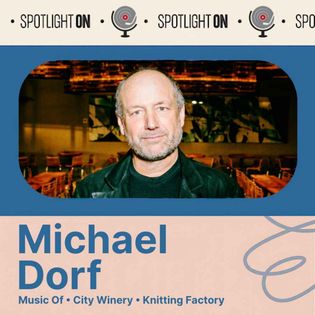
This week's Spotlight On was a special one for LP. He spoke with Michael Dorf, the New York City-based impresario who founded the national venue chain City Winery and, before that (and more impactful for LP), the Knitting Factory, which was home to some of the most adventurous live music programming in New York's Downtown scene throughout the 1990s. "Michael shared some terrific stories about Sonny Sharrock and John Zorn," LP said. "As I related to him in our conversation, I saw Sonny one night at the original Knit in 1994, which completely melted my brain. I also witnessed countless John Zorn projects (sets by Masada and Bar Kokhba stand out) as well as shows from the Last Poets, Marc Ribot, Third Rail (a supergroup of James Blood Ulmer, Bill Laswell, Amina Claudine Myers, Bernie Worrell, and Ziggy Modileste), and so much more. At City Winery, I saw Gary Louris (from the Jayhawks), Emmylou Harris and Rodney Crowell, and even War, who were surprisingly hot."
LP also continued sharing his reflections on the first five years of Spotlight On. This week, he looked back on 2022, a year that saw the podcast dramatically increase its audience and the breadth of guests. 2022 was a 'Year of Legends' of sorts, featuring discussions with Pink Floyd drummer Nick Mason, electronic music pioneer Don Slepian, jazz-funk icons The Headhunters, and dozens more.
 Lawrence Peryer
Howie Singer and Bill Rosenblatt, co-authors of Key Changes: The Ten Times Technology Transformed the Music Industry, have graciously allowed The Tonearm to publish an excerpt from their fascinating new book. And what a great excerpt it is: the section covers the technological shift from 78s to vinyl LPs, which not only altered how recorded music was made but created a whole new movement of consumer audiophiles. This stuff is right up my alley, and I'm looking forward to LP's livestreamed conversation with the authors that will take place on March 11. You can join in, too—there's more information included with the excerpt, or you can register for free via Zoom.
 Lawrence Peryer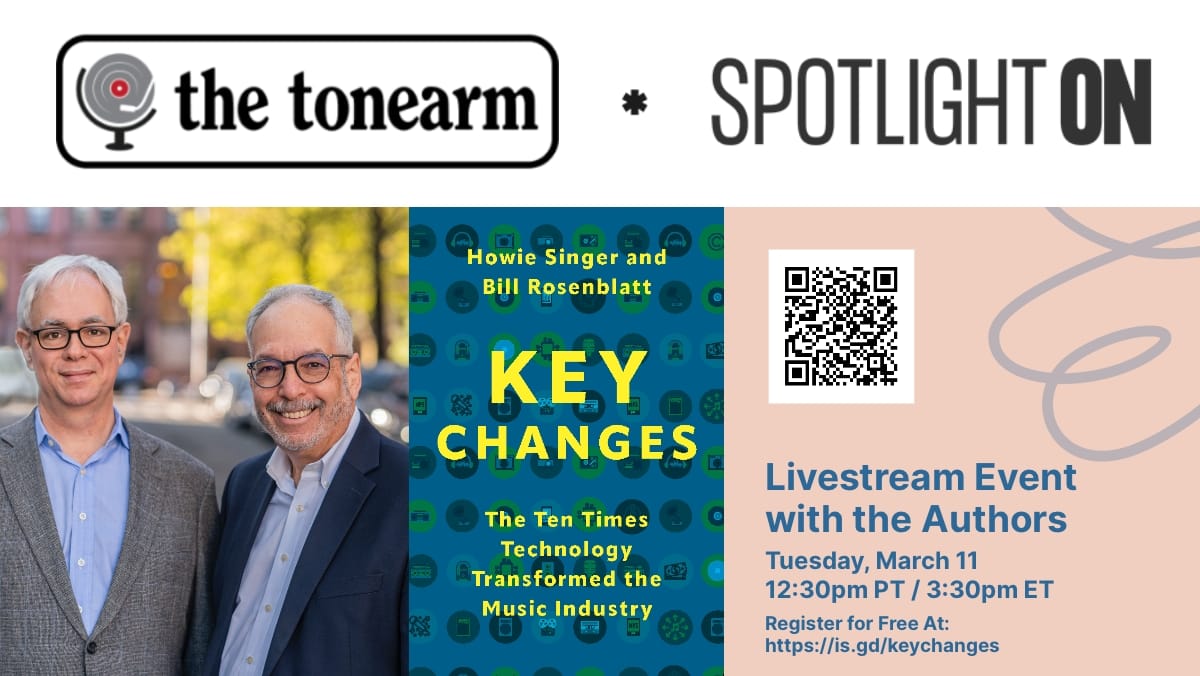
Intake Moderation
- "His playground was the limbo between death (the ultimate failure) and desire (proof of life) where the innocent exists alongside the sinister. This dynamic is hardwired, I think, and it begins with the childhood realization that clowns are frightening because they are smiling without reason." James A. Reeve's latest installment of Midnight Radio is a David Lynch tribute, and it is SO GOOD.
- Gene Hackman's tragic death reminds me of all the amazing and influential movies he starred in, but none is more important for me than The Conversation. Prescience (as we touched on with THX 1138 last time)? Well, here's Sean T. Collins in The Decider on "How Gene Hackman’s Dream in The Conversation Mirrors Our Dark Moment." Also, this film is on the Criterion Channel, leaving at the end of the month. If you often think about how sound changes our understanding of the world through perception—and if you're reading this, you probably do—then The Conversation is a must-see.
- Fun Fact! In the latest issue of his Octannual Manual newsletter, author John Higgs provided a fascinating analysis of the 'hidden' meaning behind Elon Musk's Department of Government Efficiency: "It’s well known that the name ‘DOGE’ is a joke name based on DOGEcoin and that meme of the dog—but it does have another, older meaning. ‘Doge’ is an existing word which means ‘Leader’, as in the Doge of Venice. In other parts of Italy, that same word, from the same Latin root, was ‘Duce’. Hence, when Mussolini invented fascism, he gave himself the title of Il Duce, the Leader. And in turn, Hitler was such a Mussolini fanboy that he, too, adopted the German equivalent, which was Führer. ‘Doge’, then, is ‘Leader’ in fascist terminology..."
- Continuing on from that jolly topic, LP watched the first two episodes of the 60s-era British TV show The Prisoner this week. He had this to say about it: "I don't know what I was expecting, but not this. It was shockingly good, and I was surprised by how modern it felt. I understand now why it was so impactful for people." Is it more than just a TV show?
- Drag City released a pair of winners last Friday, new albums from David Grubbs (formerly of Gastr Del Sol) and Edith Frost (one of the most fun people you could follow on Mastodon, btw). There's also a fine techno-adjacent remix of Passepartout Duo and Inoyama Land's
"Xiloteca" you should check out. (Arina posted a great interview with Passepartout Duo recently on The Tonearm.) And if you're looking to calm your nerves, you should sink into this brilliant new ambient album from anthéne. Still looking for more? Check out last week's Needle Drops recommendations.
Something We Love
At the end of my interview with Adrian Sherwood, I asked the question that's always on the brim of my brain: What's something you love that more people should know about? He didn't really answer, but at the same time, he did brilliantly, and I have to love him for that.
Adrian Sherwood (Rhythm and Echo): I mean, musically, it's just down to the individual. The problem you've got is a lot of people get older and stop listening to music. I offer our music to people and ask, “Would you like a CD or an album?" And they say, “I don't really listen to music anymore. I just listen to the radio or Spotify.” Like, try and regain some passion! That's what people need again and what I hope people will get. Many people are just jaded and cynical about stuff, and I would like to see people more unified and socializing more. Since the lockdown, the world's changed, and I probably haven't even answered the question, but along those lines is what I would say: Get out, unify, gather people, just anything. Because at the moment, everyone seems so splintered and not together.

Thanks again for reading our weekly newsletter, Talk Of The Tonearm. This is the second one, and I feel like we're about to get our sea legs. As always, please let us know what you think and want to see here. And stay tuned—there's a lot of excellent stuff in the pipeline that we can't wait to bring to you.
Share us with a friend if you're into what we do. That small gesture means a lot more to us than you know.
Thank you again, and we'll see you next time. 🚀


Comments