


Early in our conversation—and all over his band Constant Smiles's album Moonflowers—Ben Jones references the incremental, stealthy transformations of things in life and nature, mentioning specifically the gradual phenomenon of water eroding stone. I'm instantly transported to a memory of traveling with my cousins, full of fresh grief following my grandmother's celebration of life, to Flume Gorge in New Hampshire. It was carved that way: a stream flowed over granite, became a river flanked by towering stone cliffs. It rushes past them to this day, having claimed its rightful path in the world.
Maybe it's my particular relationship to that image and its association with personal loss, maybe it's the hearkening back to standard-bearing influences like Elliott Smith and Nick Drake on Moonflowers' songs (you can hear Drake in the way Jones sings "here"), but there's a companionate quality to this album, a sort of healing presence, that has kept its title track in my head as I've evolved in my own ways over the past month.
As a longtime gardener, Jones knows a lot about growth, but this observational, patient quality to his music is a more recent development, most intentionally applied since late 2022, when drummer Nora Knight joined Jones and bassist Spike Currier in Constant Smiles. And on Moonflowers, Jones brought in collaborators (producer Katie Von Schleicher, fellow musician Cassandra Jenkins, and legendary engineer Phil Weinrobe) to guide his sound in new ways. That combination, I think, is what gives the album its supportive quality. It echoes the environment in which it was made.
Jones and I spoke over video chat in late October as he enjoyed some spooky, autumnal showers in New York and I endured a seasonally dissonant heatwave in my part of the world. He bookended our conversation with celebratory spins in his desk chair.
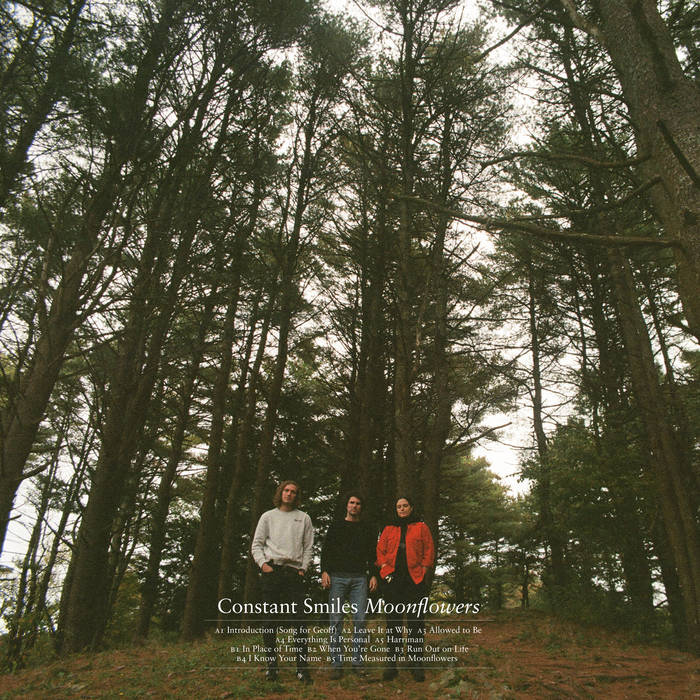
Meredith Hobbs Coons: There are a lot of nature themes in your music and on this record. I caught some references to water; there's some nature-y imagery in your promo materials. Let's talk about that.
Ben Jones: Well, I've been a gardener. Everyone in the band is a gardener, but I've been a gardener since high school. It was my main job for a while, and now, I just do it once a year. I go back to my hometown [on Martha's Vineyard] and do some gardening for my old boss. She's kind of like a second mom to me. For this record, I was doing a bit of gardening and thinking about—it sounds cheesy—how things grow. Like when water hits a rock: if it's a steady drip, you don't notice it changing, but over time it eventually makes a crevice, and then it'll make a river. I think that's what a lot of this record was about.
I've been doing music for a long time, I've been doing gardening for a long time, and as a band, Nora, Spike, and I really settled into each other. We were on tour for a lot of two years, and we wrote the album over two years, picking away at it. We'd write a lot on tour, and it was just like, "Oh, wow. Now I am knowledgeable about gardening; now we've made a full record." Moonflowers is about how things bloom (it's a night-blooming flower) and how the subconscious can really bloom when you least expect it.
Meredith: "Everyone in this band is a gardener," is not a sentence that I ever expected to hear.
Ben: So, it's funny. This guy in my hometown is making a book of musician gardeners. I think there's really something there. It's more common than you'd think.
Meredith: Please tell me that George Harrison is in that book, because of what he did at Friar Park.
Ben: Is that at his house? What did he do?
Meredith: Oh, he landscaped the hell out of that place. He was an insane gardener. He has a book, I Me Mine. It's a collection of his lyrics and his reflections on them. And the dedication is "to gardeners everywhere."
Ben: Whoa, I gotta get this book.

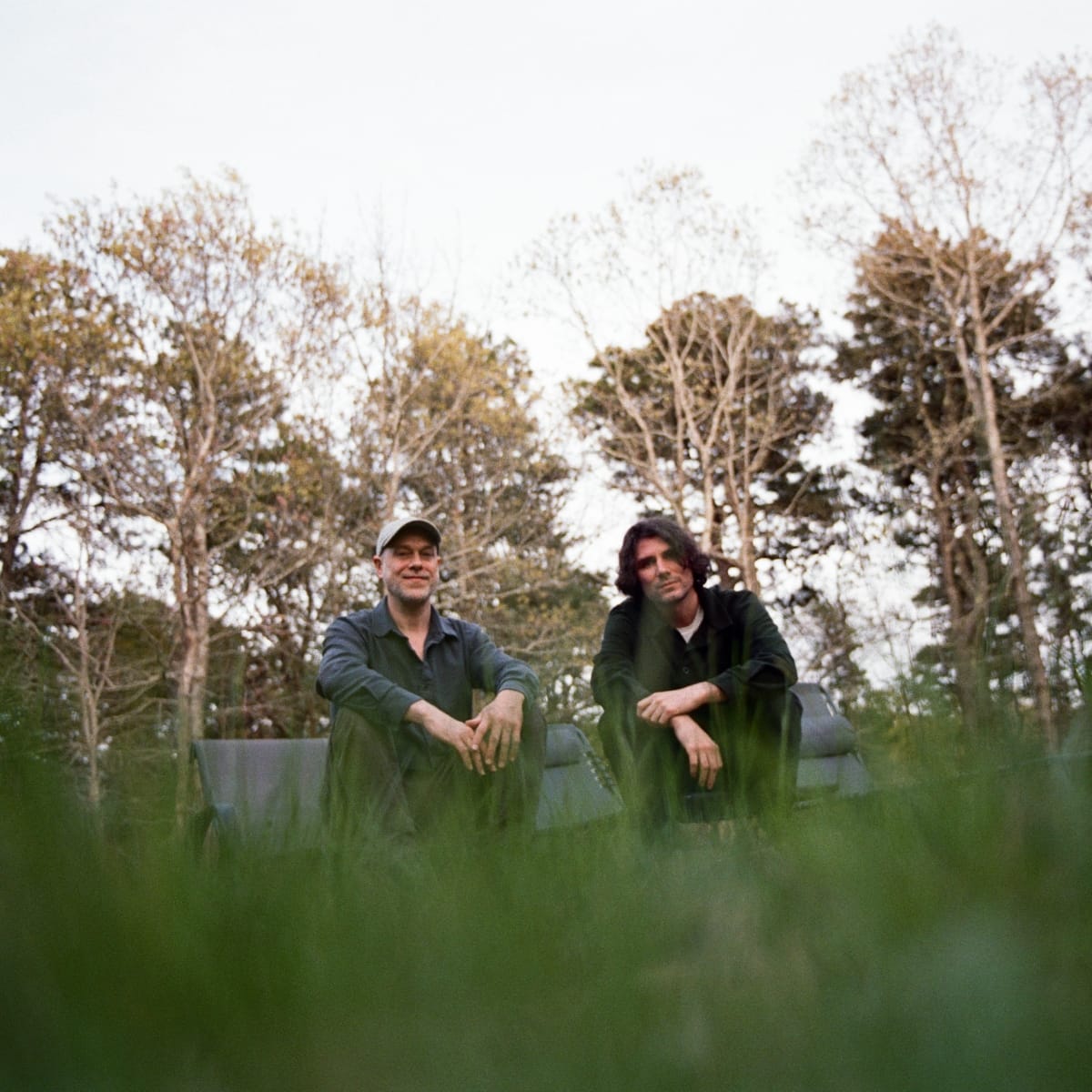
Meredith: A lot of people have been saying Nick Drake is an influence of yours, and I think you've owned up to that as well. Who are some other people who have influenced this album?
Ben: When I first started playing music in high school, I loved Nick Drake, I loved Bob Dylan, and folkies from that era. I really wanted to make a record like that, but I just didn't have the skill or the life experience. Not saying I'm successful at it this time, but I really felt like, "Oh, wow, I finally can make a record that I always wanted to make," and I felt confident in doing that. So that's why a lot of it is based in that world, in those sounds. For this, I was listening to a lot of Cassandra Jenkins—that's how she's involved. Her album An Overview on Phenomenal Nature is one of the best records ever. And I chose Phil Weinrobe to do the record because I was listening to a lot of the last Tomberlin record and Adrianne Lenker’s solo music. I definitely was going through a nostalgic phase, because I went back to Kings of Convenience. I loved them in high school, that first record. And Phil actually did work on their last record, which I didn't know until after, but I was like, "Oh, wow, this is really a sign that Phil was the one to do it."
Meredith: That's wild. I'm a big Big Thief fan, so I'm familiar with the lore of the cabin and all that stuff. Was that your experience recording with him? What was that like?
Ben: Completely the opposite. He had a studio in Bed-Stuy, so totally different. But he definitely has a very specific way of working. He likes to work live. He had us all play at the same time, and had me sing the vocals while playing guitar, which I've never done before. I definitely would never have been able to do that before now.
Meredith: I know you came up doing home recording, where you can just overdub everything; it's very easy to get locked into that way of working. In what other ways was it challenging for you to have someone else directing sessions?
Ben: What made it challenging was that he wouldn't let us listen back to any takes. He'd just be like, "Okay, that's the take." We'd do three or four takes, and he'd be like, "Okay, you got it? Move on." It was kind of like, "Oh, I hope we actually got it," but also, I'm not really a perfectionist. I feel like I follow the Steve Albini thing of if you need to remix the song, it's probably not that good. So I'm kind of like, "Well, if Phil says it's good, then it's probably good." You really trust a master like that.
Meredith: So, for a while, the constant of Constant Smiles was that you kept changing. Your first thing was black metal. You did a lot of different stuff. Was that the spirit of the scene that you were in, or was that just your thing?
Ben: It's funny, the scene was kind of the opposite. It was a folky community. James Taylor and Carly Simon live there. And then, the generation before us, a few people made it out and had some success. Now, I don't think there's anything wrong with this at all—because I think if you have a good song, it's a good song, and that's great—but at the time, seeing these musicians play the same songs for years . . . we were completely the opposite. I was in a band called Drawing Guts before, and we never played the same live set twice. We would write all new material for every show, basically.
Meredith: (laughter) No! Why'd you do that to yourself?
Ben: We were like, "The only thing that matters is the glory of the greatest songs." That was really our thing, and we never wanted to rest on our laurels. It was really a boot camp for me.
Meredith: Yeah, that's interesting, actually. In the first few years I was playing out and writing a lot, I wanted to fingerpick every single song. I couldn't have the same picking pattern on any song, and I couldn't have the same chord progression.
Ben: Wow. That's a fun exercise. I think it's cool to challenge yourself. The way I'm able to write so much is because, every album, we write so much more than we release. And I try not to judge anything; I just let it come out. Then, after it's done—we're kind of doing this process right now—I'll send everything to the band. (And there are some people in ‘the band’ that don't even play anything, they just tell me what's good and what's bad.) I'll send it to everyone, and they're like, "Okay, this song sucks, this song's good," or they'll be like, "Oh, these two sound too similar, so drop this and keep this."
Meredith: That's cool. So you have kind of a volume approach.
Ben: Exactly. And then, if the song's good and the album has two similar fingerpicking patterns, you're like, "Okay, this song's really good, but let's change it so it's different from this song." The other reason I can write so much is that I hate overthinking a song. Sometimes you'll just keep working on a song, and then eventually be like, "Wait, this song just sucks anyway." I just try to demo everything. We'll get the whole song done in a day, and then we'll pick the 10 best songs, and then from there, it's like, "Okay, this lyric isn't really that good. Let's change this one." We really dive into each song and make it even better.
Meredith: Speaking of lyrics, you had one that was particularly arresting for me as I was listening to your album (and it's from "Time Measured in Moonflowers," the song from which the album takes its name), the line about "when all of the people that we want to help are gone." That stopped me in my tracks. What a concept. What's your relationship to that lyric?
Ben: It's heavy. There's a lot in that line for me, specifically. At this point in my life, you kind of realize that you can't always help the people you want to help, so you've got to help the people you can. That's a hard thing to grapple with. For me, it was and is still.
Meredith: That's a really good answer. I'll lighten it up. Growing up, was there a particular sound you felt you were pushing back against? Seems like the answer to that is maybe a yes, you were pushing back against the folky kind of stuff.
Ben: Oh, yeah. The band started as a noise project because there weren't any noise bands on the island. It really was a true rebellion. Then the band Drawing Guts I was in was definitely a pop punk/art punk/no wave thing. Real jagged. We definitely were going the other way.
Meredith: How have you since incorporated sounds that you had previously resisted?
Ben: With this record, it was full fingerpicking, folky, clear vocals. I've always wanted to make something like that, with the darkness of a post-punk thing and elements of different genres I liked, making it a little more ominous.
Meredith: Is there anything you still resist? Where you're like, "Nope, still not doing that."
Ben: We're working on a new record right now. Since we did that one record, Lost, which is super shoegazy, when I found a concept or started writing in a particular sound, I would only listen to music in that genre. So, with Lost, I was only listening to shoegaze music, constantly. And then with this record, I was only listening to Nick Drake, Kings of Convenience, and Cassandra [Jenkins]. With this new record, I'm trying to just listen to everything again. Really, the best music is from when things blend. I used to get so sidetracked. I would be making a synth pop record, and I'd hear a folk song and be like, "Oh no, we've got to make a lo-fi, folk, solo guitar music album," and get really derailed.
Meredith: Describe your relationship to change and consistency as it relates to this project.
Ben: Obviously, the only thing that's a constant is change in life. So I think, for a while, going with the concept of this record and the title, especially the title track, "Time Measured in Moonflowers," it's been about having consistent practices. I started meditating twice a day in college. I volunteer at a food pantry every Saturday, I have a daily music practice, I try to call a friend every day, I garden, and I take care of my plants. And it's these meditative practices that keep me centered, that give me the ability to handle change when it comes. When life hits, it's important for me to have these things. Or if it hits other friends, and you have to be there for them. It's important for me to really stay on my practices, to weather the storm, because life is going to keep being life.
Meredith: Is there anything that you wanted to say that you didn't get to say?
Ben: I guess the last thing I'll say is that one of the biggest pieces of the sound is Nora [Knight] being in the band. She really has become like family to me, and is one of my favorite people ever. We just clicked. We first met and played together, and we wrote a song together, and she really helped change the sound of the record. She really helps me slow down and think about things. She's really good at intellectualizing music and taking the time to think about it, whereas I can be like, "Just get it all out." She's such an incredible person and collaborator. I feel so fortunate to have her in my life. And Spike [Currier], too, the bass player. He and I grew up together. I've known him since we were, I don't know, 12 or something, so he also is this grounding force.
Meredith: Sounds like you're working with people you really trust now, too.
Ben: Yeah, I definitely trust them.
Check out more like this:
 Jonah Evans
 Meredith Hobbs Coons


Comments