


"One of the first things I was ever quoted as saying," groaned Sex Pistols singer Johnny Rotten, “was 'I'd like to see more bands like us.' Right? When I said that, I didn't mean exactly like us. Unfortunately, that's what happened. Imitations. Billions of them. And I wanted nothing to do with any of them."
And while dyspeptic punk doyen Rotten always found something to complain about, he wasn't wrong—post-Pistols punk found an awful lot of ensembles flaunting three chords and not a thought between them. Or from the edict of my old boss and stalwart Englishman, Mick Stewart, a punk band worthy of the ages has to have a certain je ne sais quoi.
The Raincoats, formed in 1977 by bassist Gina Birch and guitarist Ana da Silva out of North London's Hornsey College of Art, sipped of the je ne sais quoi, and became one of the few acts to earn Rotten's approval: ”[They] offer a completely different way of doing things." They've spent fifty years appearing and disappearing, their music, when it arrives, coming together and shedding apart at the same time.
Audrey Golden recently released Shouting Out Loud: Lives of the Raincoats, the first comprehensive history of the band, the saga, and the wide-flung influences on others. She was kind enough to take some questions over email.
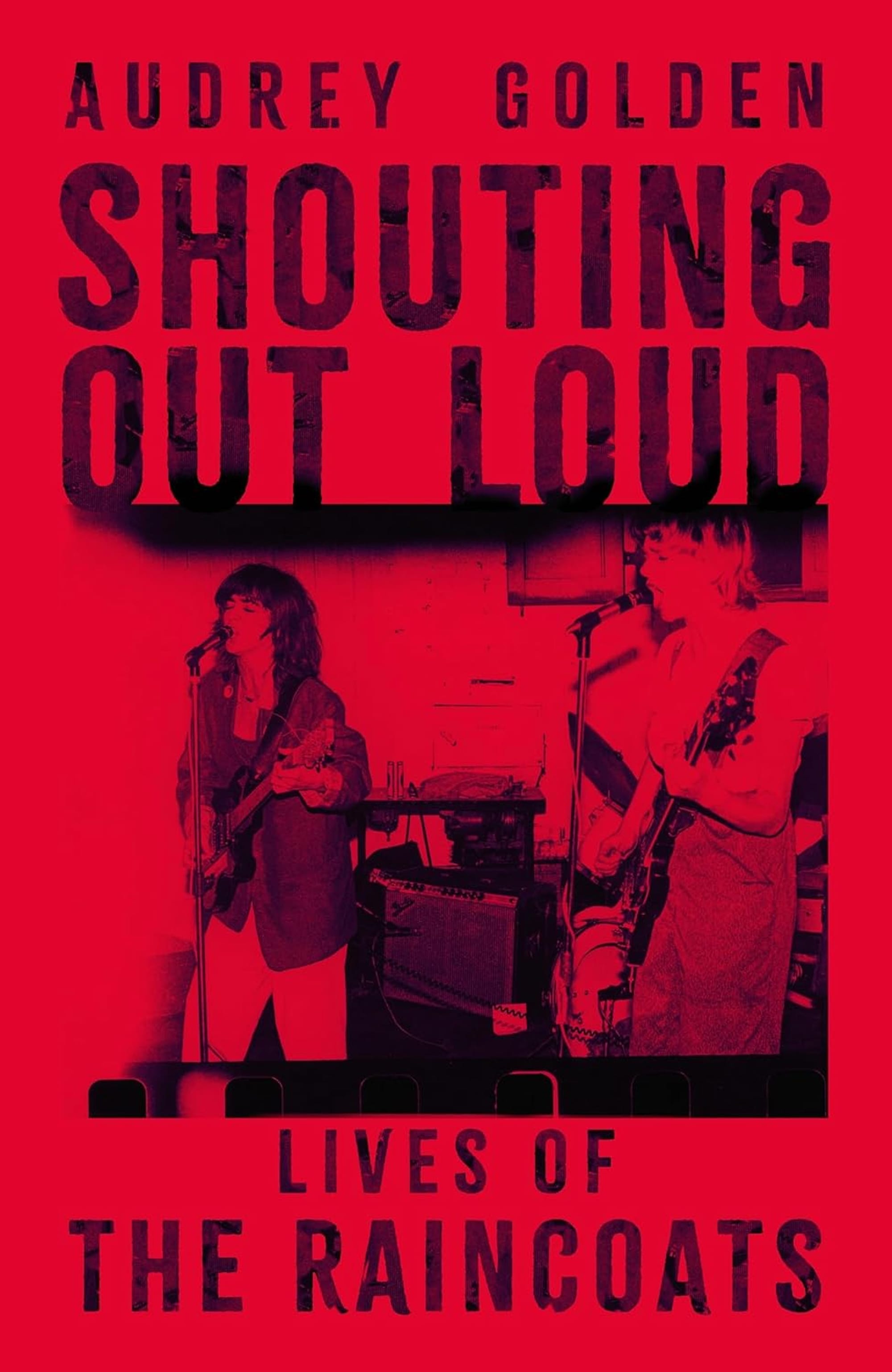
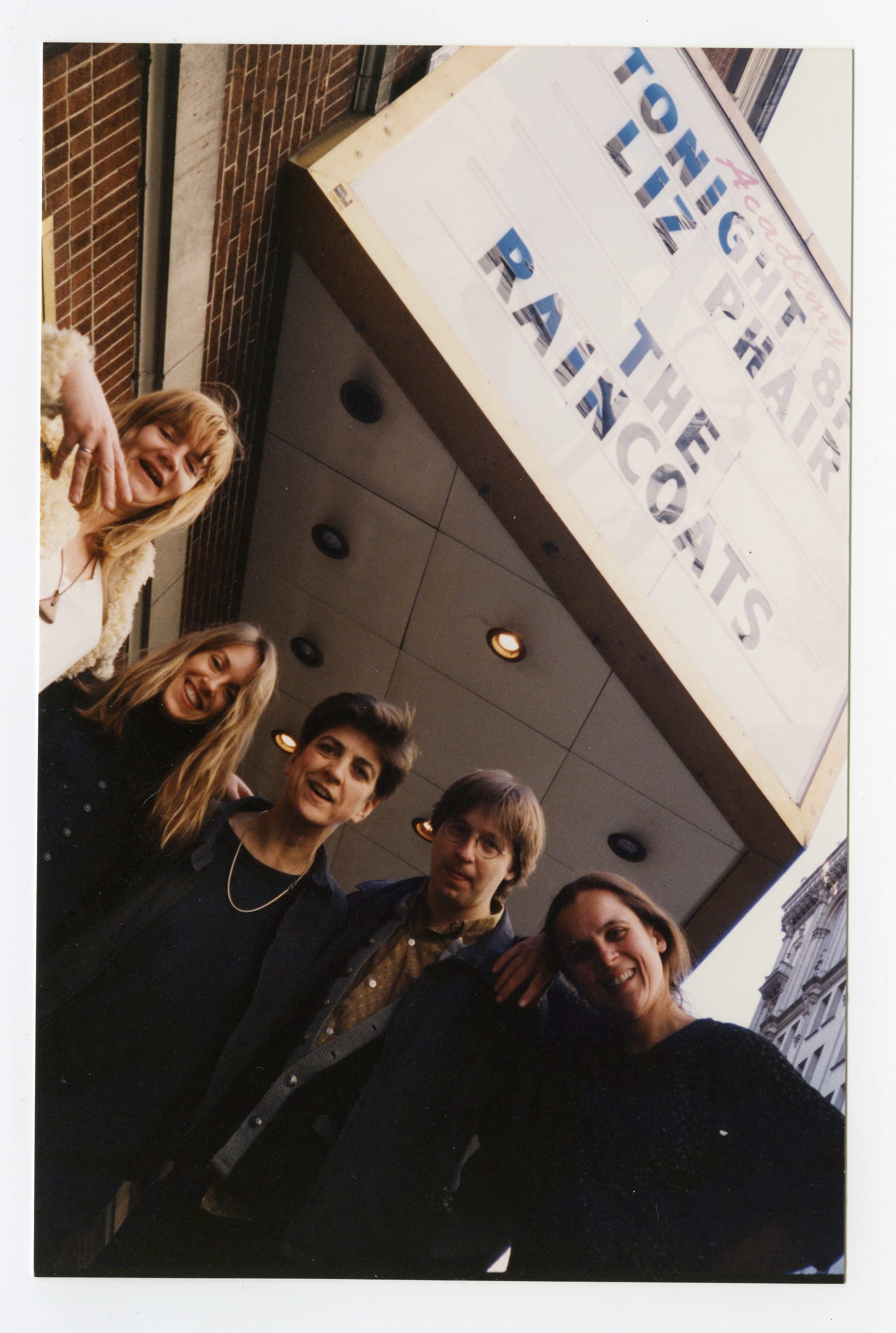
'Shouting Out Loud' cover art. / The Raincoats at the Academy in NYC with Liz Phair, 1994. Courtesy The Raincoats.
Andrew Hamlin: When and where and how did you hear the Raincoats for the first time—which record(s) and which songs?
Audrey Golden: I first heard The Raincoats in the '90s after reading Kurt Cobain's liner notes to Incesticide, where he writes about tracking down Ana da Silva in London and asking her for a copy of The Raincoats (the self-titled debut LP). I was a huge Nirvana fan, and I wanted to hear music that was so important to Kurt, but there wasn't anything to be found.
The music store in my local mall didn't even know what I was talking about ("The Raincoats? Huh?"), but eventually I found a used cassette copy of The Kitchen Tapes, the live album put out by ROIR. I listened to it in my bedroom and loved it, especially Vicky Aspinall's sweeping and raucous violin. I’d been taking classical violin lessons for many years despite wanting to learn the guitar. Finally, I realized, something cool to do with the violin.
Andrew: How have your thoughts on the Raincoats' work grown and changed as you've heard more of it and kept listening?
Audrey: I've become a much more careful listener over the last 30 years. I came to love and appreciate The Raincoats' music even more over time, but I've also learned so much more about its political reverberations.
After getting my bachelor's degree, I went on to law school to earn a JD and later a PhD, where I did in-depth research on the relationship between human rights and cultural products—music, poetry, novels, films. I came to understand—and to argue—how works of art can have political ramifications and can play key roles in fights for rights.
In writing Shouting Out Loud and going through the archive that Ana has kept, I was able to bring all of my personal and educational background together to tell two stories that I think are crucial to considering the lasting power of The Raincoats: of the music's role for prisoners in the Maze in Northern Ireland during the Troubles, and on the fight against tyranny among young artists in communist Warsaw. Those stories, and others like them, are now what keep me going when I think about The Raincoats' music and artists engaged in related political work.
Andrew: The Raincoats recorded four studio albums, an EP, and a live album. What are your thoughts on those as the band grows and changes—favorites, least-favorites, etc.?
Audrey: Their second album Odyshape has always been my personal favorite because of its playfulness, experimentation, and incorporation of so many musical instruments that weren't necessarily 'punk' until they made them so—shruti boxes, kalimbas, etc. I love the first album, too, and I suppose Moving is my least favorite if I had to pick one, in part because it feels a bit more disjointed than the others (and there's a reason for this, which I discuss at length in Shouting Out Loud).
Their fourth and least expected album, Looking in the Shadows (from 1996!) is one I actually really love. I've spent a lot of time listening to the 'Gina song' titled "Don't Be Mean" in particular, and it has a great music video that Gina directed, too. It's still hard to find a copy of this album, actually, but it's worth it. Your PSA for the day: Set out and find a copy for yourself of Looking in the Shadows!
Andrew: Did you ever get to see the Raincoats live? If so, where, when, which lineup(s), and what did you think?
Audrey: Yes, a couple of times! Once in the '90s at Brownies, when I was probably too young to fully appreciate what I was seeing, and again at MoMA in 2010. I was amazed and mesmerized both times.
Andrew: How did your previous work prepare you to write about the Raincoats?
Audrey: You know, I feel like I've been thinking about stories of marginalized women since I could breathe, but probably more like since I could walk, talk, and eventually read. I was that girl who lobbied to play baseball on the boys’ community team rather than girls’ softball, because why should I put up with segregation by gender, especially when baseball got better funding and more community support? So in a way, my previous 'work' has been ongoing since the 1980s.
But in more professional terms, my work in gender studies paved the way for this work for me. While I was in law school, I did a large-scale research project on rape as a weapon of war, and I actually went back to some of that while writing Shouting Out Loud because it's relevant to a benefit album that The Raincoats were supposed to appear on in the mid-90s.
And as time went on, doing PhD research and later research as a university faculty member and scholar, I visited archives on multiple continents, looking at various rights issues pertaining to marginalized groups. All of that shaped the way I researched and ultimately wrote Shouting Out Loud—I don't think anyone else could have written the book the way I did, or drawn out some of the specific stories that I did.
And then, of course, just a few years before, I'd written I Thought I Heard You Speak: Women At Factory Records, excavating stories of women in the music industry who'd been left behind by the so-called 'definitive' narratives out there.
Andrew: How did you contact the Raincoats members? Which were the easiest and the hardest to track down, and why?
Audrey: I'd actually interviewed both Gina Birch and Ana da Silva for previous projects, so I already had their contacts. Getting in touch with some of the former Raincoats was a bit trickier, but the band's manager, Shirley O'Loughlin, was a great help with this.
Andrew: Onetime Raincoats drummer Steve Shelley described the differences between the Raincoats' leaders as "Gina is earthier, and Ana is spicier." How would you describe their essential similarities and differences, musically and personally?
Audrey: I see their differences as similar to their paintings. Gina paints large-scale, almost-monumental paintings in bright and saturated colors that are often overtly political—and feminist—in nature. Ana does small-scale, and often miniature, paintings and drawings that reflect the tiny details, and the works are often abstract. I think you can actually hear those differences in their respective songs, and they come out in their personalities, too. Both are powerful women, but they wield power in very different ways.
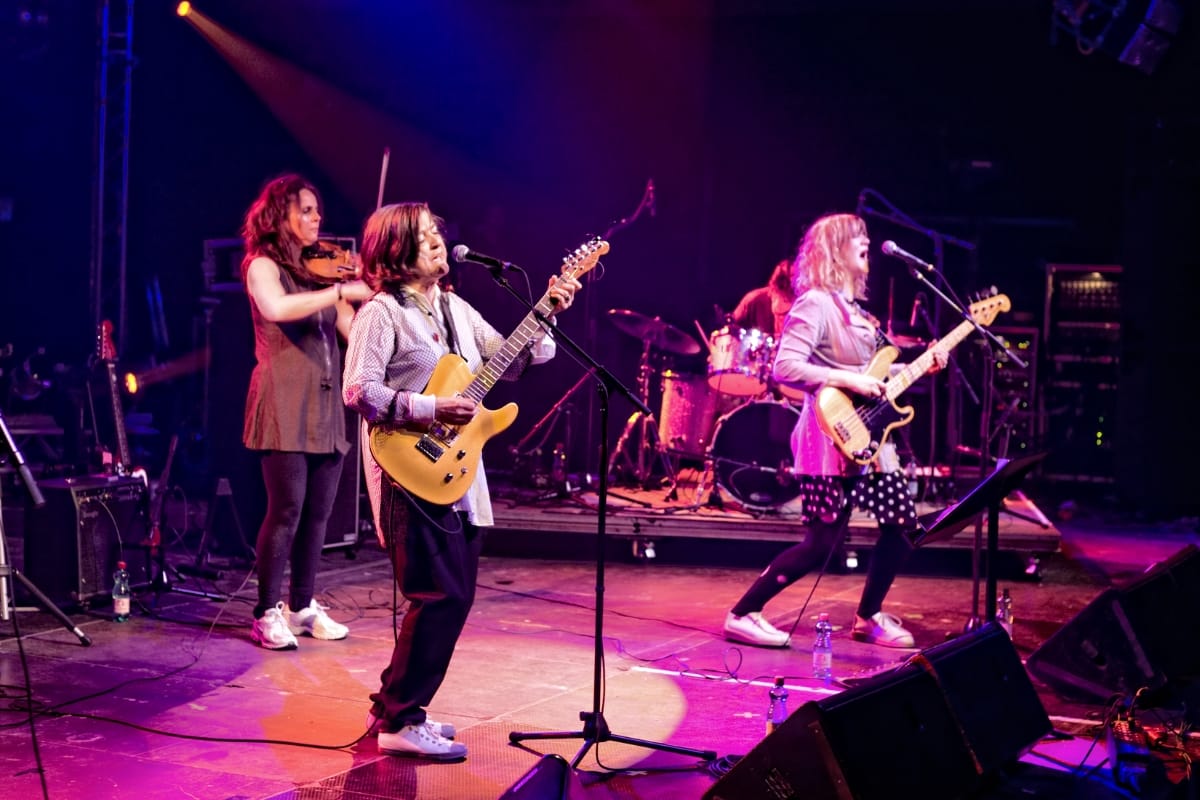
Andrew: The Raincoats were inspired by The Slits. How do they compare/contrast with The Slits and other bands with female musicians around that time—X-Ray Spex, Delta 5, Young Marble Giants, etc.?
Audrey: Largely, in my mind, they're similar solely in that they're women. But we don't compare bands with men in them this way, right? I was talking to the writer, journalist, and general all-around brilliant figure Vivien Goldman about this while I was writing Shouting Out Loud, and we shared frustrations about how women get grouped together in this way. So I suppose that part of my aim in writing Shouting Out Loud was to show how The Raincoats are distinct, how they're really their own thing.
Andrew: The Raincoats' mythology revolves around the almost-impossible-to-find records, knowledge spread by word-of-mouth. How would the story have been different if we'd had music-on-demand as we do today?
Audrey: Oh god, there probably wouldn't have been much of a story! If Kurt Cobain had had Discogs and Spotify, he probably wouldn't have tracked down Ana, and The Raincoats probably wouldn't have gotten back together in the '90s, and so on and so on. It would have been a completely different story after the band's breakup in the early 80s, I suspect. It's an interesting counterfactual to consider, though!
I do wonder if they would have been even more well-known if music were as physically accessible as it is now, or if they would have remained underground without any kind of resurrection. I think for a lot of artists who love them, part of the allure was how secretive and mysterious they were, and how hard the music was to find.
Andrew: The band was never insistent about feminism, but that didn't stop them from inspiring others. How did their work, their story, and their mythology shape third-wave feminism, fourth-wave feminism, riot grrrl, and other female reforms?
Audrey: Just getting out there and doing the thing, and experimenting with music, was how they shaped ideas of feminism, I think. And in getting back together a little bit later on, and then continuing to do that again and again as time went on, they showed musicians like Bikini Kill and others that they could (and should) do it, too.
Andrew: How has knowing the Raincoats influenced you politically, culturally, and personally?
Audrey: I've been a rebel feminist nearly from the get-go, and I've tried, whenever and wherever I could, to stick my neck out when it mattered and to have a spine even when others didn't. Sometimes I've succeeded, and sometimes I've failed, but I've done my best, and I'll be continuing to do that until my brain ceases to function.
Wanting to write Shouting Out Loud came from those impulses, and in getting to know the band, I've definitely rethought a lot of assumptions I had about feminism and what that looks like in practice. Writing the book has given me so much that I'll continue to reflect on for the rest of my days.
Andrew: What are your plans for the future, now that the book's out?
Audrey: I have a short book in Bloomsbury's 33 ⅓ new 'Genre Series' coming out this summer, titled Queercore. It'll be out in June for Pride Month. I also have a couple of other projects in the works . . . hopefully I'll be able to say a little more about those in the near future!
Check out more like this:
 Meredith Hobbs Coons
 Brook Ellingwood


Comments