


Loula Yorke is preoccupied with beauty, and not in the way you would think. She slips me an email after we chat that reads:
Benedictine monk David Steindl-Rast has written that "the intellect sifts out what is true; the will reaches out for what is good. But there is a third dimension to reality: beauty. Our whole being resonates with what is beautiful."
In a cottage adjacent to an untouched common outside of London (a two-hour trek to the city, which was at one time a daily commute), Yorke is waiting for a large nuclear power facility to go in at her beach. There is tension between water and electricity, as evidenced by her late-2025 release, Hydrology. Flanked by vases of fresh cut wildflowers from her home garden, silver modular synths serve as a drafting tool for contemplating internal beauty juxtaposed with an unfolding ecological crisis.
The Oram Award winner is precise, technically gifted, and a devout self-taught scholar of the women who have built electronic music. Her output is generous, with the absolute pleasure of listening to her work never subsiding. (See recent release Live Compendium 2, and a third installation to the Salix series where Yorke improvises with a delightfully detuned antique reed organ and clarinetist Charlotte Jolly.)
There is a comfort in talking over the phone as she prepares dinner for her family. Pots clang, sentences are punctuated with laughter. There are the same struggles we all have from the cost of touring, "mate, I can't afford to do this," to bridging being a caregiver with a life in the arts. The journey to the present peace of the cottage studio starts a little further out. Here, Yorke walks us through the squat scene of her youth, armed with a soldering gun and DIY tenacity.

Carolyn: You know, I detected a little rave undercurrent in your record. It's minimal, but tell me about your rave roots.
Loula: I think for a lot of people of my generation, it was a sort of rebellious move to go to squat parties and go dancing in fields. It was very much the thing you did in the late 90s and early 2000s. I ended up getting quite into the squat scene, and living in different places, moving around Europe. It was a big network.
Carolyn: What is the squat scene?
Loula: I mean, it may not exist anymore. At the time, it was quite common to come across buildings that had been squatted by collectives, people bound together by shared politics or artistic interests. You kind of had an open door into going around the country or around a continent, knocking on doors and going, "Hey, I'm in your city for a bit. Can I park outside, or can I sleep on the floor inside?" It was a big community.
Carolyn: So did that spark your interest in electronic music?
Loula: That's what electronic music meant to me. I didn't know anything about space music. I suppose I must have known a bit about trance music. I didn't really like trance that much, but I was aware there was a psychedelic bent. I didn't realize there were ambient electronics that weren't to do with the dance floor. When I first heard Laurie Spiegel, I was totally like, "What is this?" What's nice is discovering all those people and realizing that I am in that continuum. It was a bit of a shock, because I didn't realize any of it existed, because I just came at it from a different place.
Carolyn: I think people's traditional introduction to electronic music is often dance music. How did you come across Laurie Spiegel?
Loula: I got into modular synths as a very DIY process through Ian Miley [aka Blackmass Plastics], who unfortunately died very sadly last July. He was really big into making DIY modules and built us a modular drum machine. At that time, I was in a band with my partner, Dave [Stitch], called TR-33N. We were making live rave music using samplers, MIDI-controlled synths, and drum machines. I had a Korg ESX-1, and Dave had an MPC 500. We were given these homemade modules by Ian.
My Korg broke, and then I didn't have any choice but to continue using modular, which sounds quite weird, but I just thought, "I'll do that." I like how it looks. I like the aesthetic of it. I like that I don't have to write melodies, because I had a pseudo-random voltage generator thing, and you just quantize it, and it makes it a loop, and you're like, "Oh yeah, I don't have to write music anymore." It's just fun. There's this whole world of electronics that opened up. I learned to solder and started a project called Atari Punk Girls, which taught teenage girls to solder, and we made little oscillators together. Through that, I started to delve into the history of electronic music before dance music. That's when I started coming across Laurie Spiegel, Suzanne Ciani, and Daphne Oram.
Carolyn: You have an Oram award.
Loula: I applied [in 2020] and won that year with special commendation, which was really cool. So then it was like, okay—Pauline Oliveros, dive in. Annea Lockwood, dive in. Dive into the history of women making electronic music because I'm leading these girls and doing this female-focused electronics project. There's this whole tradition I didn't know about. It's quite fun to go on that journey late in life as well. It's good for the ego, it's ego death to find out how little you know every day.
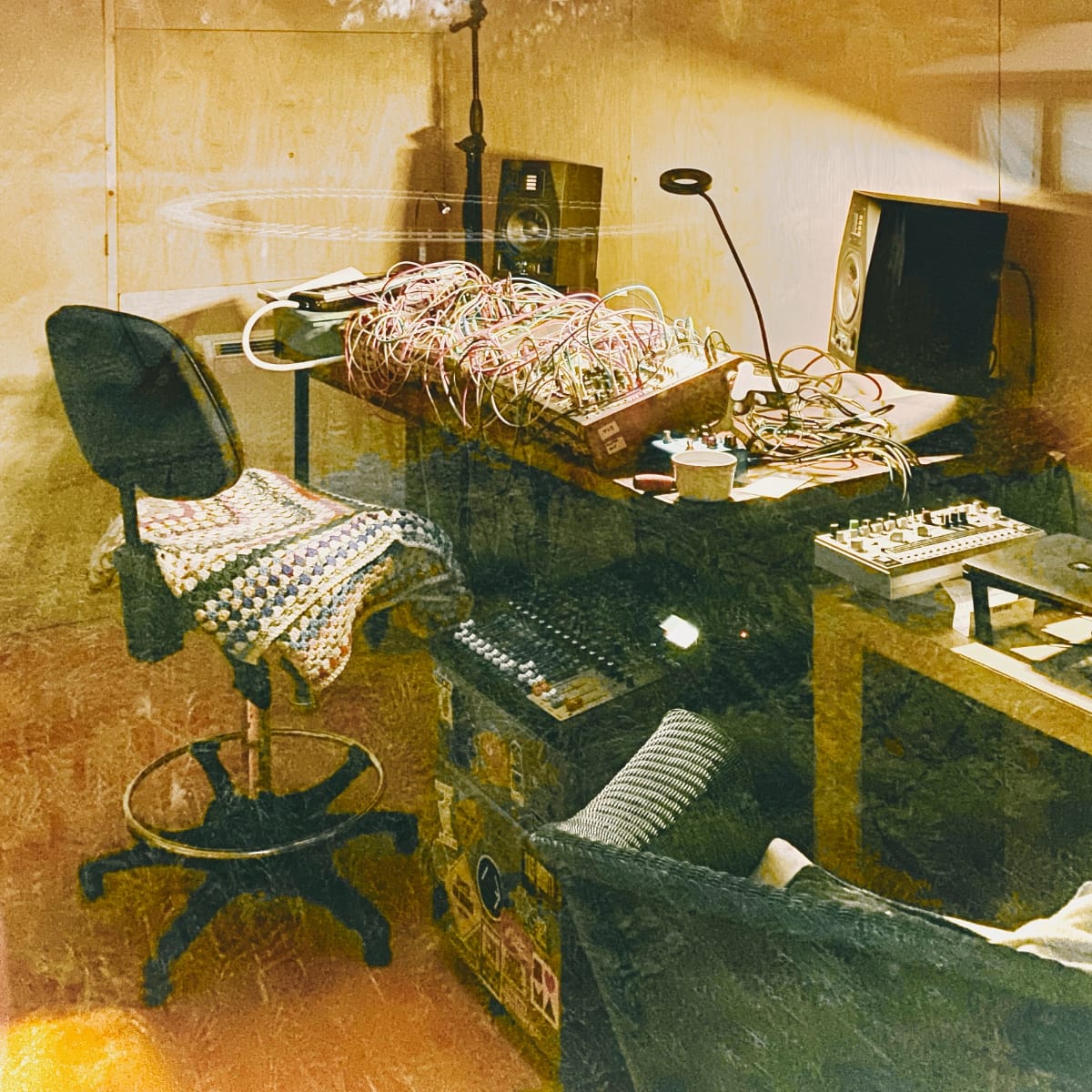
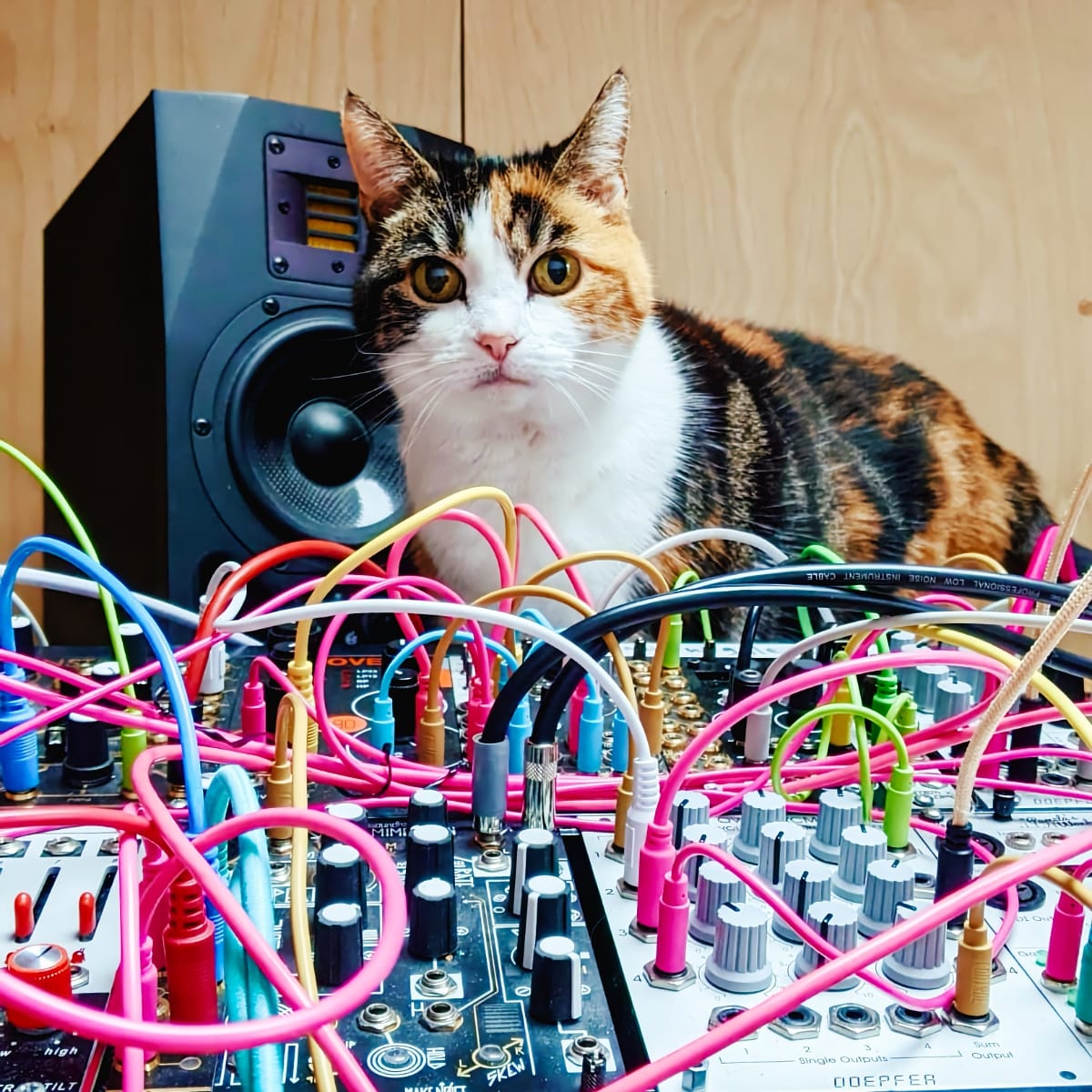
Loula Yorke's home studio set-up, complete with calico collaborator. Photos courtesy of Loula Yorke.
Carolyn: You sound like a genuinely curious person. What were you like in childhood? What did you find around you?
Loula: My childhood is a bit of a mad one, because I was moving around and I didn't have a lot of stability. I think I was just doing what people told me to do. Hence, the huge rebellious period. I did play the guitar a bit in my teens and was really into PJ Harvey, the Breeders, L7—you know, girl-fronted, noisy stuff. I'm just not technically very good at the guitar, not that you need to be that great to get what you need done. I just found it a bit of a struggle to keep practicing. It's funny because I'm now doing a practice that requires a huge amount of patience, but up until I had children, I didn't have any patience for anything. I was just floating around, you know, chasing dopamine. I wasn't focused.
Carolyn: I think it's a very human thing to chase dopamine. I would be gentle with yourself about that.
Loula: [Laughter] It's funny, the time when it all kind of came together was after I had my own children. That sudden narrowing of all the opportunities. You have to be very present every day and responsive to someone else's needs. You're not the center of everything; these other people are. So, what is it that I really want to do? And it was like, oh, my God, I've just always wanted to make electronic music. Why haven't I been doing it? I'm going to do that, and I was just super focused on it. I think also, it was about building an identity after postpartum. It wasn't an identity crisis, but certainly, parenting switches it up in a pretty massive way in terms of your life experiences and your understanding of who you are.
Carolyn: Oh, that is something I relate to in my own life. It's hard for women to jump from the sheer empowerment of PJ Harvey and L7 to the realities of narrowing opportunities by having children. I've read a lot of books on motherhood and creativity, and the adage is you're often choosing between "babies." Your human children. Your creative children. What does a day look like for you as you navigate this?
Loula: My kids are now teenagers, so I'm pretty free. The first ten years were difficult, and I made extremely slow progress. I think it's useful to spend lots of years learning the same lessons over and over. I feel like I have made more progress over the last three or four years, which is nice. I've got the foundation now. I was lucky to get a few bits of funding from doing Atari Punk Girls, and I worked as a guest composer for Britten Pears Arts, which is a cool, reputable classical institution. At some point, I decided I was making good headway with making music, to the point where I actually wanted to focus on it. It's definitely the dream, but also intensely financially difficult.
Carolyn: It's difficult to cross that bridge when the economics of music feels like it changes daily.
Loula: I guess how I do it is by not going anywhere. I've made this house, this space, and this garden into the material for the whole thing. Not necessarily for Hydrology, but for my wider output. I've made it so that if I don't leave this house, I don't have to spend money. It's extremely domestically focused.
Carolyn: I notice you always have flowers up in your videos. Are they cut from your garden?
Loula: Yes! I have tried to keep it as wildflower as possible, native plants that suit the soil, so I'm not a big showy gardener. Although I do have some very nice dahlias at the moment. They are bright red, have black leaves, and are really beautiful. I've got quite a small garden—I live on a piece of common, like, an actual wildflower meadow. There are very few commons left in England, and there are very few wildflower meadows left.
Carolyn: What's a common?
Loula: A common is basically a bit of land that never got enclosed under the Enclosures Act in the 18th century. So the place where my garden borders is a piece of common land, which means anyone can walk on it. It gets cut once a year, baled up, and then the rest of the time, it's just growing flowers. It's pretty magic.
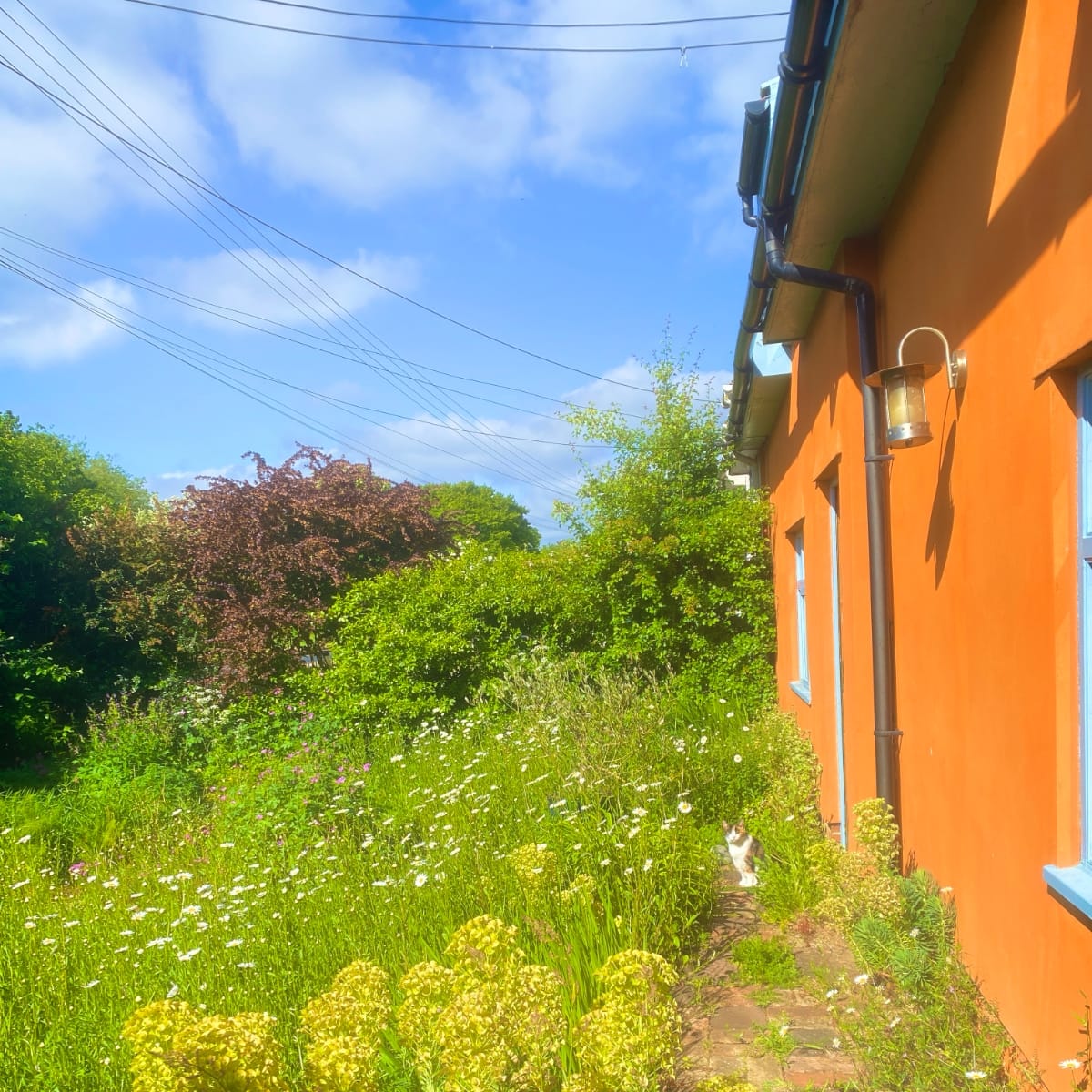
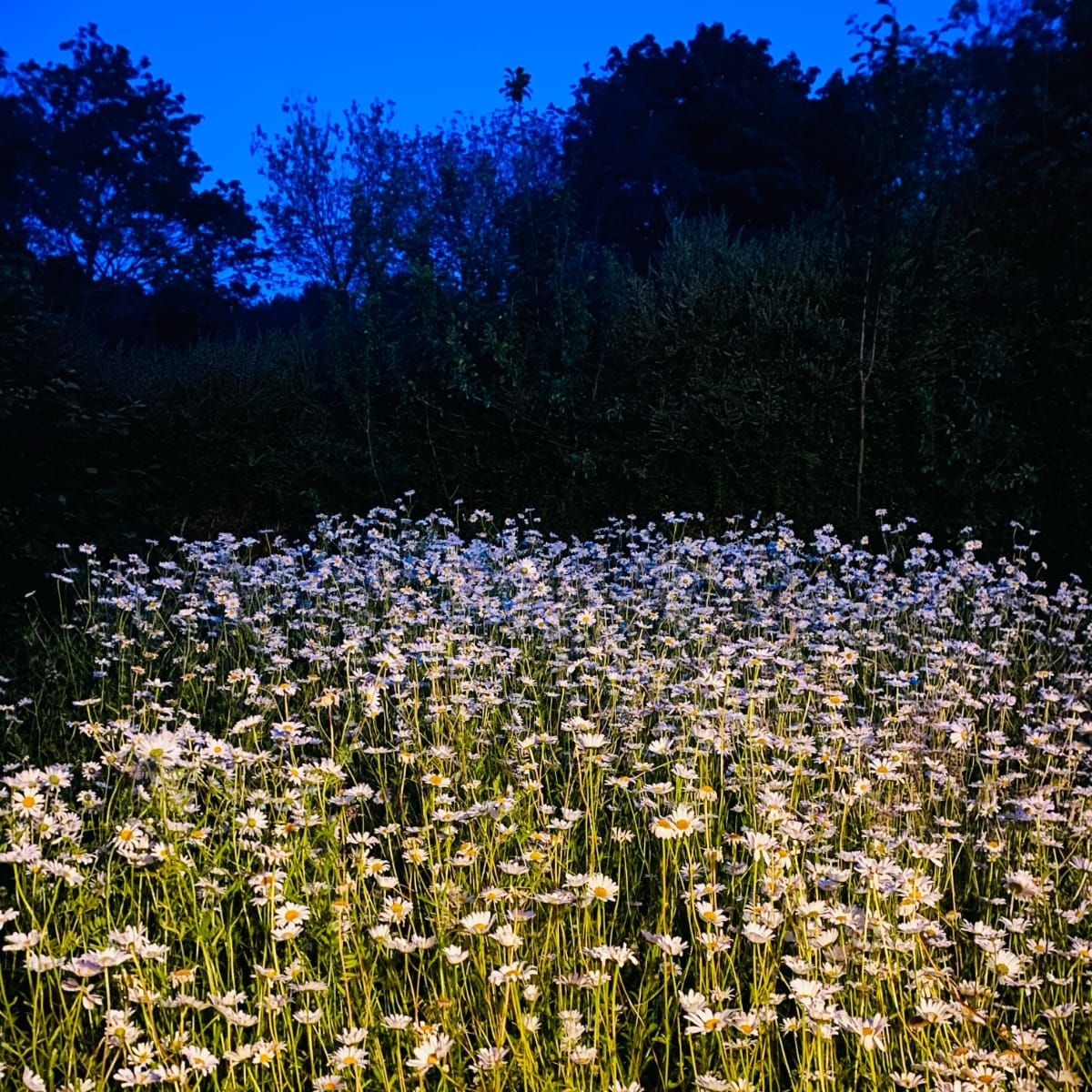
Wildflowers galore. Photos courtesy of Loula Yorke.
Carolyn: I'm noticing a theme throughout your life between being part of the squat scene and living next to a common. You like your freedom. Does your freedom come out in your music?
Loula: I hope so. I think musically at the moment, I'm kind of striving for beauty, which I appreciate is in the eye of the beholder. In the past, I made a lot of music where I've been quite angry, or I've been feeling like wanting to take up space, or wanting to communicate pain. I don't know if it's in response to what's going on—that sounds really glib, as if music can change anything—but I'm trying to find things that resonate with beauty. Hopefully, freedom is beautiful. That's what I'm resonating with.
Carolyn: So is this your headspace for this record? Focusing on beauty?
Loula: Yeah! So focusing on Hydrology particularly, that's obviously a water-based album. I'm making music that relies on electricity. And what is the one thing that you can't put anywhere near electricity? Water. So I've introduced a kind of tension immediately. The other thing that resonates with me about the Hydrology concept is that the vocabulary of water is similar to that of electricity. It's about currents and waves, rising and falling. I think that is a nice, creative jumping-off point. Water, particularly the way that light interacts with it, is super beautiful. But it also has these overwhelming and unstoppable, quite destructive tendencies. And that's what electricity is as well—the movement of energy. I've got quite a few in the track titles and motifs throughout the album. There are specific kinds of water—so, like, Flumen is a very large river, over a long span. Fontana is a bubbling up, like a spring. And then Walberswick Breaks is the sea.
Carolyn: As I listened to your record, I was expecting field recordings of water—but that does not happen.
Loula: Yeah, not at all.
Carolyn: So you're actually modeling water with your system.
Loula: Exactly. Funnily enough, I was listening to a lot of Burial while making this, and I was thinking about texture, trying to make things feel quite intimate. Like exciting little tiny bits to the ear, but not having those sounds at the front of the mix, just a consolation of stuff at the back.
Carolyn: When you go to work on a piece of music, do things for you start out as an improvisation on your modular from something you're observing?
Loula: Sometimes. It used to be more. It's funny because I'm really not sure about the concept of improvisation, by which I mean when you're playing on your own, and you're just sketching out ideas, and you're in the feedback system with the modular synth. That, for me, is just how you play a modular synth. It's improvisatory by its very nature. So I think that we are all improvising with our instruments. When it comes to improv in the way acoustic musicians think of it, it's like a conversation between multiple players. Salix is a genuine improvisation. That is me sitting with another person.
Carolyn: That was a great set, in my opinion. I was kind of bracing myself for the listen, but that was really well done.
Loula: It was really fun. I feel like that was genuine improv, because like there was space for us to actually be able to hear the other person and then make some sort of decision. When I'm playing with modular, the oscillators don't stop. The clock is going all the time. There's a movement forward, and an electrical current rising and falling. You don't really get a chance to stop and listen to what another person's doing and then react. Modular is inherently improv, but it's an improv between you and a machine. I think it's just how you play.
Carolyn: Are you going to tour this record in 2026?
Loula: I don't have any plans to go on tour because it's not financially viable. I make my living through releases and subscriptions. I do play live gigs when I'm booked, and obviously, I love playing live, but I'm in that part of the year where it's time to start reaching out and saying, "Hey guys!"
Carolyn: Live performance and touring in this modern era are difficult. I often decline things because I can't risk losing even the cost of getting to the gig.
Loula: It's tricky, especially when you feel like you want to give back to the community, but then you're actually like, "mate, I can't afford to do this." I did recently do some epic gigs supporting Brìghde Chaimbeul, a small pipes player. She has these little bagpipes, and you bellow them under one arm. She's super magic and really resonates with me, because I think a lot of my music sounds quite trad. Not necessarily Hydrology—but there's actually a lot of Gaelic, Celtic influence in the phrasing. Listening to her play made me realize that's my happy place.
Carolyn: I feel like it suits your pagan, sparse rural landscape.
Loula: Definitely. Those were epic gigs, and they were in big capacity venues. It was nice to get in front of proper big audiences. That was a real treat, you know, coming from the DIY world.
Carolyn: Do you get nervous before you play live, or are you pretty comfortable?
Loula: I'm really comfortable. I tend to feel worse afterwards, weirdly. I'll be fine before the gig, and then afterwards, I just have all this regret about what I didn't do. It's a self-destructive impulse because it's like beating yourself up about something that went really well and over which you have no power to change, because it's literally in the past. It's like time and space will not allow this to be a changed thing. Why beat yourself up over that? I think I feel like it's some kind of mental health issue, personally. I think it's called 'hypercritical'—things you've already done, that are set in stone, that can't be changed, and that you will, like, curse your dying breath over. [laughter]
Carolyn: How does it feel putting out this album on physical media? You know that can be kind of forever, too.
Loula: I'm really happy with the record. To be fair, I don't think I'm putting out bad music. I think with live shows, I'm slightly more hypercritical.
Carolyn: It's a vulnerable thing to play in front of a live audience. At least with physical media, there's a buffer between you and the listener. But even then, maybe you'll get trolled on a Discord server about modular synths by a bunch of bored dudes in California.
Loula: [Laughter] I never, ever search myself on any of those things. God, I can't imagine.
You know, I wasn't a trained musician who turned my hand to modular synths. When I started making electronic music, particularly modular music, I didn't know anything about anything. So I've learned a little bit of music theory, how music works, and different kinds of music in the world. Indian music is based on drone, and Celtic music is based on drone. Those differ from a Western sensibility of music. Then there's a classical sensibility of music, and chords—the different schools, and the different ways you can compose.
Using electronics is an accessible way to learn all about music. You are sort of fed the idea that, unless you can play an acoustic instrument really well, composition is not for you; that it's only for geniuses and people who are intensely amazing at practicing their instruments, and everyone else should forget about music. But you have just as much ability to train yourself in those schools of thought as anybody who plays an acoustic instrument. It is really democratic and accessible, and I think, particularly for women, it's been amazing over time.
Laurie Spiegel always talks about how she couldn't get any of her orchestral stuff made or played. It was only through doing what she was doing at Bell Labs that she was able to fully realize her compositions with lots of voices and parts. I think that's important—the feminist history of electronic music is an important thing to keep bringing up. It's incredibly flexible; there's no canon. There's nothing to exclude you. You get a chance to frame what music is now.
Check out more like this:
 Meredith Hobbs Coons
 Carolyn Zaldivar Snow


Comments