


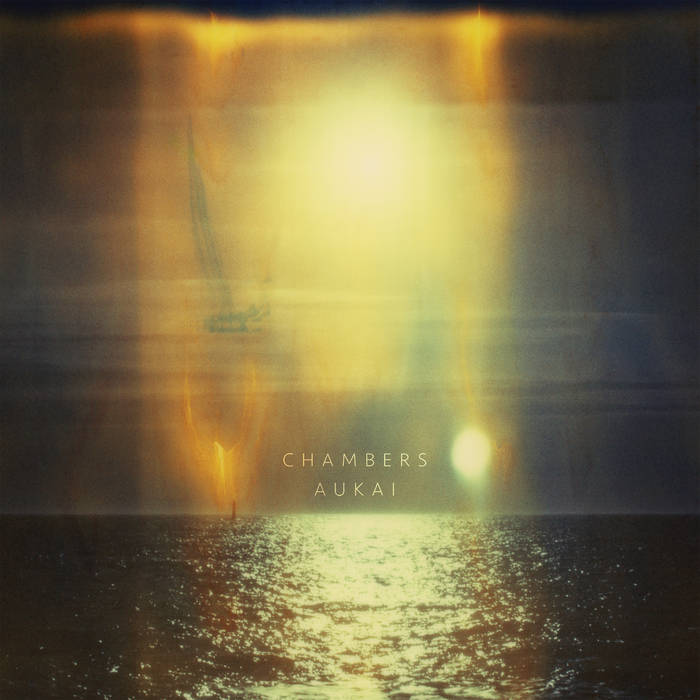
My first experience with Aukai, a project created by German-born Markus Sieber, was listening to "Vulture," one of the preview tracks off his latest album Chambers. As plucked-string instruments built upon one another, I immediately felt enveloped in an aural soundscape that was both beautiful and breathtaking. I felt I was "missing out" on something major. Feeling an intense need to rectify it, I dove into his last album, Temporal, further immersing myself in his world.
With his Aukai project, Sieber creates ambient music. His compositions are specifically acoustic in inspiration and often driven by his charango, a type of mandolin-like lute from the Andes. Other string instruments also regularly make it into the mix. However, much like the great ambient artist Brian Eno, Sieber adds electronic textures to his pieces that accentuate them, creating inspired environments that surround listeners. Imagine dreamy soundscapes that infuse global music elements with electronic touches—a lush, serene, tranquil, and inspired landscape that sets a specific vibe and mood.
Sieber has released four albums as Aukai since 2016, and Chambers will mark his fifth release. Part of the allure of his newest album comes from the limitations Sieber set for himself. In three non-consecutive days as a one-man show at the famed Berlin studio, Saal 3, also known as the Funkhaus, he created an entire album where he played all the instruments, including ones he isn't as familiar with, and—as if that wasn't enough—he also mixed the entire album at the studio in one and a half days.
A musician's process of creation always fascinates me, but Sieber's approach was unique and awe-inspiring. Putting this amount of risk on his latest album felt overwhelming. I was achingly curious to uncover what inspired Sieber record this way and how he thought the process went. Thankfully, I had the chance to talk with him, and not only did he reveal why he took the plunge he did in Chambers, but he also gave great insights into his process, harnessing intuition, and explaining why that’s so important for artists.
Bill Cooper: Tell me about creating Chambers in only three non-consecutive days. Where did that idea come from, and how did you come to this decision?
Markus Sieber: My previous records were mostly done in my home recording studio. When you have a home studio, you sit and create things. It's beautiful. You have all the time in the world to try things out. It's a good way of working because you don't have the expenses of the studio, and it's just you.
But after four records, I felt I wanted a new experience. I wanted to have some limitations, but at the same time an expansion—meaning limitations on time and an expansion in the room, acoustics, and gear. All the things you find in a really good studio.
I was curious for a long time about the studio Nils Frahm created in Berlin. He took over an old studio from the fifties, built in East Germany. I was born in East Germany—communist Germany, basically. Even though people were really poor and there was not much available at the time, they put a lot of money into art and architecture. During this time, they built an incredible studio complex in Berlin called the Funkhaus. When the wall came down, it became empty. All these amazing rooms and studios were left alone. Later, it became a hub for creatives, and people started to create studios there.
I've known Nils for some time, and I knew that in terms of sound quality and gear, he's totally on top of the game. This combination of extraordinary gear and room acoustics—I was very drawn to that. But I also didn't want to go in without a plan and spend a lot of money. A studio day is a studio day, and you'd better get your things done.
So, I basically went for it. I came in with some pieces, but they were all fragmentary. Even though I was recording for a short time, I gave myself a lot of room to see what would come up and allowed myself not to know exactly what I would do. Even if I did a lot of things in a day, they were very spontaneous, and many things were also born out of improvisation.
The other thing was that I decided to record all the instruments by myself. Even though I play guitar, charango, and all these string instruments at home, there were other instruments in the studio, like a reed organ, a piano, a celesta, and the Juno-60. So, I decided, "Hey, I'll just do it. I'll record with these things too. Even if I don't know exactly how to play them, I'll go with my intuition."
It allowed me to have a beginner's mind—almost like the mind of a child. When you touch an instrument, and you don't know how to play it, there is some magic in it. You feel it out. You go fully blindfolded into the situation. This whole album was created this way—by getting on the intuition train.
Bill: I'm just so impressed because I know that there's a lot of pressure in that. You only have a couple of days in the studio. Yeah, it's fun, but it's also, "How do I pull something together out of all this?" How did you ground yourself?
Markus: Honestly, I just had to trust myself completely. You can't think, "I want to make an amazing record," or "This record should be better than my other ones," or whatever. I just really gave myself to the moment. Even if it were shit or not usable, I would just try it out.
I got some courage from an interview I saw with Brian Eno. He doesn't know how to play an instrument well, but he does incredible music. He told a story about when he started out in the late '70s. He would just rent a very expensive studio and step into it the morning of a recording session with no plan. He explained that once he swung a microphone cable in the air and recorded it. Then he would swing another cable, record the second and a third, and play with these sounds.
I thought this was such a cool approach. And if he does it, and he's not playing an instrument, I can do it. At least I play a little bit of guitar.
Bill: It's interesting to me because I feel like you find cool ways to introduce some of these instruments that you don't know on the album. Were there any other ways that not knowing these instruments affected your recording process?
Markus: Yeah, I didn't have time to practice with these instruments. I came into the studio with a bunch of fragments of ideas on the guitar or charango. Then, the room itself talked to me. It's an incredible acoustic space. They have it beautifully lit with a dim light. It feels like you are on a movie set. Your imaginary world gets completely stimulated there.
I would record the fragments and then play on top of them. I would play a reed organ or a celeste, and I didn't try to understand my playing on a musical level. I didn't ask myself, "Which chord do I play here?" I didn't try to figure out even the structure of things because there was no time for that. Instead, I just played intuitively. Therefore, a lot of incidental things came together and made sense.
Of course, I would take all these things home. I would edit things out, of course. Then, I'd put it together as you do with a film—you shoot a lot of stuff, and then you edit it together.
Bill: I've read that you want to create this cinematic sort of experience. For me, your music is very visual. Do you feel that when you create? Do you see a visual component?
Markus: Not exactly visual. Sometimes it is, like, "This is a desert feeling," or "This is like on the mountain." It often has a lot to do with nature. But when I create music, it's more of an emotional thing. I choose an emotional pathway and then try to see what feels right in that emotional space.
Bill: When you create those fragments that you mentioned, are they emotionally driven as well? Like, if you have a part you've worked out on the charango, do you then try to identify the emotion?
Markus: It's not like I give it a name. It's more like an inner temperature, like a taste. You can't really identify what it is, but it gives you a sensation. And this is how I start a piece. There is something like a hook—an emotional, sensational hook. And then I try to follow that.
Concretely, it looks like this: I wake up in the morning, and I make myself coffee. I sit down in my studio or maybe outside in the garden with my guitar. I drink coffee, I play, and suddenly—oh, what's this? Something I play makes sense in that moment, and I try to elaborate. It's a little bit like treasure hunting.
Bill: I know a lot of this is an intuitive process. One of the things that I love, for example, is there's this sound you have in "Vulture," like halfway through, like this pulsating beat. What makes that sound?
Markus: What you mentioned, I don't know what to call it. It's not a beat, but it's not a voice either. It's a Minimoog basically doing stuff.
Bill: How do you know when you have the right sound? Is that something you just feel in your gut?
Markus: It's exactly the same. I love analog synthesizers a lot because they seem to be very close to us humans somehow. They're so unpredictable, especially if you take these old, older ones from the '70s to '80s, like the Prophet-5.
For instance, when I worked on "Vulture," I had probably tons of other possibilities there. And suddenly something just, again, made complete sense. It's really like cooking.
Bill: Do you feel like it's a skill that you've gotten better at over time, or has it always been within you?
Markus: We all have intuition, but we don't often trust it. You should never try to make something that you think other people will like, because you're already lost with that thought. It's an irrelevant thought. It's nice if people like your music, but you cannot create something just because you think others will like it . . . you cannot know. I do music for myself, and it's the only reality that exists in that moment. It's the only compass I have.
Bill: You've set up all these limitations on this album. Have you recorded under similar time constraints before?
Markus: I think it's the first. In the past, I would challenge myself with creating records in different kinds of environments. For example, I would record in a cabin somewhere in the woods in Mexico, or I would go to France. In other words, I would go out to special locations and get inspired by being in those places. Basically, I needed to explore a lot, and I needed a lot of time to explore.
But now, I am at a point where I feel like, okay, now I've explored so much—different guitars and charangos, alternate tunings, and all those things. I feel like these limitations are what I really want at the moment. I enjoyed the limited feeling.
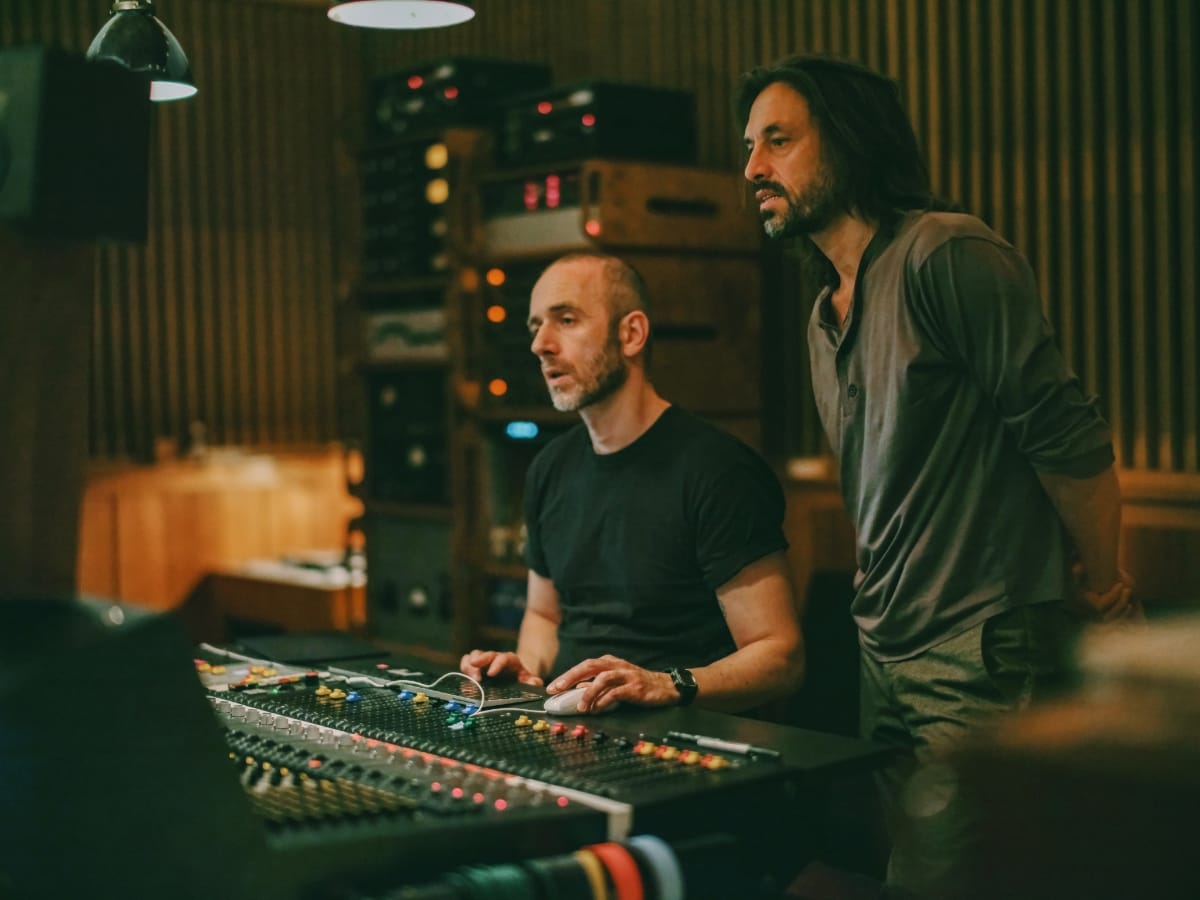
The idea of mixing the record at the Funkhaus on the big mixing board came during the process. I hadn’t thought about it at all before. But as the whole record was already so packed within time limitations, whatever decision was made was already a lasting one in the recording process. I said to Antonio Pulli, the engineer there at the Funkhaus, "Hey, what do you think if we just mix it in the same way? We sit here and go piece by piece. Whatever we decide is lasting. We don't revise it. We just leave it. We don't touch it."
It was a very freeing process. It was also overwhelming and tiring because you had to be super-concentrated at that moment. It's not like I'll make it, and if I don't like it, I'll change it tomorrow again.
Bill: Exactly. You're stuck with what you got.
Markus: You're totally stuck with what you got. We mixed it and put it all on a tape machine. What I like about that album is that it feels like one continuous stream of thought from beginning to end. It feels like a river rushing or the wind in the trees. It's just like that. It changes, but it comes from the same source. In that sense, I feel like this album is probably the most honest album, and the most ‘me’ it could be in that moment.
Bill: Were there any other discoveries that you found out either about music or yourself through setting these limitations?
Markus: The biggest discovery is just completely trusting the impulse, without trying to talk it down or doubt it, in a sense. Think less, do more. Just do it. I can say this to every musician. I know it's a hard job to produce yourself and to record yourself, and I know there are so many friends and colleagues out there who struggle with that. But just do it.
The thing is, an album is only a statement of a certain time. It won't define you for eternity. You can always do something different. You can change it. You can make something else later.
I think with this album, I have proven to myself what music is about. In some ways, not only music, but what life is about. It's such a wonderful analogy for music. This is why music is essential for me. It's a true mirror of what's going on in my life. It's for me this kind of constant checking in with myself.
Bill: That's such an interesting statement, because it's true. The best albums, at least in my opinion, are the most honest. How do you feel Chambers specifically represents you now?
Markus: If you listen to the album, it is like a dreamscape. It's a dreamer’s album. I have been a dreamer all my life. When I was a child, I could lie for hours in the grass and watch the clouds, or I could climb and sit for hours in a tree.
There's a dreamlike quality to watching something and being fascinated by it. All the sensitivity, the gentleness, and softness. We often don't allow ourselves to be that, because we think we have to be tough, or a ‘cool guy,’ or an extraordinary musician. All these values that we think we should be. On this album, I completely let go of what I think I should be.
Check out more like this:
 Arina Korenyu
 Bill Cooper


Comments